
Key Takeaways
- A Google review appeal does not stop at Google if your business is in the EU. Google's own help page lists "you reported content and Google did not remove it" as grounds to go outside it: not the review you received, the refusal you received. No competing guide quotes that line.
- Two certified bodies currently take Google Maps cases, and only two. Appeals Centre Europe added Google Maps in August 2026; Platform Control was certified for it on 4 November 2025. Picking a body that does not cover Maps gets you a notice, not a decision.
- It costs the business nothing. The Appeals Centre charges users no fee and invoices the platform between 290 and 1,050 euros per case, and Article 21(5) says a user who loses still owes nothing absent manifest bad faith.
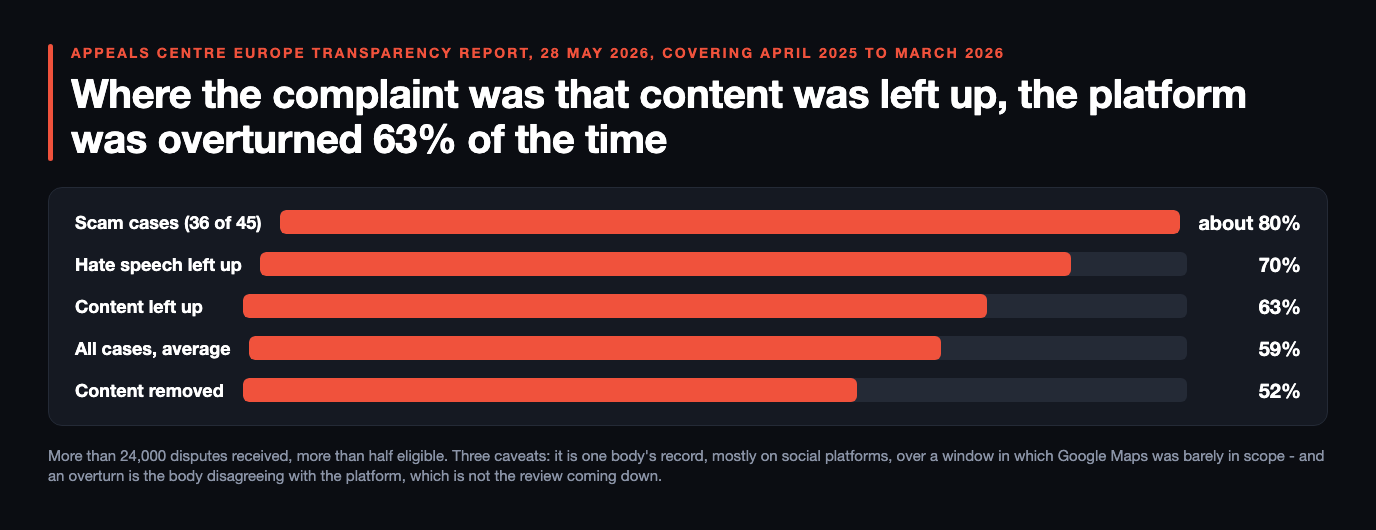
- Where the complaint was that a platform left content up, the Appeals Centre overturned the platform 63% of the time across a year of cases. That is the category a business reporting a fake review is in.
- The decision is not binding, and Google says so in writing. The route is still worth running, for reasons we take apart below, but anyone selling it as a guaranteed removal is selling you something.
- What this route is, and who actually has it
- Google's own page says a refusal can be appealed outside Google
- Your one internal appeal, and how not to waste it
- Only two certified bodies take Google Maps
- The fees are Google's, not yours
- Two clocks: six months in, ninety days out
- The number that makes it worth filing: 63%
- Non-binding, and what that is still worth
- "EEA" is Google's word, not the DSA's
- What to file, and where this route will not help
- The first two weeks
- Frequently asked questions
You reported a review you are certain is fake, you waited, and Google sent back the sentence that ends most of these stories: the content does not violate our policies. In the United States that is close to the end of the road. In the European Union it is not, because a Google review appeal can leave Google entirely and go to a body a national regulator had to certify first. Two of them took their first Google Maps disputes in the last twelve months. We read both bodies' rules of procedure, Google's redress page, a year of published outcomes and the German certification notice: the machinery is real, it is free to you, and almost nobody is using it. We also found the part the guides get wrong, which is who is eligible.
What this route is, and who actually has it
The Digital Services Act, Regulation (EU) 2022/2065, gives two separate rights to anyone a platform's content decision lands on. Article 20 obliges the platform to run an internal complaint-handling system, free of charge and electronic, open for at least six months after the decision. Article 21 then lets you take the same dispute to an out-of-court dispute settlement body, chosen by you, certified by a national Digital Services Coordinator.
What makes this a review-removal story is who counts. Both articles extend to recipients of the service and to "individuals or entities that have submitted a notice", and a notice in DSA language is a report. The business that flagged a defamatory one-star and was told no is not a bystander to someone else's moderation decision. It is a party to its own.
Three things this is not. It is not a court case, and it does not use up your right to bring one. It is not Google's internal appeal, which is a separate and earlier step. And it is not a legal-removal request on grounds of defamation, which runs through Google's legal channel and a different body of national law. Those paths can all be open at once, and the bodies below will refuse a case that is already sitting with a court or with another body.
One point changes what you write. Article 20(6) says complaint decisions must be supervised by qualified staff and cannot be taken "solely on the basis of automated means". Your first report almost certainly was. The appeal is where a person enters the process, so write for one.
Google's own page says a refusal can be appealed outside Google
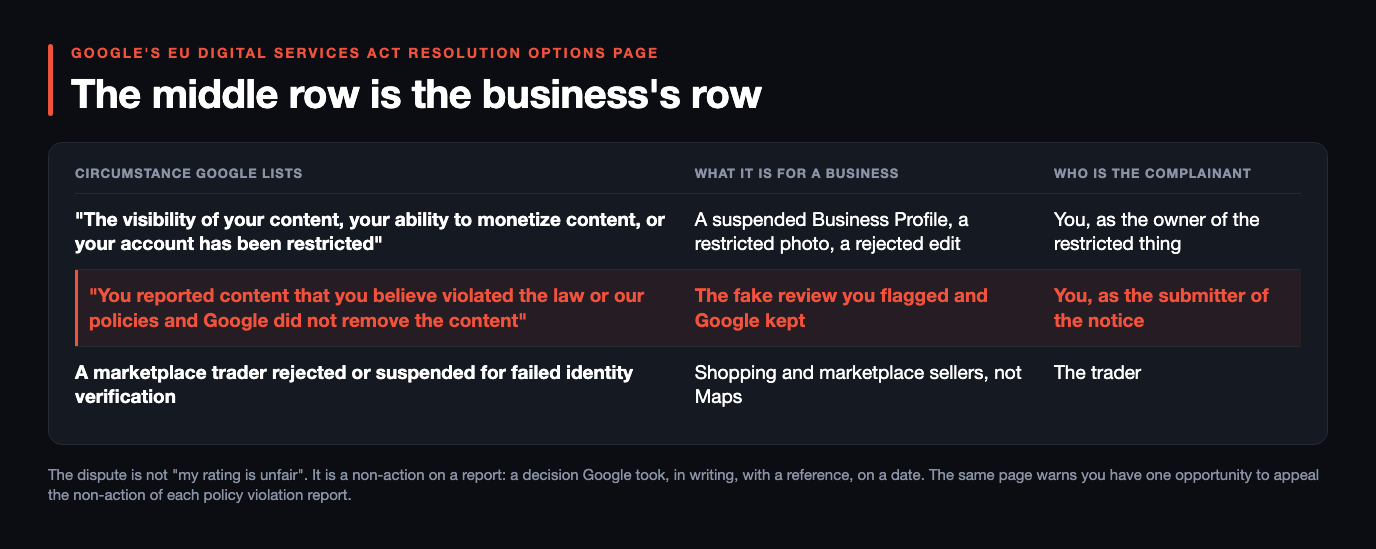
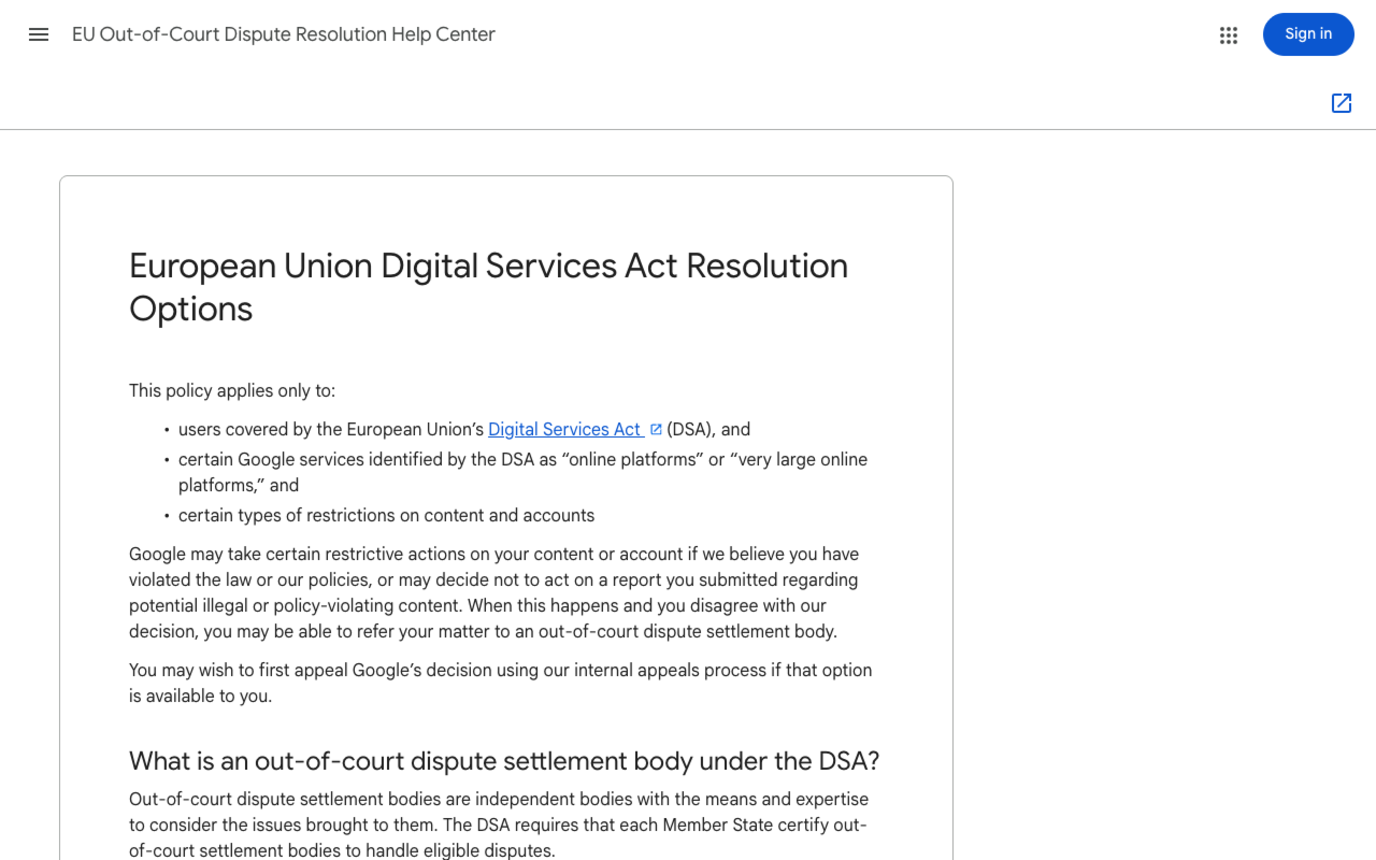
Google runs a help centre for this, the EU Digital Services Act resolution options page, and it is the most useful document in the subject. It opens: "Matters may be referred to a certified out-of-court dispute settlement body in the following circumstances", then lists three. Read the second twice.
| Circumstance Google lists | What it is for a business | Who is the complainant |
|---|---|---|
| "The visibility of your content, your ability to monetize content, or your account has been restricted" | A suspended Business Profile, a restricted photo, a rejected edit | You, as the owner of the restricted thing |
| "You reported content that you believe violated the law or our policies and Google did not remove the content" | The fake review you flagged and Google kept | You, as the submitter of the notice |
| A marketplace trader rejected or suspended for failed identity verification | Shopping and marketplace sellers, not Maps | The trader |
The middle row is the business's row, and no competing guide quotes it. The dispute is not "my rating is unfair". It is a non-action on a report: a decision Google took, in writing, with a reference, on a date. The same page warns that "you will have one opportunity to appeal for the non-action of each policy violation report", and that Google "is not bound by any decisions made by these out-of-court settlement bodies". We come back to both.
Google also says where the list of bodies lives: the Commission's out-of-court dispute settlement register, with the note that "procedures may vary". They vary more than that suggests.
Your one internal appeal, and how not to waste it
Review decisions do not go through the Business Profile appeals tool. Google's page on appealing Business Profile content and profile restrictions routes profile suspensions, rejected edits and restricted media through that tool, and sends review removals somewhere else: the reviews management tool, where "if a reported review is judged not to violate policy, you can submit a one-time appeal". The same page says "appeals can only be submitted once", tells you not to file twice before a decision, and puts the turnaround at "up to 5 business days".
So the internal step is a single shot on a five-day clock, and most businesses spend it by resubmitting the same complaint in the same words. Our guides on tracking a removal request and what to do when one is denied cover the mechanics. The strategic part: write the internal appeal as the document an outside body will read next, because it is.
One wrinkle. The Appeals Centre's rules say an internal appeal is not a precondition: "It is not required that you seek to resolve your appeal directly through the online platform's own appeals mechanism", though it encourages it, and its form carries an optional box handing the platform another 30 days. Do the internal appeal anyway. It is free, it is fast, and a refusal on the record is the cleanest thing to put in front of a body.
Only two certified bodies take Google Maps
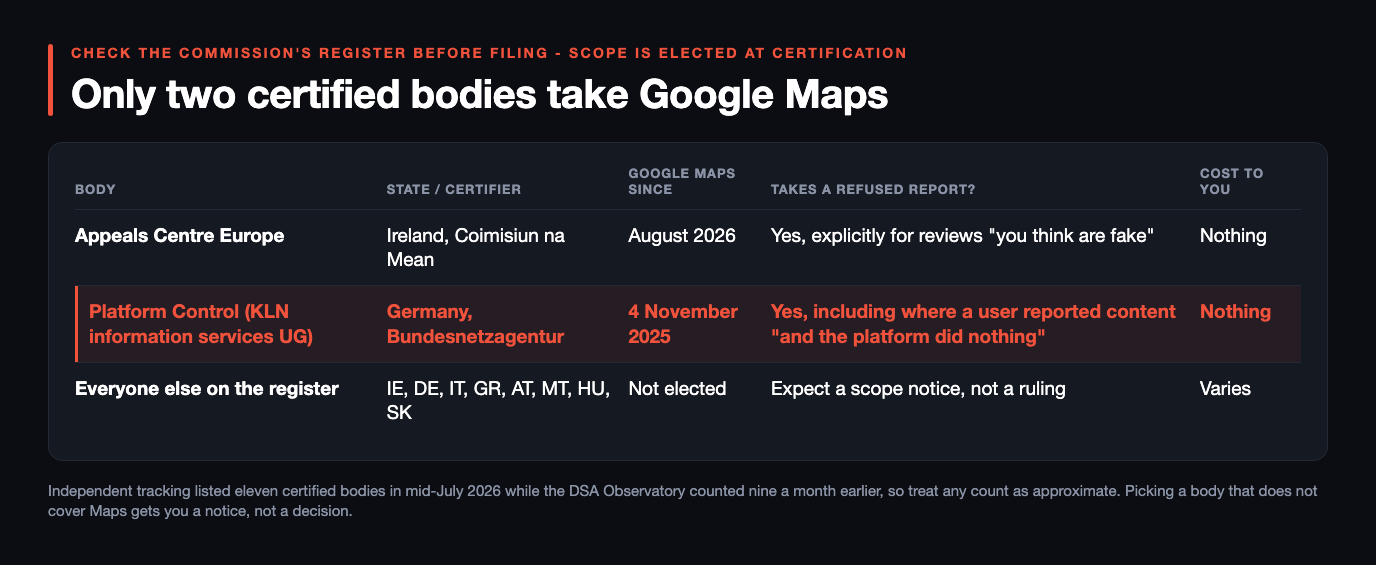
Article 21 lets you pick any certified body, which is not the same as any certified body being able to help you: each elects a scope when certified, and most elected social platforms. Independent tracking listed eleven certified bodies in mid-July 2026, while the DSA Observatory counted nine across eight member states a month earlier, so treat any count as approximate and check the register before filing. Two name Google Maps.
| Body | State / certifier | Google Maps since | Takes a refused report? | Languages | Cost to you |
|---|---|---|---|---|---|
| Appeals Centre Europe | Ireland, Coimisiun na Mean | August 2026 | Yes, explicitly for reviews "you think are fake" | Submissions in 7; content reviewed in ~90 | Nothing |
| Platform Control (KLN information services UG) | Germany, Bundesnetzagentur | 4 November 2025 | Yes, including where a user reported content "and the platform did nothing" | German, English | Nothing |
| Everyone else on the register | IE, DE, IT, GR, AT, MT, HU, SK | Not elected | Expect a scope notice, not a ruling | Varies |
The German certification is older and better documented. The Bundesnetzagentur notice of 4 November 2025 records it as the second national body certified in Germany, assessed against Article 21(3) for expertise, independence, impartiality and speed. Platform Control's site lists Google Maps, YouTube, Reddit and the dating apps, says the service stays free because platforms carry the fees, and adds that jurisdiction over any given decision still depends on Article 21 and its own rules. The Appeals Centre is blunter about the audience: "People and businesses in the EU can now challenge fake Google Maps reviews", telling you to "report it to Google and then send us a dispute".
File outside a body's scope and the Appeals Centre at least closes the loop: a dispute eligible under Article 21 but outside its elected scope gets a Cannot Contribute notice to both you and the platform, so you can take it elsewhere. Nothing obliges every body to do that, which is the argument for starting with one of the two above.
The fees are Google's, not yours
This surprises owners who assume any process with "dispute" in it needs a retainer. Article 21(5) sets the economics and they run one way. Win, and the platform "shall bear all the fees charged by the out-of-court dispute settlement body" plus your reasonable expenses. Lose, and you are not required to reimburse the platform's fees unless you acted in manifest bad faith. Platform fees must be reasonable and must not exceed the body's costs.
| Appeals Centre fee | Amount | Who is invoiced |
|---|---|---|
| Procedural decision (either party) | 290 euros | The platform |
| Case decision, short | 350 euros | The platform |
| Case decision, standard | 700 euros | The platform |
| Case decision, extended | 1,050 euros | The platform |
| User submission | No fee currently charged (a 5 euro fee is reserved for adults if introduced) | You, in principle |
Platforms are invoiced monthly in arrears. Set the columns beside each other and the incentive is visible: every case costs Google a few hundred euros whatever the outcome, and costs you nothing. That is the design, and it is why the route has teeth a support-form reply does not. Against the cost of handling the same review commercially, the arithmetic is simple.
Two clocks: six months in, ninety days out
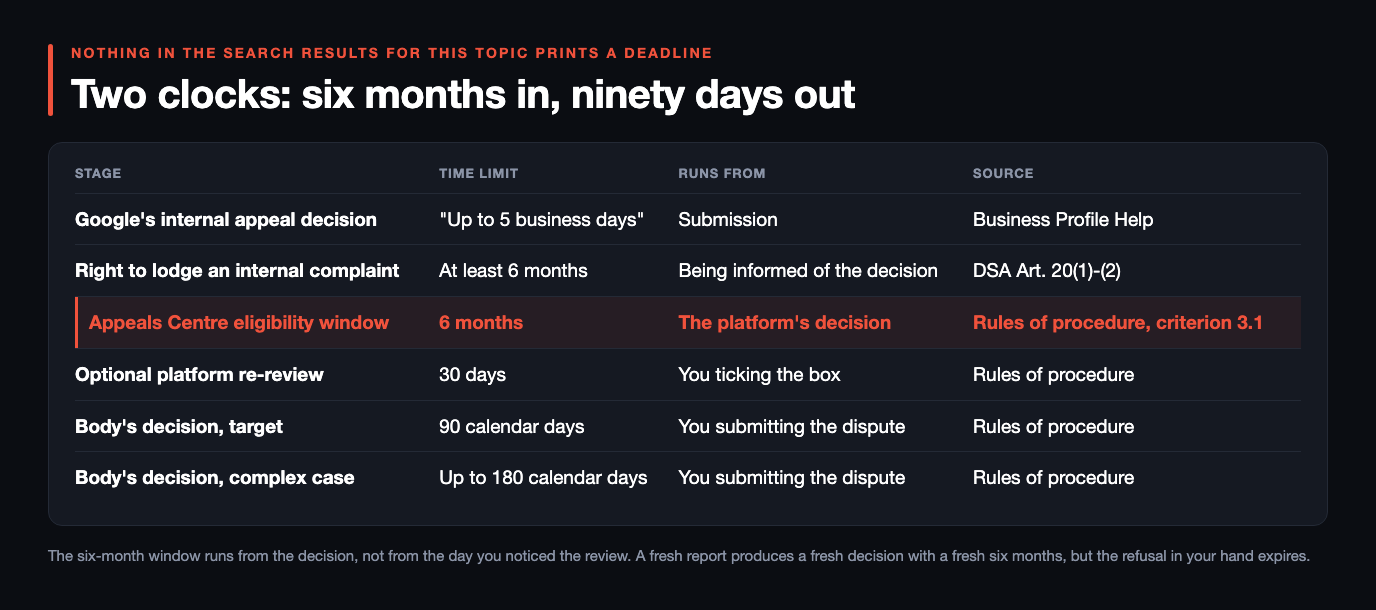
Nothing in the search results for this topic prints a deadline, and there are two that will decide whether you have a case at all.
| Stage | Time limit | Runs from | Source |
|---|---|---|---|
| Google's internal appeal decision | "Up to 5 business days" | Submission | Business Profile Help |
| Right to lodge an internal complaint | At least 6 months | Being informed of the decision | DSA Art. 20(1)-(2) |
| Appeals Centre eligibility window | 6 months | The platform's decision | Rules of procedure, criterion 3.1 |
| Optional platform re-review | 30 days | You ticking the box | Rules of procedure |
| Body's decision, target | 90 calendar days | You submitting the dispute | Rules of procedure |
| Body's decision, complex case | Up to 180 calendar days | You submitting the dispute | Rules of procedure |
Read the six-month row as the live risk. It runs from the decision, not from the day you noticed the review, and the decision is the refusal email you probably deleted. A year-old review is still disputable, because what you appeal is the refusal, and a fresh report produces a fresh decision with a fresh six months. But the refusal in your hand expires. Our guide on how long Google takes to remove a review covers the upstream timings.
The number that makes it worth filing: 63%
A free appeal only matters if it changes outcomes, and here there is published data rather than vendor claims. The Appeals Centre's second transparency report, dated 28 May 2026 and covering April 2025 to March 2026, reports more than 24,000 disputes received, more than half eligible, and an overall disagreement rate with the platform of 59%. Then it splits that figure, and the split is the story.
| Complaint type | Platform decision overturned | Who files this |
|---|---|---|
| Content left up | 63% | A business whose report was refused |
| Content removed | 52% | A poster whose content was taken down |
| All cases, average | 59% | Everyone |
| Hate speech left up | 70% | Reporters, by category |
| Scam cases (small sample) | 36 of 45, about 80% | Reporters, by category |
Three caveats, because this number gets quoted badly. It is one body's record, mostly on social platforms, over a window in which Google Maps was barely in scope. The report notes the share of cases where platforms hand over the content "has plateaued", and a decision made without the content is a weaker one. And an overturn is the body disagreeing with the platform, which is not the review coming down. Compare it anyway with what the ordinary route achieves; the direction is not close.
For scale: the Commission's DSA Transparency Database, where platforms file a statement of reasons for essentially every EU moderation decision, now holds more than 4.45 billion of them from 384 active platforms, 42% of them fully automated. Your refused report is one row in that.
Non-binding, and what that is still worth
Article 21(2) is explicit that the body "shall not have the power to impose a binding settlement", and Google writes the consequence in plainer words: "Google is not bound by any decisions made by these out-of-court settlement bodies." Anyone who sells you this route as a guaranteed removal is misreading the regulation.
What remains is more than nothing. Both parties must "engage, in good faith" with the chosen body, which is an obligation on Google, not a courtesy. Platforms must publicly report the share of decisions they decline to implement, so a pattern of ignoring rulings is visible to the regulator. Article 20(4) separately requires a platform to reverse an unfounded decision without undue delay, which does bind. And a reasoned finding naming your review and the policy it breaches is a document you can attach to whatever you do next.
The implementation picture is mixed. The Appeals Centre's first report found Meta implemented roughly half of its overturn decisions where it responded at all; the second gives no comparable figure, and for Google Maps the sample is too young for anyone to have one. That is a reason for realistic expectations, not for skipping a free step.
"EEA" is Google's word, not the DSA's
Here is the finding that sends some businesses down the wrong path, and no guide on this Google review appeal route mentions it. Google's Business Profile help page tells businesses "located in an EEA member state or territory" that they can refer an appeal to an out-of-court body. The European Economic Area is the EU plus Norway, Iceland and Liechtenstein. The Appeals Centre's own eligibility criterion is narrower, and it is the one that decides your case: "You must be located in an EU Member State."
The gap exists because the DSA has not arrived in the EEA yet. EFTA's register for Regulation 2022/2065 lists it as marked EEA-relevant and still "under scrutiny" for incorporation by Iceland, Liechtenstein and Norway, with a draft Joint Committee decision pending rather than in force, and practitioners in Norway and Iceland were still describing national implementation as not commenced through 2026. So a Norwegian owner reads "EEA" on a Google page, files, and can be refused on eligibility with nothing explaining why.
Where you are decides what you have. EU member state: Article 20 and Article 21 both apply, both bodies above are open to you. Norway, Iceland, Liechtenstein: Google's tooling may treat you as in scope while the regulation is not yet incorporated, so verify eligibility with the body before you build a file. United Kingdom: the DSA does not apply, full stop. The UK left the EU before the regulation existed and is not in the EEA; the domestic regime is the Online Safety Act, which does not give a business this appeal. Google's appeals tool groups "UK/EEA" for suspensions, which is a Google product decision and not a route to Article 21.
We say this plainly because we published the looser version ourselves: two older guides here describe EEA and UK businesses as able to refer disputes. The mechanism is EU, the EEA extension is pending, and the UK has no equivalent. Treat this as the correction.
What to file, and where this route will not help
A body hearing a Google Maps case decides one narrow question: on the material in front of it, does this review breach the platform's rules or the law? It is not weighing whether the review is unfair. So the file wants the shape of a good report, only tighter. Our walkthrough on documenting evidence is the long version; the short one is a single named ground with proof attached.
- The decision you are appealing. Google's refusal, with its date and reference, and the report that preceded it. Without a decision there is nothing to dispute.
- One policy ground, not five. Fake engagement, conflict of interest, off-topic, harassment. Pick the one the content actually breaches, using the violation types, and argue it.
- Evidence a stranger can check. Booking records showing no such customer, a timestamp against your closing hours, the same text posted on three competitors, an employment date. What actually counts as fake is narrower than most owners assume.
- The review itself, captured. Screenshot with the reviewer handle, star rating, date and full text. Bodies have reported being unable to review content platforms do not supply.
- A short, unemotional statement in one of the body's procedural languages, written for the qualified human that Article 20(6) says has to be in the loop.
And the limits, because they cover most of the cases we see. This route does nothing about a genuine customer's harsh but honest opinion. It does not restore reviews that vanished in a spam sweep, nor lift a pause on new reviews. It is slower than the five-day internal appeal by an order of magnitude. And a body may decline a case already resolved on the same facts and grounds, or one sitting with a court.
The first two weeks
- Find the refusal. Search the owner inbox and spam for the decision on your report. Its date is day zero of your six months.
- Capture the review before anything else, exactly as it appears, in an incognito window.
- Spend your one internal appeal in the reviews management tool, on a single named ground with evidence attached. Decision inside five business days.
- If it is refused, confirm your eligibility against the body's own criteria, not against Google's "EEA" wording.
- Check the Commission register for the current scope of each certified body before you choose one.
- File with a body that names Google Maps, in one of its procedural languages, attaching the refusal, the report, the capture and the evidence.
- Decide on the 30-day re-review box deliberately: another look for Google, a later decision for you.
- Diary day 90, the body's target. If nothing has arrived and the case was not flagged complex, chase it.
Then keep reporting the next one properly. This route rewards businesses with clean policy-violation reports on the record: the refusal of a good report is a far better starting document than the refusal of a bad one.
The appeal is only as good as the report underneath it
Bodies decide on the file you hand them, and most refused reports were refused because they argued five grounds instead of one. Flaggd reads Google's policies against the actual content and files evidenced, single-ground disputes on the reviews that breach them.
Flaggd is our own service. We dispute content that breaches Google policy; we do not remove or suppress content that does not, nobody can guarantee a removal, we are not a certified dispute settlement body and cannot decide a case on Google's behalf, and nothing here is legal advice.
Frequently asked questions
Can I appeal Google's refusal to remove a review?
Yes, twice over if your business is in the EU. Google gives one internal appeal through the reviews management tool when a reported review is judged not to violate policy, usually decided inside five business days. If that fails, Google's own EU redress page lists reported content it did not remove as grounds to go to a certified out-of-court body under Article 21.
Which dispute settlement bodies handle Google Maps reviews?
Two, as of October 2026. Appeals Centre Europe, certified in Ireland, added Google Maps in August 2026 and takes cases about reviews a business believes are fake. Platform Control, certified in Germany on 4 November 2025, covers Maps and explicitly handles reports the platform did nothing about. Other bodies elected social platforms, so check the Commission register first.
How much does a DSA dispute cost a business?
Nothing, in practice. The Appeals Centre charges users no submission fee and invoices the platform 290 to 1,050 euros per case. Article 21(5) puts the body's fees on the platform where you win, and a user who loses owes nothing absent manifest bad faith. Your real cost is the hour assembling the file.
How long does an out-of-court dispute take?
The Appeals Centre targets 90 calendar days from submission, up to 180 for complex disputes. Google's internal appeal takes up to five business days, and the optional re-review box adds 30. Against a review that has cost you bookings for months that is a trade worth making, but it is not a fast remedy.
Is the decision binding on Google?
No. The body cannot impose a binding settlement, and Google writes that it is not bound. What binds is the duty on both sides to engage in good faith, the public reporting of decisions platforms decline, and Article 20(4), which requires reversal of an unfounded decision without undue delay. The finding is reusable evidence.
Can a UK business use the DSA route for a Google review?
No. The DSA is EU law and the UK is neither an EU nor an EEA member, so Article 21 is not available; the domestic regime is the Online Safety Act, which does not create this appeal. Google's appeals tool groups UK and EEA businesses for profile suspensions, which is a product decision rather than a legal route, and it is the commonest confusion on this topic.
What is the deadline for filing a DSA dispute about a review?
Six months from the platform's decision. Article 20 keeps the internal route open at least that long, and the Appeals Centre requires the decision to be under six months old. The clock runs from Google's refusal, not the review's post date, so an old review is still disputable: file a fresh report, get a fresh decision, and six fresh months start.
Do I have to appeal to Google first?
Strictly, no. The Appeals Centre's rules say it is not required, though it encourages it, and Google suggests trying its internal process first. Do it anyway: it is free, decided in days, and a documented refusal is the strongest single item in the file.