Key Takeaways
- Google paused new reviews for one of five different reasons, and only two are a penalty. Each has its own policy page and its own way out, and the email you got does not say which you have.
- Google's notice says "typically within a few days". The only published dataset says 30 days, every time across five profiles tracked over 60 days, "regardless of the appeal."
- One of the five is a finding against you under the Fake Engagement policy, and it is the only one with a documented appeal.
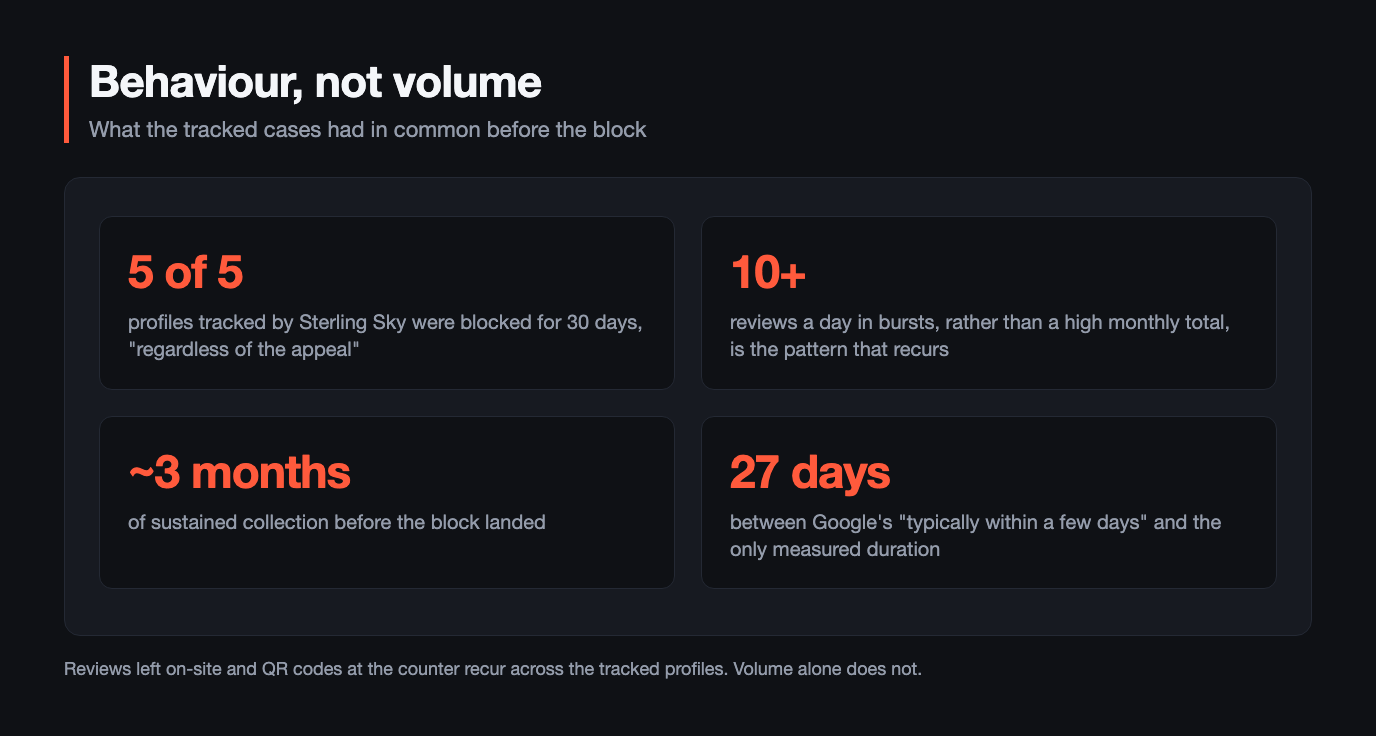
- Google appears to pattern-match review behaviour, not volume: reviews left on-site, QR codes at the counter, bursts of 10 or more a day, sustained about three months before anything happened.
- It can also be your customer, not your profile. A restricted Google Account cannot contribute "anywhere in the world", and nothing on your end fixes that one.
- What a review pause actually is, and what it is not
- Five reasons new reviews stop, and only two are a penalty
- Read the notice you were sent, it names your mechanism
- How long Google keeps new reviews paused
- What actually triggers a block: behaviour, not volume
- What the pause costs you in reviews nobody can write
- If it is a Fake Engagement restriction, you have an appeal
- When it is your customer's account, not your profile
- The July 2026 incident, and what it settled
- The first 48 hours
- Frequently asked questions
Your profile looks normal, your rating has not moved, and yet three customers this week have said the review they wrote never appeared. If Google paused new reviews on your profile, you are in a state Google documents in four places and explains in none of them: contributions are frozen while the listing stays visible, and the notice you get, if you get one, reads the same whether you were protected or penalised. The difference decides everything, because one gives you an appeal and the other gives you a wait. We read Google's Fake Engagement restrictions page, its Consumer Alerts page, its Posting Restrictions page and its Maps content policy line by line, pulled the verbatim owner email, and set Google's stated duration against the only tracked dataset anyone has published. They do not agree, and the gap is 27 days.
What a review pause actually is, and what it is not
A pause restricts incoming contributions. The profile stays live, existing reviews usually stay published, your rating holds, and the only change is that the form at the other end stops accepting anything. Customers who try see a message, most often "Posting reviews is turned off for this place", and almost none of them mention it to you.
That makes it the quietest problem on a Business Profile. A suspension takes the listing down within the hour. A one-star wave shows in your rating. A pause shows up as nothing: no drop, no alert, no gap you would spot without counting. Most owners find out the way you probably did, from a customer mentioning it weeks later.
Four states, four different problems. A pause blocks new reviews while the profile stays live. A removal deletes reviews you already had, which is a different failure with a different cause. A suspension takes the whole listing out of Search and Maps, covered in our guide to a profile suspended after a review dispute. And a permanently closed label blocks new reviews as a side effect of a status field, which we take apart in the permanently closed fix. Only the first and the last stop reviews without touching anything you can see.
One sentence tells you whether to check that last one first. On Google's page about reviews on closed and moved businesses: "Customers can leave new reviews for temporarily closed businesses but not for permanently closed ones." So before you treat this as enforcement, open your listing in an incognito window and read the hours line. If it says permanently closed, you have a status field to flip, not a review pause.
Five reasons new reviews stop, and only two are a penalty
No guide on this subject sets out the part that is the whole diagnosis. Google runs five distinct mechanisms that end with your customers unable to post, across four help pages and one blog post. Two are protective, two are enforcement against your business, and one is not about your business at all.
| Mechanism | What triggers it | Are you told? | Duration Google states | Route out |
|---|---|---|---|---|
| Protective spam pause | "A sudden spike in spam reviews" aimed at you | Yes: owner email plus a public banner | "Typically within a few days" | Wait; "no action is required" |
| Fake Engagement restriction | A finding that the owner broke the Fake Engagement policy | Yes, by email, "if we plan to apply a restriction" | "Set period of time" | Appeal form |
| Consumer Alert restriction | "Suspicious review activity on a business" | The public is, via a banner; the owner page says nothing | "For a period of time" | Not stated |
| Place posting restriction | Contributions at that place are "consistently unhelpful, harmful, or off-topic" | No owner notice documented | Short-term or long-term, no figure | Lifts when "risk subsides" |
| Reviewer account restriction | Your customer's Google Account broke the Maps content policy | They are; you never are | "Globally and indefinitely" | Theirs to appeal, not yours |
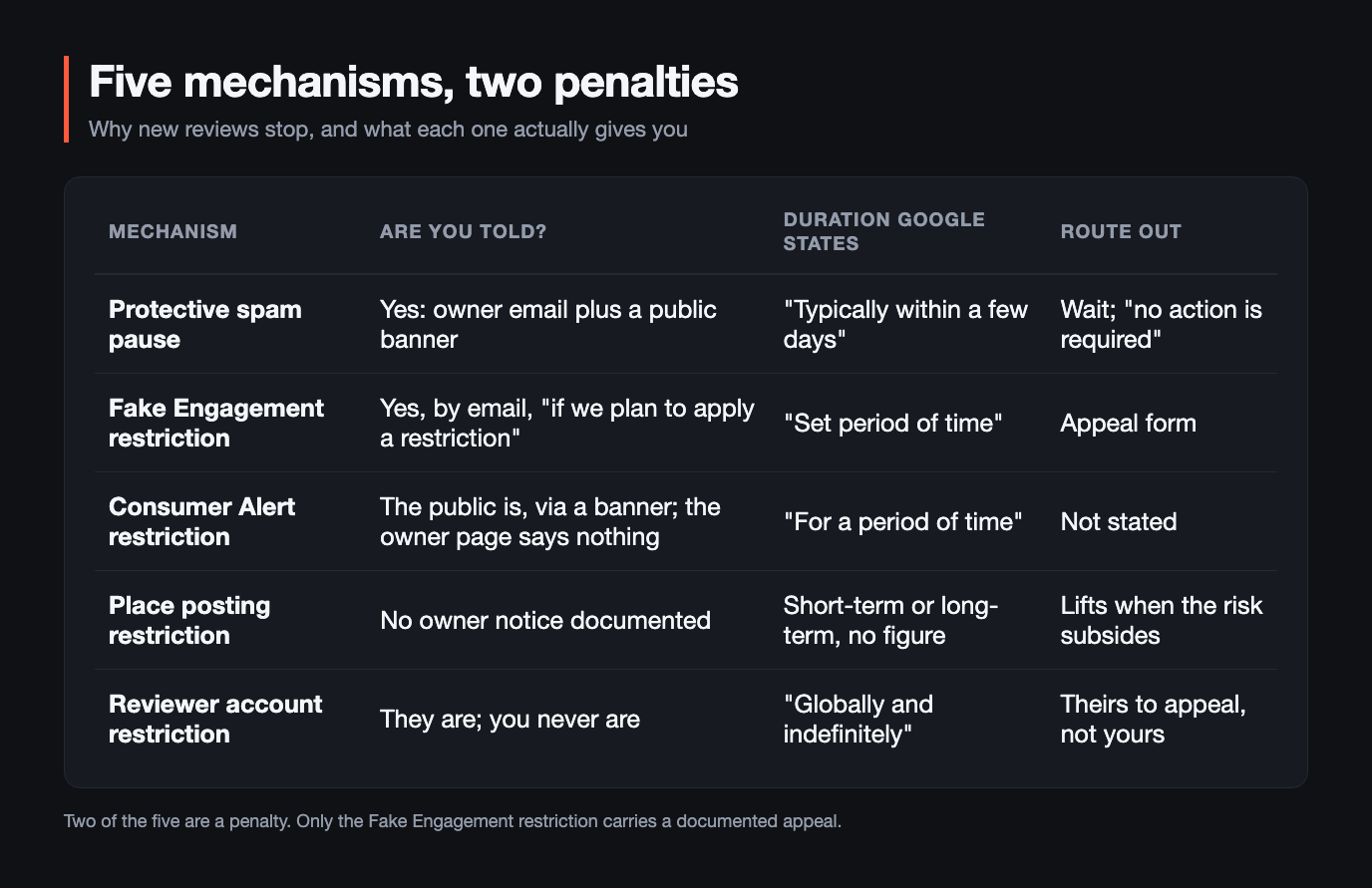
Read it as a decision tree. Got an email? Row one or two, and the next section says which. Got nothing, and only some customers blocked? Row five. Nothing, and everyone blocked? Row three or four, where support is the only lever. Advice that treats "reviews paused" as one thing is guessing at four of them.
Read the notice you were sent, it names your mechanism
The protective pause is the one Google announced. In its 16 April 2026 post on protecting businesses on Maps: "if we do see a sudden spike in spam reviews, we'll quickly remove the fake content, pause new reviews on the profile, alert the Business Profile owner and display a notification banner" "to let consumers know why contributions are temporarily paused."
That is good design: the spam goes, the door shuts while the attacker is still pushing, and both you and the public learn why. The email, reproduced in Search Engine Roundtable's 22 September 2026 write-up, is headed "Protecting your Business Profile from spam reviews" and reads, in part:
"Google has detected a spike in spam reviews on your Business Profile and removed them" so they do not affect your Google rating. "To protect your Business Profile, new ratings, reviews, and other user contributions have been temporarily paused." "Google will lift this pause once the risk is mitigated, typically within a few days." "No action is required on your part," but "if you believe legitimate reviews have been removed by mistake you can request a review."
Now compare the other email. Google's page on Business Profile restrictions for policy violations covers what follows a finding that "a business owner violated the Fake Engagement policy", and its first listed restriction is the same outcome in the same words: "Business Profile will not be able to receive new reviews or ratings for set period of time." Two more are the tell: existing reviews "will be unpublished for set period of time", and the profile "will display a warning to let consumers know that fake reviews were removed."
How to tell the two apart in ten seconds. The protective pause says spam was "detected" and "removed" on your profile, says no action is required, and gives a duration. The enforcement restriction is a finding against your profile, names the Fake Engagement policy, offers an appeal, and gives no duration at all.
The public banner differs too. One says contributions are paused to protect you. The other is "a warning to let consumers know that fake reviews were removed", which is a sentence about your business, not an attacker.
If neither email is there, check the inbox of the Google Account that owns the profile rather than the one you read daily, and check spam. Google's April post promises alerts to "verified and active owners", and those two words do real work: a profile nobody signs into is the one least likely to be told anything.
How long Google keeps new reviews paused
Here is the contradiction at the centre of the problem. Google's email gives a number, Google's help pages refuse to, and the only person publishing tracked cases gets a third answer matching neither.
| Source | Stated duration | What it is based on |
|---|---|---|
| Google's owner email (spam pause) | "Typically within a few days" | Google's own wording, verbatim, Sept 2026 |
| Fake Engagement restrictions page | "Set period of time" | No figure published anywhere on the page |
| Consumer Alerts page | "For a period of time" | No figure; applies to both the block and hidden reviews |
| Posting Restrictions page | Short-term or long-term | Lifted "once the abuse and policy-violating risk subside" |
| Sterling Sky, 28 Sept 2026 | 30 days, in 5 of 5 cases | Five blocked profiles tracked over about 60 days |
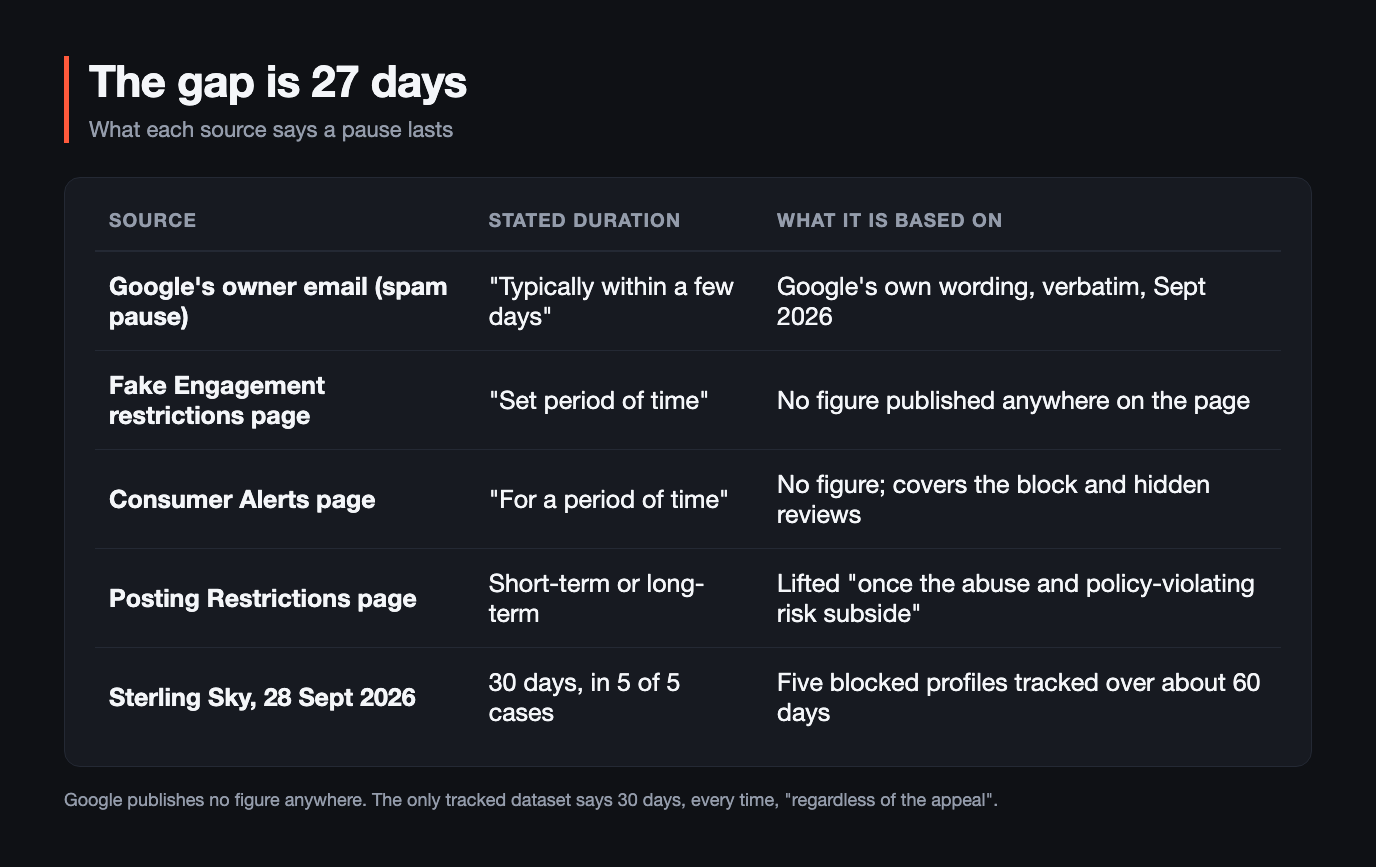
The tracked figure is the one to plan around, and the sentence it comes from is blunt. Claudia Tomina, writing on Sterling Sky's blog on 28 September 2026, describes a review block as a temporary restriction "commonly 30 days", paired with messaging about "suspicious high-rated reviews", and then: "in every case I have tracked over the last 60 days, the block lasted the full 30 days, regardless of the appeal."
Five cases is a small sample and she says so, but it is five more than anyone else has published, and it points the same way as the help pages: the number in the protective email belongs to the protective mechanism, not the enforcement one. Treat "a few days" as the ceiling if you were protected, a month as the assumption if you were restricted, and file the appeal anyway, on her reasoning: "they need this data ... to see where legitimate businesses are being incorrectly flagged."
What actually triggers a block: behaviour, not volume
The useful finding in that dataset is about cause. The blocked profiles were not the ones with the most reviews, but the ones whose reviews arrived in a particular shape: "reviews being left inside the business", "QR codes used at the counter/tables/checkout", and "bursts (ex: 10+ reviews in a single day)". None breaks a rule alone. Repeatedly and in combination, they appear to raise the odds of a restriction.
The timing is slower than you would expect, which is why nobody connects cause to effect. In her published case a profile averaging 72 reviews a month from January to August 2025 went to 179, 235 and 181 across September to November, a 2.75-fold rise sustained three months before Google acted. The removal that followed was selective: of 595 reviews generated, 342 went, 57.5%.
What this means for your review-generation push. A tablet by the till, a QR code on the receipt and a staff bonus for review counts produce exactly the pattern above, and each is standard practice on its own. If your monthly count has run at two or three times its own baseline for a quarter, you are inside the window the tracked cases sat in: spread the asks out, move them off-premises, stop paying staff by volume. Our guide to getting more positive Google reviews covers asks that do not cluster, and review gating and what Google's rules actually say covers the one that gets you restricted on purpose.
Scale is the context. Google says it "blocked or removed over 292 million policy-violating reviews" in 2025 and placed "posting restrictions on more than 782,000 policy-violating accounts". A system at that volume is a classifier, and classifiers have false positives, which is the honest reading of an organically-grown profile getting caught. More on that machinery in how AI is changing Google review moderation.
What the pause costs you in reviews nobody can write
A removal takes content you can dispute. A pause takes content that was never created, and there is no form for that: nothing recovers the review a happy customer would have written in week two, because they do not come back in week six to try. The arithmetic below is ours, not Google's, and it is only multiplication once you accept the block is absolute while it stands.
| Length of pause | Quiet single site (3/month) | Busy service business (12/month) | High-volume site (72/month) |
|---|---|---|---|
| "A few days" (4) | 0 | 1 to 2 | 9 to 10 |
| 14 days | 1 | 6 | 34 |
| 30 days (the tracked case) | 3 | 12 | 72 |
| 60 days | 6 | 24 | 144 |
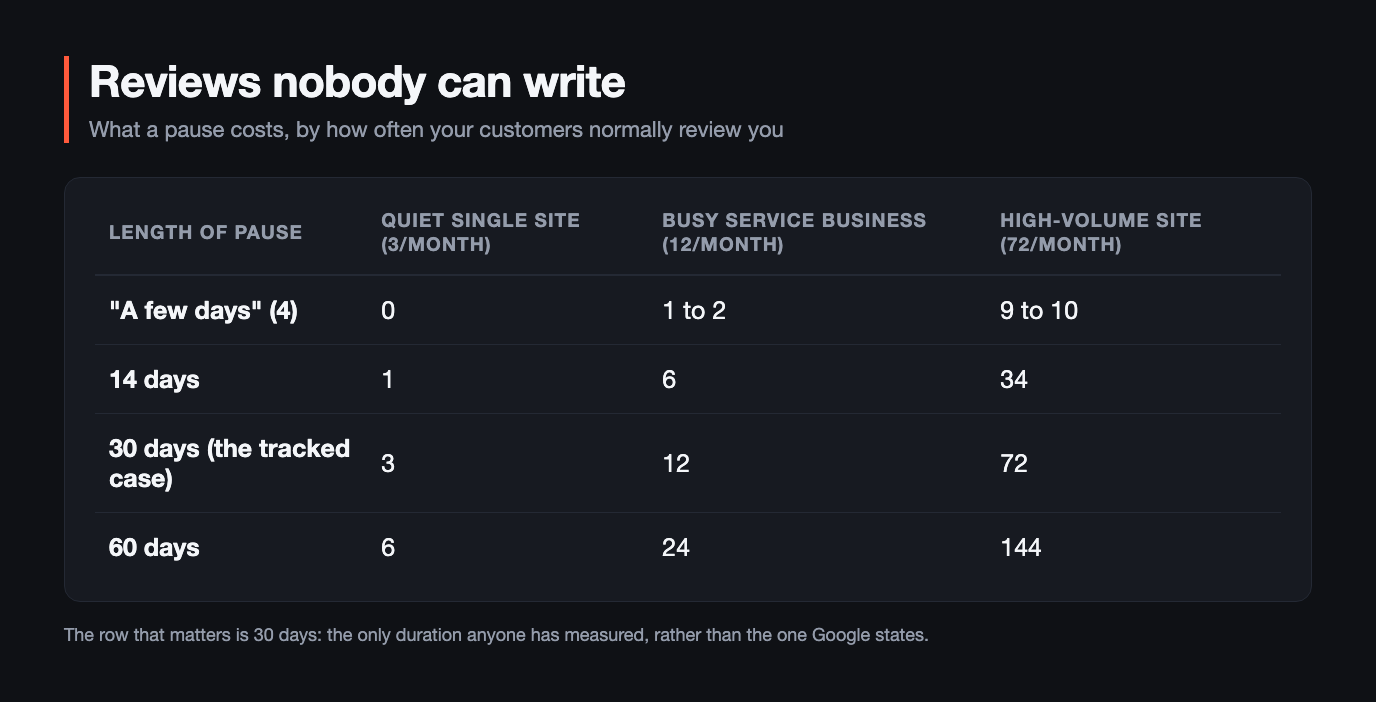
The 72-a-month column is not hypothetical: it is the pre-surge baseline of the tracked profile above. At that velocity a 30-day block costs a month of social proof, plus several hundred reviews if a selective removal came with it, and a rating that does not move reads as a profile that is fine.
If it is a Fake Engagement restriction, you have an appeal
Exactly one of the five carries a documented appeal, and it is the one that is a finding against you. Google's restrictions page is explicit: "we will notify business owners via email if we plan to apply a restriction to their profile", "businesses have the ability to appeal our decision", and "once submitted, we will re-review the profile and any additional context the business provides in the appeal." The outcome returns the same way: "we will share the status of our review."
The operative phrase is additional context the business provides. An appeal saying the restriction is wrong is a vote; one explaining the pattern the classifier saw, and why it was legitimate, is evidence. Put these in it:
- Your own baseline, in numbers. Monthly review counts for the twelve months before the spike, then the spike months. A real-world cause, a new location, a seasonal peak, a press mention, is context nothing else supplies.
- How the reviews were solicited, honestly. Counter tablets and on-premises QR codes are the pattern under suspicion, so "we removed the tablet on the 3rd" beats denying it existed.
- Evidence of real transactions behind the reviewers, aggregated: order volumes, footfall, booking counts for those months. Not customer names.
- No staff incentive scheme, or the date you ended one. A bonus tied to review counts sits close to the policy line.
- What you have changed so the pattern does not repeat.
Then plan for the restriction to run its course, because the tracked cases all did, and a failed appeal still puts a legitimate business into the data Google tunes the classifier on. If support will not engage, our walkthrough of contacting Google support about a profile dispute covers what gets a case escalated rather than closed.
Do not confuse this appeal with the "request a review" link in the protective email. They go to different places and do different jobs. The appeal asks Google to lift a restriction on your profile. "Request a review" asks Google to look again at reviews it removed as spam, in case legitimate ones went with them, which is the half of a spam pause that actually costs you content you can get back.
When it is your customer's account, not your profile
The fifth mechanism is the one that wastes the most owner time, because every diagnostic you run on your own profile comes back clean. Google's Maps user-generated content policy says Google "may remove UGC, restrict feature access or suspend Google Accounts that violate our policies globally and indefinitely", and spells out the scope: "when your Google Account is restricted from accessing or contributing to Maps features, you will not be able to use those features anywhere in the world."
Globally and indefinitely. A customer in that state cannot review you, your competitor, or a restaurant on holiday, and from your side it looks like a profile problem. The test is cheap: if some customers can post and others cannot, your profile is not paused. Ask one blocked customer to check their Google Account for a posting restriction, and ask a second customer to try. Two data points settle it in an afternoon.
The opposite trap: a single review that disappears from an account in good standing is a removal, not a block. There, what Google actually removes when you flag a review is the better starting point than anything on this page.
The July 2026 incident, and what it settled
On 3 July 2026, Barry Schwartz reported at Search Engine Roundtable that reviews were vanishing from Business Profiles at scale, behind eleven forum threads and more. One owner watched roughly 4,651 reviews collected over years drop to 63 in about 24 hours; others lost a few dozen; new reviews stopped publishing. Google's statement to that article is the clearest account of the machinery anyone has got out of the company:
"When our systems detect suspicious reviews, we take a range of actions including removing reviews and temporarily pausing reviews on the profile to prevent further abuse. We are investigating the issue and will restore any reviews that were incorrectly removed."
Three things in it are worth keeping. Removal and pausing are one combined response, so a profile that loses reviews and stops accepting them has had one thing happen to it. The trigger is "suspicious reviews" detected by systems, which caught both profiles that had been attacked and profiles whose owners had reported an attack. And incorrect removals get restored, with no timeline attached.
Nobody followed up on the ending. The same Roundtable article now carries an update: Google said the issue "has been resolved and all missing reviews should now be visible." Several vendor write-ups from that week still stop at "Google is investigating, no timeline given". So if your reviews went missing in early July 2026 and never came back, you are not in the incident any more, you are an unresolved individual case, and that is its own support ticket. If the vanishing arrived with a wave of one-stars, treat both as one campaign: detecting and stopping competitor sabotage covers how to document the timing.
The first 48 hours
- Count what you have, screenshotted and dated: review total, rating, and the date of the newest published review. That last figure proves when the pause started.
- Open your listing in an incognito window. Look for a banner and for a permanently closed label. Both change the diagnosis.
- Search the owner account's inbox and spam for "Protecting your Business Profile" and for anything naming Fake Engagement. That email decides which of the five you have.
- Have two customers try to post. If one can, your profile is not blocked and you are chasing an account restriction.
- Pause the asks. Turn off the QR codes, the counter tablet and the follow-up SMS. Nothing is being collected, and clustering is what the classifier watches.
- Tell your team why review counts are flat, before a quiet month reads as a service problem.
- File the appeal if the notice names a restriction, with the baseline numbers and the solicitation history in it.
- Use "request a review" if reviews were removed as well as paused. It is the only route that gets published content back.
- Diary day 31. Still blocked past the tracked 30-day mark, with no appeal outcome, is a support escalation rather than a wait.
Then restart on a flatter curve: steady collection is not the shape this classifier looks for.
A pause usually arrives with reviews worth disputing
The one-stars left standing after the spam sweep are the ones that keep costing you. Flaggd reads Google's policies against the actual content and files evidenced, single-ground disputes on the reviews that breach them.
Flaggd is our own service. We dispute content that breaches Google policy; we do not remove or suppress content that does not, nobody can guarantee a removal, we cannot lift a posting restriction or shorten a pause on your behalf, and nothing here is legal advice.
Frequently asked questions
Treat a pause as a clock with a diagnosis attached: find the notice, decide which of the five you have, appeal the one that can be appealed, and stop feeding the pattern while you wait. The reviews already on your profile are safe. The ones you lose are the ones nobody can write while the door is shut, and there is no form for those.
- Business Profile restrictions for policy violations — Google Business Profile Help
- Consumer Alerts, Posting Restrictions and the Maps user-generated content policy — Google Contribution Policy Help
- Reviews on closed, moved and renamed businesses — Google Help
- New ways we're protecting businesses on Maps — Google, 16 April 2026
- Google Local Reviews Go Missing For Many Businesses — Search Engine Roundtable, 3 July 2026
- Google Business Profiles Email: Detected A Spike In Spam Reviews — Search Engine Roundtable, 22 September 2026
- Review posting blocks are surging: the data and the patterns behind them — Sterling Sky, 28 September 2026