Key Takeaways
- The first 60 minutes determine the outcome. A successful review bombing attack response begins within an hour of detection — flagging, documenting, and pausing ads before the attack scales beyond manageable volume.
- Evidence vanishes fast. Bombers delete accounts, edit reviews, and rotate IPs within 24-48 hours. Real-time evidence preservation is non-negotiable; reviews removed by Google before screenshots are captured cannot be re-evidenced for legal action.
- Google removes coordinated bombs faster than isolated fakes. Cluster patterns, new-account signatures, and content similarity are unambiguous policy violations. Bulk disputes filed within 24 hours typically resolve in 7-21 days versus 30-60 days for single-review disputes.
- Stop responding individually. Replying to every bombing review feeds engagement signals and amplifies visibility. One calm template response on 2-3 representative reviews is the institutional standard.
- Pause paid traffic immediately. Ads driving visitors to a bombed listing waste budget and compound rating damage. Pause Google Ads, LSAs, and Performance Max campaigns until Google removes the wave or you've contextualized the situation publicly.

Eleven 1-star reviews land on your Google Business Profile in nineteen minutes. None of them mention a real transaction. Three use the same misspelled phrase. Two reviewer accounts were created today. Your overall rating drops from 4.7 to 3.9 in the time it takes to refresh the page. This is not a bad week — this is a coordinated review bombing attack response situation, and what you do in the next sixty minutes will determine whether the campaign is contained in 24 hours or metastasizes into a multi-week reputation crisis. Review bombing has become one of the most common attack vectors in 2026, hitting restaurants, contractors, medical practices, and e-commerce listings with weaponized 1-star waves designed to crater rankings overnight.
This playbook is the institutional response — written for the business owner, marketing lead, or reputation manager staring at an active bombing wave right now. It covers the first 60 minutes of triage, real-time evidence preservation before reviews are deleted, the fastest Google dispute pathway during an active attack, when to pause ads and freeze responses, when to escalate to law enforcement, and how to harden your defenses so the next bombing is detected in minutes rather than hours. Speed is the entire game.
What is a review bombing attack vs. organic negative reviews?
A review bombing attack is the coordinated posting of negative reviews — usually 1-star — by multiple accounts within a compressed time window, designed to damage a business's overall rating, search visibility, or reputation faster than any organic dissatisfaction event could. Bombings are deliberate, coordinated, and almost always inauthentic. Organic negative reviews are spontaneous expressions of real customer frustration. The two patterns look superficially similar in any single review but diverge sharply when examined as a wave.
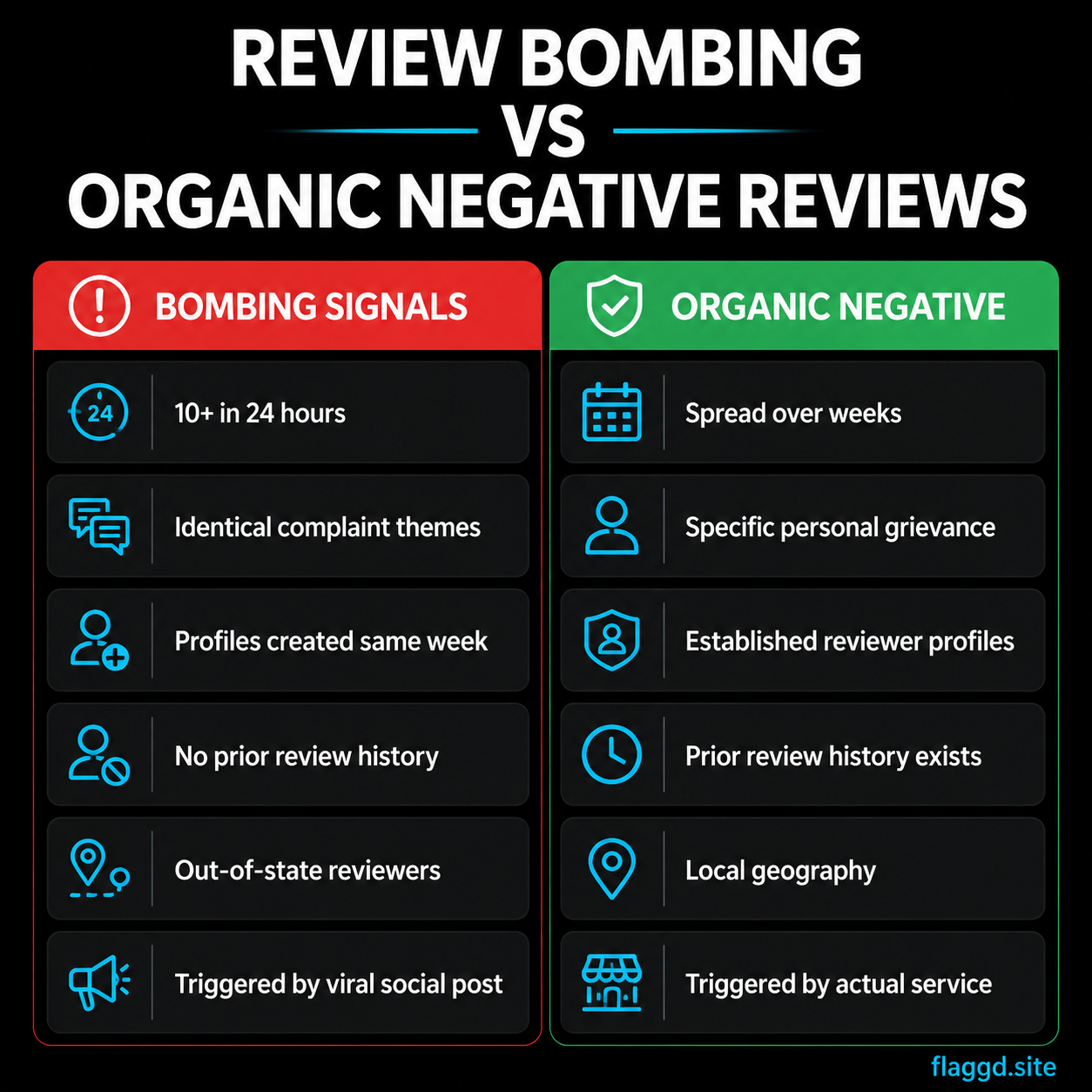
Velocity is the first signal. A typical service business receives 1-2 reviews per week. A coordinated review attack delivers 5-50 reviews in hours. When you see more reviews in an afternoon than in the last six weeks, the statistical probability of organic origin collapses. Bombing waves often arrive in identifiable bursts: a primary wave of 6-15 reviews, a quiet pause, then a second wave designed to overwhelm any response activity.
Account age and history are the second signal. Bombing reviews come disproportionately from accounts created within days of the attack, accounts with one or two prior reviews, or accounts whose review history is geographically inconsistent (a "reviewer" with critiques of restaurants in seven different states in one week). Organic negative reviewers usually have established profiles with mixed review histories that match real consumer behavior.
Content patterns are the third signal. Bombing reviews share linguistic fingerprints: identical phrases, the same misspellings, generic complaints that could apply to any business in your category, and absence of specific details a real customer would mention (employee names, dates, transaction specifics, location details). Organic complaints are messy, specific, and emotional — bombing reviews are templated and abstract.
Trigger correlation is the fourth signal. Bombing waves often follow a triggering event: a public controversy, an executive's social media post, a news mention, a competitor's product launch, or a dispute with a former employee or customer. If the wave correlates with an external event but the reviews do not reference that event specifically, you are almost certainly looking at a coordinated bombing rather than organic backlash from people who actually experienced your business.
First 60 minutes: emergency triage
The first hour after detecting a coordinated review attack is your highest-leverage window. Actions taken now compound; actions delayed cost geometrically more later. The triage protocol below is sequenced for speed — every step is parallelizable across team members if you have them, but if you are alone, run them in order.
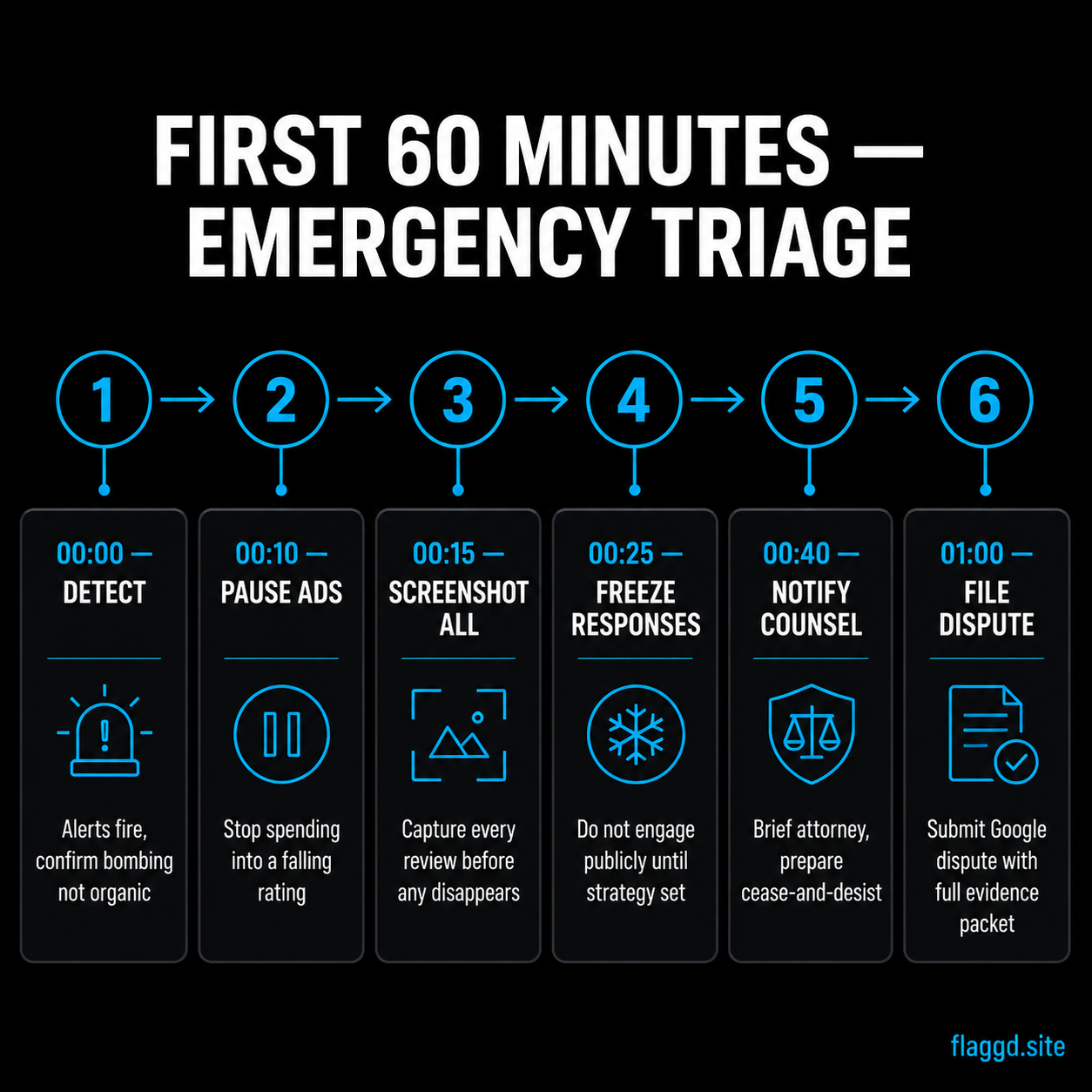
Minute 0-10: Confirm the attack. Open your Google Business Profile, sort reviews by newest, and count reviews posted in the last 24 hours. Compare to your baseline weekly volume. If you see more than 3x your normal volume, treat it as an active attack until proven otherwise. Note timestamps to the minute. Take a full-page screenshot of your listing showing the current rating and review count — this is your "moment zero" benchmark.
Minute 10-25: Bulk-flag the wave. For every review in the bombing cluster, click the three-dot menu and select "Flag as inappropriate." Choose "Spam" or "Off-topic" depending on content. Do not write detailed dispute text yet — bulk flagging gets the reviews into Google's queue. Detailed disputes come later. The goal in this phase is volume — every flagged review is one more datapoint Google's anti-spam system can use to identify the cluster.
Minute 25-35: Pause paid traffic. Open Google Ads, pause all campaigns driving traffic to the bombed listing. Pause Local Services Ads, pause Performance Max, pause any third-party directory placements that pull from your Google rating. Every dollar spent driving visitors to a bombed listing right now is wasted — and worse, it accelerates rating damage as new visitors see the artificial 1-star spike.
Minute 35-45: Freeze automated responses. If you use a review-response tool that auto-replies to negative reviews, disable it immediately. Auto-responses to bombing reviews look defensive at best and complicit at worst — and they create engagement signals that amplify the attack's visibility. Manual control only until the wave is contained.
Minute 45-60: Open the evidence file. Create a single dated document — call it "Bombing-Incident-2026-05-08.md" or similar — and start logging: time of first detected review, total review count at detection, screenshots taken, accounts noted, suspected trigger event, and any patterns identified. This file becomes the foundation for every subsequent action: Google disputes, IC3 reports, attorney consultations, insurance claims.
| Signal | Bombing Pattern | Organic Pattern | Confidence Level |
|---|---|---|---|
| Posting velocity | 5-50 reviews in hours | 1-2 reviews per week typical | Very high |
| Account age | Created within days of attack | Established profiles, mixed review history | Very high |
| Star rating distribution | 100% 1-star, no 2-3 star variance | Mix of 1-3 stars even when negative | High |
| Content specificity | Generic complaints, no employee names, no dates | Specific incident details, employee names, dates | High |
| Linguistic fingerprint | Identical phrases, shared misspellings, templated structure | Idiosyncratic voice, varied phrasing, personal tone | Very high |
| Reviewer geography | Inconsistent — multi-state review history in one week | Local, consistent with reviewer's actual region | Medium-high |
| Trigger correlation | Tied to public event but reviews don't reference it | No external trigger, scattered timing | Medium |
| Profile photo | Default avatar, AI-generated face, or stock image | Personal photo or established Google avatar | Medium |
| Transaction match | No record in CRM, POS, or appointment system | Verifiable customer record exists | Very high |
| Cross-platform mirroring | Similar attacks on Yelp, Trustpilot, Facebook simultaneously | Single-platform, no coordinated cross-posting | High |
Real-time evidence preservation
Evidence preserved in the first 24 hours of a coordinated review attack is admissible, defensible, and durable. Evidence captured later — after Google has removed reviews, after bombers have deleted accounts, after content has been edited — is fragmentary and weaker. Real-time preservation is the difference between a winnable Google dispute and a losing one, between a viable IC3 case and a thin one.
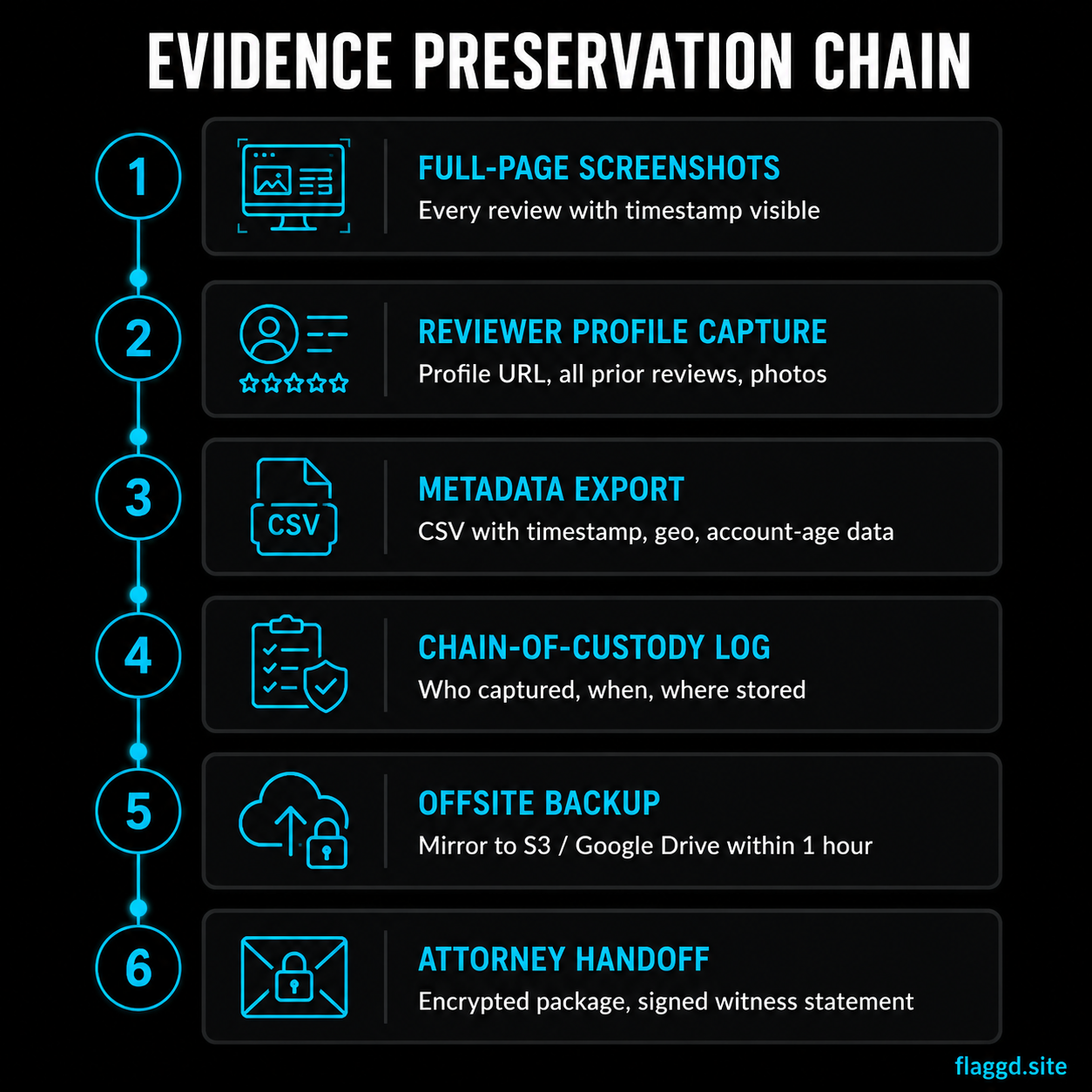
Full-page screenshots, not snippets. Use a full-page capture tool (browser extension or built-in feature) for every bombing review. Capture the entire review including the reviewer's profile photo, name, account age indicator if visible, star rating, full review text, posting timestamp, and any review response. Snippets that crop out timestamps or reviewer names are nearly worthless for disputes.
Reviewer profile captures. Click into each bombing reviewer's profile and screenshot it: total reviews posted, average rating they give, dates of recent reviews, and any geographic patterns visible. A reviewer profile showing 47 reviews of restaurants across nine US states in two weeks is dispositive evidence of inauthentic behavior. Save these alongside the review screenshots.
Archive the listing snapshot. Use the Wayback Machine (archive.org) or a similar service to archive your live Google Business Profile listing during the attack. Submit the URL to archive.org; this creates a third-party timestamped snapshot that cannot be edited or removed. Repeat the archive every few hours during an ongoing attack to capture the wave's progression.
Metadata documentation. For each captured review, log the review URL (right-click on the review timestamp), exact posting time in your local timezone and UTC, screenshot file name and capture time, and any other reviews from the same account. This metadata table becomes Exhibit A for both Google's review team and any subsequent legal action.
Witness logs and internal verification. If you have staff, customer-service logs, CRM records, or POS systems, run a quick check: do any of the bombing reviewers have transaction records with your business? Document the absence of records — "searched CRM, no record of [reviewer name] in last 24 months" — because absence is itself evidence under Google's content policy that prohibits reviews from people who have not transacted with the business.
Cross-platform evidence sweep. Coordinated bombings often hit multiple platforms — Yelp, Trustpilot, Facebook, BBB, industry-specific directories — within hours of each other. Check all your listings within the first hour. Identical or near-identical reviews appearing on multiple platforms simultaneously is one of the strongest evidence patterns Google's review team accepts as proof of coordinated inauthentic behavior.
Google emergency dispute pathway
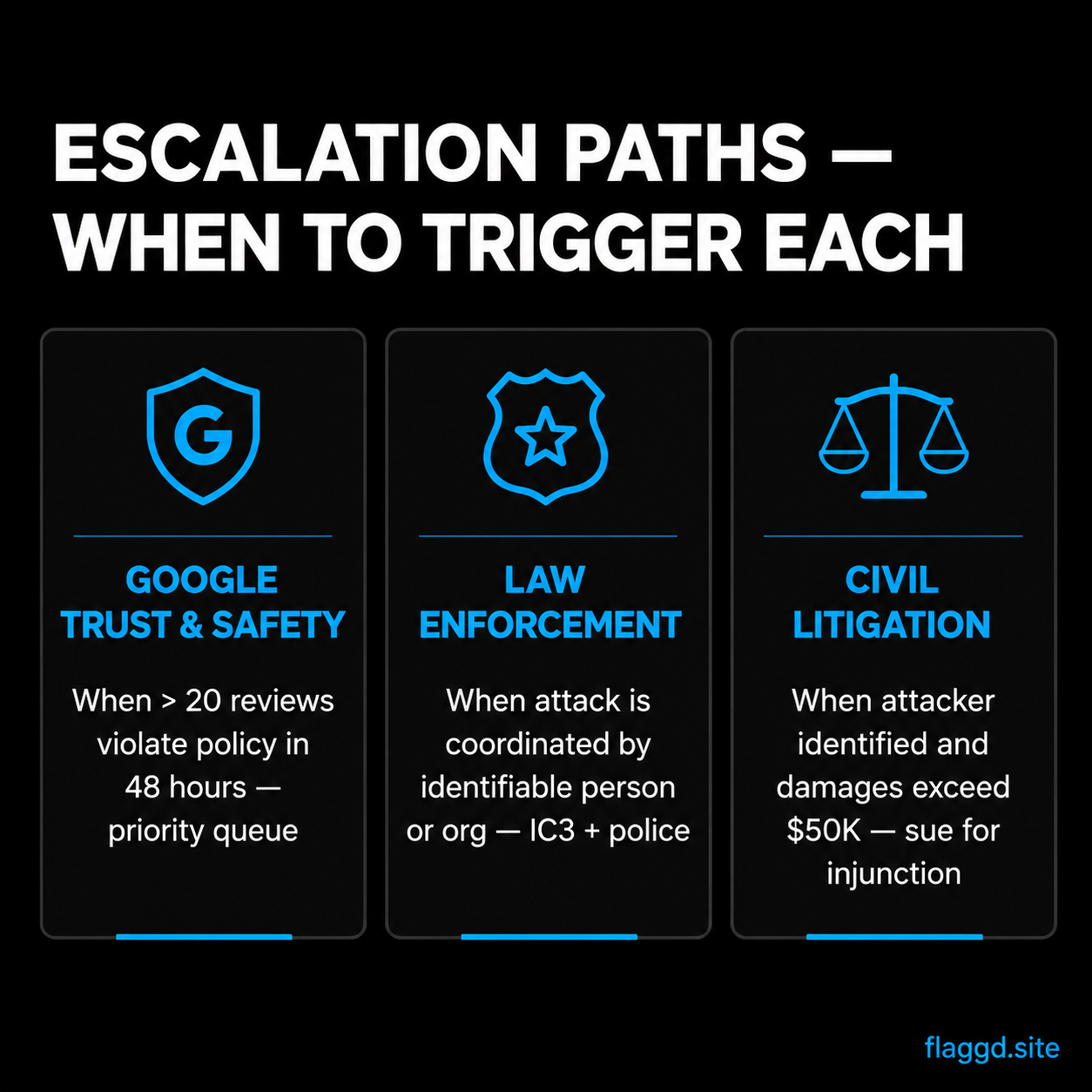
Google's standard review dispute process is calibrated for individual fake reviews and resolves in 30-60 days. The emergency review bombing pathway is different: when Google's automated systems detect cluster patterns, account-network signatures, and content similarity, the review escalates to faster manual queues. The key is filing your disputes in a way that flags the cluster pattern, not just individual reviews.
Bulk-flag first, then detail-dispute second. The two-step approach is critical. Step one is the fast bulk-flag pass described in the triage section — every review flagged as Spam or Off-topic. Step two, performed within the first 4-6 hours, is filing detailed disputes through your Business Profile's "Report a problem" pathway, citing the cluster as a coordinated attack and providing evidence.
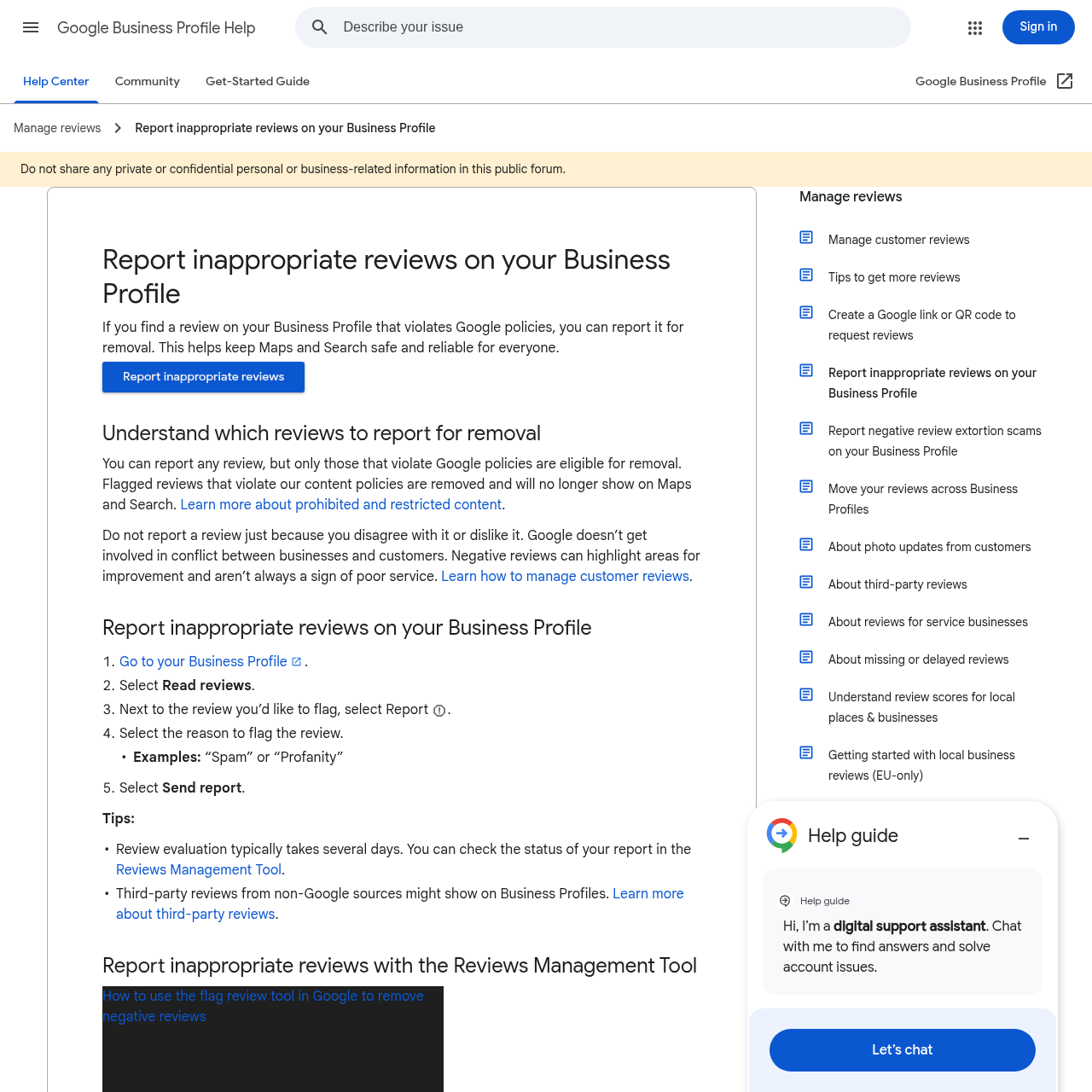
Detailed dispute language. In the dispute description, write something like: "Coordinated review bombing detected on [date] between [time] and [time]. [N] reviews posted within [duration] from accounts with [shared characteristics: new accounts, identical phrasing, no transaction history]. This pattern violates Google's policy on coordinated inauthentic behavior. Evidence file available on request: screenshots, reviewer profiles, posting timestamps, archive.org snapshot URL." Specific, factual, evidence-anchored — not emotional.
Use the Business Profile Help Community. Google's Business Profile Help Community (support.google.com/business/community) has Product Experts who can escalate genuine attack cases to internal review teams. Post a thread describing the bombing with redacted evidence; Product Experts can flag your case for priority review. This pathway is underused and often produces faster outcomes than the standard dispute form alone.
Twitter and X escalation. Google's @GoogleMyBiz support account on X monitors public mentions. A polite, factual public post — "@GoogleMyBiz our profile is under a coordinated review attack. We've filed disputes and need urgent review." — sometimes triggers internal attention. Do not post screenshots that name reviewers; describe the pattern, not the individuals.
Professional dispute services for active attacks. Services like Flaggd specialize in emergency bulk dispute filing during active bombings. The advantage is speed and pattern expertise: a service that has filed thousands of bombing disputes knows exactly which evidence framing produces the fastest removals. Engagement during an active attack typically produces results within 7-14 days versus the 30-60 day baseline for self-filed individual disputes.
Expected timeline for active-attack removals. Obvious cluster patterns — multiple new accounts, identical text, no transaction history — are often auto-removed by Google's anti-spam systems within 24-72 hours. Reviews surviving the automated pass typically resolve in manual review within 7-21 days when filed with cluster evidence. Reviews lacking obvious cluster signatures take longer; this is why bombing waves with sophisticated evasion (older accounts, varied phrasing) are harder to remove and require more detailed dispute work.
Pause, suspend, and counter protocols
Containment during an active review bomb defense is about controlling what you can while Google processes the disputes. Pause what amplifies, suspend what could backfire, and counter only on the narrowest defensible ground.
Pause: paid traffic and review-generation campaigns. Pause every Google Ads campaign, Local Services Ads, Performance Max, and any review-request automation. Sending review requests to recent customers during an active bombing creates an obvious sentiment-mismatch pattern that Google's anti-spam systems may interpret as your own coordinated counter-bombing — even when intentions are clean. Wait until the attack wave is contained before resuming.
Suspend: automated responses and emotional posts. Disable any review-response automation. Do not draft public statements while the attack is fresh — adrenaline produces messaging that reads as defensive or accusatory. The single template response approach is institutional standard: 2-3 representative bombing reviews receive one calm, factual response stating the situation is under investigation. The rest stay un-responded until removed.
Counter: narrative control without escalation. A brief public statement on your website and social channels reframes the attack from your perspective: "We have detected a coordinated review attack on our Google listing. We have reported it to Google and authorities. We remain committed to authentic feedback and thank our real customers for their patience." This statement is not a counter-attack — it is a context-setter that prevents the bombing from defining the public narrative.
Do not name suspects. Even if you strongly suspect a competitor, former employee, or specific individual, do not name them publicly during the attack. Naming without conclusive evidence creates defamation exposure for you, distracts from the bombing itself, and can give the attacker grounds for a counter-claim. Evidence collection and law-enforcement reporting handle the naming when the time is appropriate.
Internal communications discipline. Brief your team with a one-line script for customer questions: "We're aware of a coordinated review attack on our listing and have reported it to Google. We can't comment further while it's being investigated." Staff who improvise in the absence of guidance create messaging chaos. A scripted line keeps everyone aligned without locking down legitimate customer service.
Legal and platform escalation paths
Most review bombings resolve through Google's content policy enforcement alone. Some require legal escalation — particularly when the attack is paired with extortion demands, when the source is identifiable, or when the bombing is part of a recurring pattern targeting your business specifically.
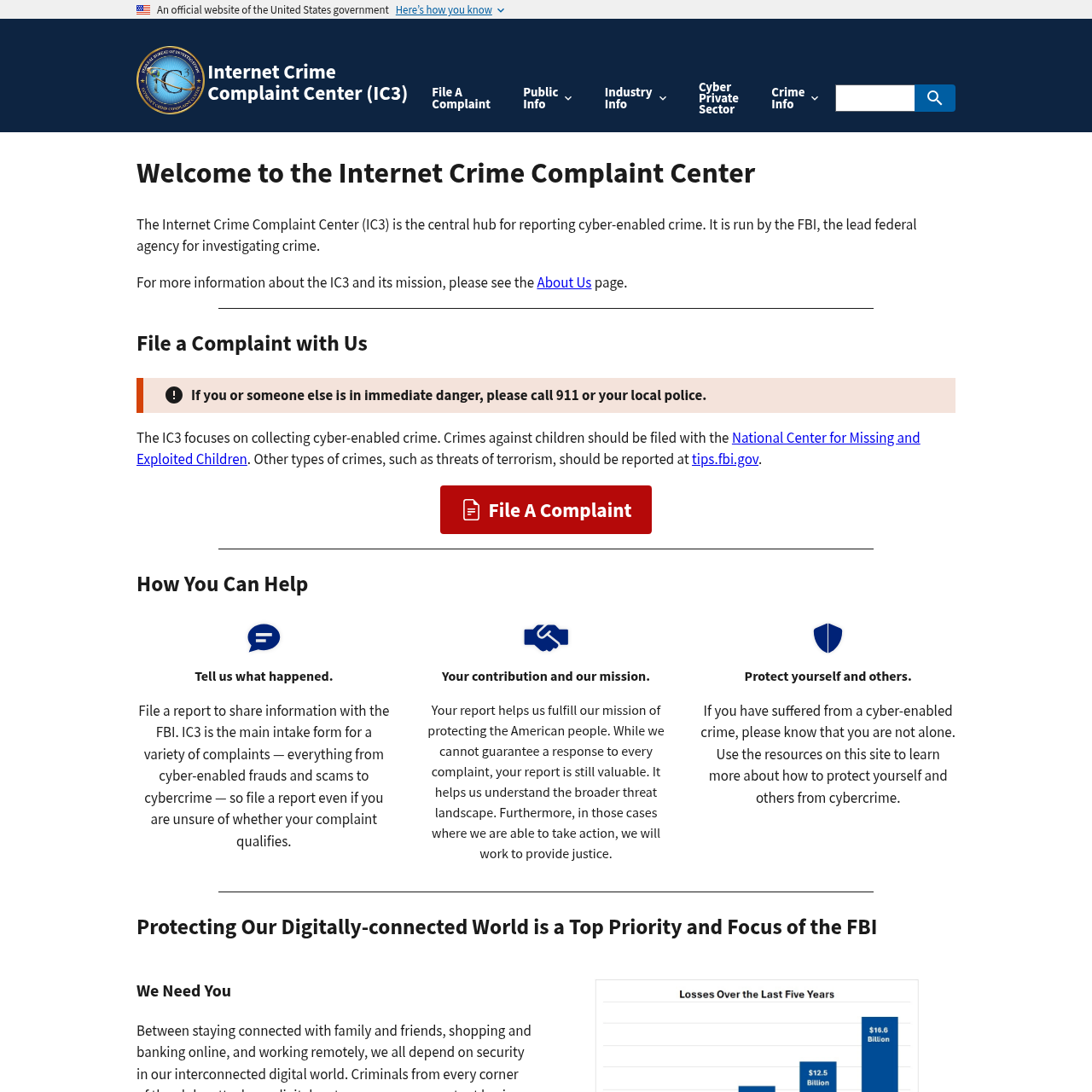
FBI Internet Crime Complaint Center (IC3). File at ic3.gov within 24 hours of the attack. The IC3 is the federal repository for cybercrime complaints, and review bombings frequently fall under its jurisdiction when they involve interstate communication (which any online attack does). Filing creates a federal record that supports later prosecution if attackers are identified, and IC3 data is used by FBI analysts to identify coordinated campaign networks targeting multiple businesses.
State attorney general consumer protection division. Most state AGs have consumer protection or cybercrime units that track coordinated review attacks. Filing a complaint with your state AG creates a state-level record and may contribute to investigation of attackers targeting multiple businesses in your region. Several state AGs have actively prosecuted coordinated review fraud rings since 2024.
Local law enforcement. File a report with your local police department, particularly if the bombing is paired with extortion threats, harassment, or any indication of physical proximity. Many police departments have cybercrime liaisons who can coordinate with the FBI. A local report number strengthens any subsequent civil action.
Civil litigation pathways. If the bombing's source is identifiable — a former employee, a known competitor, an individual with a documented grievance — civil action under defamation, tortious interference with business relationships, or unfair competition statutes is available. The threshold for civil action is lower than criminal prosecution; you need preponderance of evidence rather than beyond reasonable doubt. Consult a business litigation attorney with experience in online reputation cases. Many offer free initial consultations.
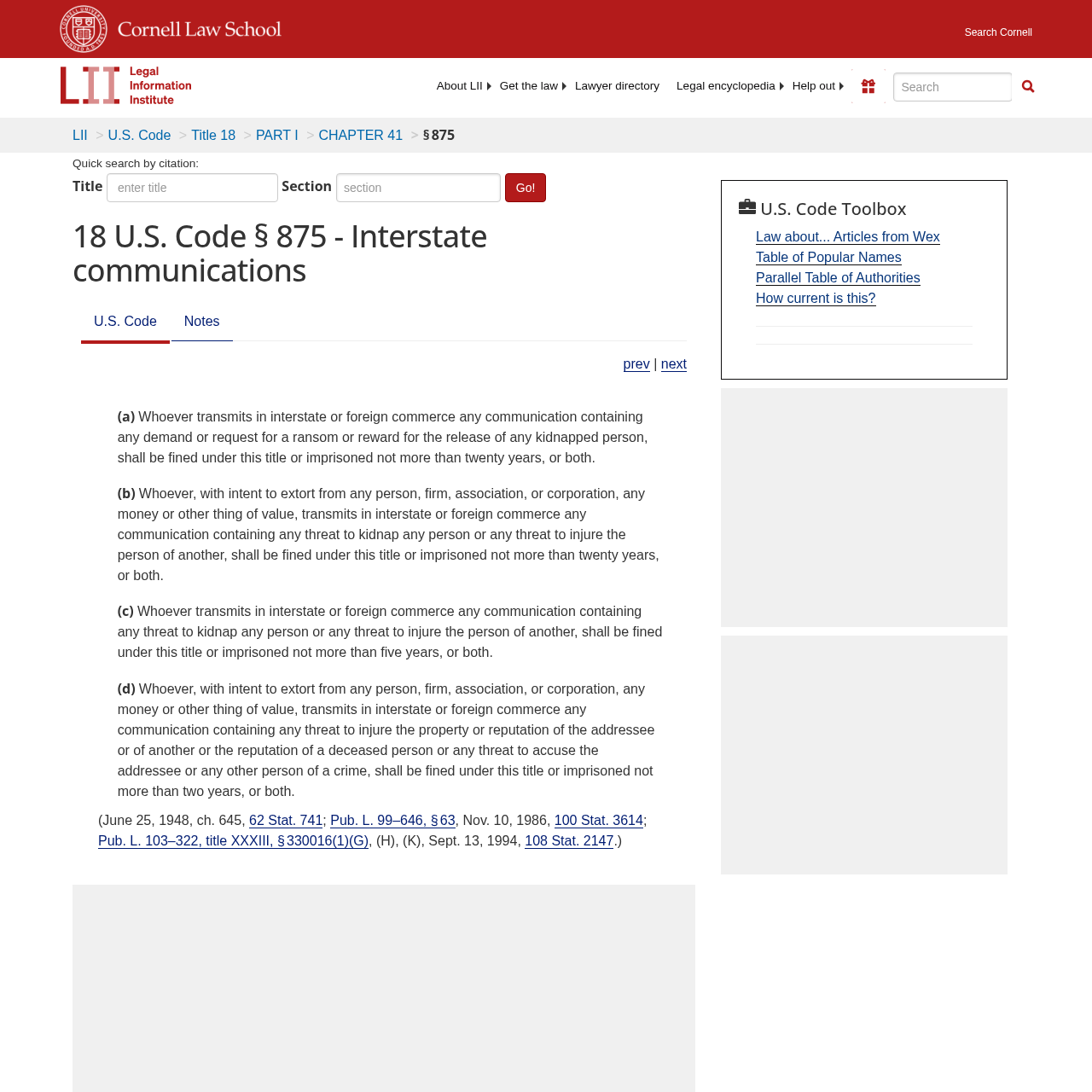
FTC fake review rule violations. The FTC's 2024 fake review rule explicitly prohibits coordinated fake review campaigns. Filing a complaint at reportfraud.ftc.gov adds another federal datapoint and may contribute to FTC enforcement action, particularly when the bombing is part of a broader fake-review-as-a-service operation.
Subpoena and discovery options. If civil litigation proceeds, subpoenas to Google can compel disclosure of reviewer IP addresses and account metadata. This pathway is rarely used for individual reviews but is available when a coordinated attack causes documented financial damage and the source is plausibly identifiable. Attorney experience matters here — the subpoena framing determines whether Google complies or moves to quash.
Post-bombing recovery and hardening
After the wave subsides and Google has processed initial removals, attention shifts to recovery and hardening. The goal is twofold: restore the rating to its pre-attack baseline, and ensure the next bombing is detected within minutes rather than hours.
Authentic review generation. Resume systematic review-request campaigns to recent verified customers. This is not review gating — you are inviting all customers to leave honest feedback, not selectively routing happy ones. Authentic positive reviews from verified customers dilute the bombing impact mathematically: ten new authentic 5-star reviews can offset a wave of 1-star bombs in rating terms. Volume matters; consistency matters more.
Real-time alerting infrastructure. Deploy a review monitoring service that notifies you within minutes of new reviews. Google Business Profile native alerts are too slow for bombing detection; third-party tools fire faster and can flag velocity anomalies (more than N reviews per hour) automatically. The next bombing should hit your phone in 90 seconds, not your morning email digest.
Response template library. Build and maintain a small library of pre-approved response templates for different scenarios: bombing acknowledgment, individual bombing review response, post-removal customer reassurance, public statement boilerplate. Pre-written templates cut response time from 30 minutes to 30 seconds when the next attack happens.
Staff training and escalation paths. Train customer-facing staff to recognize a bombing wave, run them through the triage protocol once a quarter, and document a clear escalation path: who flags reviews, who pauses ads, who notifies the executive team, who files disputes. A trained team executes the response playbook in 15 minutes; an untrained team takes 4 hours.
Access control and account security. Some bombings are paired with attempts to compromise the Google Business Profile itself. Audit account access: enable two-factor authentication, review delegated user permissions, remove former employees, rotate any shared credentials. A bombing followed by an account-takeover attempt is the textbook pattern for serious targeted attacks — harden the account before the next wave arrives.
Insurance and financial recovery. Some business insurance policies — cyber liability, business interruption, crime coverage — include reputation attack coverage. Review policy language with your broker. Document any lost revenue attributable to the bombing window (canceled appointments, decreased traffic, ad budget waste) for potential claims. Coverage varies widely; the only way to know is to ask.
- →Identify whether competitors orchestrated the bombing
- →Spot AI-generated reviews in coordinated campaigns
- →Recover your Google star rating after the bombing
- →When bombing is paired with extortion demands
- →Build airtight evidence for Google's review team
- →Set up alerts to catch the next bombing in minutes
Frequently asked questions
A coordinated review bombing attack feels like a sudden catastrophe in the moment — eleven 1-star reviews land in nineteen minutes, the rating drops, the phone starts ringing — but it is a recognized, recoverable pattern with a known response playbook. The first 60 minutes determine 80% of the outcome: detect, document, pause, report. Evidence preserved in real time turns Google disputes from gambles into near-certain removals. A calm institutional public response protects the narrative without amplifying the attack. Law enforcement reporting creates the federal record that matters if the campaign recurs. Authentic review generation, real-time alerting, and quarterly staff training harden the business so the next bombing is a 15-minute event rather than a multi-week crisis. Your review bombing attack response works when it is fast, scripted, and disciplined. The campaign was designed to overwhelm you in real time. The playbook above is designed to outpace it. Run the steps, save the evidence, and let Google's content policy and the legal system do their jobs while you keep serving the customers who matter.