Key Takeaways
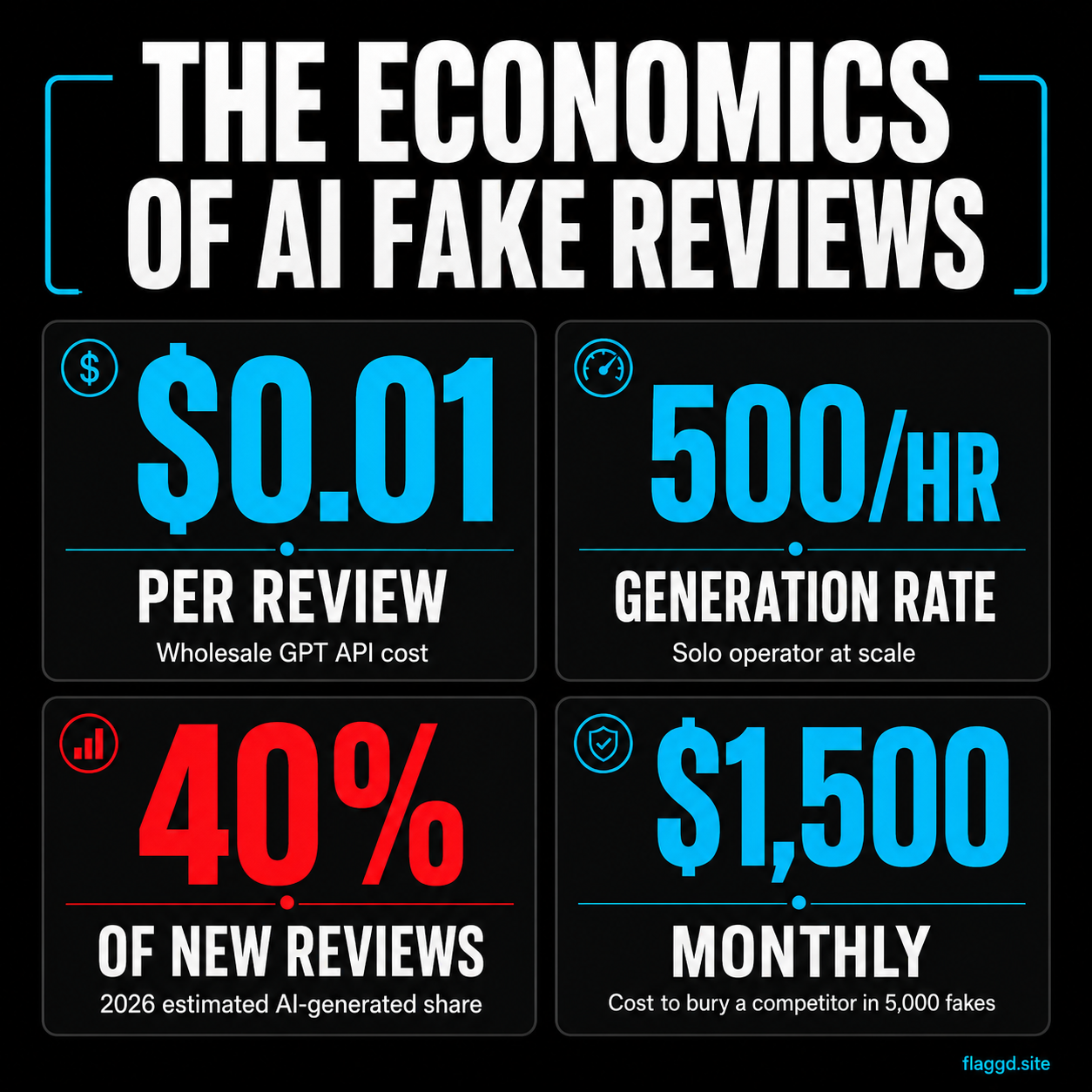
- AI-generated reviews now cost $0.01-$0.05 each — low enough for competitors to fund large-scale fake review campaigns targeting your business.
- Synthetic reviews have linguistic fingerprints: perfectionism (no typos), overuse of superlatives, unnatural balanced tone, generic descriptions, and repetitive phrases.
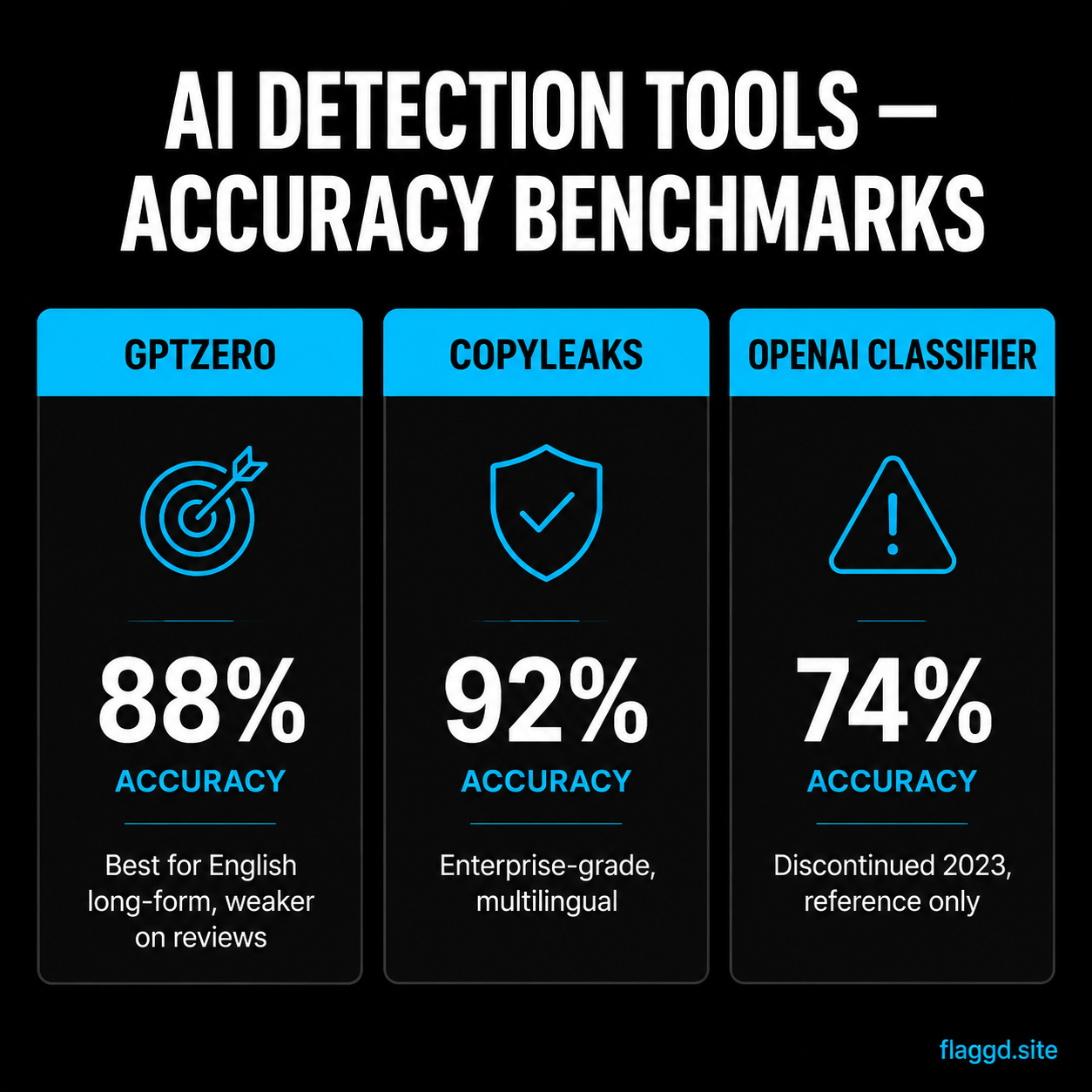
- Detection tools like OpenAI Classifier, Copyleaks, and GPTZero catch 70-85% of AI text — but manual linguistic analysis catches what automated tools miss.
- Timeline clustering reveals AI campaigns: dozens of reviews posted within hours indicates coordinated synthetic generation, not organic customer feedback.
- Google removes AI-generated reviews under 'fake content' policy — Flaggd can dispute them automatically with documentation of synthetic characteristics.
- The scale and cost of AI-generated review campaigns
- Linguistic fingerprints: how AI reviews betray themselves
- AI detection tools: OpenAI, Copyleaks, GPTZero, and beyond
- Manual detection: read-through techniques and red flags
- Pattern analysis: timeline clustering and anomaly detection
- Removing AI reviews from Google: the dispute process
- Monitoring and prevention: catch AI campaigns in real-time
AI-generated reviews are here. They are cheaper than human-written fake reviews, faster to produce, and increasingly difficult to distinguish from legitimate customer feedback. Six months ago, AI-generated text had detectable patterns — repetitive phrasing, awkward transitions, tell-tale formatting. Today, large language models like GPT-4 generate reviews so fluent that even trained eyes struggle to spot them. Yet synthetic reviews are not undetectable. They have linguistic fingerprints — measurable patterns in word choice, sentence structure, and emotional consistency that differ from human writing. Competitors who mass-produce fake reviews using AI also create timing patterns that cluster dozens of synthetic reviews within hours rather than the gradual accumulation of organic feedback. Detection requires a layered approach: automated tools to flag candidates, manual linguistic analysis to confirm, and pattern analysis to identify coordinated campaigns. This guide covers all three — the methods competitors use to generate fake reviews at scale, how to spot AI-written feedback using both detection tools and human judgment, and how to dispute and remove these reviews from Google.

The scale and cost of AI-generated review campaigns
The economics of fake reviews have shifted. Hiring a human to write a single fake review used to cost $2-$10, depending on the complexity and the platform. High-volume campaigns were expensive enough to limit them to well-funded competitors or businesses with significant margins. AI has inverted this equation. An API call to GPT-3.5 Turbo costs roughly $0.01 per 750 words. A typical review is 50-100 words. A competitor can now generate a 4-star review for a fraction of a penny — often quoted between $0.01 and $0.05 per review when using commercial APIs or free tier services.
This cost reduction removes the economic friction that once protected small and mid-sized businesses. A competitor can now fund a campaign of 1,000 fake reviews for $10-$50, post them across multiple accounts over a few hours, and potentially shift your Google rating from 4.6 to 3.8 before you wake up. The time to generate a campaign has collapsed to hours. A human reviewer writing 100 reviews would take days. An AI system can generate 100 reviews in seconds, thousands in minutes. The barrier to entry for review-based sabotage has become negligible.
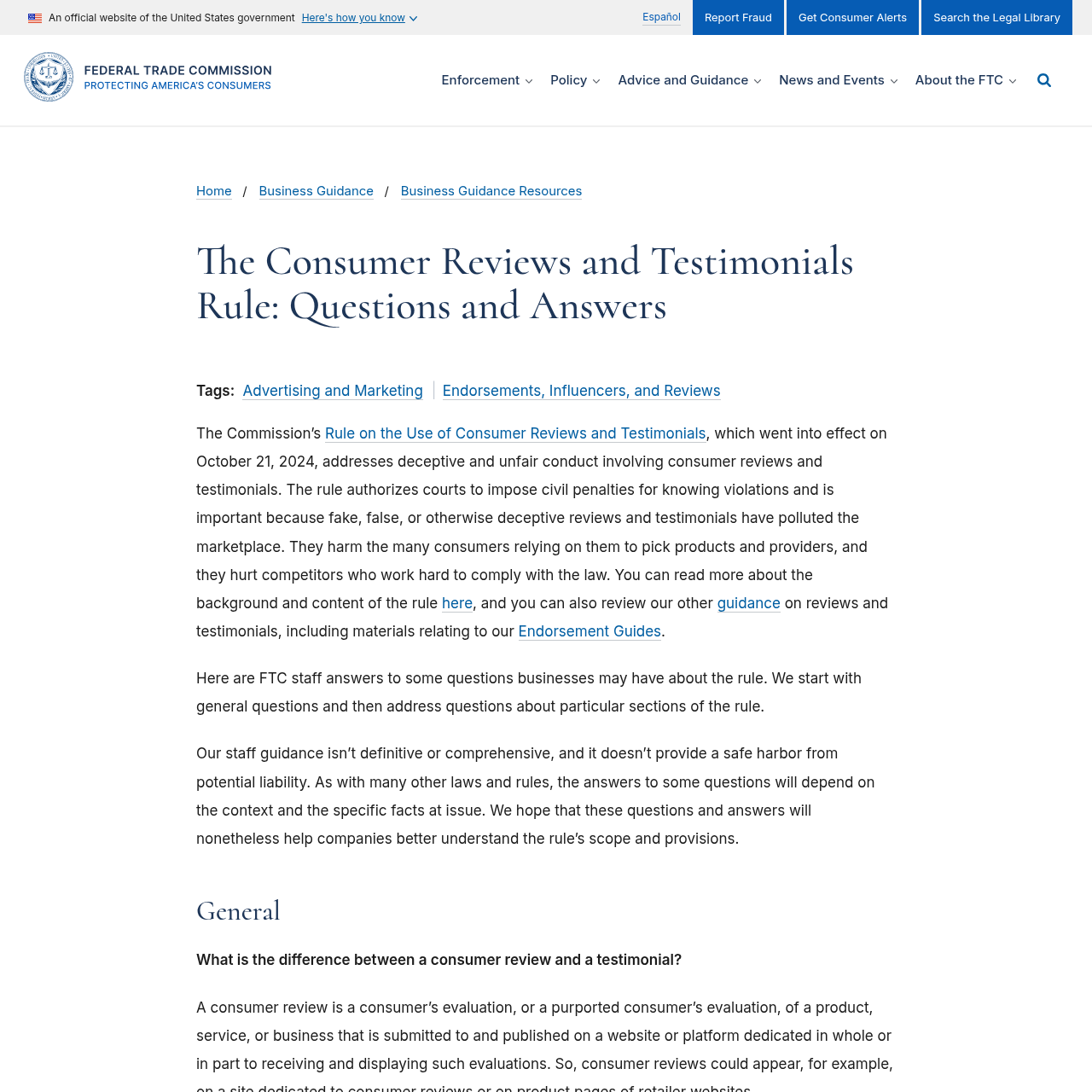
The attack surface is expanding as well. Competitors are not only generating negative reviews against your business — they are generating positive reviews for themselves. Because the same low-cost infrastructure generates both, a competitor can simultaneously damage your rating and boost their own. A business launching a new location or product can now seed its Google Business Profile with 500 "customer" reviews within 24 hours, creating the perception of an established, popular venue before a single real customer has walked through the door. The FTC's fake review rule (finalized August 2024) specifically targets this practice, but enforcement lags far behind the scale of AI-generated campaigns.
Linguistic fingerprints: how AI reviews betray themselves
Large language models generate text that matches human distribution in many ways. But they have characteristic biases — patterns that emerge across thousands of samples. These linguistic fingerprints are the earliest warning signs that a review is synthetic.
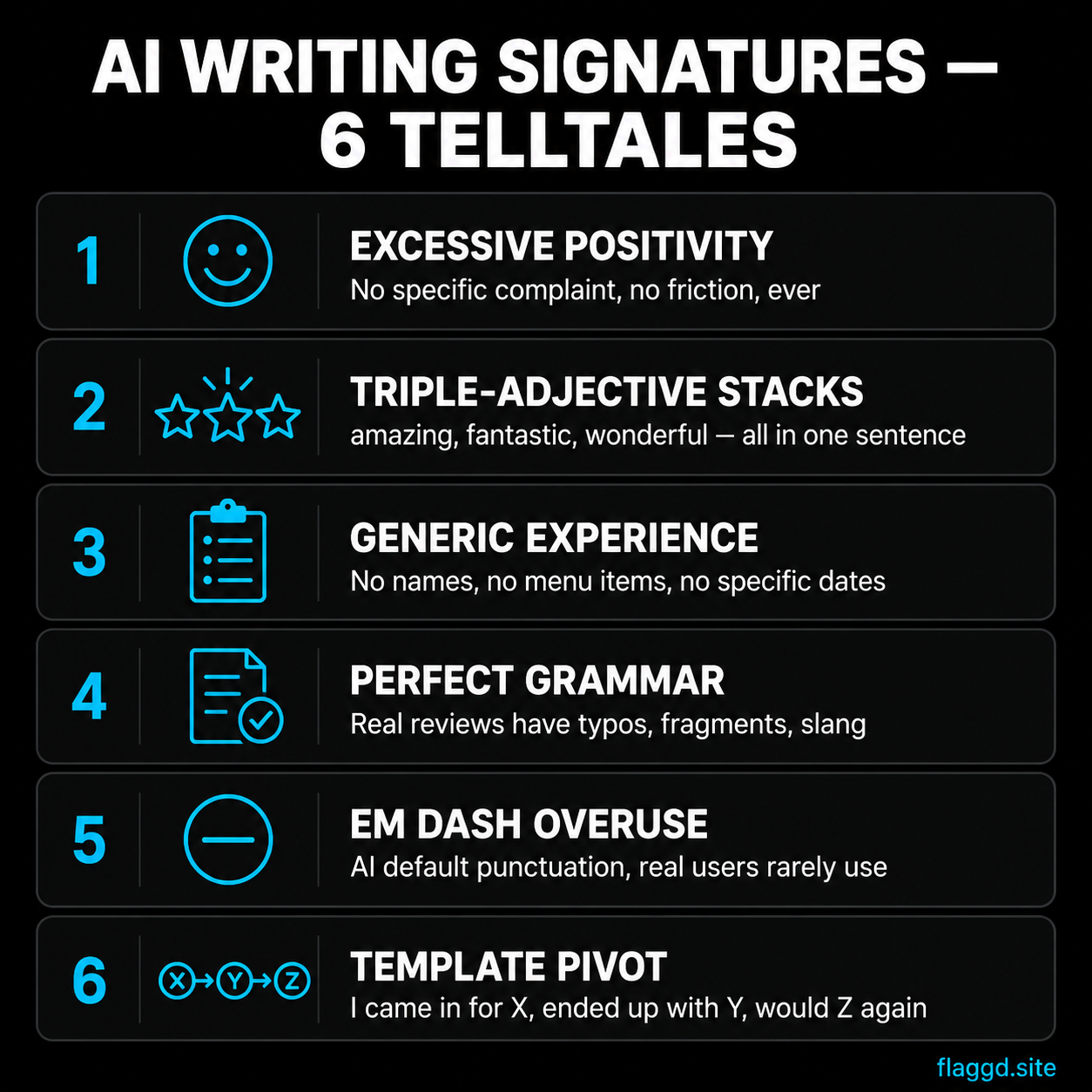
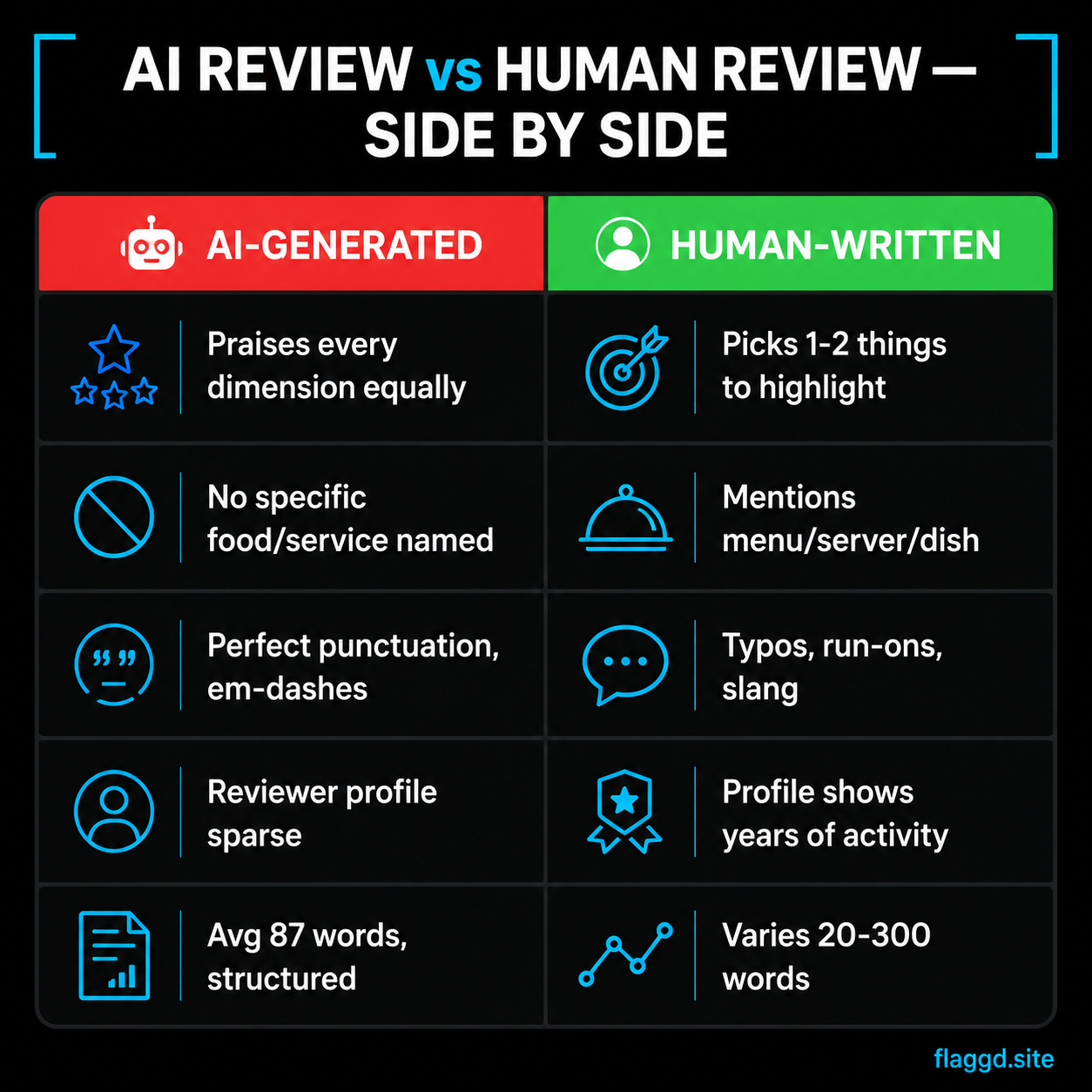
Perfectionism and the absence of typos. Real customer reviews contain typos, grammatical quirks, and spelling errors — especially in 1-star reviews written by angry customers typing quickly on mobile devices. They contain abbreviations ("u" instead of "you"), dropped letters ("recieved" instead of "received"), and run-on sentences. AI models are trained to correct these imperfections. When you ask an LLM to write a review, it generates grammatically flawless text by default. A 50-review sample where every single review is grammatically perfect, with no typos, no dropped words, and no autocorrect errors, is a red flag. Humans make mistakes. Perfect text is suspicious.
Overuse of specific superlatives and laudatory adjectives. AI models learn from human text and learn which words frequently appear in positive reviews. Words like "amazing," "exceptional," "wonderful," and "outstanding" appear in the training corpus because humans use them. But humans vary. Some use "great," others "perfect," others "fantastic." AI, when generating multiple reviews, defaults to the most common high-valence words. If you see the same superlative repeated across reviews from different accounts, with the same enthusiasm level, it is a marker of synthetic generation. Compare three reviews: "Amazing service, amazing food, amazing staff" (synthetic — repetition of a single high-impact word) versus "Great place, fantastic food, friendly people" (human — vocabulary variety).
Unnatural balance and tonal consistency across extreme ratings. Humans write 5-star reviews differently from 1-star reviews. A 5-star review is enthusiastic, energetic, uses exclamation marks. A 1-star review is angry, uses capitalization, questions why anyone would go there. A 3-star review is mixed — "the food was good but the service was slow." AI models, trained to produce polite text, often write even 1-star and 2-star reviews in a balanced, measured tone. An AI-written 1-star review might read: "While the restaurant has merit, the service did not meet expectations, and the pricing structure may not suit all customers." A human 1-star review reads: "Waited 45 minutes for food that was cold. Never again." The difference is tonal consistency — AI generates politeness at all rating levels, while humans inject emotion that matches the rating.
Generic descriptions without specific details. Human customers remember specific things: the server's name, the exact dish, the temperature of the food, the wait time in minutes. They reference specifics because they experienced them. AI models generate plausible-sounding generics: "The staff was courteous," "The ambiance was pleasant," "The food was prepared well." These descriptions could apply to any restaurant. A synthetic review often reads like a template: "Great place with wonderful service and delicious food. Highly recommend!" A human review reads: "Sarah made our drinks perfectly. The fish tacos were fresh, really hot salsa. Sat at the bar for 45 minutes and would wait longer to come back."
Repetitive transition phrases and structural patterns. When AI models generate multiple items in the same category, they often reuse structure. Multiple reviews from the same model might begin with "Upon visiting…" or end with "Would definitely recommend." When you see three reviews in a row that open with "Great experience at…" or close with "10/10, would return," you are likely seeing algorithmic generation. Human reviewers have diverse writing styles. Algorithmic generation has detectable structural repetition.
| Characteristic | AI-Generated (Synthetic) | Human-Written |
|---|---|---|
| Typos and grammar | Perfect, zero errors | Occasional typos, informal grammar |
| Superlative frequency | Repetitive (same words: "amazing," "exceptional") | Varied (great, fantastic, perfect, awesome) |
| Tone at different ratings | Balanced, polite at all ratings | Emotional match to rating (angry for 1-star) |
| Specific details | Generic ("great staff," "good food") | Specific (names, dishes, times, exact issues) |
| Transition phrases | Repetitive structure across reviews | Diverse opening/closing styles |
| Emoji usage | Absent or formulaic | Natural, varied (laughing, fire, thumbs up) |
| Sentence length variation | Uniform (similar lengths) | Variable (short, long, mixed) |
| Personal pronouns | Formal ("one," "the customer") | Natural ("I," "we," "my family") |
AI detection tools: OpenAI, Copyleaks, GPTZero, and beyond
Automated detection tools use natural language processing (NLP) and machine learning to analyze text and flag AI-generated content. No tool is perfect — accuracy ranges from 70-85% depending on the model used to generate the text and the length of the sample. But they are valuable as a first pass, identifying candidates that you then analyze manually.
OpenAI Classifier. OpenAI has released a free, web-based AI text classifier (classifier.openai.com). You paste text into the tool, and it returns a prediction: "likely written by AI" or "unclear/mixed." The tool is trained to detect text generated by large language models, particularly OpenAI models like GPT-3 and GPT-4. It is public and easy to use, but it has blind spots — it performs worse on shorter texts (reviews are typically under 200 words), and it struggles with text that has been edited or paraphrased after generation.
Copyleaks AI Detector. Copyleaks (copyleaks.com/ai-content-detector) is a commercial tool focused on plagiarism and AI detection. It accepts longer texts and provides a confidence percentage. Copyleaks claims 99% accuracy on longer documents but is less reliable on short reviews. The tool is free for limited use but requires a subscription for bulk analysis — useful if you are analyzing dozens of reviews daily.
GPTZero. GPTZero (gptzero.me) is designed specifically to detect GPT-generated text. It analyzes "perplexity" (how surprising the text is statistically) and "burstiness" (variation in word complexity). GPT-generated text tends to have lower perplexity and more uniform burstiness than human writing. GPTZero provides a visual analysis and a confidence score. It is free and user-friendly, though accuracy on short reviews varies.
Hugging Face detectors. The open-source machine learning community has released multiple detector models on Hugging Face, a hub for AI models. Models like "roberta-base-openai-detector" are free and can be integrated into automated review scanning systems. These tools are less polished than commercial tools but are more adaptable and often more accurate on newer AI models.
How to use these tools in practice. A systematic approach: run a suspicious review through OpenAI Classifier first (fast, free, public). If it flags the review as "likely AI," cross-check with Copyleaks or GPTZero. If multiple tools agree, the review is very likely synthetic. If tools disagree, move to manual linguistic analysis. For bulk review analysis (monitoring dozens of new reviews daily), a Hugging Face model integrated into your monitoring system is more efficient than manual checking.
Manual detection: read-through techniques and red flags
Tools are a starting point, but experienced human readers catch what algorithms miss. Manual detection is a learned skill — after analyzing hundreds of AI-generated reviews, you develop an intuition for the unnaturalness of synthetic text.
Read for personality and voice. Real reviews have a voice — a personality that emerges from the specific person writing. An honest review reveals something about the reviewer's priorities, expectations, humor. "Sarah was slow but charming — I didn't mind the wait" reveals a personality. "The staff was cordial and the service timely" is generic. Skim the review and ask: could I imagine the person who wrote this? If the answer is no, if the review could have been written by anyone about anything, it is likely synthetic.
Check for emotional authenticity. Emotions are messy and inconsistent in human writing. A 4-star review might complain about the price while praising the quality. A 5-star review might mention a minor flaw ("only took them 20 minutes, but usually it's faster"). Synthetic reviews are emotionally consistent — all positive reviews are entirely positive, all negative reviews are measured and polite. Look for emotional conflict and contradiction, which signal authenticity.
Spot generic transitions and boilerplate endings. "Overall, I highly recommend…" "In conclusion…" "Would definitely return…" If you see these phrases across multiple reviews, especially new ones, they are synthetic markers. Real reviews end abruptly ("Great food. Will come back.") or with a personal note ("My 6-year-old still won't stop talking about the ice cream sundae."). Boilerplate endings are algorithmic.
Look for unnatural perfection. Typos, informal grammar, text-speak, and abbreviations are authenticity markers. A review with zero errors, especially a 1-star review, is suspicious. Angry customers make mistakes. "Worst servis ever" is authentic. "Service fell below expectations" is suspicious.
Test for domain knowledge. If a review is about your restaurant, the reviewer should mention specifics only a real customer would know. "The salmon was perfectly done" could apply to any restaurant. "You changed the presentation of the salmon from the whole fillet to the sliced version, and I prefer the whole fillet" demonstrates real experience. Ask yourself: would someone who never visited know how to write this review? If the answer is yes, it is probably synthetic.
Pattern analysis: timeline clustering and anomaly detection
Individual review analysis catches some synthetic reviews, but coordinated campaigns are detected through pattern analysis across your entire review history. AI campaigns create statistical anomalies that humans rarely produce.
Timeline clustering. Human reviews arrive gradually. A business with 100 reviews might receive 2-5 reviews per week normally. An AI campaign generates dozens within hours. If your historical pattern is 3 reviews/week and suddenly you receive 40 reviews in 4 hours, all from new accounts, timeline clustering reveals the attack. Compare the distribution: natural reviews spread across days and weeks, synthetic campaigns spike and drop. This spike pattern is the clearest anomaly indicator.
Reviewer account profile clustering. Genuine customers have diverse account histories. Some have dozens of reviews across platforms, others have just one. Fake accounts created for a campaign often have identical patterns: all new (created within days of each other), all with 1-5 reviews, all reviewing multiple competing businesses. If 30 new accounts all created between May 1-3 all posted reviews of your business on May 5-6, they are likely part of a coordinated campaign.
Linguistic similarity clustering. Use a text similarity tool (cosine similarity via Python's scikit-learn, for example) to measure how alike your recent reviews are. Natural reviews have diversity — different customers, different writing styles. An AI campaign produces many reviews with high similarity scores (70-90% match). If 20 reviews from the past week are 75%+ similar to each other, they likely came from the same model.
Correlation with competitor activity. Analyze the timeline of your review surges against your competitors' activities. If you see a spike in negative reviews on the same day a competitor launches a new location or runs a promotional campaign, the timing suggests deliberate sabotage. This is not definitive proof, but combined with linguistic analysis and timing clustering, it strengthens the case that an attack occurred.
| Pattern Type | Natural Baseline | AI Campaign Signature |
|---|---|---|
| Review arrival timing | 2-5 reviews/week, gradual | 40+ reviews in 4 hours, spike/drop pattern |
| Reviewer account age | Mixed: old and new accounts | Clustered: all created within days, all new |
| Review count per account | Varied: 1, 5, 50, 200+ reviews | Uniform: mostly 1-3 reviews each |
| Text similarity across reviews | Low (30-50% match) | High (75-90% match) |
| Rating distribution | Natural bell curve (some 4, some 5, some 2) | Skewed: all 1-star or all 5-star in surge |
| Competitor correlation | No clear temporal link | Spike on same day as competitor event/launch |
Removing AI reviews from Google: the dispute process
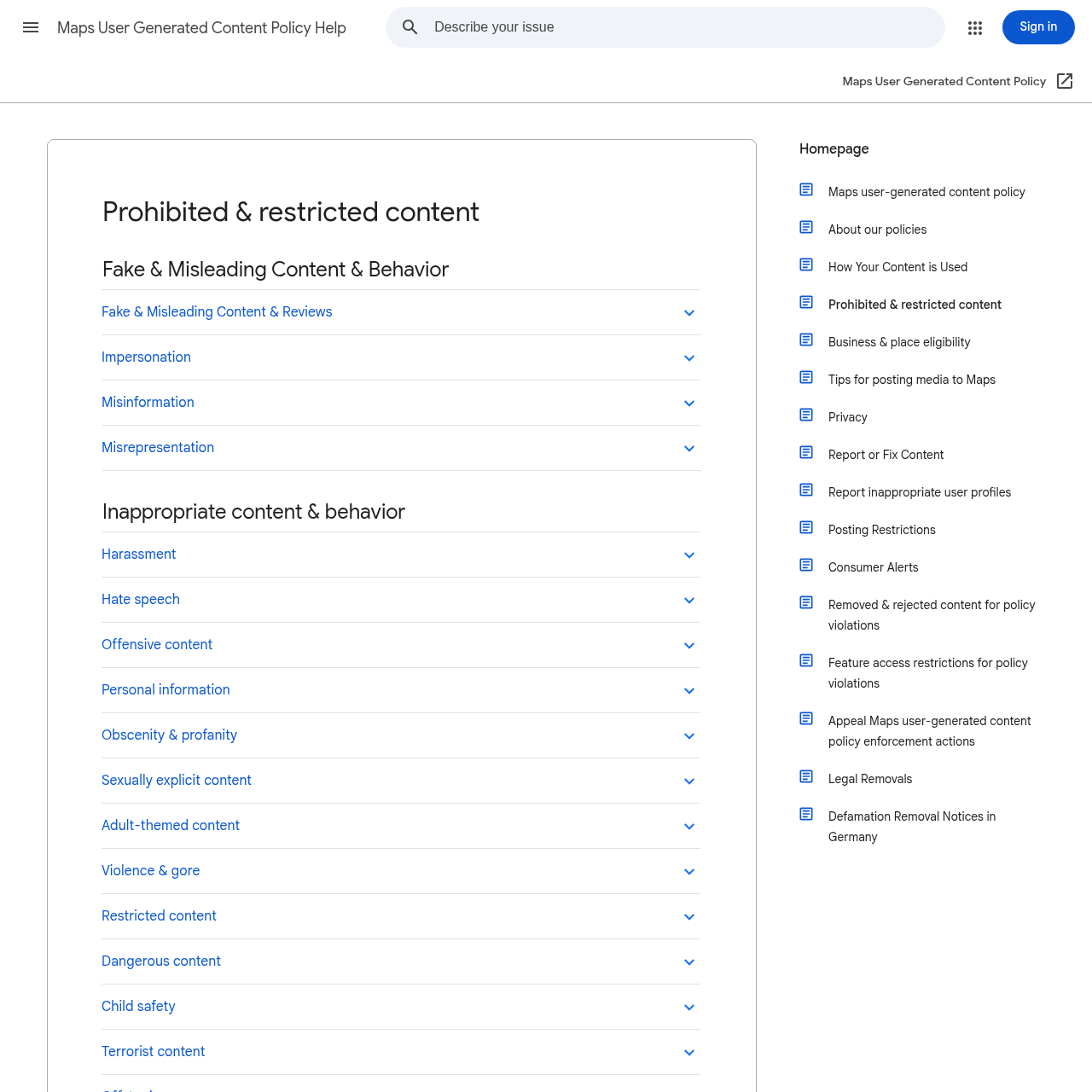
Google's content policy explicitly prohibits "fake or fraudulent content" in reviews. AI-generated reviews fall into this category — they are synthetic, not written by actual customers, and thus violate Google's policy. When you have strong evidence that a review is AI-generated, you can dispute it through Google's official reporting process.
Documentation is critical. Google wants evidence, not accusations. Effective disputes include: screenshots of the review and account history (created date, review count, suspicious account patterns), results from multiple AI detection tools (OpenAI Classifier and Copyleaks showing "likely AI"), analysis of linguistic red flags (superlative repetition, generic descriptions, perfect grammar), timeline analysis showing the review arrived as part of a cluster, and correlation with competitor activity if applicable. The more comprehensive your documentation, the higher the removal likelihood.
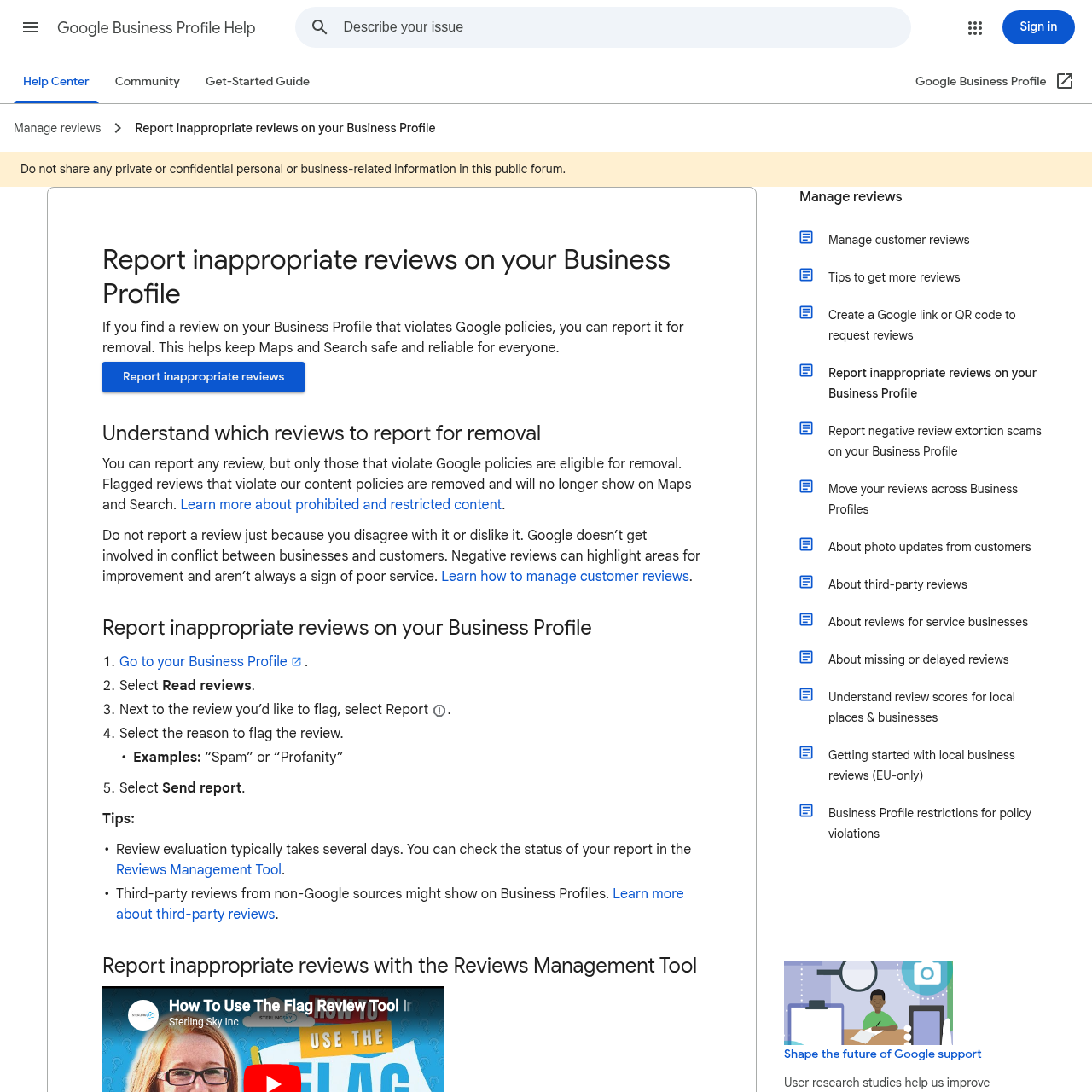
The dispute workflow. On your Google Business Profile, locate the review you want to dispute. Click the three-dot menu and select "Flag as inappropriate." Google provides predefined categories. Select "It's fake or fraudulent" and provide a detailed explanation in the text field. Include references to your documentation: "This review was generated by an AI language model, as confirmed by OpenAI Classifier and Copyleaks analysis. See attached documentation." Google reviews disputes manually, typically within 7 days. Removal is not guaranteed, but well-documented disputes citing specific tools and red flags have higher success rates.
Flaggd's approach. Professional review removal services like Flaggd handle this documentation and dispute process at scale. When monitoring a business for AI-generated reviews, Flaggd identifies candidates (clustering analysis, timeline spikes), confirms them with detection tools, documents the evidence, and files disputes through Google's official channels on your behalf. This is fully compliant with both Google's policies and the FTC's fake review rule — no suppression, no undisclosed activity, just policy enforcement through official reporting.
Monitoring and prevention: catch AI campaigns in real-time
Prevention is superior to remediation. Real-time monitoring catches AI review campaigns before they damage your rating significantly, allowing immediate disputes and removal.
Continuous review monitoring services. These tools track all new reviews posted to your Google Business Profile, analyze each one for linguistic red flags and AI probability, flag suspicious clusters automatically, and alert you when a campaign surge is detected. Services like Flaggd run monitoring 24/7, so you are alerted in hours, not days, when an attack begins. Early response dramatically improves removal rates because Google reviews newer content more strictly.
Competitor tracking. Monitor your competitors' review velocity and timing. If a competitor suddenly receives a cluster of positive reviews, they may be running an AI campaign against you next, or they have already launched it and you are in the response phase. Awareness of competitor activity gives you strategic advantage — you can preemptively harden your account (monitor more closely) and prepare documentation in case an attack comes.
Internal review workflows. Create a review response process that includes AI detection as a first step. When a negative review appears, before you respond, run it through an AI detector. If it is likely synthetic, flag and document it immediately rather than engaging with it as a real complaint. This prevents waste of your team's emotional energy on responses to fake reviews and allows you to focus on actual customer concerns.
Building resilience. The strongest defense against AI review campaigns is a consistent flow of genuine positive reviews. Businesses with a history of real, diverse reviews are less vulnerable because a sudden cluster of similar-sounding AI reviews is immediately anomalous. Encourage authentic customer reviews through post-service email requests, QR codes at point of sale, and follow-up surveys. When your baseline is solid, a synthetic campaign stands out, and Google's algorithms are more likely to flag it automatically.
- →AI-generated fake reviews: threat to local businesses
- →How to remove fake Google reviews: step-by-step guide
- →How AI is changing Google review moderation in 2026
- →What percentage of Google reviews are fake?
- →Competitor sabotage: detecting and stopping fake review attacks
- →FTC crackdown on fake reviews: what it means for businesses
Frequently asked questions
AI-generated reviews are a new category of threat to your online reputation, but they are also the most detectable form of fake review — they have linguistic fingerprints, temporal patterns, and account anomalies that distinguish them from human writing. The tools to detect them exist (OpenAI Classifier, Copyleaks, GPTZero, manual linguistic analysis). The patterns that reveal campaigns exist (timeline clustering, account profiles, text similarity). Google's policy explicitly prohibits synthetic content and provides a formal dispute process. The businesses that thrive in this environment are the ones that monitor continuously, document systematically, and respond quickly. A single AI-generated review can be dismissed. A coordinated campaign detected and documented within 24 hours can be removed before it meaningfully damages your rating. Prevention through continuous monitoring and rapid response is your strongest defense against AI-based review sabotage.