Key Takeaways
- Google review extortion is a federal crime. Threatening to post fake reviews unless payment or demands are met violates extortion, mail fraud, wire fraud, and computer fraud statutes with prison and fine penalties.
- Never pay an extortionist. Payment confirms you will comply under pressure, triggers repeated demands, and may implicate you in obstruction of justice if federal charges are filed.
- Act within 24 hours. Document all threats and communications, notify Google immediately, and file an FBI Internet Crime Complaint Center (IC3) report. Time is critical to establishing evidence.
- 34% of SMBs report extortion threats in 2026. Review extortion is not rare — it is a growing attack vector targeting service businesses, medical practices, restaurants, and e-commerce companies.
- Recovery takes 30-90 days. Dispute removal takes 30-60 days; reputation recovery with positive reviews and professional responses typically takes 2-4 weeks to show measurable improvement.
- What is review extortion and how does it work?
- Extortion patterns and tactics businesses face
- Legal framework: extortion, fraud, and Google's policies
- Immediate response protocol: first 24 hours
- Google removal process during extortion
- Law enforcement reporting and FBI procedures
- Post-extortion recovery and reputation rebuilding
Your phone pings. An unfamiliar email lands in your inbox. The message is direct and alarming: "Your Google rating is about to drop to 1 star unless you pay $500. You have 24 hours." Or: "Remove this review and pay me $1,000, or I'm posting 20 more fake reviews tomorrow." This is Google review extortion — a federal crime that an estimated 34% of small-to-medium-sized businesses in 2026 have received at least one threat of. It is not a negotiation. It is not a customer complaint. It is extortion, and your response in the first 24 hours will determine whether you become a repeated target or cut off the threat at the source.

This guide walks you through every phase: recognizing an extortion threat versus a legitimate complaint, the exact steps to take in the first 24 hours, how to file disputes through Google, how to report to the FBI and local law enforcement, and how to rebuild your reputation after an attack. Review extortion is prosecuted under federal statutes with serious penalties — prison time and fines — which means law enforcement takes these threats seriously if you do first.
What is review extortion and how does it work?
Review extortion is the threat to post fake negative reviews, flood a business listing with 1-star ratings, or damage a company's online reputation unless money is paid or demands are met. The threat is deliberate, the intent is financial gain or leverage, and the mechanism is Google Reviews or other major platforms.
The crime is not the posting of fake reviews itself — although that is separately illegal under the FTC's fake review rule and Google's content policies. The crime is the threat combined with the demand. The moment someone sends a message saying "I will post fake reviews unless you pay me," they have committed extortion. Whether they actually post the reviews afterward does not change the fact that extortion occurred.
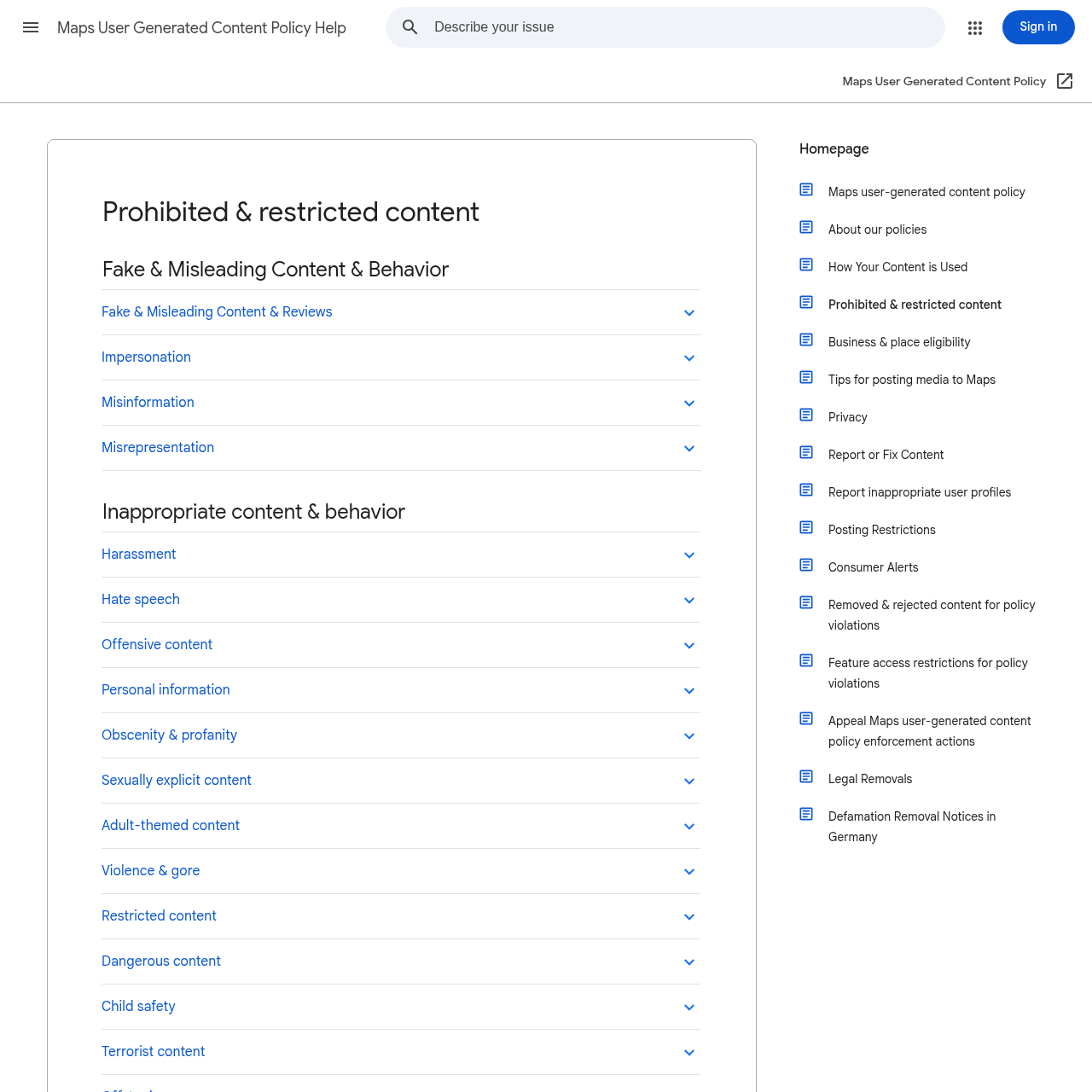
Extortion differs fundamentally from a legitimate customer complaint. A real negative review, even a harsh one, is an honest expression of a customer's experience. An extortion threat is a demand for payment backed by a threat to damage your reputation. The distinction is clear: if someone is offering to remove their complaint, refrain from posting negative content, or prevent future posting — in exchange for money — it is extortion, not a dispute.
In 2026, review extortion has become a recognized attack vector targeting businesses with high reliance on online reputation: restaurants and hospitality, medical and dental practices, e-commerce sellers, contractors and home services, and professional services. The attacks are sometimes random (criminals mass-mail threats to thousands of businesses with small success rates), and sometimes targeted (competitors, former employees, or individuals with specific grievances). Regardless of origin, the legal response is identical — extortion is extortion.
Extortion patterns and tactics businesses face
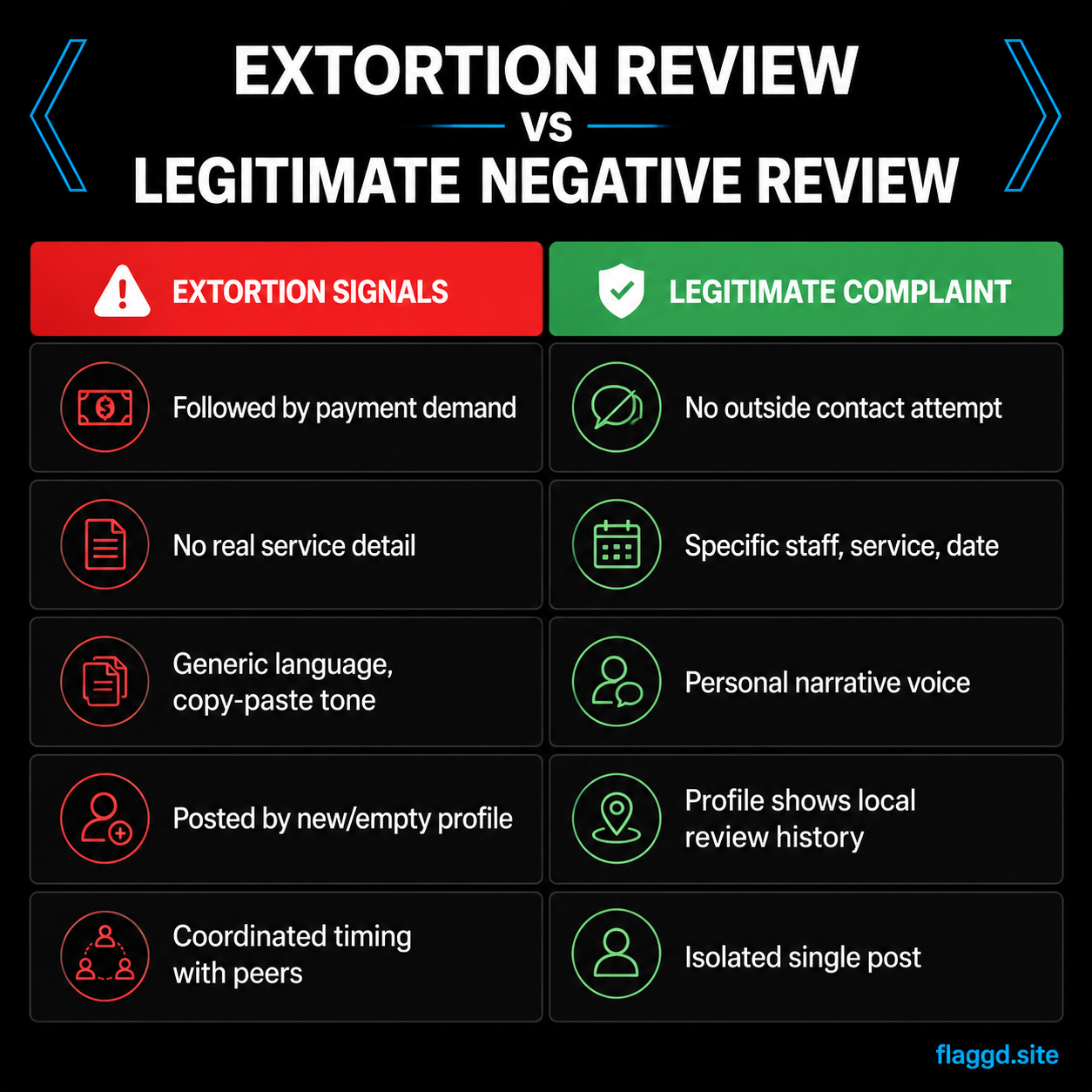
Extortion threats arrive in recognizable patterns. Understanding these patterns helps you distinguish a real threat from a frustrated customer complaint.
1-star flood threats. "I have 50 accounts ready to post 1-star reviews to your Google listing unless you pay me $2,000." The threat specifies a volume of fake reviews and a payment demand. The sender claims access to networks of fake accounts or coordinated reviewers. This is often a bluff — many extortionists lack the capacity to follow through — but the threat itself is prosecutable regardless of capability.
Removal threats. "Remove the negative review I left and pay me $500, or I am posting 20 more." The extortionist claims they posted the original negative review themselves and is leveraging it to demand payment. This variant suggests some level of insider knowledge or actual transaction history, though not always. The demand combines review removal with payment — a dead giveaway for extortion.
Blackmail and defamation threats. "I know dirt on your business. Pay me $5,000 or I am posting reviews claiming you committed fraud, had a data breach, or were sued." This variant threatens not just a review flood but false claims designed to maximize reputational damage. The threat includes false factual statements, making it both extortion and defamation.
Coordinated attack threats. "Multiple people are going to post coordinated reviews tomorrow complaining about the same issue. Here is a preview of what they will say. Pay me or it happens." The threat includes sample reviews showing coordination and planning. The sender may or may not execute the attack, but the threat of coordinated inauthentic behavior is itself extortion.
AI-generated review threats. "I can use AI to generate 100 reviews indistinguishable from real customer accounts. Pay me $10,000 or these go live on your Google listing." This newer variant leverages AI and deepfakes to make threats feel more credible. The extortionist claims technological capability to evade detection, though Google's detection systems continue to improve.
| Signal | Extortion threat | Legitimate complaint |
|---|---|---|
| Message channel | Email, text, social media DM — outside official channels | Google Business Profile, email from a known customer, direct conversation |
| Explicit payment demand | Yes — "pay $X or reviews will be posted" | No — customer wants refund or service resolution, not payment to avoid reviews |
| Threat to remove existing review | Extortionist offers to remove review they claim to have posted in exchange for payment | Customer discusses resolution to the underlying issue (refund, fix problem) — not review removal |
| Tone | Threatening, urgent, impersonal, generic language ("your business") | Frustrated but describing specific incident, personal, refers to specific transaction or service |
| Deadline | Urgent, artificial — "24 hours or this happens" | None or flexible — customer wants resolution, not racing against clock |
| Proof of capability | Vague claims ("50 accounts ready", "AI-generated reviews") — no proof provided | Specific facts about transaction or service — demonstrable experience with your business |
| Logic | Illogical — payment goes to unknown party with no accountability | Logical — customer seeks specific outcome tied to their issue |
Legal framework: extortion, fraud, and Google's policies
Review extortion is prosecuted under multiple overlapping federal and state statutes, each targeting different aspects of the threat or the underlying conduct.
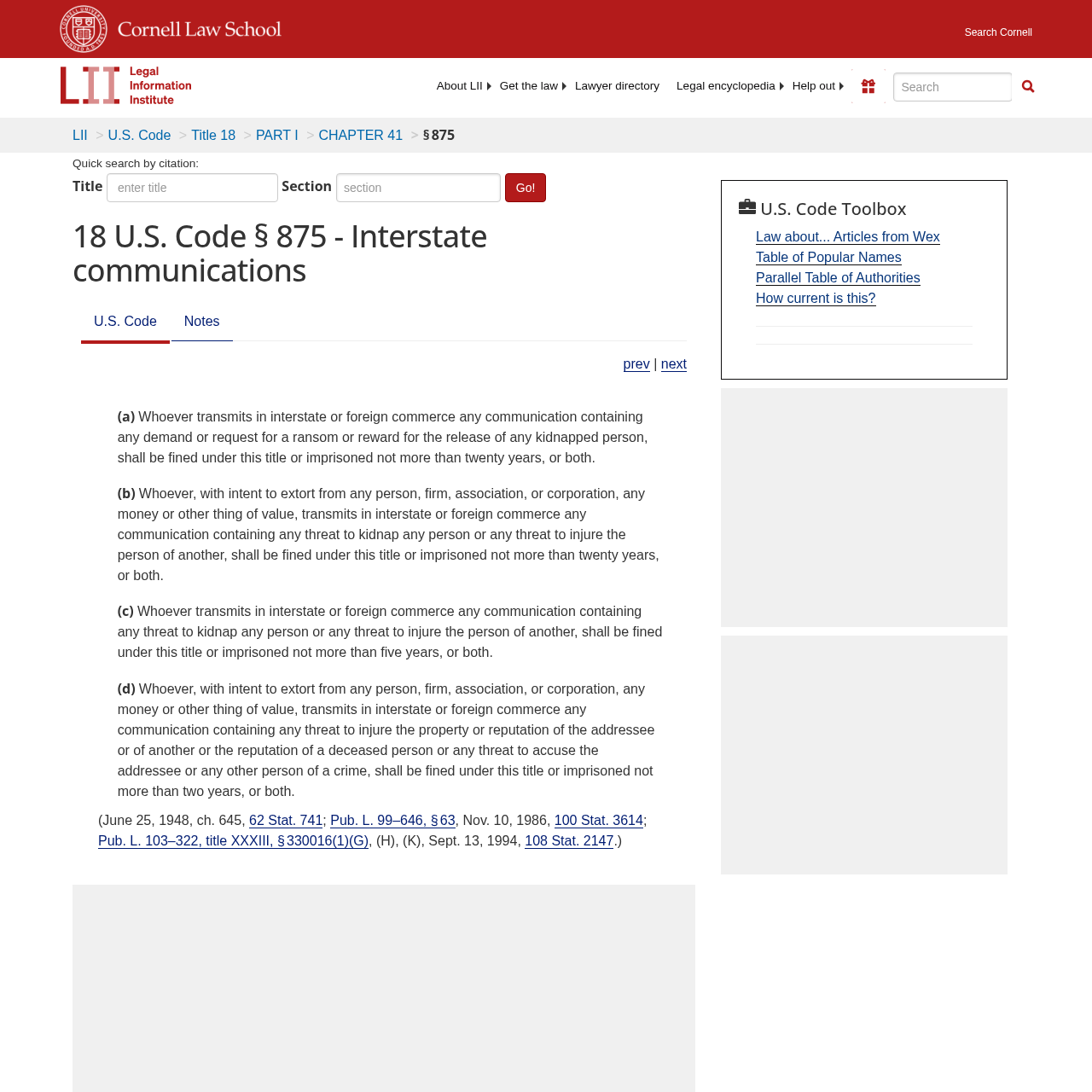
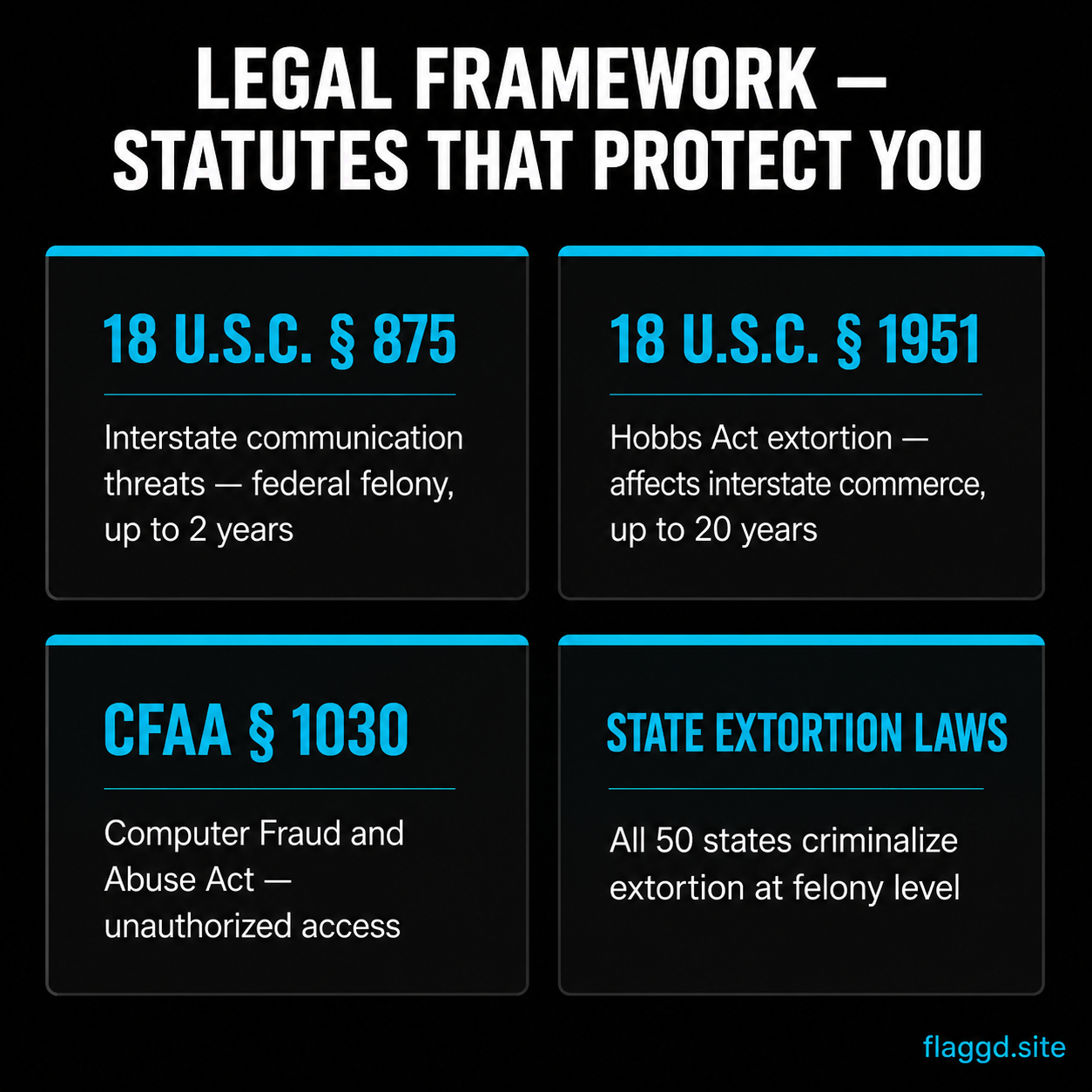
Federal extortion (18 U.S.C. § 875). This statute makes it illegal to transmit a threat to injure someone or damage their property, reputation, or business, made with intent to extort money or other things of value. The threat does not have to be carried out. The statute applies to threats transmitted by mail, phone, email, or any interstate communication. Penalties include up to 20 years in federal prison and substantial fines.
Mail fraud (18 U.S.C. § 1341). When extortion threats are sent via email or any electronic communication traveling through interstate networks, mail fraud applies. The defendant knowingly devises a scheme to defraud or obtain money by false pretenses using the mails. Penalties: up to 20 years and fines up to $1 million.
Wire fraud (18 U.S.C. § 1343). Similar to mail fraud but applies to any use of interstate wire communications — email, text, phone calls, social media. An interstate extortion threat sent by email is nearly always wire fraud. Penalties: up to 20 years and fines up to $1 million.
Computer Fraud and Abuse Act (18 U.S.C. § 1030). When extortion involves unauthorized access to computer systems, compromised accounts, or threats to interfere with computer access, the CFAA applies. For example, if an extortionist threatens to hack your Google Business account, the CFAA applies. Penalties: up to 10 years in federal prison.
State extortion statutes. Most states have their own extortion laws that mirror federal law. Some states allow for state prosecution even when federal charges apply. State penalties vary but typically include prison terms and fines.
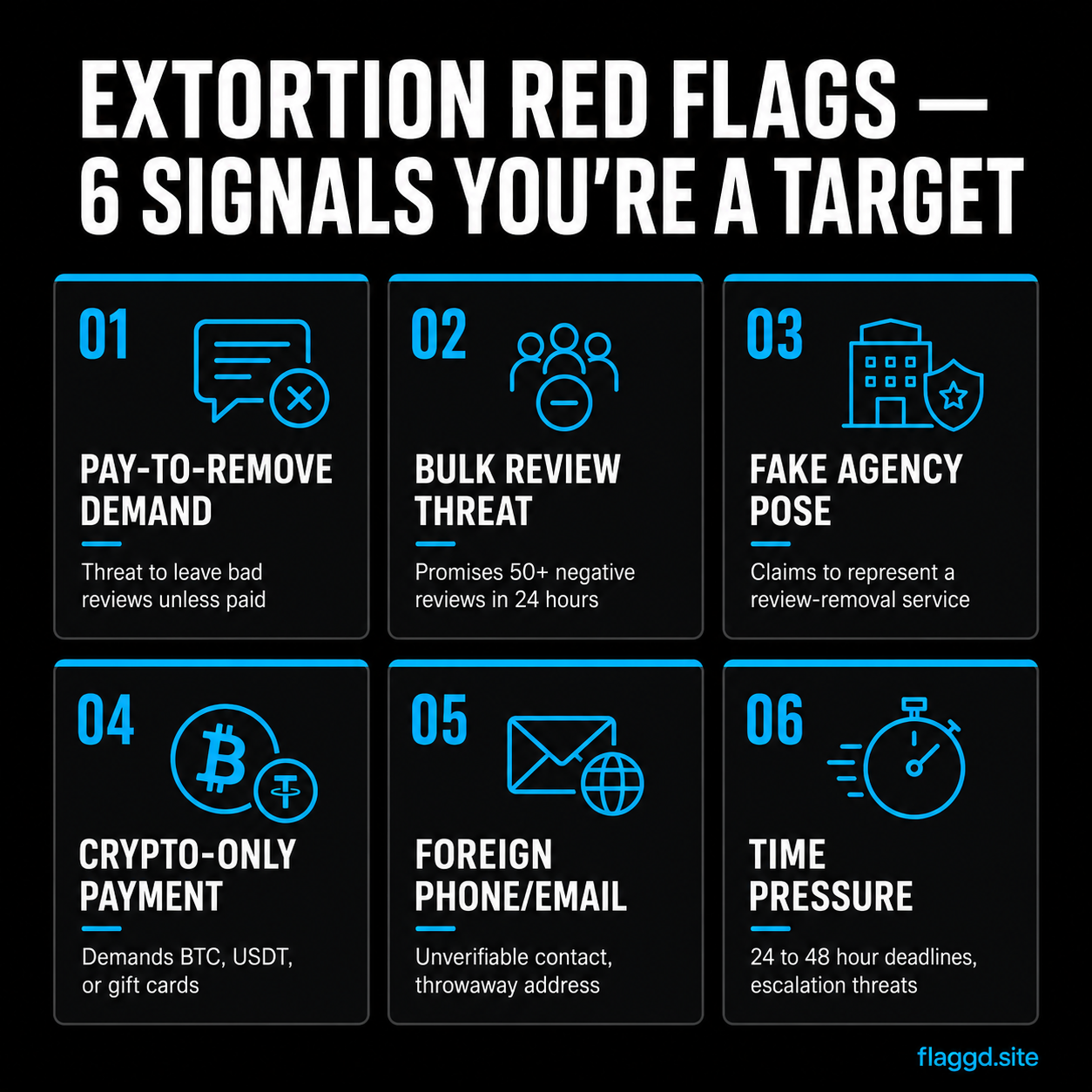
Google's content policies. Google prohibits fake reviews and reviews posted as part of coordinated inauthentic behavior or extortion schemes. If you receive an extortion threat followed by fake reviews, those reviews independently violate Google's content policy and can be removed through the dispute process. Google's policy operates independently of criminal law — removal is not a criminal matter, it is a content enforcement matter.
FTC fake review rule (August 2024). The extortion of fake reviews is separately prohibited under the FTC's fake review rule. If an extortionist actually posts fake reviews as threatened, those reviews violate the FTC rule as well as Google's policy.
Immediate response protocol: first 24 hours
The first 24 hours after receiving an extortion threat are critical. Your actions during this window will determine the strength of your evidence, your credibility with law enforcement, and whether you become a repeated target.
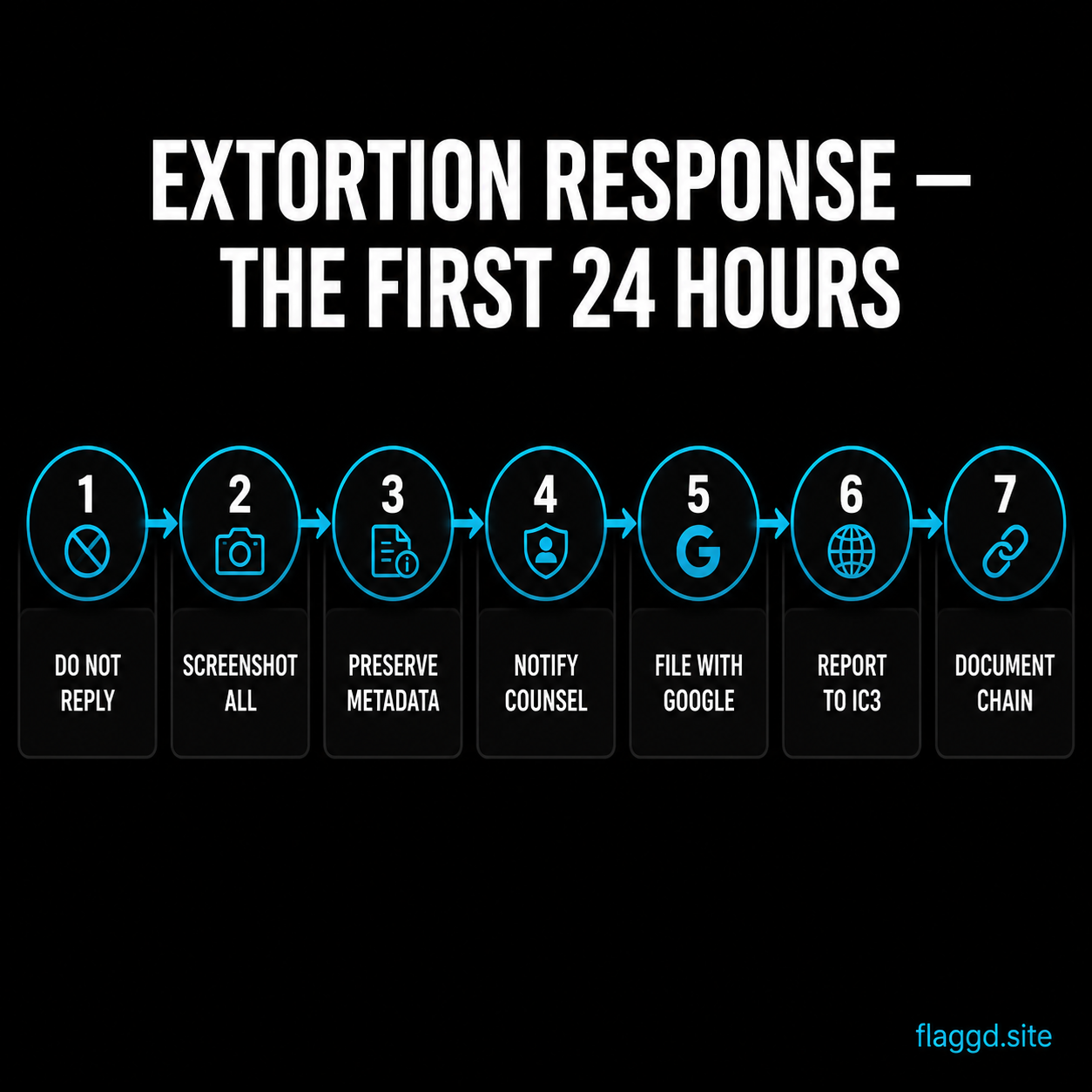
Step 1: Document everything immediately. Preserve every communication. Take screenshots of emails, texts, social media messages, and any direct communications. Include full headers in email screenshots (sender, recipient, date, time). Save original email files if possible. Do not delete anything, even if it seems minor. Note the date, time, and channel of each message. If the threat came via phone call, document the number, time, and what was said as soon as the call ends.
Step 2: Do not pay and do not negotiate. Paying an extortionist confirms you will comply under pressure. It signals that the threat worked, inviting repeated demands. It also creates legal exposure — you may be seen as complicit in fraud or obstruction. Do not respond to the threat unless you are acknowledging it for documentation purposes. Do not offer a partial payment or ask for an extension. The only appropriate response is silence until you have reported it to authorities.
Step 3: Notify Google immediately. Log into your Google Business Profile. If you have not yet received fake reviews, report the threat to Google through their support channels and flag your account as under attack. If you have received fake reviews coinciding with the threat, flag each fake review as violating content policy and submit a detailed report citing the extortion threat as context. Be specific: provide the date of the threat, the channel (email, text, etc.), and the payment demand.
Step 4: File an FBI Internet Crime Complaint Center (IC3) report. Go to ic3.gov and complete a complaint form. Include all documentation: threat messages, sender details, payment instructions if provided, timeline of events. The IC3 is the federal repository for cybercrime complaints and extortion reports. Filing creates an official record that law enforcement can access. Expect a confirmation number and a reference ID — save these.
Step 5: Contact local law enforcement. File a report with your local police department. Provide all documentation. Ask for a report number. This creates a local record that your state attorney general's office can see. Some local jurisdictions have cybercrime units — ask if yours does.
Step 6: Consider contacting your state attorney general. Many state attorneys general have consumer protection divisions that track extortion complaints. Reporting to your state AG adds another layer of official record and may contribute to investigation of coordinated extortion campaigns targeting multiple businesses.
Step 7: Consult with an attorney. Contact a lawyer experienced in extortion, federal crimes, or business litigation. An attorney can advise you on state law, help you understand your options, and coordinate with law enforcement on your behalf. Many attorneys offer free initial consultations.
Google removal process during extortion
If fake reviews appear on your Google Business Profile coinciding with an extortion threat, Google's removal process becomes your primary tool for immediate relief. This process operates independently of law enforcement — it can happen in parallel with your FBI report and does not require police involvement to succeed.
Identifying fake reviews posted as extortion. Reviews posted as part of an extortion attack often share characteristics: they appear in clusters (multiple posted within hours), they use similar language or point to the same issue, they come from new accounts with no other reviews, and they contradict your actual customer base. Compare the extortion threat (if it included sample content) with the reviews that appeared — exact matches are common. Document these correlations.
Filing disputes through Google Business Profile. Log into your Google Business Profile. For each fake review: click "Flag as inappropriate," select the reason (fake review, spam, or off-topic), and in the description field, include context: "This review is part of an extortion campaign. I received a threat on [date] demanding payment in exchange for not posting negative reviews. Here is the threat [include screenshot or description]. This review matches the threat." Be specific about the extortion threat and its timing relative to the review appearing.
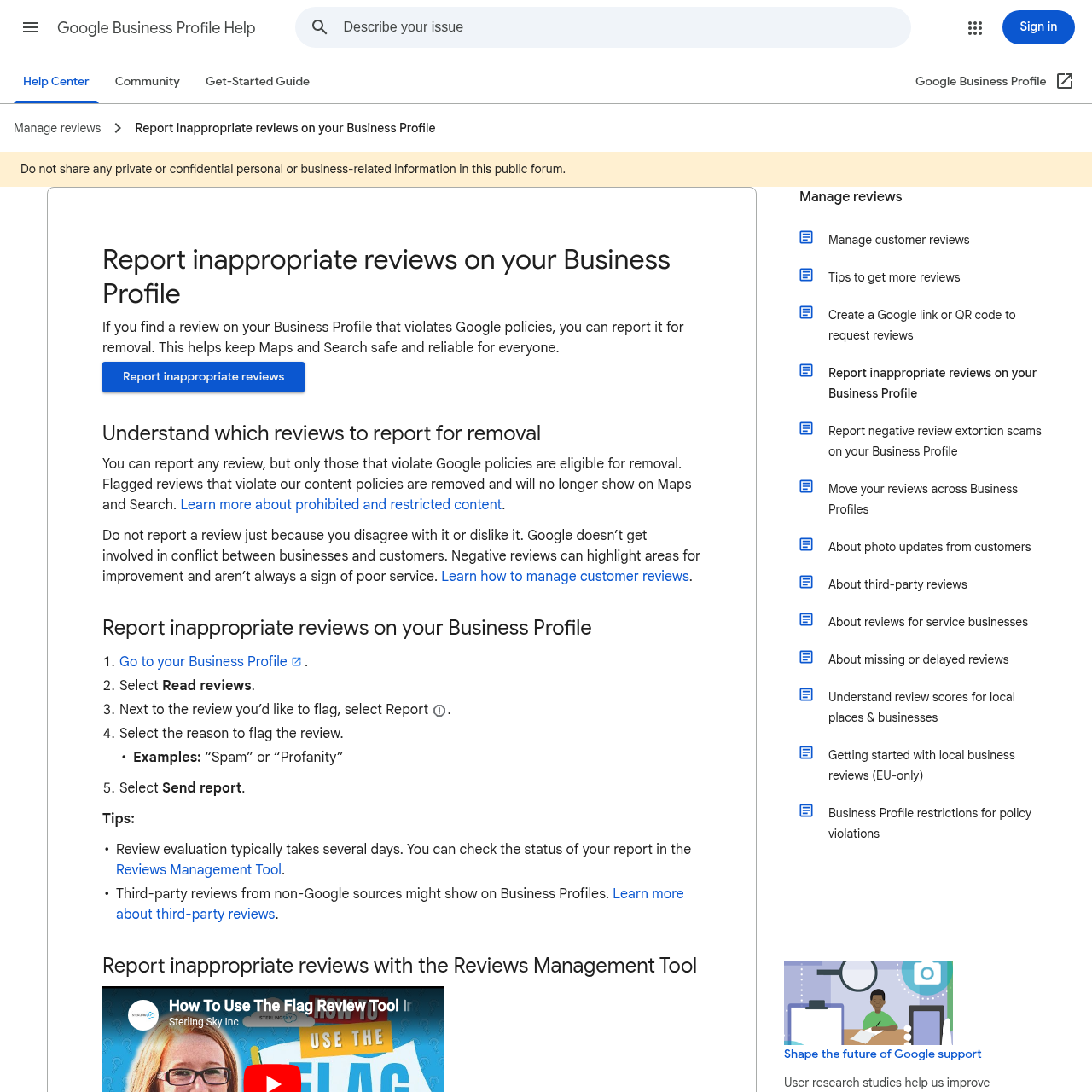
Evidence collection and documentation. Google's review moderators evaluate disputes based on content policy violations. Provide evidence that supports the policy violation: if the review is clearly fake (no transaction history, off-topic content, matches other reviews exactly), state this in your dispute. Screenshots of the extortion threat help but are not required — the review itself being obviously fake is often sufficient. Some businesses keep records of all customer transactions to prove that a reviewer had no business with them.
Timeline expectations for Google removal. Google does not publish removal timelines, but typical resolution for clear policy violations is 30-60 days. Some reviews are removed within 7-14 days if the violation is obvious. During this window, do not delete your dispute or resubmit it multiple times — this can slow the process. Google tracks all submissions, and resubmitting the same dispute multiple times may be flagged as spam.
What to do if Google denies your removal request. If Google declines to remove a review, you have options: appeal the decision (request a manual review), consult with a professional review management service that can file more detailed disputes, or explore legal action if the review contains false statements of fact rising to defamation. The fact that Google declined removal does not mean the review is legitimate — it means Google's moderators did not find a clear policy violation. This is where legal counsel becomes valuable.
Parallel professional dispute filing. Many businesses hire professional review management services like Flaggd during an extortion attack to maximize removal success. These services file detailed disputes emphasizing policy violations and can appeal Google's decisions more effectively than individual owners can. Using a professional service is fully legal and does not violate any policies.
Law enforcement reporting and FBI procedures
Law enforcement investigation of extortion is taken seriously. The FBI, local police, and state attorneys general have tracked review extortion campaigns and have investigated and prosecuted cases. Understanding how to effectively report to law enforcement maximizes the likelihood of investigation.
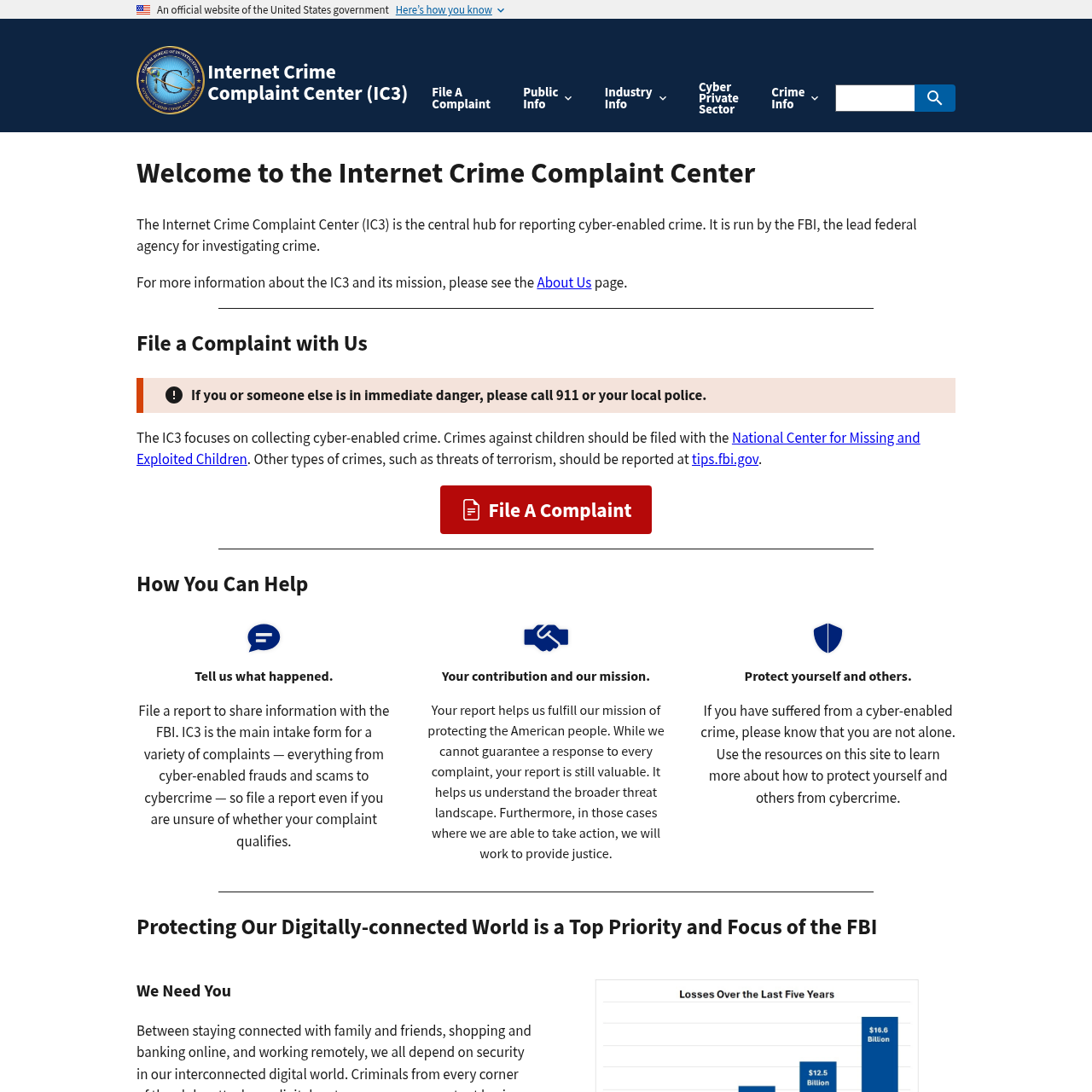
FBI Internet Crime Complaint Center (IC3). The IC3 (ic3.gov) is the federal repository for cybercrime complaints, including extortion. It is operated by the FBI and the National White Collar Crime Center. Filing a complaint takes 20-30 minutes and requires: your business and personal information, detailed description of the threat, copies of all communications (screenshots or attachments), date and time of threat(s), payment demand amount, communication channels used, and any identifying information about the threat maker. The IC3 provides a confirmation number. Law enforcement agencies check IC3 database regularly to identify patterns and coordinate investigations.
Local police and state law enforcement. File a report with your local police department. Many jurisdictions have dedicated cybercrime units or high-tech crime task forces. Provide the same documentation as you would to the FBI: threat messages, sender details, timeline, and evidence of payment demands. Ask for a case number and the investigating officer's contact information. Your state attorney general's office typically coordinates with local police on business-facing crimes — some state AGs have dedicated extortion hotlines.
FBI field offices. If the threat is serious (large payment demand, credible execution, targeted harassment), contact your local FBI field office directly. The FBI maintains field offices in all 50 states. You can find yours at fbi.gov. Call the main office number and ask to speak with the white-collar crime unit, cybercrime unit, or extortion task force. Have your IC3 confirmation number ready. The FBI prioritizes extortion cases — if the threat is credible and involves interstate communication (which email automatically does), the FBI will consider opening an investigation.
Working with law enforcement as a business owner. After you file reports, law enforcement may contact you. Be responsive. Provide any new information or communications. Do not take independent action that could compromise an investigation — for example, do not attempt to trace the threat maker yourself or communicate with them once law enforcement is involved. If law enforcement asks you to take a specific action or avoid an action, follow their guidance. Some investigations require business owners to maintain normal appearance and not publicly acknowledge the threat until law enforcement says it is safe to do so.
Multi-jurisdiction coordination. Review extortion often involves threat makers in one state targeting businesses in another, or using email providers and payment systems that cross state and international lines. Federal investigators coordinate across jurisdictions. This is why federal statutes (mail fraud, wire fraud, extortion) apply — they were designed to handle crimes that cross state boundaries.
Post-extortion recovery and reputation rebuilding
After the immediate threat has been reported and disputed reviews are being handled, your focus shifts to reputation recovery. The extortion attack has created a reputation dent — your goal is to stabilize your rating and restore customer confidence.
Professional response strategy. Respond publicly to the fake reviews that are still visible. A brief, calm response acknowledges the fraudulent activity: "We have reported this review and others like it to Google and law enforcement as part of an ongoing extortion investigation. We are confident in the legitimate reviews from actual customers and are working to have fraudulent content removed." This does not require legal language — it should be straightforward. The response signals to other customers that you are aware of the fraud and taking it seriously.
Generation of authentic positive reviews. After an extortion attack, systematically encourage real customers to leave reviews. This is not review gating — you are asking all customers to review, not selectively routing happy customers. Send follow-up emails requesting reviews, include review request cards in shipments, add review prompts to your website, and mention reviews in conversations. Real positive reviews from verified customers provide evidence that the fake reviews do not reflect actual customer sentiment.
Timeline expectations for reputation recovery. It typically takes 2-4 weeks of consistent positive reviews and responses for your rating to begin recovering, 30-60 days for Google removal disputes to resolve, and 3-6 months for rating metrics (overall star count, rating distribution, customer trend) to stabilize. The exact timeline depends on your pre-attack baseline. A business with 100 reviews in 2026 recovers faster than a business with 10 — the fake reviews represent a smaller percentage of total volume and are more quickly diluted by new authentic reviews.
Insurance and financial recovery. Some business insurance policies (cyber liability, crime insurance, or business interruption coverage) cover losses from extortion or fraud. Review your policy or consult with your insurance broker. If you can document lost revenue due to the attack (for example, canceled orders after fake reviews appeared), insurance may cover the loss. Law enforcement may also pursue restitution as part of criminal prosecution — if the extortionist is caught and prosecuted, the court may order them to pay restitution to you.
Preventive measures for the future. After recovery, implement ongoing monitoring. Google Business Profile alerts notify you when new reviews post — enable these. Use a reputation monitoring service that flags unusual review patterns. Educate your staff on what an extortion threat looks like so they can immediately escalate if another threat arrives. Keep documentation of your initial response plan so you can respond faster if another threat comes. Consider setting up a dedicated email for suspicious communications so you do not miss them in your main inbox.
- →Google review extortion: how to report and stop it
- →Competitor sabotage: detecting and stopping fake review attacks
- →How to remove Google reviews left by competitors
- →Can you sue for a fake Google review?
- →Google review defamation: when reviews cross the legal line
- →How to document evidence for a Google review dispute
Frequently asked questions
Google review extortion is a federal crime with serious penalties — prison time, substantial fines, and potential restitution orders. The business owner's job is to report it, not to manage it alone. Law enforcement takes these threats seriously, and the FBI actively investigates extortion campaigns. Your response in the first 24 hours — documenting the threat, notifying Google, filing an IC3 report, contacting police — sets the tone for whether you become a one-time target or a repeated victim. Do not pay. Do not negotiate. Report. The legal system is equipped to handle extortion; your job is to get out of the way and let it work. Reputation recovery takes time, but it is entirely achievable. Authentic customer reviews, professional responses, and patience will restore your rating. The fake reviews will fade as they are removed and as real reviews accumulate. In the meantime, the fact that you reported the threat and cooperated with law enforcement is proof that your business operates with integrity — something that will ultimately matter far more to your real customers than any 1-star reviews ever could.