Key Takeaways
- Disputing policy-violating reviews is legal and intended by Google. The Reviews Management Tool is the sanctioned legal path.
- You cannot sue Google directly. Section 230 immunity covers user-posted content. You can sue the reviewer and then ask Google to honor a court order.
- Defamation requires four elements. False statement of fact, publication, harm, and fault. Missing any one kills the claim.
- Non-disparagement clauses in consumer contracts are void. The US Consumer Review Fairness Act (CRFA) makes them unenforceable and exposes businesses to FTC action.
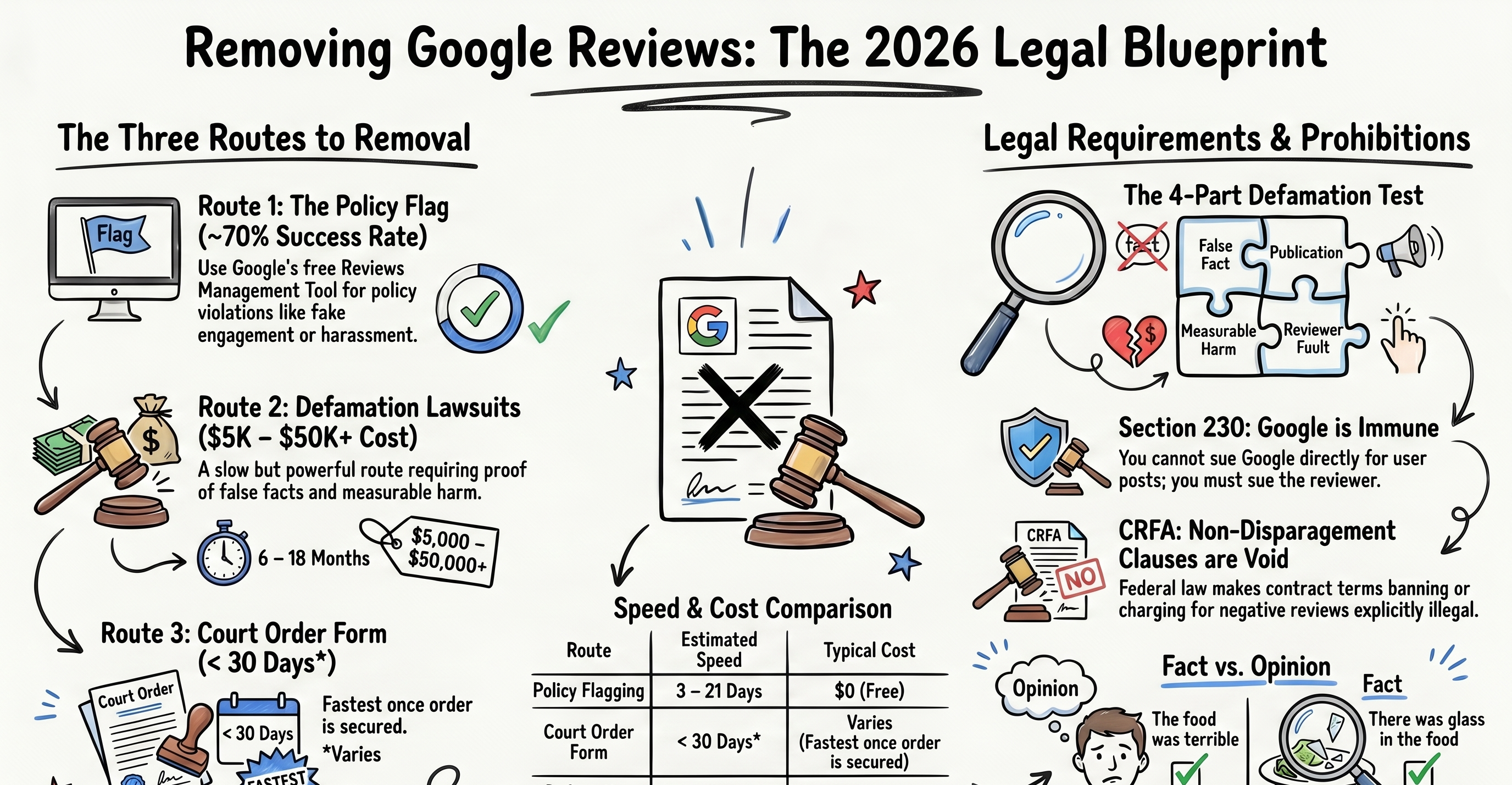
- Three legal routes exist: policy flag (free, fast), defamation lawsuit (expensive, slow, strongest), and court order via Google legal form (fastest path once you have the order).
Short answer: yes, within limits. Flagging a review that violates Google's published content policies — fake engagement, off-topic, conflict of interest, harassment, impersonation — is not only legal, it's the sanctioned path Google itself built. The longer answer involves three distinct routes, each governed by different laws, and a fourth category of actions that are explicitly not legal.
This is the 2026 legal map, written for US business owners but flagging where UK and EU law differs. Nothing here is a substitute for an attorney if you are considering the defamation route — but knowing the terrain before you call a lawyer saves a billable hour.
The short legal answer
There are three things business owners mix up, and the legal answer depends on which one you actually mean:
- "Is it legal to flag a review for removal?" Yes, always. Google built the tools specifically for this. Misusing the tools to target legitimate reviews is bad faith and can hurt your own profile, but the act of flagging is legal.
- "Is it legal to sue a reviewer to force the review down?" Yes, if you have a valid defamation claim. The bar is high — four elements, all of which must be provable — and the cost is significant.
- "Is it legal to use contracts, threats, or legal intimidation to prevent or silence legitimate reviews?" No. This is where the Consumer Review Fairness Act and, in the EU, the Digital Services Act draw hard lines with real penalties.
The three legal routes to removal
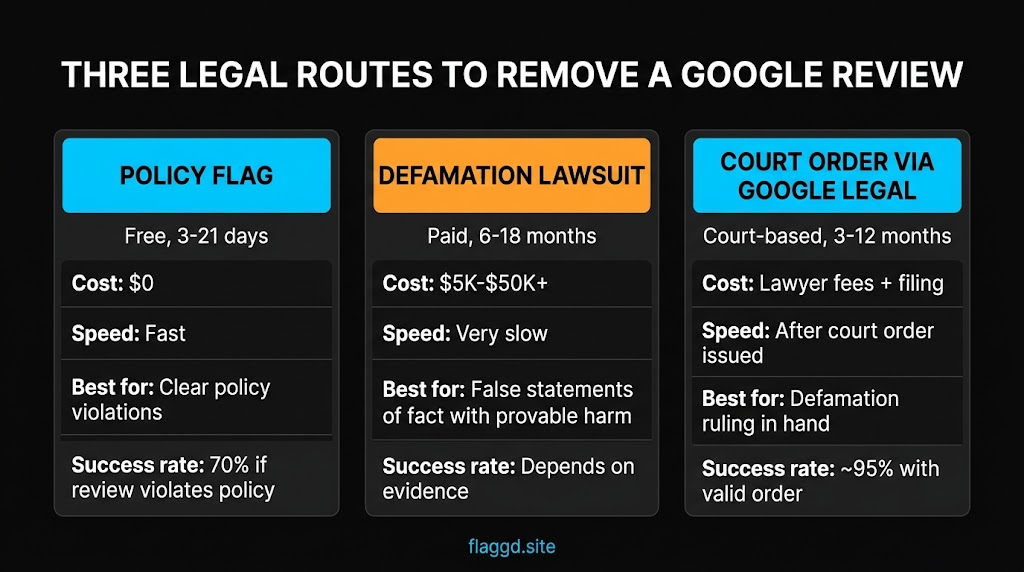
| route | cost | speed | success rate | best use case | Source |
|---|---|---|---|---|---|
| Policy flag | Free | 3–21 days | ~70% (when violating policy) | Reviews that violate one of Google's seven content policies (fake engagement, harassment, etc.) | [1] |
| Court order via Google legal removal form | Variable (cost of securing underlying order) | 30 days (once submitted) | 95%+ (Near-automatic) | Final step after winning a lawsuit or securing a court order to compel removal | [1] |
| Defamation lawsuit | 5,000–50,000+ in attorney fees | 6–18 months | Varies (95%+ removal once order is secured) | Provably false factual claims where defamation can be legally established in court | [1] |
Every Google review removal that actually happens comes through one of three routes. Each has a distinct cost, speed, and success profile.
Route 1 — Policy flag (free, 3–21 days)
Google's Reviews Management Tool. This is the route for reviews that violate one of Google's seven content policies — a detailed breakdown of those categories is in our guide to what counts as a fake Google review. Cost: zero. Speed: 3 business days for clear cases, longer for reviews requiring appeal. Success rate: ~70% when the review genuinely violates policy, much lower otherwise.
Route 2 — Defamation lawsuit (paid, 6–18 months)
Sue the reviewer for defamation, secure a judgment, then use the judgment as the basis for a Google legal removal request. Cost: $5,000–$50,000+ in attorney fees. Speed: 6–18 months in the court system. Success rate: varies with the underlying defamation claim's strength, but the 95%+ removal success on the Google side is near-automatic once you have a valid court order.
Route 3 — Court order via Google legal removal form (fastest once you have the order)
This is less a separate route than the final step of Route 2. Google operates a dedicated legal content removal form for court orders, copyright takedowns, GDPR requests, and other legally-mandated removals. Submission with a valid court order typically results in removal within 30 days. The expensive and slow part is everything before you have the order — the lawsuit itself.
Section 230 — why you can't sue Google directly
Section 230 of the Communications Decency Act (47 U.S.C. § 230), passed in 1996, is the legal backbone of every user-generated-content platform in the United States. For review removal purposes, it means exactly one thing: Google is not liable for what its users post. You can sue the reviewer. You cannot sue Google for hosting the reviewer's content.
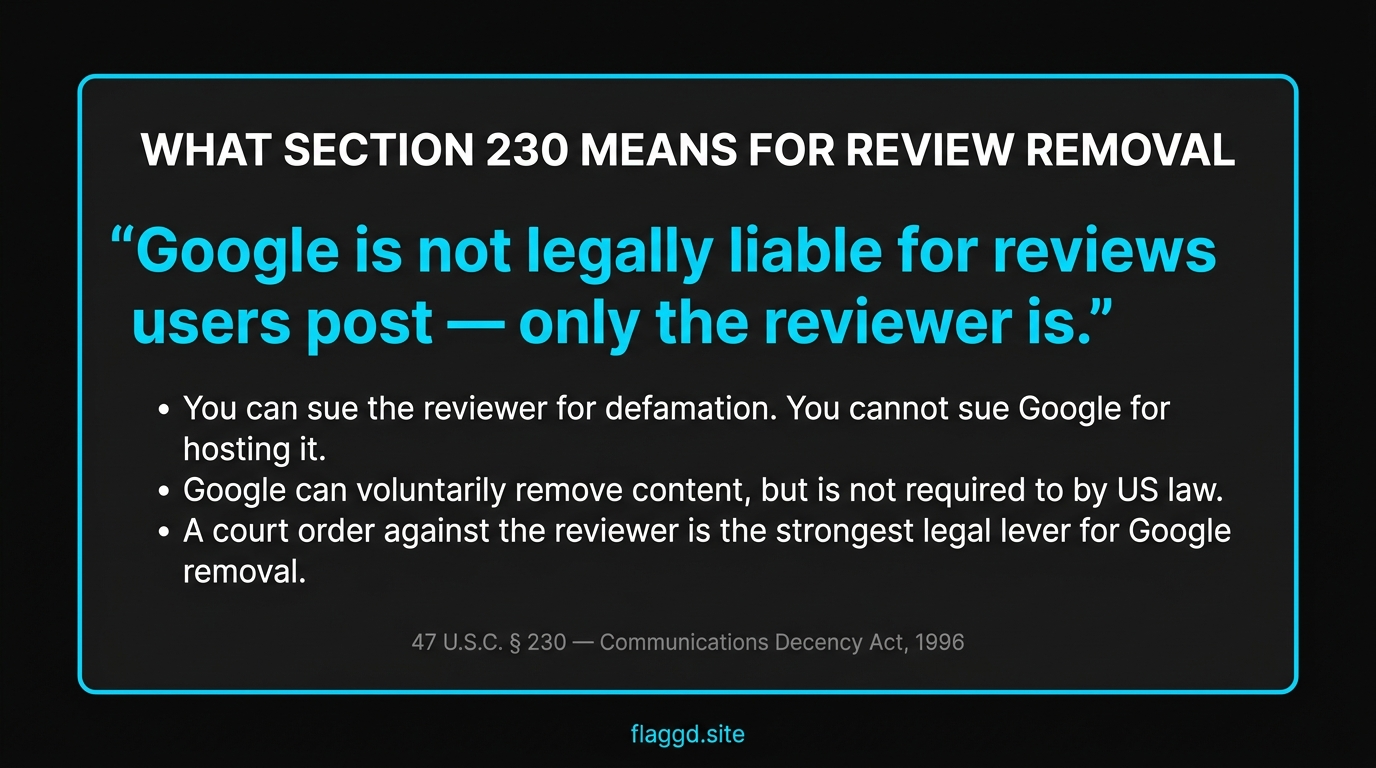
Three practical implications:
- Google can voluntarily remove content, but is not required to by US law. The policy-based tools exist by Google's choice, not legal mandate. Google could shut down the Reviews Management Tool tomorrow and face no Section 230 liability.
- A court order against the reviewer is the strongest legal lever available. Google honors valid court orders through its legal removal form — not because Section 230 forces it to, but because ignoring a US court order would create separate legal exposure.
- Legal threats sent directly to Google rarely work. "Remove this defamatory review or I'll sue you" lands in the wrong queue and usually gets a standard "report it through the Reviews Management Tool" response.
When a review crosses into defamation
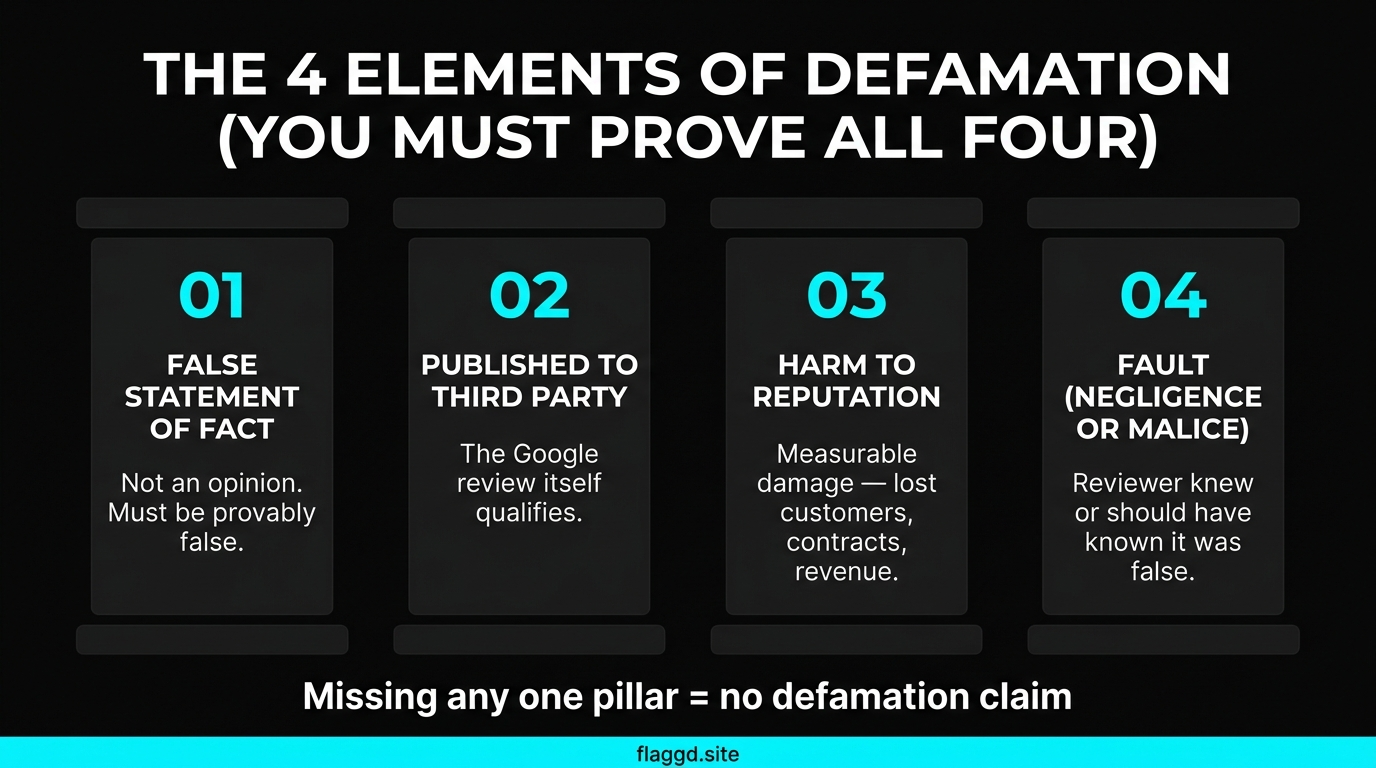
Defamation is the legal lever that converts a review you merely disagree with into a review a court can order removed. But defamation has a specific technical definition with four elements, all of which must be present. Miss any one, and the claim collapses.
Element 1 — False statement of fact
Not opinions. "The food was terrible" is opinion and protected. "This restaurant served me food with glass in it" is a statement of fact that can be proven true or false. Only factually testable statements can be defamatory, and you must be able to prove they are false. "The lawyer stole my retainer" is factual; "the lawyer is a crook" sits on the boundary and often loses.
Element 2 — Publication to a third party
The review being visible on Google's platform satisfies this automatically. This is the easiest of the four elements to meet.
Element 3 — Harm to reputation
Courts require measurable damage — lost contracts, lost customers, documented revenue decline, damage to professional licensing. Vague claims of hurt reputation without receipts rarely survive. Keep documentation: timestamp analytics showing review-correlated drops in bookings, cancelled contracts citing the review, lost referrals.
Element 4 — Fault (negligence or actual malice)
The reviewer must have known the statement was false, or been negligent about whether it was true. For public-figure plaintiffs — which some business owners qualify as — the bar rises to "actual malice," requiring proof the reviewer knew it was false or acted with reckless disregard. Private businesses generally meet a lower standard.
The Consumer Review Fairness Act — what you can't do
Passed in 2016, the Consumer Review Fairness Act (CRFA) is the US federal law that explicitly protects consumers' right to post honest reviews. For business owners, the CRFA matters because it defines four practices that were once common and are now illegal:
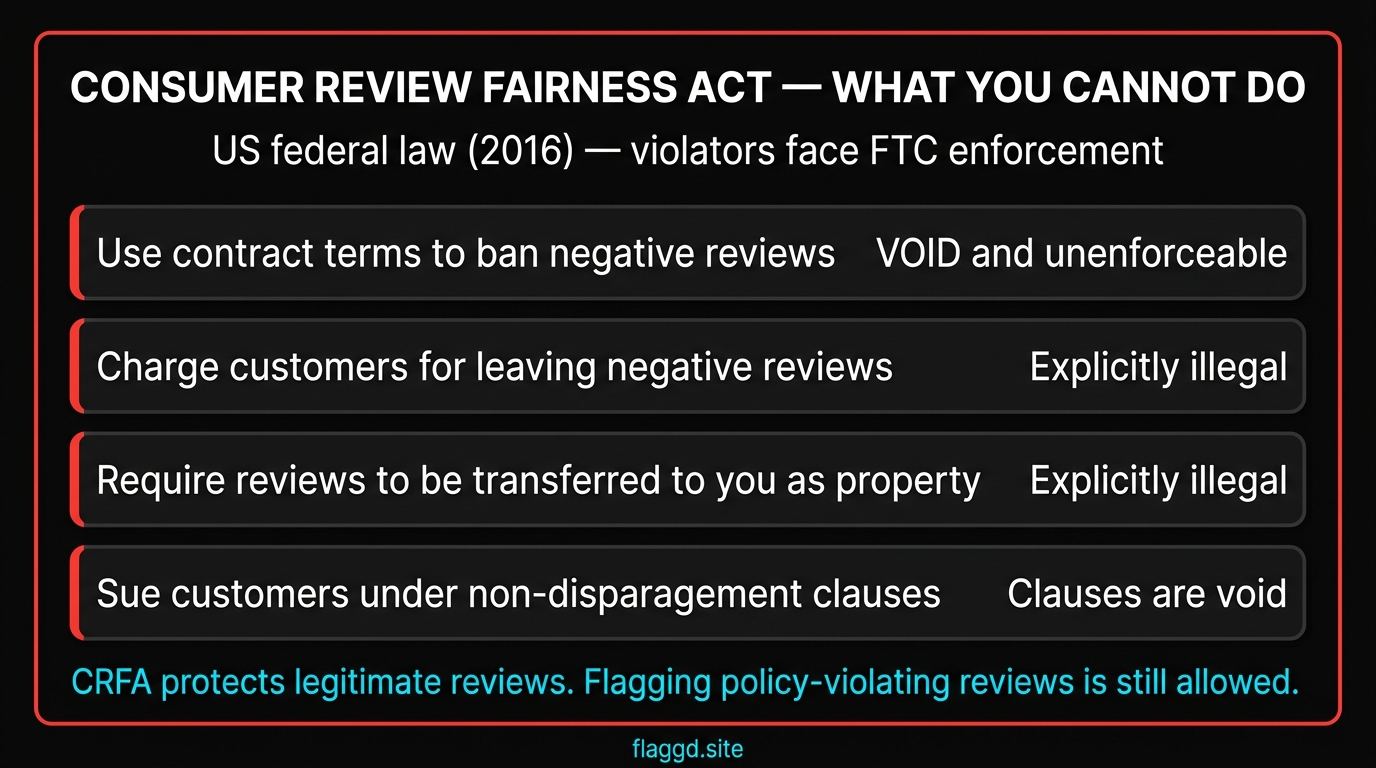
- Contract terms banning negative reviews. Void and unenforceable. Any clause in a consumer contract that penalizes reviews — "customer agrees not to post negative comments about the service" — is worthless in court and exposes the business to FTC action.
- Charging customers for leaving negative reviews. Explicitly illegal. Businesses that add "disparagement fees" to invoices have been fined.
- Requiring reviews be transferred to you as property. Explicitly illegal. Language like "customer assigns all review rights to the business" is void.
- Suing customers under non-disparagement clauses. Because the clauses are void, the lawsuits fail — and the FTC has historically taken action against businesses that pursue them aggressively.
CRFA does not prevent you from disputing policy-violating reviews. It prevents you from contractually silencing legitimate ones. The distinction matters because enforcement has teeth — the FTC has referenced the CRFA in settlements with businesses operating in retail, healthcare, and home services. It overlaps with the much newer FTC Consumer Reviews Rule, which we cover in the FTC fake review rule 2026 guide.
International: UK, EU, and the Digital Services Act
US Section 230 has no direct UK or EU equivalent. In place of it, the EU Digital Services Act (DSA), which took full effect in 2024, imposes affirmative content moderation duties on platforms like Google — and provides businesses with an additional appeals route that US businesses do not have.
Under the DSA, businesses in the EEA and UK can refer disputes over Google's moderation decisions to out-of-court dispute settlement bodies. This is a genuine additional path — not a court case — and while the success-rate data is still early, it gives EU businesses a middle option between policy flagging and a full defamation lawsuit.
UK defamation law follows the Defamation Act 2013, which includes a serious-harm threshold for individuals and a serious-financial-harm threshold for corporate claimants. The bar for corporate defamation is meaningfully higher in the UK than in most US states.
Frequently asked questions
The legal framework around Google review removal is friendlier to business owners than it looks at first glance — but only for the right reasons. Disputing policy violations is always legal. Pursuing defamation against provably false factual claims is legal and sometimes the only path. Silencing legitimate negative reviews through contracts or threats is illegal and increasingly enforced. Pick the right route for the actual review you're dealing with, and the legal side of the process rarely becomes the bottleneck.