Key Takeaways
- Google's stated target: most reported reviews processed within 3 business days, appeals within 5 business days.
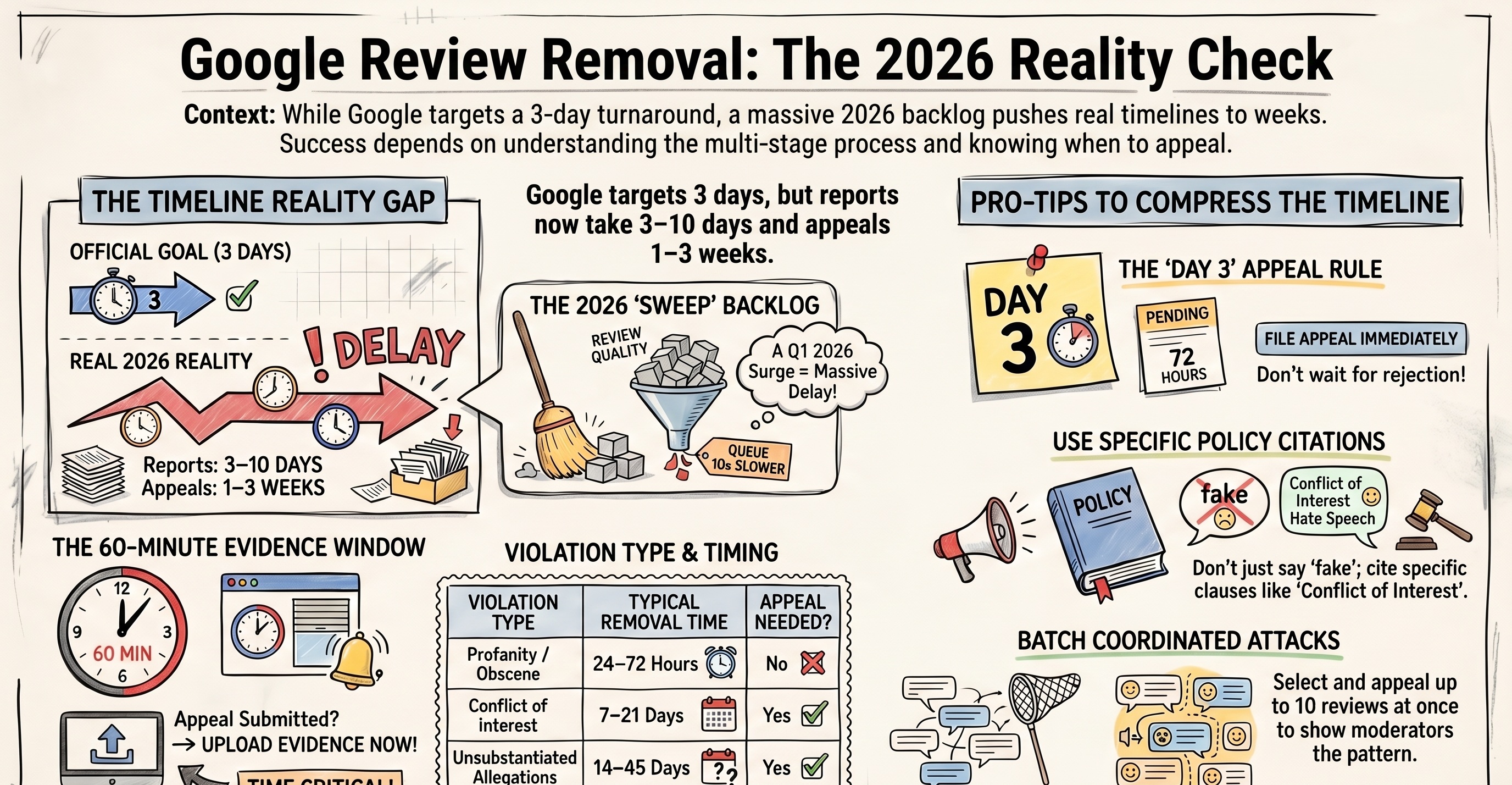
- Actual 2026 timeline: 3–10 days for initial reports, 1–3 weeks for appeals, 3–6 weeks for escalations due to a visible backlog.
- Fastest removals: profanity and obscene language — often cleared inside 24–48 hours by automated filters.
- Slowest removals: unsubstantiated allegations and conflict-of-interest reviews — almost always require an appeal with documentary evidence.
- You cannot pay Google to expedite a removal. But you can compress total elapsed time by filing an appeal on day 3 even if your report is still pending.
- The short answer: timeline by violation type
- Why the timeline varies so much
- The full removal timeline, stage by stage
- What Google says vs. what actually happens in 2026
- The 2026 appeals backlog: why it's slower right now
- Five things that actually speed up removal
- Reviews Google probably won't remove — no matter how long you wait
- Frequently asked questions
If you flagged a fake or policy-violating Google review this morning, you probably want to know one thing: when will it actually come down? There are two answers. Google's published target is 3 business days for most reported reviews and up to 5 business days for appeals. Across the 2,400+ disputes we've filed through Google's official channels, what we see in practice is different — and in early 2026, significantly different.
This is the real timeline, broken down by violation type, stage, and the factors that determine whether your review clears in 48 hours or sits in an appeals queue for a month.
The short answer: timeline by violation type
| violation type | typical time to removal | whether appeal is usually needed | fastest path | Source |
|---|---|---|---|---|
| Profanity / obscene language | 24–72 hours | No | Automated filters | [1] |
| Clear spam or bot-generated | 2–7 days | No | Automated filters | [1] |
| Off-topic content | 3–10 days | Sometimes | Human moderation | [1] |
| Personal information / doxxing | 5–14 days | Sometimes | Human moderation | [1] |
| Conflict of interest (ex-employee, competitor) | 7–21 days | Yes | Appeal with documentary evidence | [1] |
| Unsubstantiated allegations ("crook", "scam") | 14–45 days | Yes | Appeal with documentary evidence | [1] |
| Fake engagement (proved) | 14–60 days | Yes | Appeal with documentary evidence | [1] |
Not all policy violations are processed at the same speed. Google's automated filters catch some categories instantly; others require a human moderator to read context, verify evidence, and apply judgment. The spread is wide — and it's the single biggest factor in how long your review takes to come down.
| Violation type | Typical time to removal | Appeal usually needed? |
|---|---|---|
| Profanity / obscene language | 24–72 hours | No |
| Clear spam or bot-generated | 2–7 days | No |
| Off-topic content | 3–10 days | Sometimes |
| Personal information / doxxing | 5–14 days | Sometimes |
| Conflict of interest (ex-employee, competitor) | 7–21 days | Yes |
| Unsubstantiated allegations ("crook", "scam") | 14–45 days | Yes |
| Fake engagement (proved) | 14–60 days | Yes |
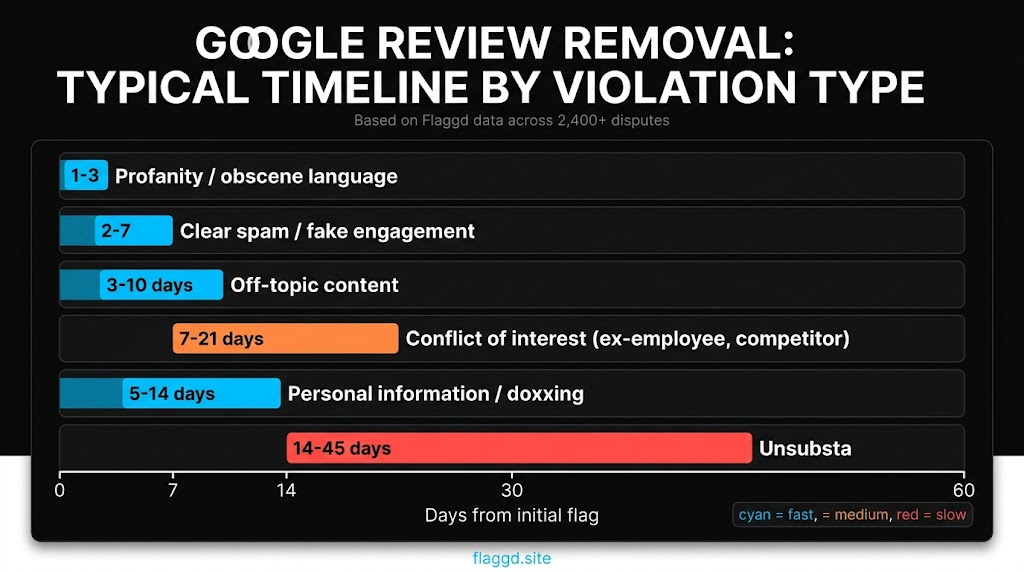
Ranges like these are an average — not a guarantee. A single "crook" comment on a law firm page has come down in 4 days when the evidence was airtight; another took 38 days across two appeals because the reviewer's context wasn't clear from the text alone.
Why the timeline varies so much
Six factors account for almost all of the spread between a two-day removal and a two-month removal:
- Which policy the review violates. Google's automated filters are confident about profanity, specific slurs, and obvious spam patterns. They are cautious — correctly — about calling a review "false" or "conflict of interest." Those categories require a human read, which adds queue time.
- Whether the violation is visible in the review text. Google's moderators look at the review itself first. If the word "scammer" or "fraud" appears in the text, that's a signal. If the violation is contextual — the reviewer is your competitor, the incident never happened — the burden of proof shifts to you, and that takes an appeal.
- Whether the review has text at all. Rating-only reviews (a single 1-star with no comment) are the hardest to remove at any speed. There's no language for the algorithm to evaluate. We still recommend flagging them, but set expectations accordingly.
- The quality of your first report. The initial report form is narrow — you pick a category and submit. There's no space to explain. If you pick a category that doesn't quite fit, Google may reject on the first pass, and you lose 3–7 days before you can appeal.
- The review count on your profile. Profiles with a sudden burst of 1-star reviews against a long history of 5-star reviews get flagged as potential review attacks and reviewed faster. Newer profiles with fewer total reviews tend to sit in the queue longer.
- Google's current workload. This one is out of your hands, and in 2026 it has become the single largest variable. More on that below.
The full removal timeline, stage by stage
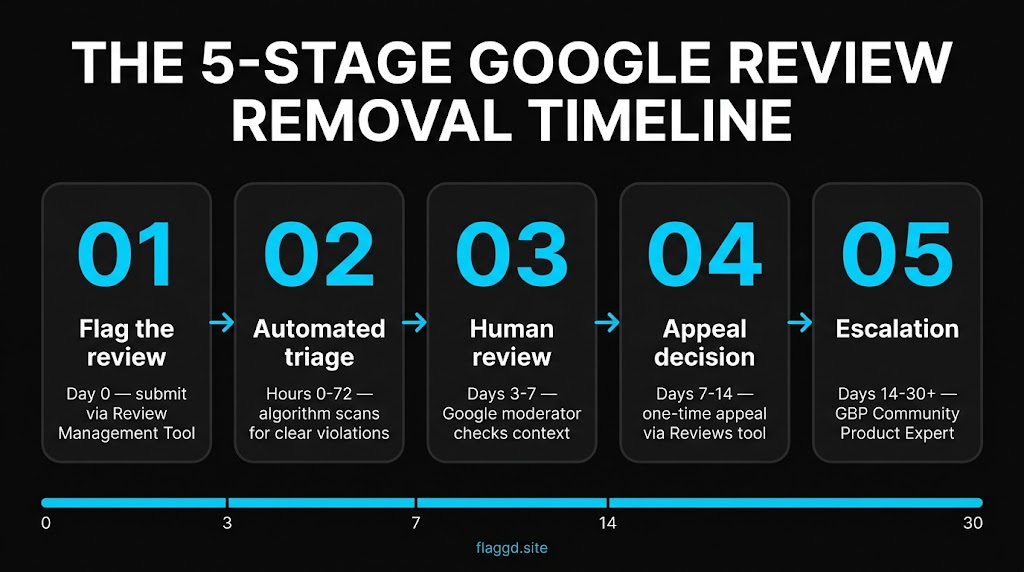
Every Google review removal passes through up to five stages. Knowing what happens in each one — and what you can do to accelerate the handoff — is the difference between a week and a month.
Stage 1 — Automated triage (hours 0–72)
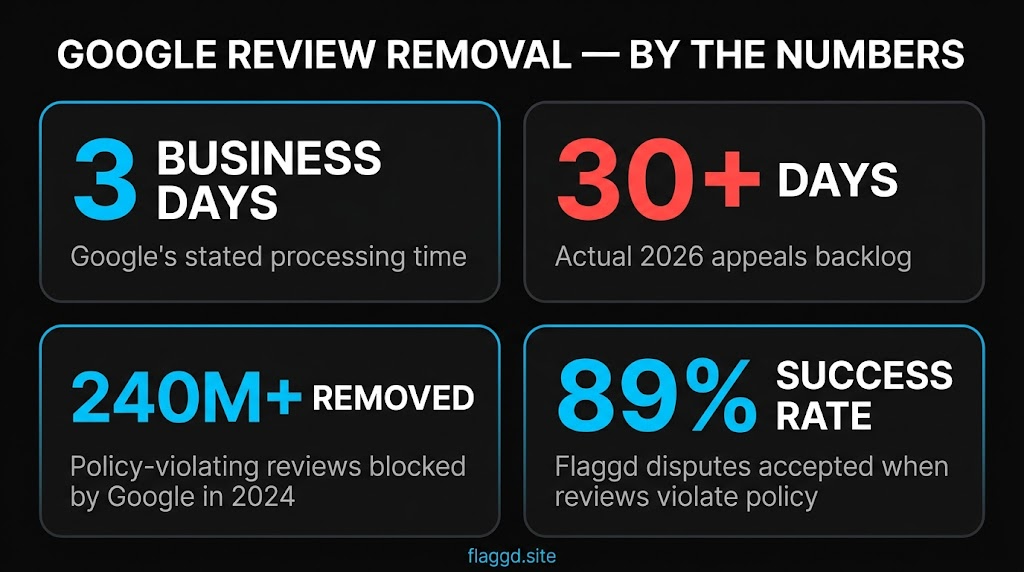
The moment you flag a review, it enters Google's automated moderation pipeline. Algorithms scan for banned language, known spam patterns, and signals that overlap with previously removed content. Anything that trips a high-confidence filter is removed without human review. According to Google, this accounts for the majority of the 240 million+ reviews removed or blocked in 2024.
If your review is profanity or obvious spam, this is the stage where it usually comes down — often overnight, sometimes within hours.
Stage 2 — Human moderation (days 3–7)
Reviews that don't trip an automated filter get routed to a human moderator. This is where context starts to matter. Google publishes that "most reported reviews are processed within 3 business days," and in practice this stage usually clears inside a week — if your category selection was accurate and the violation is unambiguous.
You'll get one of four statuses in the Reviews Management Tool at the end of this stage: Report reviewed — no policy violation, Escalated — check email for updates, Review removed, or Decision pending.
Stage 3 — First decision (days 3–14)
If the decision is review removed, you're done — skip to how long removal propagates across search. If the decision is no policy violation, you get one appeal. Don't treat that appeal as a formality. It's the single most important step in the process.
Stage 4 — Appeal (days 7–21)
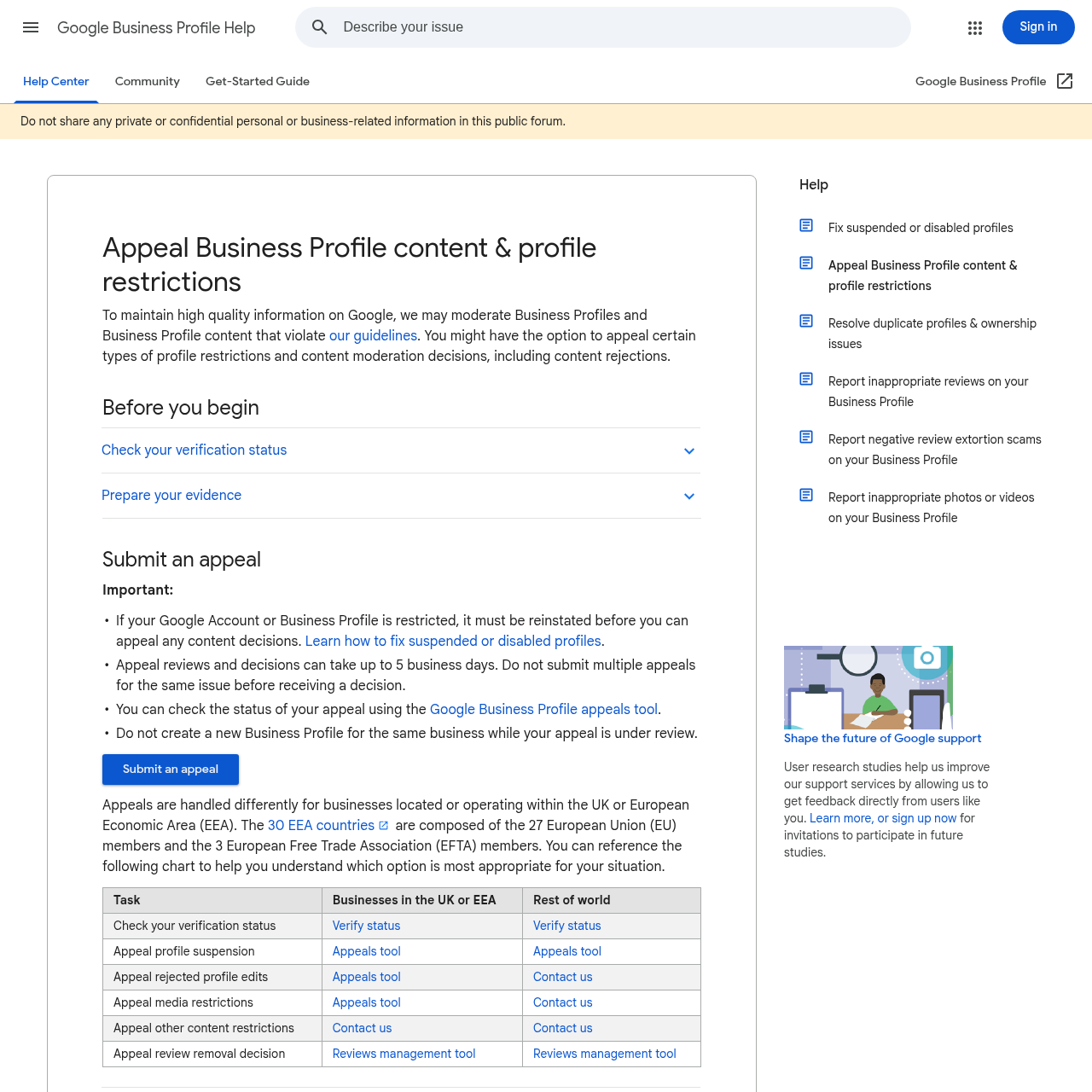
The appeal opens in the Reviews Management Tool once your report status is either pending for 3+ days or resolved against you. This is where you attach the evidence the original report form had no room for — court records, LinkedIn screenshots showing a reviewer works for a competitor, internal HR records showing a reviewer is a former employee. Google's policy allows evidence files to be submitted for 60 minutes after the appeal is filed. Have them ready before you click submit.
Google's stated SLA on appeal decisions is 5 business days. Actual elapsed time in Q1 2026 is running 1–3 weeks.
Stage 5 — Escalation via Product Expert (days 14–45+)
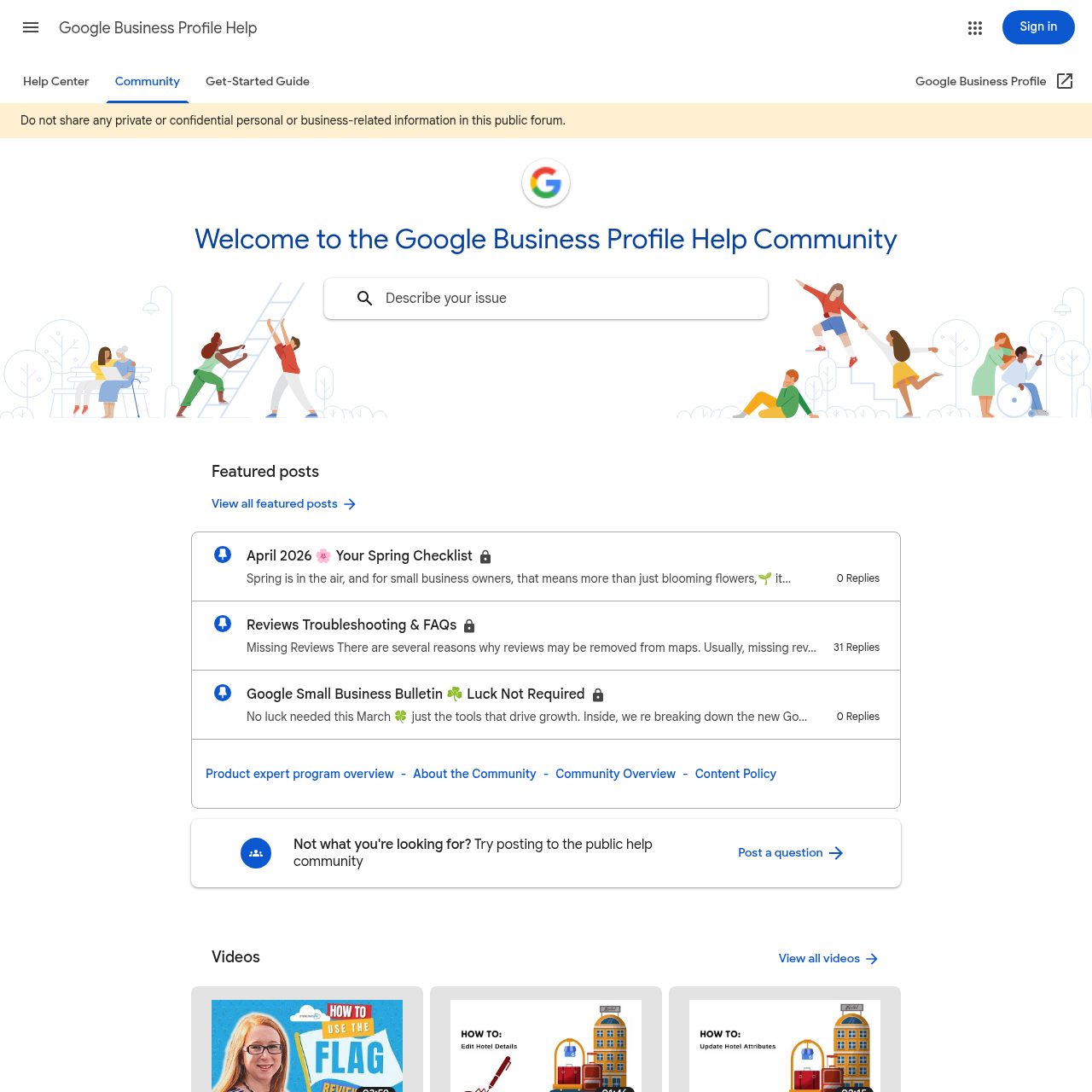
If your appeal is rejected, the last formal path is the Google Business Profile Community. Volunteer Product Experts — not Google employees, but vetted power users — can re-escalate cases where moderation clearly misread context. Bring your Case ID from the appeal. The response times here depend entirely on which expert picks up the thread and what Google's escalation queue looks like that week.
What Google says vs. what actually happens in 2026
Google's official documentation publishes a simple story: 3 business days for most reports, 5 business days for appeals. Our operational data across Q1 2026 tells a different one. The gap isn't because Google is misrepresenting its SLA — it's that the official numbers describe the median case in a normal queue. The 2026 queue is not normal.
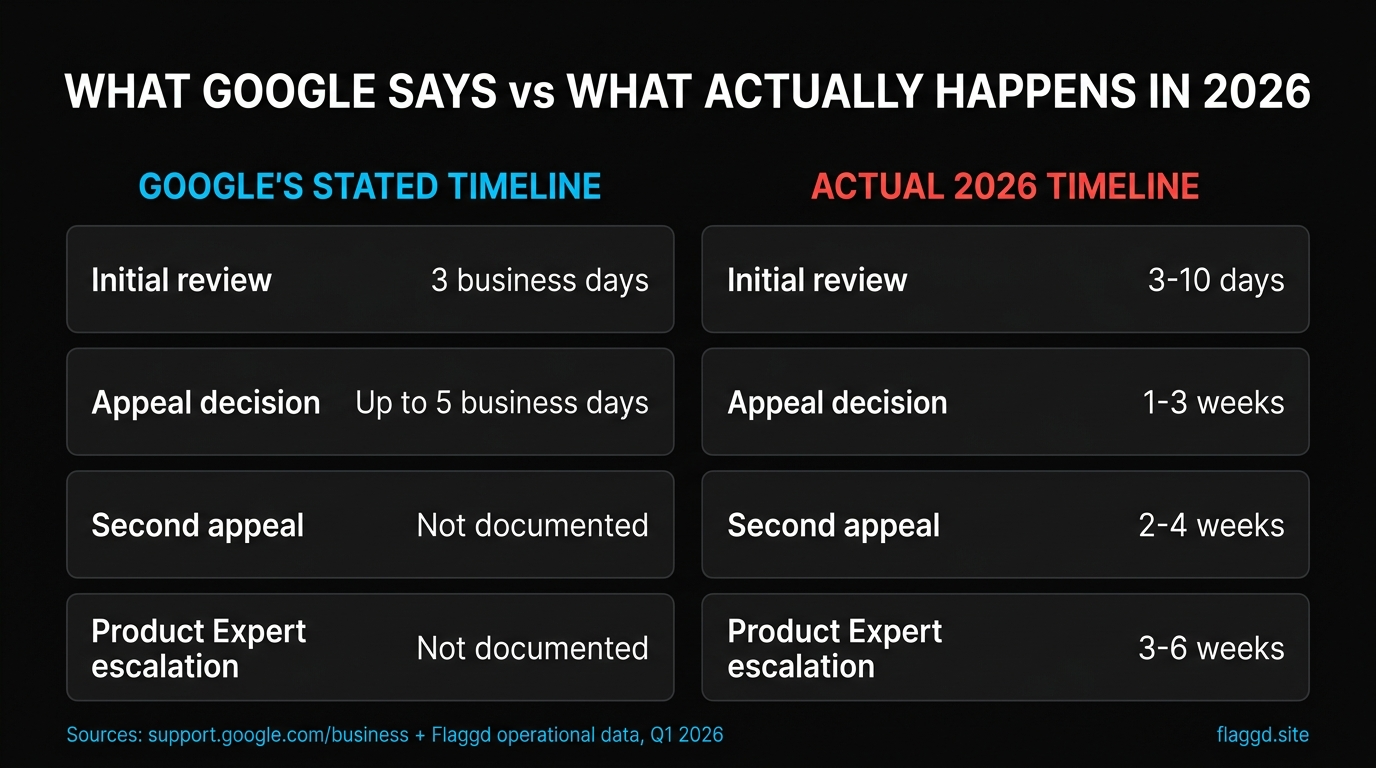
The practical implication: when you flag a review on Monday, set a calendar reminder for Thursday. If the report is still pending on Thursday, file an appeal immediately. Do not wait for a rejection.
The 2026 appeals backlog: why it's slower right now
Two events in early 2026 have stretched Google's review moderation timelines well past its published targets.
In January 2026, multiple Google Business Profile support threads documented appeals taking 30 days or more. A Product Expert volunteer, referencing the trailing 40 days of escalations, reported the queue was running at roughly ten times Google's stated SLA. No expedite path was available.
Between February 16 and March 16, 2026, Google ran a widespread review-quality sweep that removed hundreds of millions of reviews from live profiles. The sweep caught legitimate reviews alongside the fake and policy-violating ones it was designed to clear. The result was a surge of appeals from businesses trying to get legitimate reviews reinstated — which loaded the same queue that handles removal requests.
Operational note: the timelines in the table above reflect cases we've filed since February 2026. Before the sweep, average appeal resolution was closer to Google's stated 5 business days. If you're reading this article in a calmer quarter, the real-world numbers should compress back toward the published SLA.
Five things that actually speed up removal
There is no premium support tier for Google review removal. You cannot pay to jump the queue, and anyone telling you otherwise is selling you an "expedite fee" that goes directly into their pocket. What you can do is compress the elapsed time between stages. Five tactics move the needle:
- File the appeal at day 3, not day 7. Google's own documentation confirms you can appeal an undecided report after 72 hours. Most businesses wait for a rejection, losing a full week. Don't.
- Have your evidence ready before you click "submit appeal." The evidence upload form opens for 60 minutes — if you miss it, the evidence isn't attached to your case, and the moderator reviews the appeal without it. Prepare a folder with the URL of the review, screenshots of any context (LinkedIn, HR records, court filings), and a one-paragraph summary tying the evidence to the specific policy violated.
- Cite the exact policy clause in your appeal. Generic appeals ("this review is fake") lose. Specific appeals — "this review violates the conflict of interest clause of Google's Prohibited and Restricted Content policy, because the reviewer is identifiable as a former employee via the attached LinkedIn profile" — win.
- Batch coordinated attacks into a single appeal. The Reviews Management Tool allows up to 10 reviews to be selected and appealed together. Batching a review-bombing incident is consistently faster than filing each one individually, because the moderator sees the pattern.
- Escalate to a Product Expert with a Case ID. If both your report and appeal are rejected on a review that clearly violates policy, the Google Business Profile Community forum is the final formal route. Always include your appeal's Case ID in the post — that's what allows an expert to re-escalate directly rather than re-litigating the case from scratch.
Reviews Google probably won't remove — no matter how long you wait
Some reviews are outside the reach of the removal process entirely. Flagging them burns calendar time you could spend on reviews that will come down. The clearest cases:
- Rating-only reviews with no text. There's no language for the algorithm or a moderator to evaluate. Unless you can prove coordinated fake engagement, these almost never come down.
- Legitimate negative experiences. If a real customer had a bad experience and described it in fair terms, Google will not remove it — and shouldn't. The fix here is operational, not dispute-based.
- Factual disputes between parties. Google explicitly states it "doesn't enter disputes over facts between the business owner and the review." If your argument is "the event didn't happen," without third-party evidence, you won't prevail.
- Criticism of service quality using non-prohibited language. A review calling your food "cold" or your service "rude" is protected speech on Google's platform, even if you disagree.
Knowing which reviews are unwinnable is as valuable as knowing which are. It focuses your time on the 10–30% of reviews that actually violate policy — which, in our data, covers about one in three reviews that businesses believe to be fake.
Frequently asked questions
The short version, if you only remember one thing: Google's 3-business-day target is real for clear-cut reports, but assume 2–4 weeks for anything that requires an appeal. Flag fast, appeal at day 3, attach your evidence inside the 60-minute window, and cite the exact policy clause. That's the formula that moves cases from the 6-week tail into the 1-week mean.