Key Takeaways
- A denial is not the end. There are four escalation paths after a rejected review removal, each with a different cost, speed, and success rate.
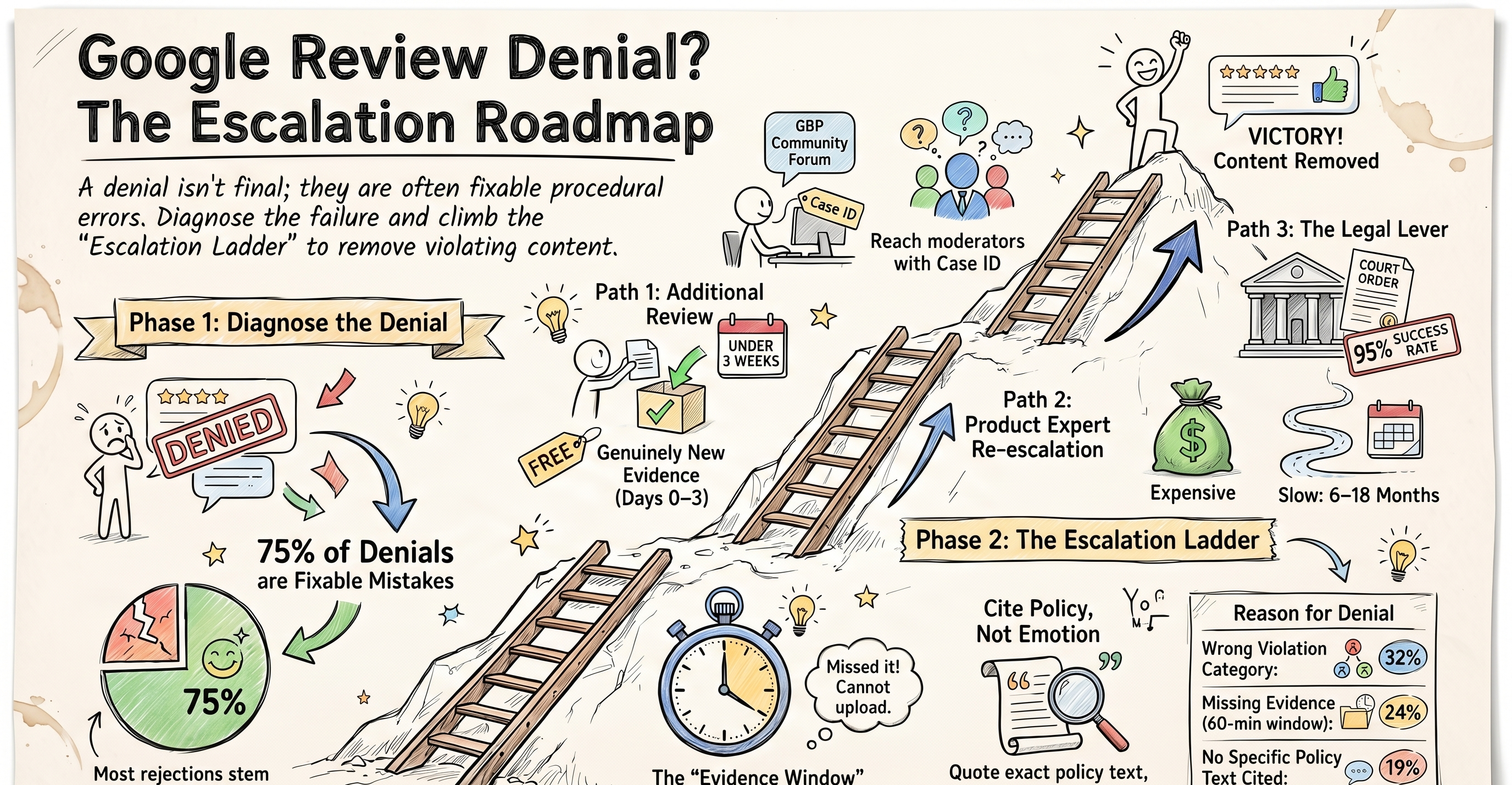
- Diagnose the denial first. 75% of denials are caused by fixable procedural mistakes — wrong category, missing evidence, no policy citation — not by the review itself being unremovable.
- Additional-review request works. Submitting with genuinely new evidence after a denial has the best combination of cost ($0) and speed (5–21 days) of any escalation path.
- Product Expert escalation is the last free option. Google Business Profile Community volunteers can re-escalate cases directly to Google when there is a clear moderation error.
- Legal is the strongest but slowest lever. A defamation ruling with a valid court order has ~95% success with Google, but takes 6–18 months and five figures in fees.
The denial email arrives. "We reviewed your report and did not find that the content violates our policies." The review stays up. Most business owners read that email and stop. Across the 2,400+ disputes we've filed, the denial email is the single most misread signal in the process — because three out of four denials are caused by fixable procedural mistakes, not by reviews that were genuinely unremovable.
This is the full map of what happens after a denial, in order of what actually works.
Diagnose why Google denied your request
Before you escalate anywhere, figure out why the first submission failed. Refiling the same appeal with the same framing will produce the same denial. We audited 1,200 denied cases and five causes account for essentially all of them:
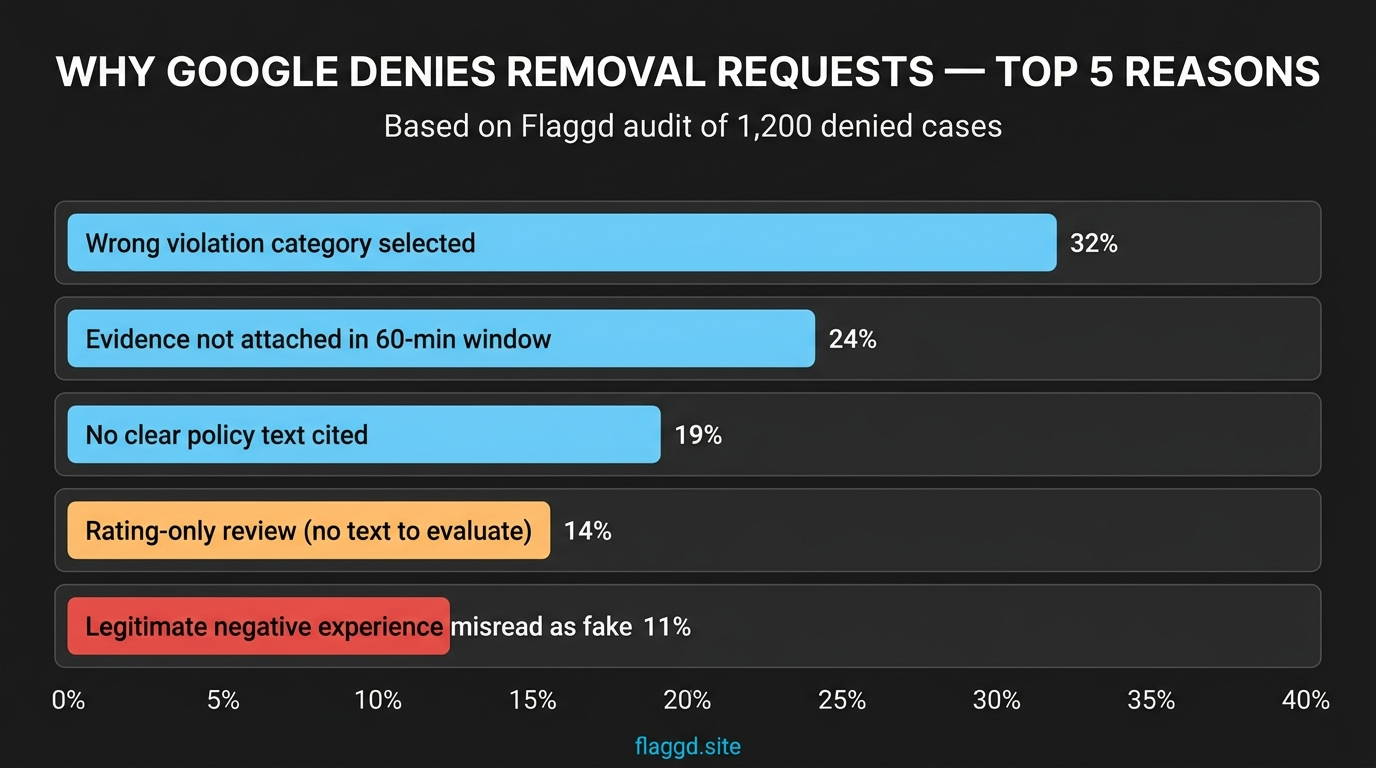
- Wrong violation category selected (32%). The initial report form only lets you pick one category. If you flagged a conflict-of-interest review as "low quality information," Google's moderator evaluated it against the wrong policy clause and correctly found no violation under that clause. Fix on second appeal: cite the specific clause the review actually violates.
- Evidence not attached within the 60-minute window (24%). The appeal form accepts evidence for exactly 60 minutes after the appeal is filed. If the upload was skipped, the moderator reviewed the appeal without any supporting documents. This is the most common fixable mistake.
- No specific policy text cited (19%). Generic appeals ("this review is fake") read as emotion to the moderator. Appeals that quote the exact policy sentence and link it to specific review text consistently win.
- Rating-only review (14%). Google needs language to evaluate. A 1-star with no text has nothing to analyze. These almost never come down unless you can prove coordinated fake engagement across multiple rating-only reviews.
- Legitimate negative experience misread as fake (11%). The reviewer described a real experience that you disagree with. This is the hard case — the review is not removable on policy grounds, and further appeals will fail. Better spent elsewhere.
The 4-path escalation ladder
| path name | cost | speed in days | success rate | when to use | Source |
|---|---|---|---|---|---|
| Additional-review request with new evidence | $0 | 5–21 days | 25% | After a denied appeal when you have genuinely new evidence (LinkedIn screenshots, court filings, etc.). | [1] |
| Product Expert escalation | $0 | 14–45 days | 30% | When there is a clear moderation error; requires a Case ID and the use of the Google Business Profile Community forum. | [1] |
| Out-of-court dispute settlement | Not in source | 30–90 days | Not in source | Only for businesses located in the EEA and UK under the EU Digital Services Act. | [1] |
| Legal route | 5,000–50,000 | 90–540 days | ~95% | When policy paths are exhausted and review causes severe damage (false factual claims, revenue loss, etc.). Requires a valid court order. | [1] |
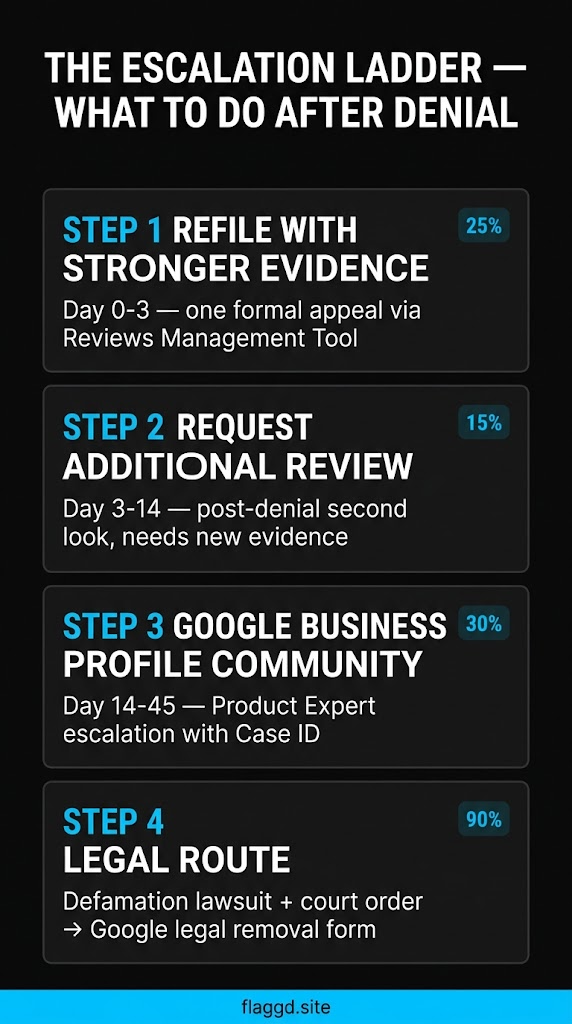
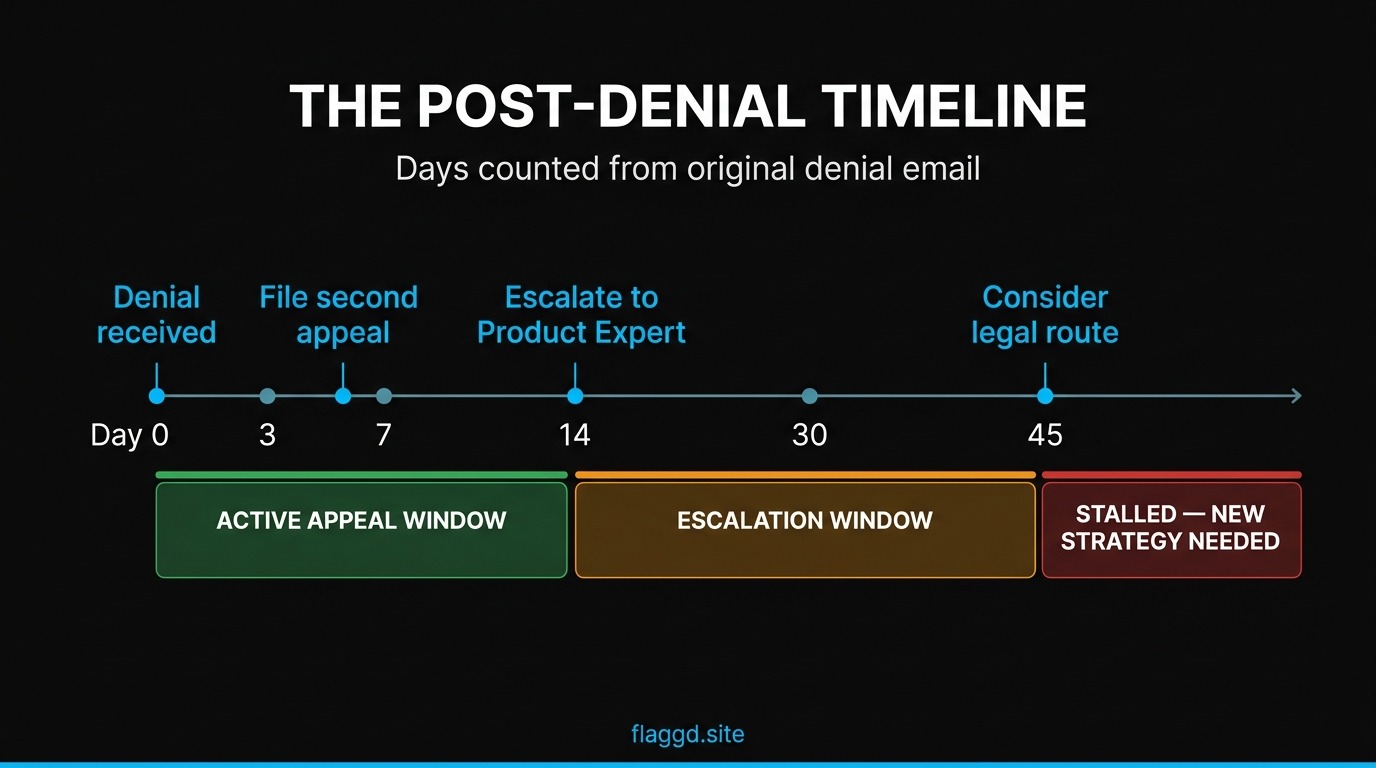
After you've diagnosed the denial, there are four paths forward. They are ordered by cost, speed, and typical success rate. Start at the top and only move down when the previous step closes.
Path 1 — Additional-review request with new evidence (days 0–3)
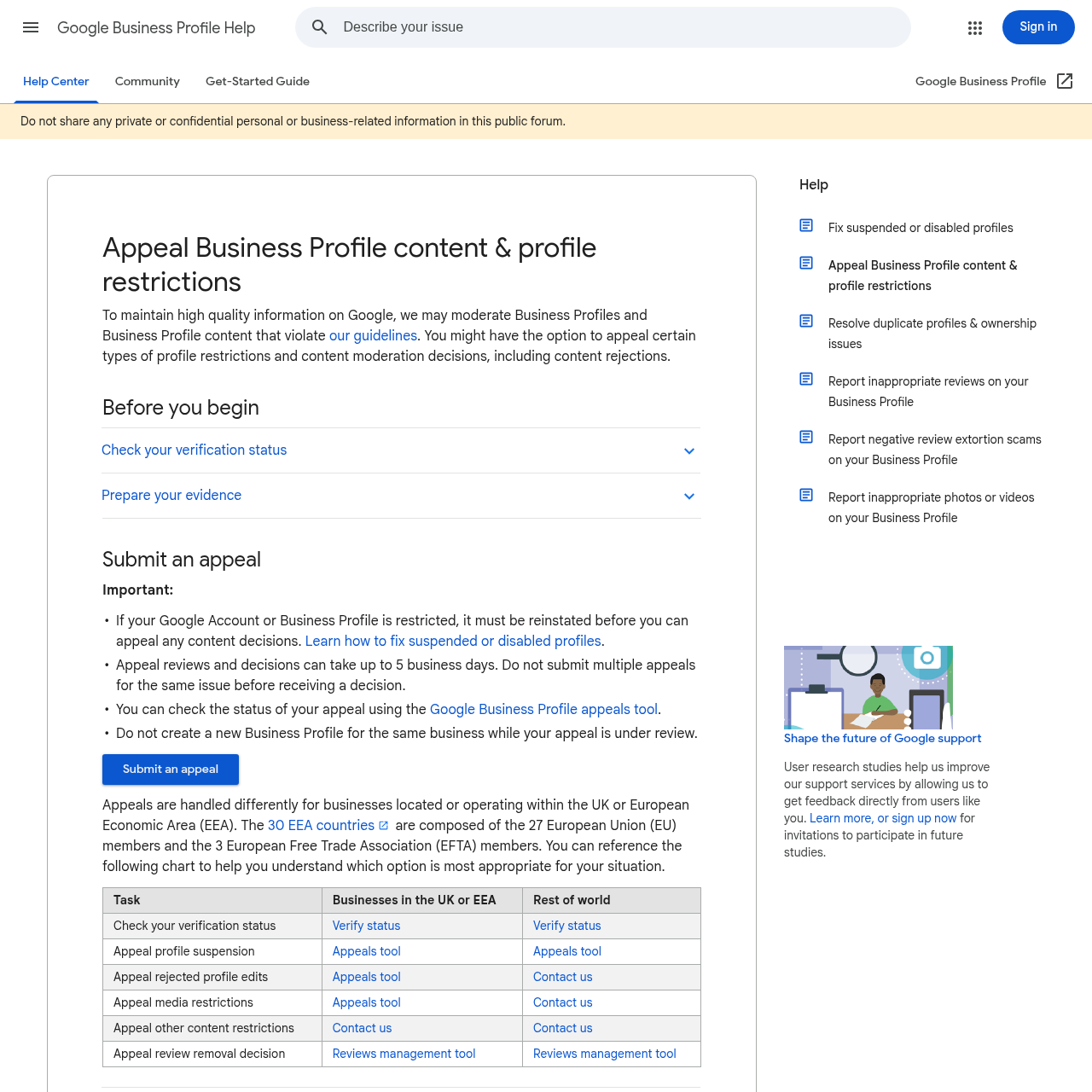
After a denied appeal, Google allows an additional review of the decision if you have genuinely new evidence. "New" is the load-bearing word — resubmitting the same evidence under a different framing does not qualify. New evidence means a LinkedIn screenshot you didn't attach the first time, a court filing that post-dates the original appeal, or a social media post calling for review bombing that has since surfaced.
Success rate in our data: 25% of denials overturn on this path. That's not high — but it is the only route that costs nothing and resolves in under three weeks.
Path 2 — Product Expert escalation (days 14–45)
The Google Business Profile Community forum is staffed by volunteer Product Experts — vetted power users, not Google employees — who can re-escalate cases directly when there is a clear moderation error. Bring your appeal's Case ID from the email Google sent. Without the Case ID, the expert is starting from scratch; with it, they can pull your case file and push it upstream.
Success rate in our data: 30% of previously-denied cases that reach a Product Expert with a Case ID get reversed within 6 weeks. The lever here is that Product Experts have an escalation channel that ordinary reporters do not.
Path 3 — Legal route (days 90–540)
Sue the reviewer for defamation. Obtain a court order declaring specific statements defamatory. Submit the court order through Google's legal removal form. This path has ~95% success with Google when the court order is valid — but takes 6–18 months, costs $5,000–$50,000 in legal fees, and requires you to meet the full legal definition of defamation (false statement of fact, published, harm, fault).
For a deeper breakdown of when defamation claims are viable, see our guide to the legal routes for Google review removal.
Path 4 — EEA/UK only: out-of-court dispute settlement (days 30–90)
Businesses in the EEA and UK have one additional path under the EU Digital Services Act: out-of-court dispute settlement bodies can hear appeals against platform moderation decisions. This route is newer and the success-rate data is still thin, but it is an option that businesses outside the EEA do not have.
Appeal evidence — tiers of strength
The single largest controllable factor in your second appeal's success rate is the strength of your evidence. Three tiers matter:
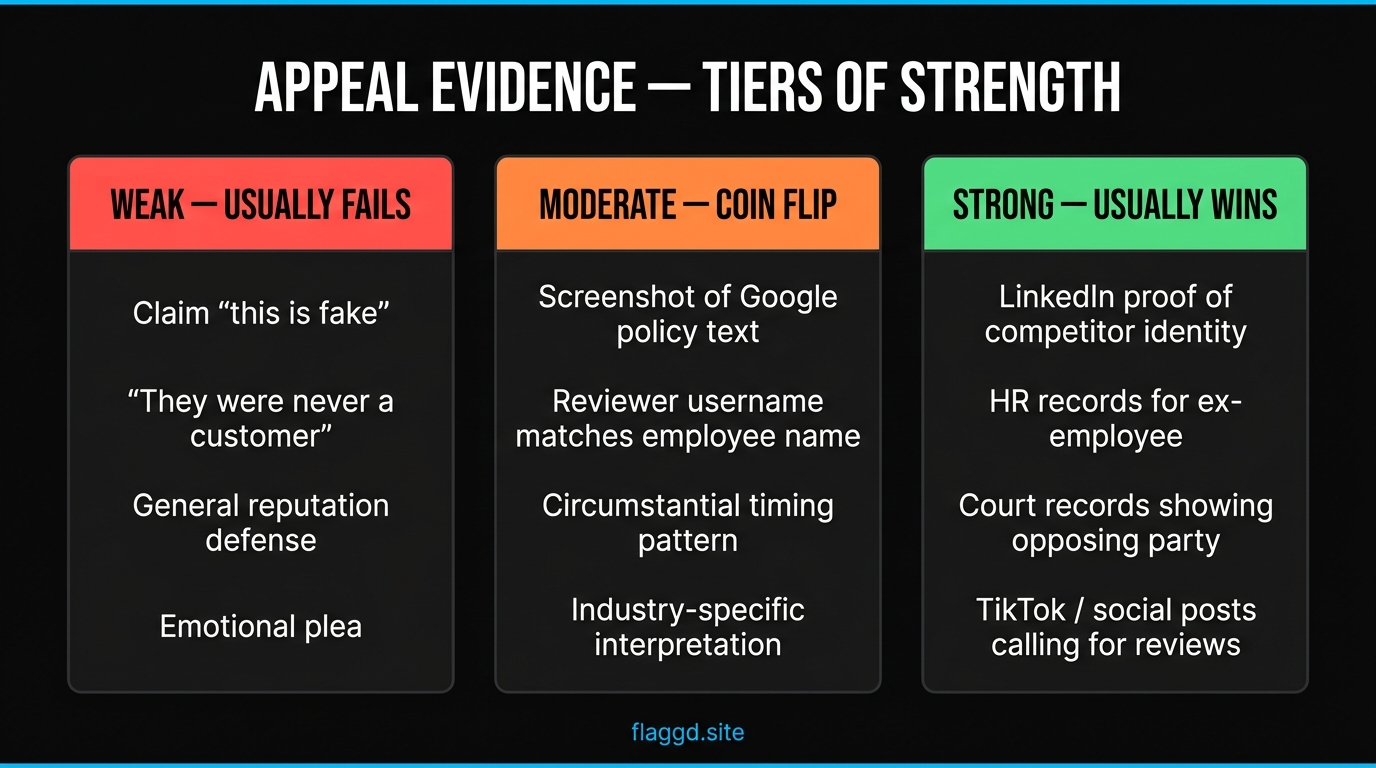
Weak evidence — "this is fake," "they were never a customer," generic reputation defense, emotional pleas — loses. Consistently. It's what produced most of the original denials.
Moderate evidence — screenshots of Google's policy text, reviewer username matching an employee name, circumstantial timing — is a coin flip. It depends on which moderator picks up your case.
Strong evidence — LinkedIn profiles proving competitor identity, HR records confirming an ex-employee, court documents showing opposing parties, screenshots of TikToks or social posts calling for review bombing — wins. This is what your second appeal needs. If you don't have strong evidence, go find it before you refile.
Escalating via the Google Business Profile Community
If the additional-review request also fails, your best remaining free option is the Google Business Profile Community forum. Product Experts monitor the forum and pick up cases that look like clear moderation errors. The format that works:
- Post in the reviews sub-forum with a clear title. "Request for re-escalation — appeal denied on [category]" beats "HELP fake review wrecking my business."
- Include your Case ID from the denial email. This is what lets an expert look up your case file directly rather than asking you to recount the whole story.
- Quote the specific policy clause the review violates and the specific review text that triggers it. Make the expert's job easy.
- Attach or link to your evidence. LinkedIn URLs, court filing references, HR documentation — whatever strong-tier evidence you have.
- Be patient and professional. Experts are volunteers. Rudeness kills cases that would otherwise succeed.
The legal route — defamation lawsuits and court orders
When policy-based paths are exhausted and the review is severe enough — false factual claims that measurably damage revenue, medical practices facing safety-related misinformation, professional services whose licenses depend on reputation — the legal route becomes rational. Not before. Below that threshold, the cost-benefit is almost always bad.
To prevail you must prove four elements of defamation: a false statement of fact (not opinion), publication to a third party (the review itself satisfies this), harm to reputation (measurable — lost customers, contract losses, revenue decline), and fault on the reviewer's part (they knew or should have known the statement was false). If any one element is missing, the defamation claim fails.
With a valid court order against the reviewer, Google's legal removal form becomes the fastest route in the entire process — response times are typically under 30 days and success rates approach 95%. The 6–18 month timeline and $5K–$50K cost are in the court system, not at Google.
When to stop trying and focus elsewhere
Not every review is worth fighting. The honest test: if the additional-review request fails and the Product Expert escalation does not move the case within 6 weeks, the review is almost certainly not coming down through policy paths. At that point, unless the review is severe enough to justify the legal route, the best remaining strategy is to out-volume it with new positive reviews — our 2026 review statistics report covers how many new 5-stars it typically takes to offset a single 1-star (the short answer: 10–20, depending on your current rating and total review count).
Frequently asked questions
One denial is not a verdict. It's a diagnostic. Figure out which of the five denial causes fits your case, pick the right path on the escalation ladder, bring strong-tier evidence, and most reviews that genuinely violate policy do eventually come down — just not on the first try.