Key Takeaways
- A name search is not a no record search. Repair orders are written against a vehicle, so the reviewer is often a spouse, an adult child or a fleet coordinator. Search plate, VIN, every phone number and the date window before you call anything fake.
- Five common reviewers never bought a repair from you. The tow-in, the shared-address mix-up, the warranty claimant, the declined estimate and the household name mismatch each need a different filing, and two are not removable at all.
- Price is not a Google matter. A charge that exceeded the written estimate is a state regulator question. California's Bureau of Automotive Repair caps an overrun at 10% without fresh authorisation, and Google will not enforce that for you.
- Your digital inspection log is the evidence nobody else has. Timestamped photos and a recorded authorisation turn "we have no record of this" into a dated, exportable file.
- Two replies create real exposure. Conditioning a refund or a free service on deletion runs into the FTC's review rule and its $53,088 per violation ceiling, and answering with a plate or an address publishes a customer's data.
- Why an auto shop's one stars are different
- The five reviewers who never bought a repair from you
- Which auto repair reviews Google actually removes
- What Google will not remove, however unfair it feels
- The five field search that wins the filing
- The warranty denial review, and how to handle it
- Filing and escalating: the routes and the clock
- Two replies that turn a review into a legal problem
- Between repair orders: making the next dispute quick
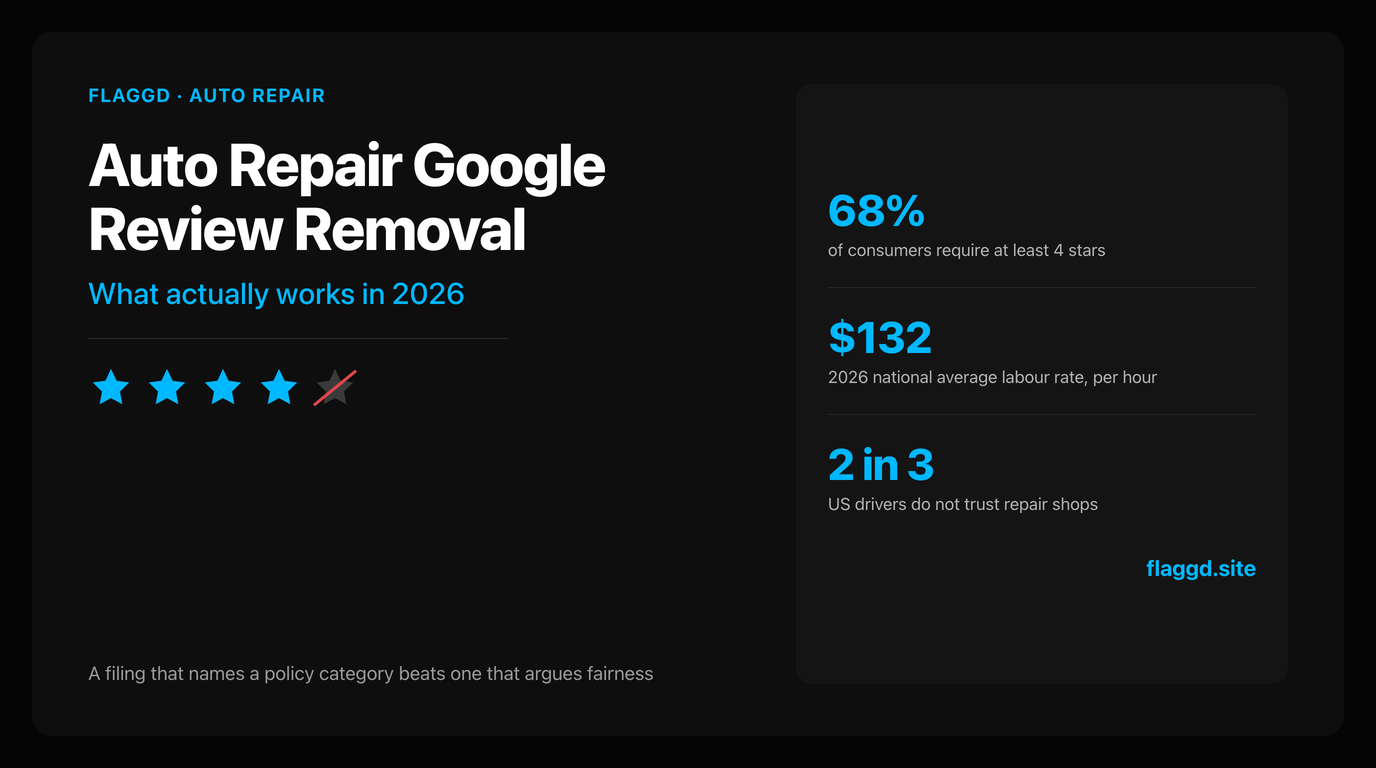
A one star lands at 7am from a name nobody at the counter recognises, describing a transmission job your shop does not even take, and by the time the first car is on the lift you have gone from 4.8 to 4.5. Auto repair Google review removal matters at exactly that moment, because in this trade the rating is arguing against a headwind: BrightLocal's 2026 Local Consumer Review Survey found that 68% of consumers now require a minimum of 4 stars before they will use a local business and 31% will not go below 4.5, up from 17% the year before, while AAA has been reporting since its 2016 consumer survey that two out of three US drivers do not trust repair shops in general, with 76% naming unnecessary recommended services as the reason. You start from suspicion, not neutrality. We file these disputes every week, and the difference between a removal and a denial is almost never how unfair the review is. It is whether the filing names a Google policy category and attaches records only your shop management system holds.
Why an auto shop's one stars are different
Nearly every other local business meets its customer in a calm state, on a chosen day, at a price agreed in advance. You meet yours after something broke, at a price that cannot be known until the car is on the lift and the codes are pulled, and then you keep their transport while they wait for an answer.
Two structural facts make the reviews land harder than they do on a dentist or a florist. The first is that price has no public anchor. Tekmetric's shop index, drawn from more than 10,000 shops across North America, puts the 2026 national average labour rate at $132 an hour, with state averages running from $85 to $197. The same brake job is fair in one market and daylight robbery in another, and reviewers compare against whatever number is in their head.
The second is that almost every job has a third party in it: a warranty administrator, an insurer, a fleet manager, a parts supplier whose remanufactured unit failed. When one of those parties says no, the customer is standing in your lobby, so the review lands on your listing.
- Quote shock. The teardown found more than the scan suggested and the invoice moved. Real customer, real job, genuine anger. Not removable, and the one that stings most.
- Declined work revenge. They paid the diagnostic, took the estimate to a cheaper shop, and rated you on the way out. Real transaction, so it stays.
- The third party no. An administrator or insurer denied the claim and you delivered the news. Real experience of your business, and rarely removable however unfair.
- The wrong listing. The review describes the tow yard, the body shop or the used car lot that shares your address or your first word. Removable, and badly under-filed.
Telling those four apart before you file is the whole job, because two of them will never come down however the filing is written. Our contractors and home services guide covers the ground these trades share; this one is about vehicles, repair orders and the third parties in between.
The five reviewers who never bought a repair from you
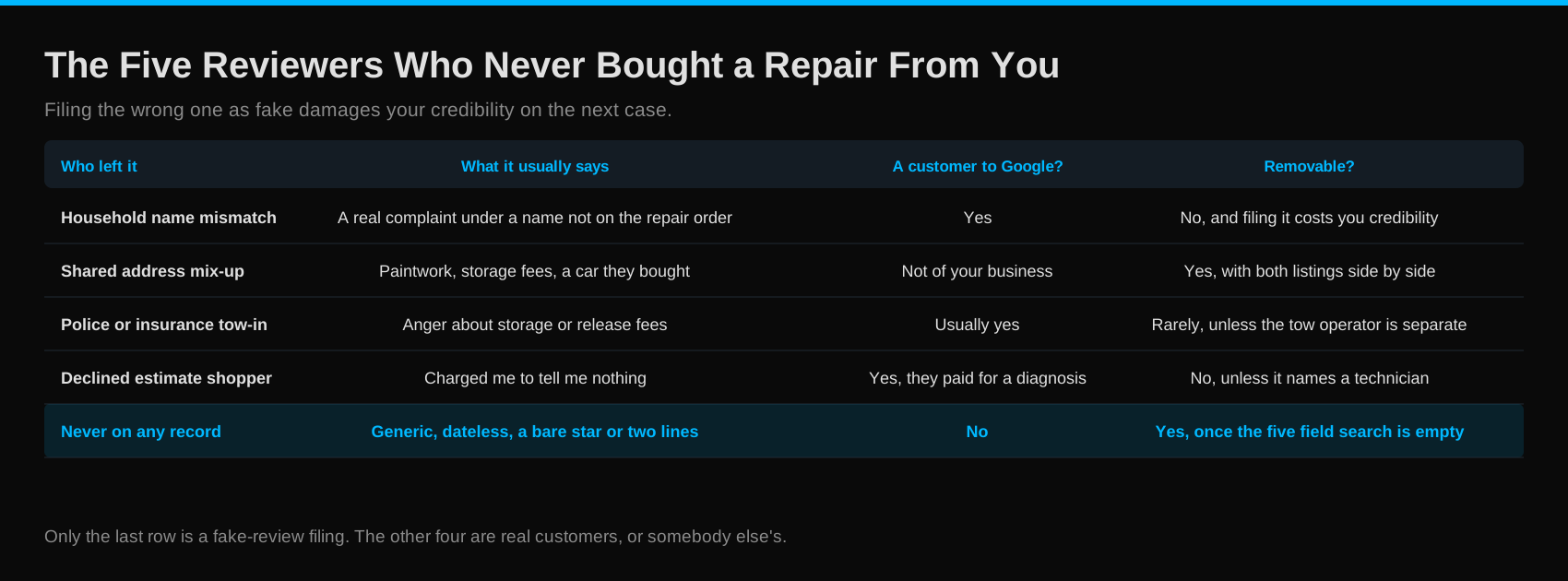
Auto repair has a wider cast of non-customers than any other local business, and each one produces a different filing. Getting the category right at this stage is what separates a removal from a week of waiting.
| Who left it | What it usually says | A customer in Google's sense? | Removable? |
|---|---|---|---|
| Household name mismatch | A real complaint about a real job, under a name not on the repair order | Yes | No. Filing it as fake damages your credibility on the next case |
| Shared address mix-up | Services you do not offer: paintwork, storage fees, a car they bought | Not of your business | Yes, with both listings shown side by side |
| Police or insurance tow-in | Anger about storage or release fees on a car they never brought you | Usually yes, they interacted with you | Rarely, unless the tow operator is a separate business with its own listing |
| Declined estimate shopper | "Charged me to tell me nothing" | Yes, they paid for a diagnosis | No, unless it names a technician's personal details |
| Never on any record | Generic, dateless, often a bare star or two lines | No | Yes, once the five field search comes back empty |
The first row is the one that costs shops the most. Repair orders are written against a vehicle, not a person, so the name on a Google account is frequently the spouse who paid, the adult child who dropped the keys, or the office manager of a small fleet. A shop that searches the name, finds nothing and files a fake review report has just told Google something untrue about a genuine customer, and the denial is deserved.
Which auto repair reviews Google actually removes
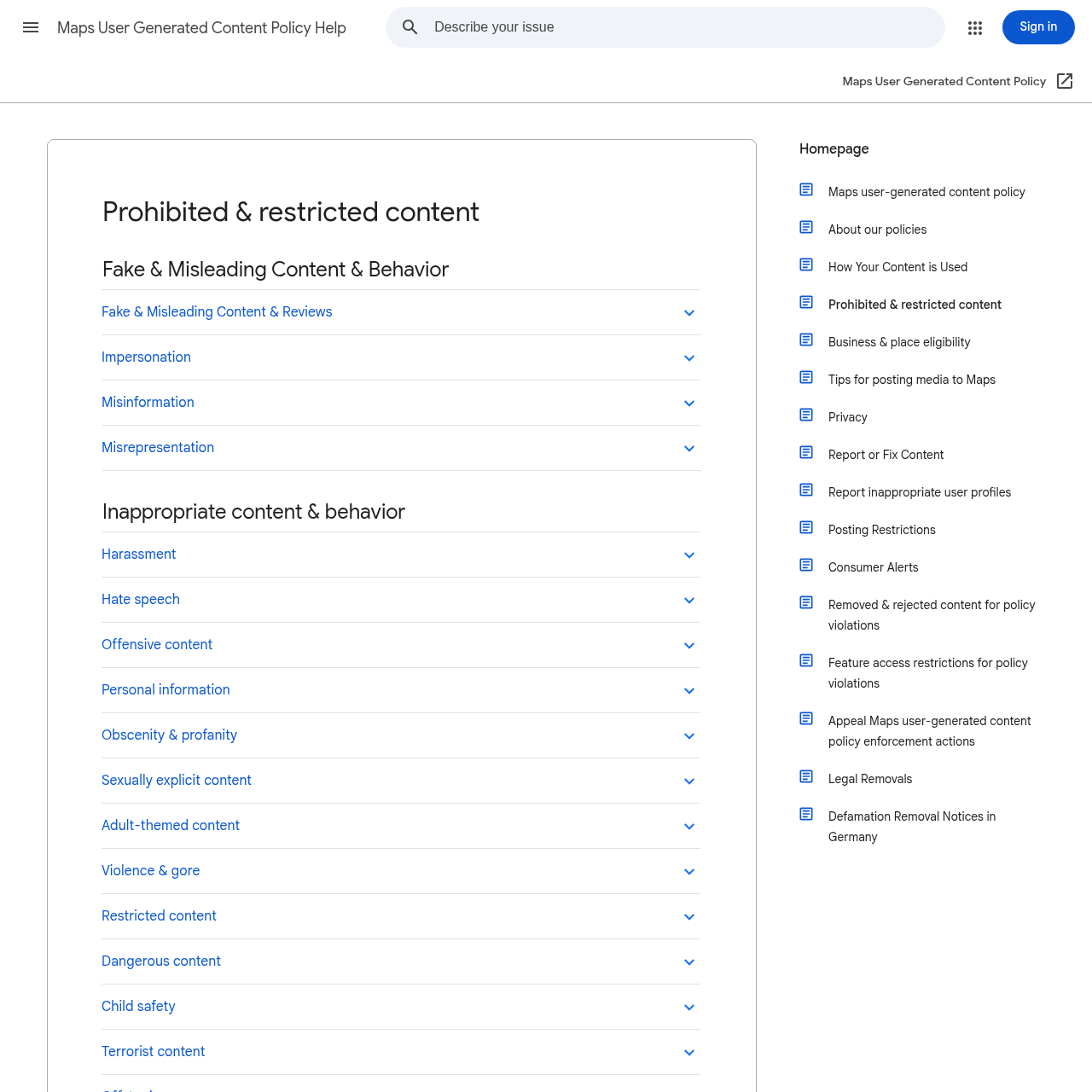
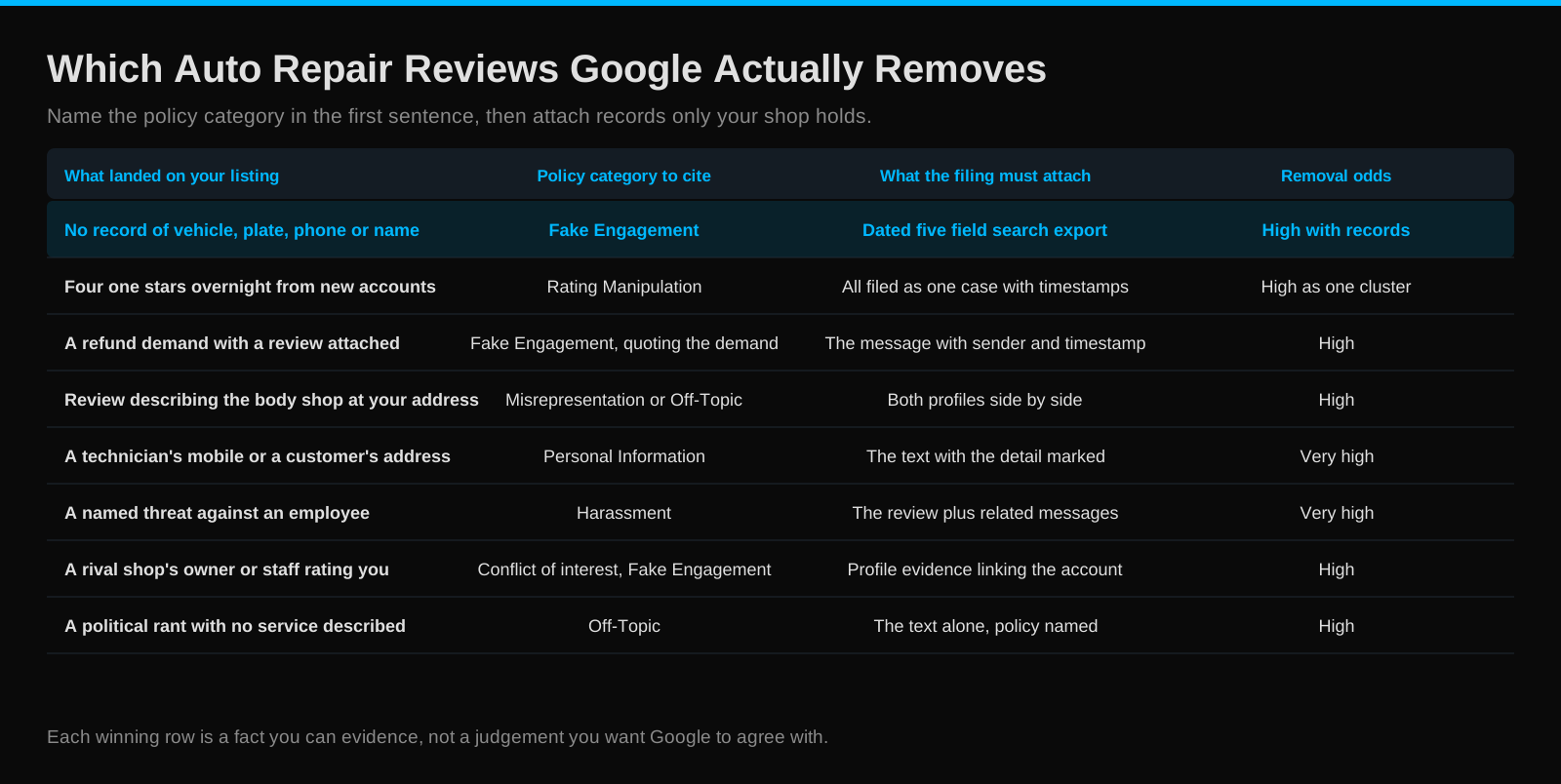
Google publishes the rules it enforces, and they are narrower than most owners assume. The prohibited and restricted content policy for Maps names each category: Fake Engagement, Rating Manipulation, Impersonation, Misrepresentation, Harassment, Personal Information, Off-Topic, Advertising and Solicitation, and a dozen more. Your filing has to land inside one of them. Nothing is removed for being harsh, and nothing is removed because you disagree with it.
Here is the map we use when an auto shop sends us a review, translated from what happened in the bay into what Google is prepared to act on.
| What landed on your listing | Policy category to cite | What the filing must attach |
|---|---|---|
| No record of the vehicle, plate, phone or name | Fake Engagement | Dated export of the five field search across the shop management system and card processor |
| Four one stars overnight from accounts days old | Rating Manipulation | All of them filed as one case, with timestamps, account ages and any shared reviewing pattern |
| A refund demand with a review attached | Fake Engagement, quoting the demand | The message itself with sender details and timestamp visible |
| Review describing the body shop or lot at your address | Misrepresentation or Off-Topic | Both Business Profiles side by side and the service you do not offer, circled |
| A technician's mobile number or a customer's address published | Personal Information | The review text with the identifying detail marked, nothing else needed |
| A named threat against an employee | Harassment | The review, plus any related messages to the shop |
| A rival shop's owner or staff rating you | Conflict of interest under Fake Engagement | Public profile evidence linking the account to the competing business |
| A political or personal rant with no service described | Off-Topic | The text alone, quoted back with the policy named |
Notice what the winning rows share. Each is a fact you can evidence rather than a judgement you want Google to agree with. The shared address row is the most under-used in this trade, because parcels with a repair bay, a tow operator and a used car lot are everywhere, each listing collecting the others' complaints. For the categories in full rather than the auto subset, our breakdown of every Google review violation type walks through all of them.
What Google will not remove, however unfair it feels
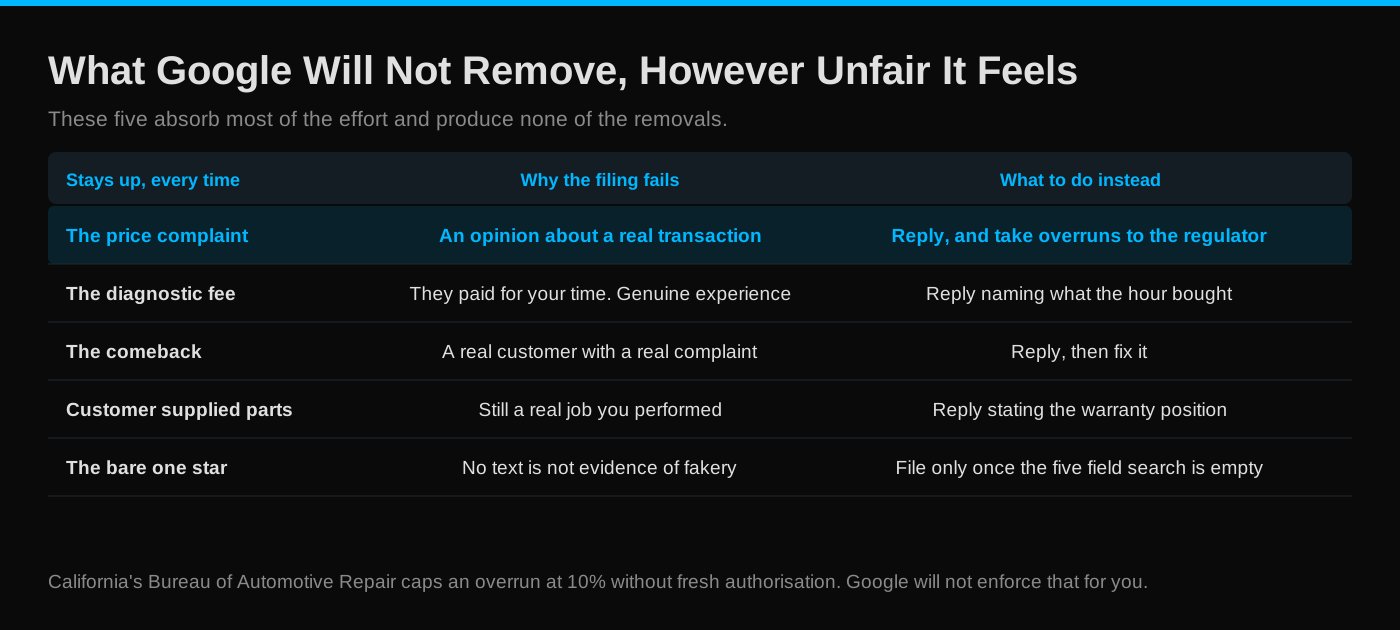
This is the section owners skip and then wish they had not, because the reviews listed here absorb most of the effort and produce none of the removals.
The biggest single misunderstanding in auto repair is the estimate overrun. A review saying you charged twice what you quoted feels like a factual claim you can disprove with paperwork, and in a regulatory sense it often is. California's Bureau of Automotive Repair requires a written estimate, authorisation before work begins and fresh authorisation for anything extra, with the underlying statute capping an overrun at 10% without that second approval. Most states have an equivalent. But that is a regulator's rule, enforced by the regulator. A filing that argues the reviewer is lying about the price comes back denied.
- The price complaint. Including the one where your paperwork proves the authorisation. It is an opinion about a real transaction.
- The diagnostic fee. They paid for your time and did not like what it bought. Genuine experience.
- The comeback. A repair that failed inside its warranty is the clearest possible case of a real customer with a real complaint.
- Customer supplied parts. You declined to warranty their part, they reviewed you for it. Still a real job.
- The bare one star. No text is not evidence of fakery. It becomes a filing only when the five field search comes back empty, and the case you make is the missing record, not the missing words.
When the review is one of these, the work moves from the dispute queue to the reply box. That is not a consolation prize: a calm, specific public reply is read by every future customer who scrolls past. If a previous attempt came back denied, what to do after a denial sets out the escalation properly.
The five field search that wins the filing
Assertion loses. Records win. In auto repair the records are unusually good, because your shop management system already logs everything a reviewer at Google would want to see, and most owners never export it.
| Field to search | Where it lives | Why it matters here |
|---|---|---|
| Plate and VIN | Repair order history | The only identifier that survives a change of name, address or payer |
| Every phone number | Customer record, call log, text thread | Catches the household mismatch before you file something untrue |
| Name and likely aliases | Customer record and invoices | Weakest field on its own, necessary for completeness |
| Date window either side of the review | Repair orders and appointment book | Shows the absence is a gap in your records, not a gap in your search |
| Card and payment processor | Processor portal | Independent of your own system, which is exactly why it carries weight |
Then add the thing no other trade has. Modern shop platforms send a digital vehicle inspection with timestamped photos, and the customer approves or declines each line from their phone. That log answers "they did work I never approved" with a timestamp, and "they invented the problem" with a photograph of the problem.
Capture before you reply, always, because reviewers edit and delete and an edited review takes your evidence with it. Screenshot the review with its timestamp and the reviewer's profile URL visible, then build the pack. Our guide to documenting evidence for a review dispute has the capture checklist in full and it applies to a repair shop unchanged.
The warranty denial review, and how to handle it
This one deserves its own section because shops burn more goodwill on it than on anything else, and it is almost never removable.
The sequence is always the same. A customer arrives with a third party vehicle service contract. You diagnose, you submit, the administrator sends an inspector or asks for teardown, and days pass while the car occupies a bay. Then the claim is denied as a pre-existing condition, the customer faces a bill they expected someone else to pay, and the review names your shop, because yours is the only party in the story they can find on Google.
The customer brought you the car, you inspected it and you delivered a decision. Google reads that as a genuine experience of your business, and it does not weigh who was at fault. So the dispute route is closed, and the reply route is open.
- Reply once, naming the administrator's process in general terms and no claim number, no customer name and no vehicle detail.
- Say what you did on their behalf: the submission, the photographs, the follow up calls, the days you held the bay.
- Keep the full file, dated, in case the customer escalates to your state regulator. That complaint, unlike the review, is decided on paperwork.
The prevention is a conversation at intake rather than a filing afterwards: tell every contract holder, in writing, that the administrator decides and that diagnostic time is payable whatever they decide. Shops that do this see the same denials and far fewer of the reviews.
Filing and escalating: the routes and the clock
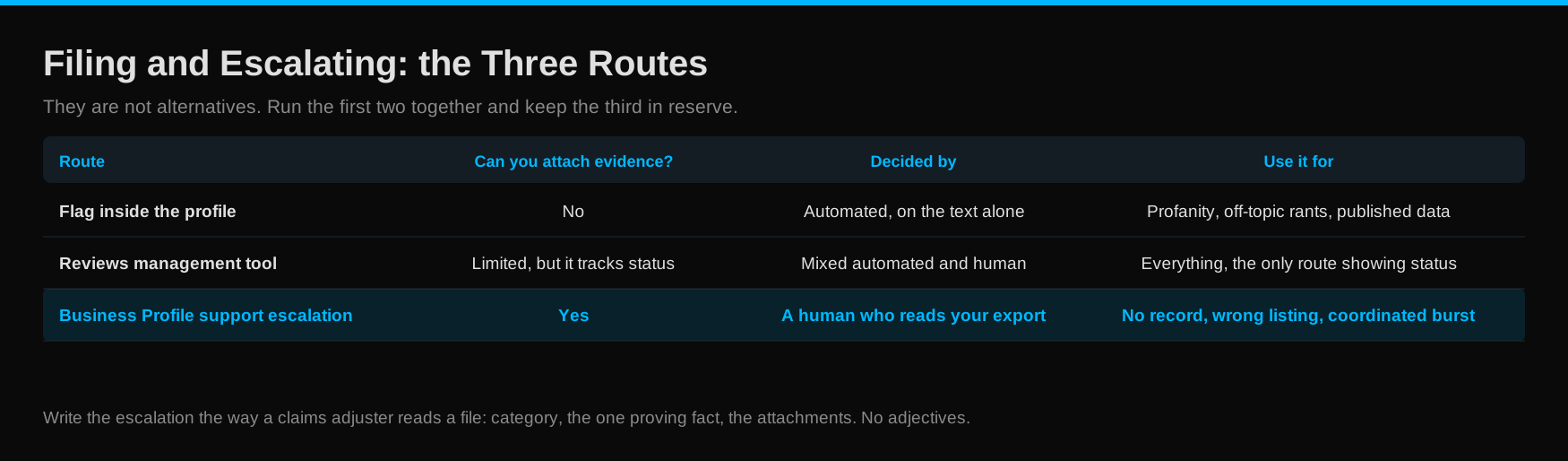
There are three ways in, and they are not alternatives. Run the first two together and keep the third in reserve.
| Route | Can you attach evidence? | Decided by | Use it for |
|---|---|---|---|
| Flag inside the profile | No | Automated systems, on the text alone | Obvious profanity, off-topic rants, published personal data |
| Reviews management tool | Limited, but it tracks status | Mixed automated and human | Everything, because it is the only route that shows you where a case stands |
| Business Profile support escalation | Yes | A human who can read your export | The no record case, the mis-targeted listing, the coordinated burst |
Write the escalation the way a claims adjuster reads a file. First sentence, the policy category by name. Second, the one fact that proves it. Third, the attachments, listed. Nothing about how long you have been in business, nothing about what the review has cost you, no adjectives at all. "This review breaches Fake and Misleading Content. A search of our repair order history on the plate, the VIN, the phone number in the review and the fortnight either side of 3 September returns no record. Attached: repair order export, payment processor search." That is the whole filing, and it outperforms two paragraphs of frustration every time. For realistic expectations on timing, how long Google takes to remove a review sets them out.
Your Bays Are Full. Your Afternoon Should Not Be Spent On Hold With Google.
Send us the review and your repair order export. Flaggd maps it to the right policy category, builds the evidence pack and files the escalation while you keep turning cars.
Flaggd is our own review dispute service. We file removals against Google's published content policies; we do not buy, sell or suppress legitimate reviews.
Two replies that turn a review into a legal problem
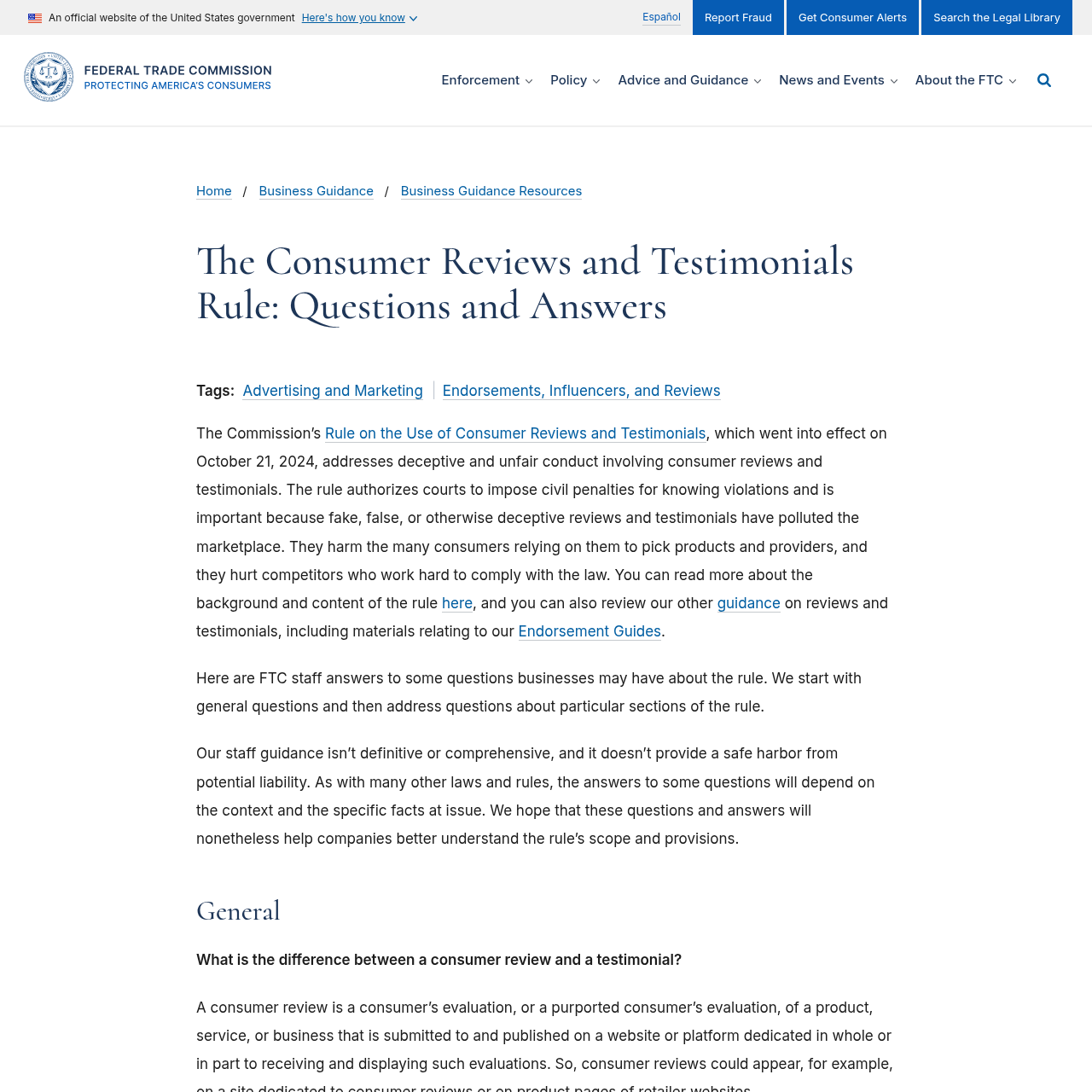
The first is the trade. A free oil change, a discounted brake job or a partial refund, offered on the condition that the review comes down. It is the most natural response in the world and it is the one with a federal rule attached. The Federal Trade Commission's Rule on the Use of Consumer Reviews and Testimonials, in force since 21 October 2024, treats conditioning anything of value on a review being removed or changed as review suppression, and it carries civil penalties of up to $53,088 per violation. The same rule prohibits unfounded legal threats made to get a review taken down, which rules out the letter some shops send next.
You can still fix the problem. Refund what should be refunded, redo what should be redone, and tell the customer plainly that they are welcome to update the review if their view changes. What you cannot do is make the money contingent on the words.
The second is the correction. The urge to reply with "your vehicle came in on the 14th with 187,000 miles, you declined the timing belt twice and the plate is on the invoice" is entirely understandable, and it publishes a customer's vehicle, mileage, address history and decisions to the open internet. Keep the public reply to one short paragraph that names no plate, no VIN, no address and no technician, then take the detail to a phone call. Our guide to responding to negative reviews has templates that hold that line, and the FTC fake review rule in 2026 covers the compliance side in depth.
Between repair orders: making the next dispute quick
Every shop that files fast has done three unglamorous things in advance, and none of them take a week.
Know how to export a plate and VIN search from your shop management system before you need it, and check your digital inspection records are retained for at least two years rather than whatever the default is. Put one person on the Business Profile with alerts on, so a burst is caught the morning it lands rather than the week it lands. And build the review request into the moment the keys go back, which in this trade is the highest trust minute you get with a customer.
Velocity is the defence that also works on the reviews Google was never going to remove. A shop turning a few hundred repair orders a month can bury a bad week faster than almost any other local business, and the arithmetic runs the other way too: a thin profile drops half a star on one review, a deep one barely registers it. Set up review monitoring and alerts first, then attach the request to the invoice step.
Frequently asked questions
I have no record of this customer. Is that enough to get the review removed?
A customer paid the diagnostic fee, declined the repair and left one star. Can I get it removed?
The review is about the body shop next door, not us. What do I file?
The customer's extended warranty company denied the claim and they blamed us. Is that removable?
Someone demanded a refund and said they would post a one star if I refused. What now?
Can I offer a free oil change if the customer takes the review down?
Google denied my flag. Is that the end of the road?
Auto repair Google review removal is a translation exercise, not a fairness argument. In your head the review is the customer whose warranty administrator said no, or the one who took your diagnosis to a cheaper shop and rated you on the way out. To Google it has to be a breach of a named content policy, evidenced by records your shop management system can export in minutes. Run the five field search before you file, name the category in your first sentence, run the flag and the escalation together, and accept early that price complaints and comebacks are reply work rather than dispute work. If you would rather hand the filing to a team that does this every day, that is what we are here for.