Key Takeaways
- Policy category, not unfairness, decides the outcome. Google removes reviews that break a named content policy. "This review is wrong and it is costing me work" is not a category, and disputes framed that way fail.
- Your dispatch software is the evidence. The single strongest HVAC filing is a no-record search across dispatch, phone system and payment processor for the reviewer's name, address, phone and email. Assertion loses, records win.
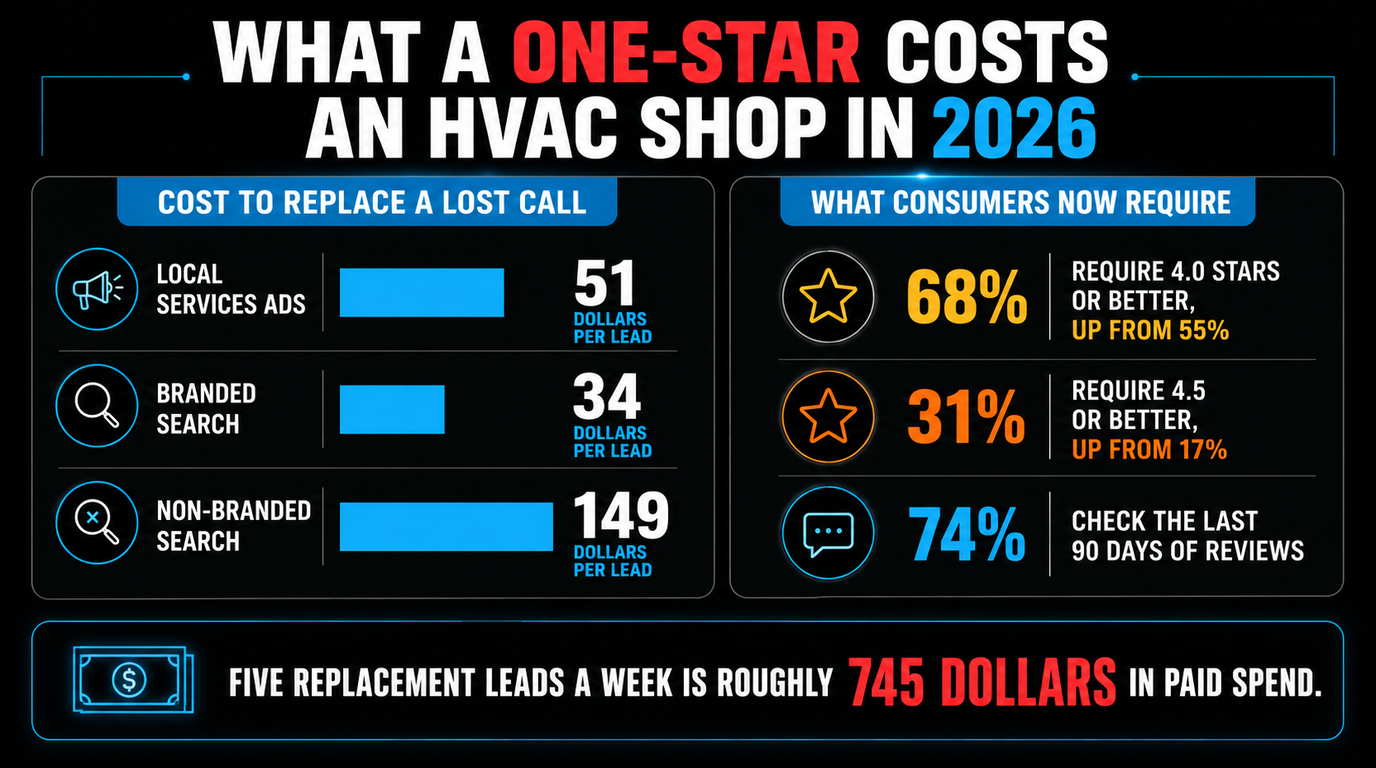
- Rating expectations moved against you in 2026. BrightLocal's 2026 survey found 68% of consumers now require at least 4 stars, up from 55% a year earlier, and 31% will only use a business at 4.5 or higher.
- The maths is brutal at HVAC lead prices. With non-branded HVAC search leads benchmarked near $149 in 2026, a rating drop that halves your organic call volume in July costs more in a fortnight than a year of reputation work.
- Never buy your way out. Paying an extortion demand does not reliably remove anything, and conditioning a refund on deletion or sending a groundless legal threat can breach the FTC's review-suppression rule.
- Why HVAC listings collect more disputable reviews than most trades
- The HVAC review types Google actually removes
- What Google will not remove, however unfair it feels
- The HVAC evidence pack that wins disputes
- Filing: three routes, and how long each one takes
- What a single one-star review costs an HVAC shop
- Review extortion in the trades, and the FTC line you must not cross
- Off-season hardening: making the next dispute a 20-minute job
It is the second week of a heat wave, your board is stacked with no-cool calls, and a one-star review lands from a name nobody at the shop recognises. HVAC Google review removal is not a vanity exercise at that moment: BrightLocal's 2026 Local Consumer Review Survey found 68% of consumers now require a minimum of 4 stars before they will use a local business, up from 55% a year earlier, so a rating that slips from 4.6 to 4.3 in peak season quietly removes you from a third of your market's shortlist while your phones are already ringing. We have run this dispute pattern enough times to know exactly which HVAC filings Google acts on and which ones come back denied within a week, and the difference is almost never the strength of the grievance.
This guide is written for the owner or service manager of a residential HVAC shop, not for a marketing agency. It covers why HVAC listings attract a disproportionate share of removable reviews, the exact policy categories Google enforces, the evidence pack you can pull from your dispatch software in twenty minutes, the three filing routes and their real timelines, what a one-star actually costs at 2026 lead prices, and the two moves that will get you in trouble with the FTC rather than out of trouble with Google.

Why HVAC listings collect more disputable reviews than most trades
Most negative reviews across local business are honest reports of a bad experience. HVAC is one of the trades where a meaningful minority are not, and the reasons are structural rather than bad luck.
The buying moment is a crisis, not a decision. Nobody shops for emergency heat at leisure. A homeowner with a dead furnace in January calls the first three shops in the local pack, and the two that could not come out that night are as likely to be blamed as the one that did. Reviews written for "you did not answer at 11pm" describe no transaction at all, which is precisely the ground Google removes on.
The diagnostic fee is a built-in dispute. A residential diagnostic runs roughly $75 to $200 nationally, with most shops charging $99 to $159 in 2026. Customers who decline the quoted repair and still owe the trip charge produce a reliable stream of one-star reviews that mention no work, no technician and no date, because there was none. Those reviews are usually genuine opinions about a genuine transaction, which makes them frustrating and unremovable.
Third-party lead platforms scramble the attribution. When a homeowner books through a lead marketplace or a home warranty network, they frequently do not know which company actually turned up. Reviews land on the wrong Google listing constantly in this trade, and a review describing a job you never held is removable once you can show your dispatch records contain nothing matching it.
Named technicians attract personal attacks. HVAC reviews name the tech far more often than reviews in most categories, because the customer spent two hours with one person in their home. When a review moves from "the work was poor" to naming and abusing an individual, or publishing their phone number or vehicle details, it crosses into Google's harassment and personal information policies and becomes straightforwardly removable.
Seasonality makes you a soft target. Coordinated attacks land in July and January, not April, because that is when a rating drop converts to lost revenue fastest and when the owner is too busy to respond. The same structural pressure applies to the wider trades, which is why our contractor and home services removal guide covers the shared groundwork this article builds on.
The HVAC review types Google actually removes
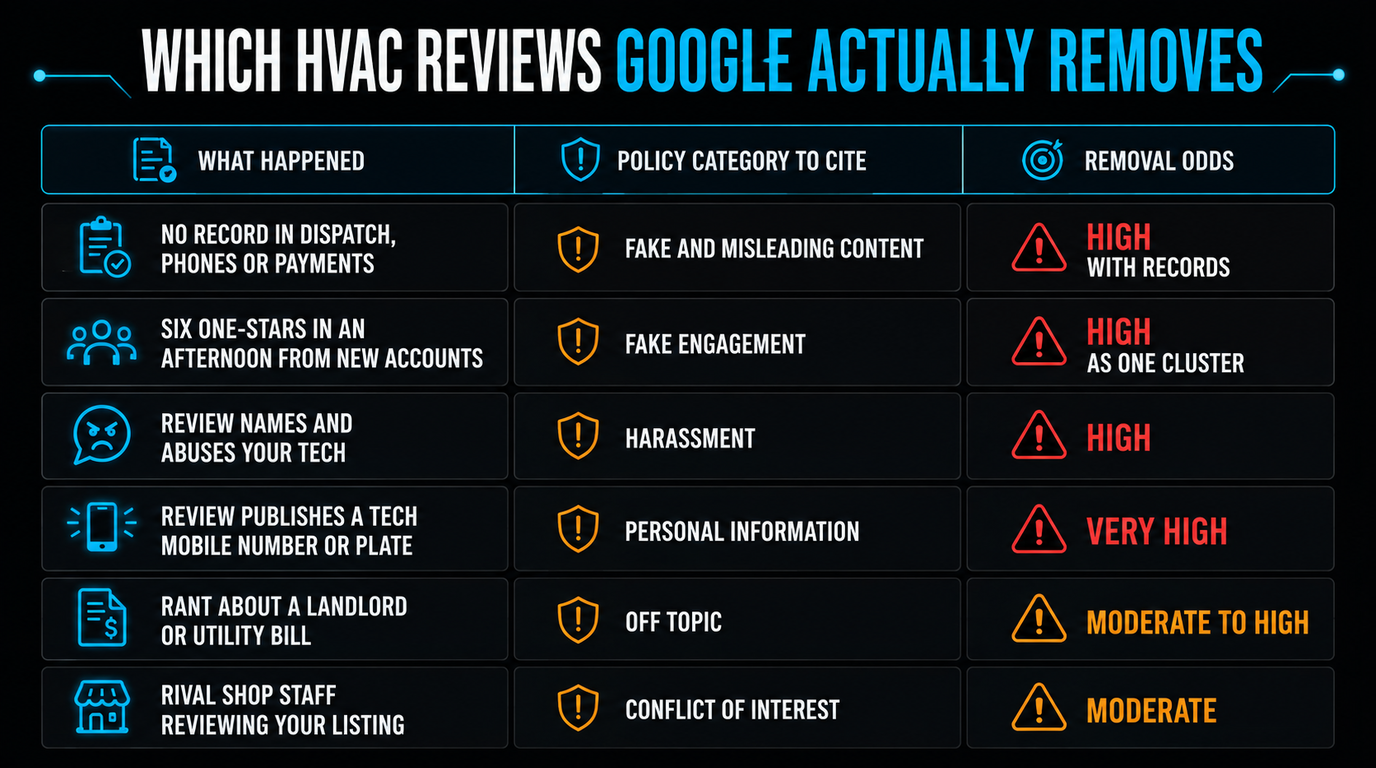
Google publishes named prohibited and restricted content categories in its Maps user contributed content policy, and a dispute is judged against those names. Your job is to translate what happened at the shop into the category a moderator recognises. The table below is that translation for the scenarios HVAC shops file most.
| What happened | Google policy category to cite | Removal odds |
|---|---|---|
| Reviewer has no record in dispatch, phones or payments | Fake & Misleading Content | High with records, low without |
| Six one-stars in an afternoon from accounts made that week | Fake Engagement / Rating Manipulation | High when filed as one cluster |
| Review names your tech and abuses him personally | Harassment | High |
| Review publishes a technician's mobile number or plate | Personal Information | Very high |
| Sustained profanity with no service content | Obscenity & Profanity | High |
| Rant about a landlord, a utility bill or a permit office | Off-topic | Moderate to high |
| Rival shop's owner or staff reviewing your listing | Conflict of interest / Misrepresentation | Moderate, needs linkage proof |
| Review is for a different HVAC company entirely | Misrepresentation / Off-topic | High, quote the mismatch |
| Ex-installer posting after a bad exit | Conflict of interest | Moderate with HR dates attached |
Cite the category by name in your submission. Moderators triage volume, and a filing that opens with "this review breaches your Fake and Misleading Content policy because our dispatch system holds no record of this address" is routed and decided faster than three paragraphs of context.
What Google will not remove, however unfair it feels
Half the HVAC disputes we see fail because they were never removable. Knowing the boundary saves you weeks of filing and re-filing, and it redirects the effort to the response, which is where those reviews are actually won or lost.
Price complaints stay up. "They charged $159 to tell me the capacitor was gone" is a truthful account of a real visit. It is not a policy breach, and no amount of explaining your cost structure to Google will move it.
Disagreements about the diagnosis stay up. A homeowner who got a second opinion and believes you oversold a system replacement is expressing an opinion about a service they received. Google does not adjudicate technical disputes between contractors and customers.
Star-only reviews with no text stay up. A bare one-star from a genuine customer carries no content to evaluate, and Google will not remove it for having no explanation. A bare one-star from an account with no history that appeared alongside five others is a different matter, and that is a cluster case.
Old reviews stay up. There is no ageing-out rule. A four-year-old one-star from an owner who sold the business is still live, and the only remedy is burying it under recent volume. That matters more in 2026 than it used to: BrightLocal found 74% of consumers now look for reviews written in the last three months.
If your review lands in this group, skip the filing and go straight to a reply. Our guide on responding to negative reviews covers the structure that works on price disputes specifically.
The HVAC evidence pack that wins disputes
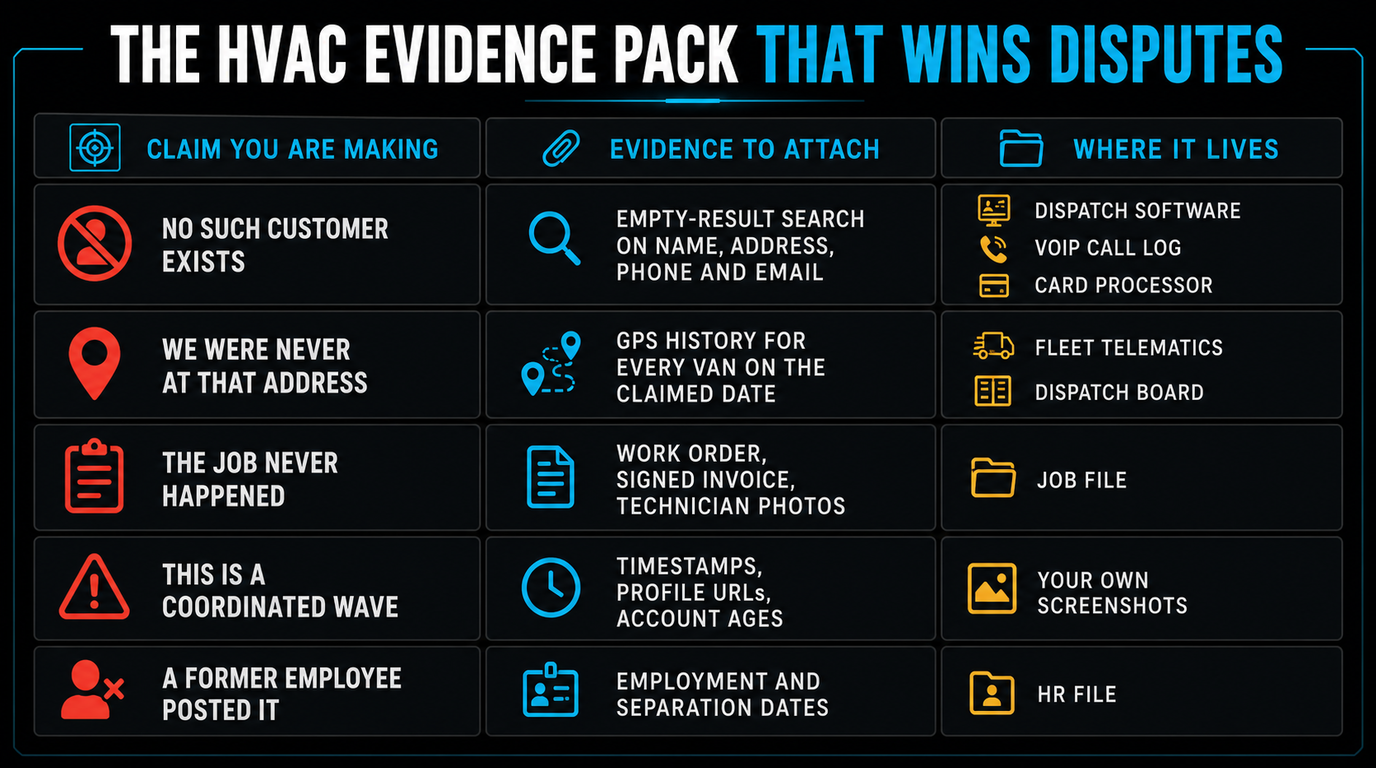
This is the part HVAC shops are unusually well equipped for and unusually bad at using. Your dispatch software already logs everything a moderator needs. Pull it before you file, not after you are denied. The general evidence documentation method applies across trades; the table below is the HVAC-specific version.
| Claim you are making | Evidence to attach | Where it lives |
|---|---|---|
| No such customer exists | Empty-result search on name, address, phone and email across all three systems, screenshotted with the query visible | ServiceTitan / Housecall Pro, VoIP call log, card processor |
| We were never at that address | GPS history for every van on the claimed date, plus the day's completed job list | Fleet telematics, dispatch board export |
| The job described never happened | Work order, signed invoice and technician job photos showing what was actually done | Job file, photo attachments |
| This is a coordinated wave | Timestamps to the minute, reviewer profile URLs, account ages, prior review counts, shared phrasing highlighted | Your own screenshots, taken immediately |
| A competitor is behind it | Reviewer's public review history showing five-stars for one rival and one-stars for that rival's competitors | Reviewer profile page |
| A former employee posted it | Employment dates and separation date, with the profile name or photo match | HR file |
Screenshot the review itself before you do anything else. Attackers delete accounts and edit text within 24 to 48 hours, and a review Google removes before you captured it cannot be used later if the campaign escalates into something legal.
Filing: three routes, and how long each one takes
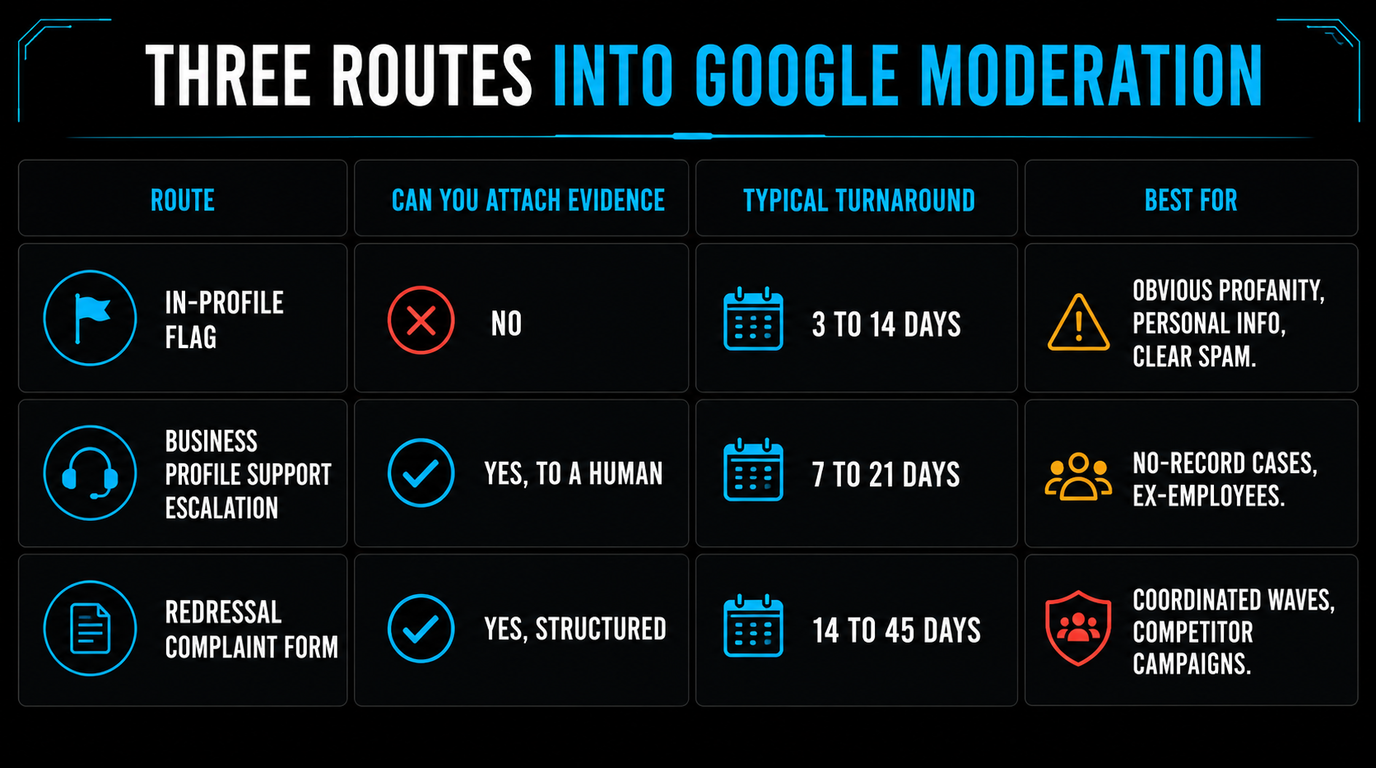
There are three ways into Google's moderation queue and they are not interchangeable. Most HVAC owners only know the first one, which is also the weakest, because it gives you nowhere to put the dispatch records you just pulled.
| Route | Can you attach evidence? | Typical turnaround | Best for |
|---|---|---|---|
| In-profile flag | No | 3 to 14 days | Obvious profanity, personal info, clear spam |
| Business Profile support escalation | Yes, to a human | 7 to 21 days | No-record cases, ex-employees, anything needing proof |
| Redressal Complaint Form | Yes, structured | 14 to 45 days | Coordinated waves, competitor campaigns, repeat offenders |
Run the flag and the escalation in parallel, not in sequence. Flag every review in scope first so the cluster enters the automated queue, then escalate the strongest two or three with full evidence. Waiting for a flag result before escalating adds two weeks to a July problem for no gain.
A denial is a first pass, not a verdict. The in-profile flag is decided without your records because the form has nowhere to put them, so a denial there tells you almost nothing about the merits. What to do next is covered in detail in our guide on what to do when a removal request is denied, and the realistic waiting periods are set out in how long Google takes to remove a review.
What a single one-star review costs an HVAC shop
Owners underinvest in this because the cost is invisible. It shows up as calls that never came, not as an invoice. The way to make it concrete is to price the replacement traffic you would have to buy to stand still.
| Channel or measure | 2026 benchmark | What it means when your rating slips |
|---|---|---|
| Local Services Ads | around $51 per lead | Cheapest replacement, but LSA ranking is itself review-weighted |
| Branded search | around $34 per lead | Only reaches people already looking for you by name |
| Non-branded search | around $149 per lead | This is what organic local pack calls actually cost to replace |
| Consumers requiring 4.0 stars or better | 68% in 2026, up from 55% | Dropping below 4.0 removes you from most shortlists outright |
| Consumers requiring 4.5 or better | 31% in 2026, up from 17% | The 4.7 to 4.4 slide is no longer cosmetic |
| Consumers checking last-90-day reviews | 74% | A fresh one-star outweighs forty older five-stars |
Work it through for your own shop. If peak-season organic brings you twenty calls a week and a rating drop costs you a quarter of them, five replacement leads a week at non-branded search prices is roughly $745 a week in paid spend to hold the same board, before you have booked a single job. Lead-price benchmarks vary by market and source, so treat the figures above as order-of-magnitude anchors rather than quotes, and check them against your own ad account. Either way, the arithmetic settles the question of whether a fake review is worth twenty minutes of dispatch-record pulling.
Review extortion in the trades, and the FTC line you must not cross
Extortion campaigns hit HVAC contractors hard because the trade depends on ratings for visibility and because peak season creates urgency the attacker can price. The pattern is consistent: a burst of one-star reviews from new accounts, then an email or direct message offering to remove them for a fee, often a few hundred dollars, escalating if you engage.
Do not pay. Payment does not reliably remove anything, because the attacker frequently cannot delete reviews posted from burner accounts they have already abandoned. It also confirms you are a business that pays, and repeat waves against known payers are the norm. Our extortion defence guide sets out the full response sequence.
Preserve, flag, report, in that order. Screenshot the demand with full headers and every review in the cluster before flagging. Flag the wave as fake engagement citing the shared timestamp window and account ages. File with the FBI Internet Crime Complaint Center at ic3.gov, which creates the federal record that matters if the campaign recurs or the sender is identifiable.
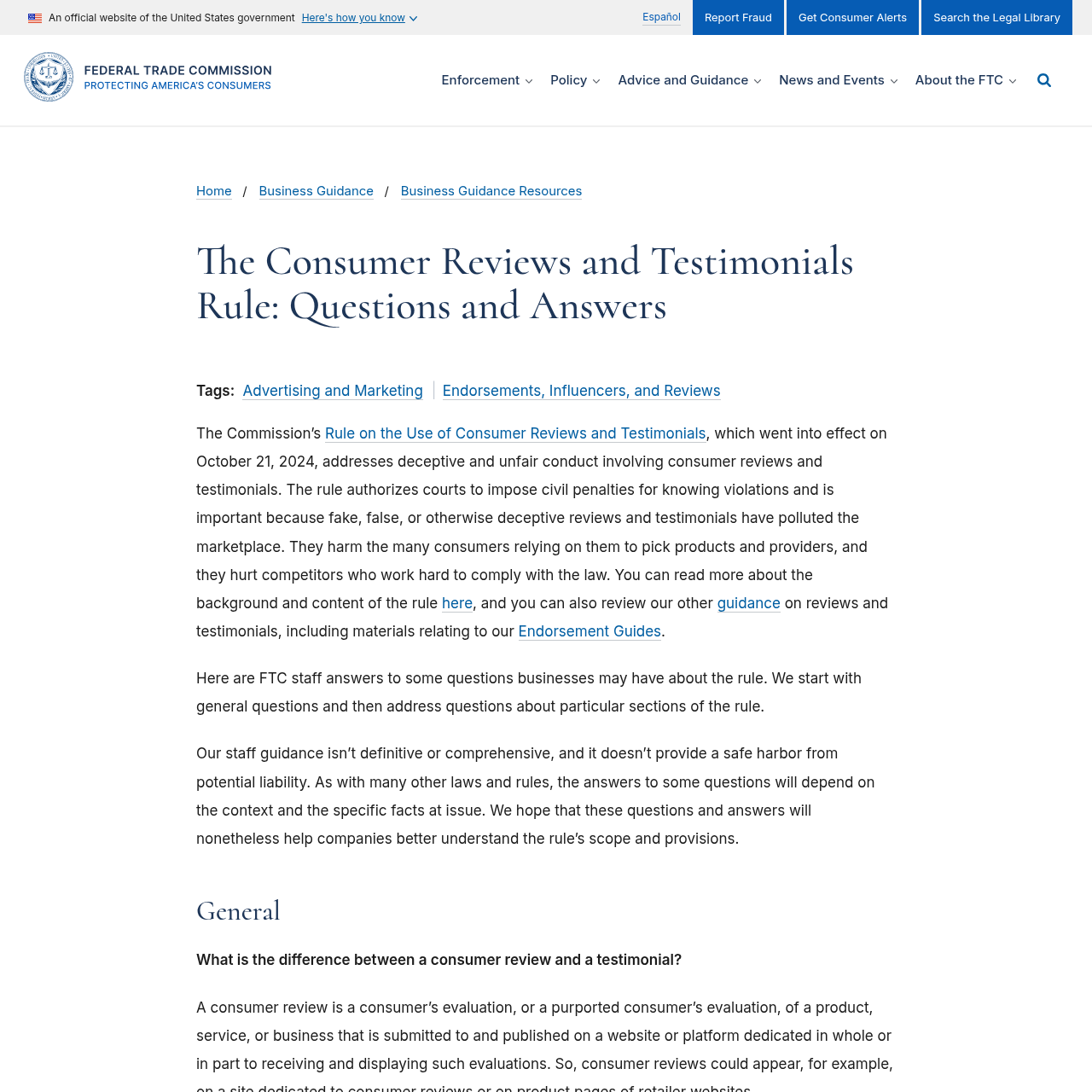
Now the line that catches honest owners. The FTC's Consumer Reviews and Testimonials Rule took effect on 21 October 2024, and its review-suppression provision prohibits using false accusations, threats, intimidation, or unfounded legal threats to get a review taken down. A demand letter from your attorney over a review that is merely unflattering is exactly the conduct the rule targets. The same rule bars conditioning compensation on a review expressing a particular sentiment, which is why "refund if you delete it" is a bad idea even when the refund is deserved.
The safe version is simple and works more often than owners expect: fix the underlying problem, tell the customer what you fixed, and say nothing at all about the review. Customers update reviews on their own initiative regularly once the complaint is genuinely resolved, and a self-initiated update carries none of the compliance risk. What the rule means in practice for small businesses is covered in our FTC fake review rule breakdown.
Off-season hardening: making the next dispute a 20-minute job
Every removal we have described gets faster when the groundwork is already done. Spring and autumn are when HVAC shops have the slack to do it, and it is the difference between a twenty-minute filing and a lost week in July.
Set an alert on your own listing. Most owners find out about a wave days later from a customer. Same-day detection is what keeps evidence capturable, because attacker accounts start disappearing within 48 hours.
Make the dispatch search a documented procedure. Write down which three systems get searched, on which four fields, and who does it. When it is a checklist rather than a scramble, the evidence pack is consistent and a service manager can build it without the owner.
Ask every completed job for a review, and mean it. A shop taking eight reviews a month absorbs a one-star in a fortnight. A shop taking one a quarter carries it for a year. Given that 74% of consumers now look at the last three months, review velocity is defensive infrastructure, not vanity.
Have technicians log the customer identity properly. Most no-record disputes are won or lost on whether the job file carries a real phone number and email rather than "cash, front door". Clean intake data is what turns "we do not recognise this person" into a provable claim.
Frequently asked questions
HVAC Google review removal comes down to a translation problem. The review that is hurting you is described in your head as unfair, expensive and badly timed, and it has to be described to Google as a breach of a named content policy, backed by records you already hold. Shops that make that translation get removals; shops that write to Google about how much the review is costing them get denials. Pull the dispatch search before you file, cite the category by name, run the flag and the escalation in parallel, and reserve the reply for the reviews that were never going to come down. Then use the shoulder season to set the alert, write the checklist and build the review velocity that makes the next one a twenty-minute job instead of a bad week in July. If you would rather hand the filing to someone who does it daily, that is what we are here for, and either way the reviews that break Google's rules do not have to stay on your listing.