Key Takeaways
- Plumber Google review removal starts in your dispatch software. The strongest filing is a no-record search across dispatch, call recordings, invoices and the payment processor on the reviewer's name, phone, service address and date. Assertion loses, records win.
- Local Services Ads has no separate dispute path. Google says reviews are managed through Business Profile Manager, not the Local Services Ads account. One pool, one filing, and a removal clears both surfaces.
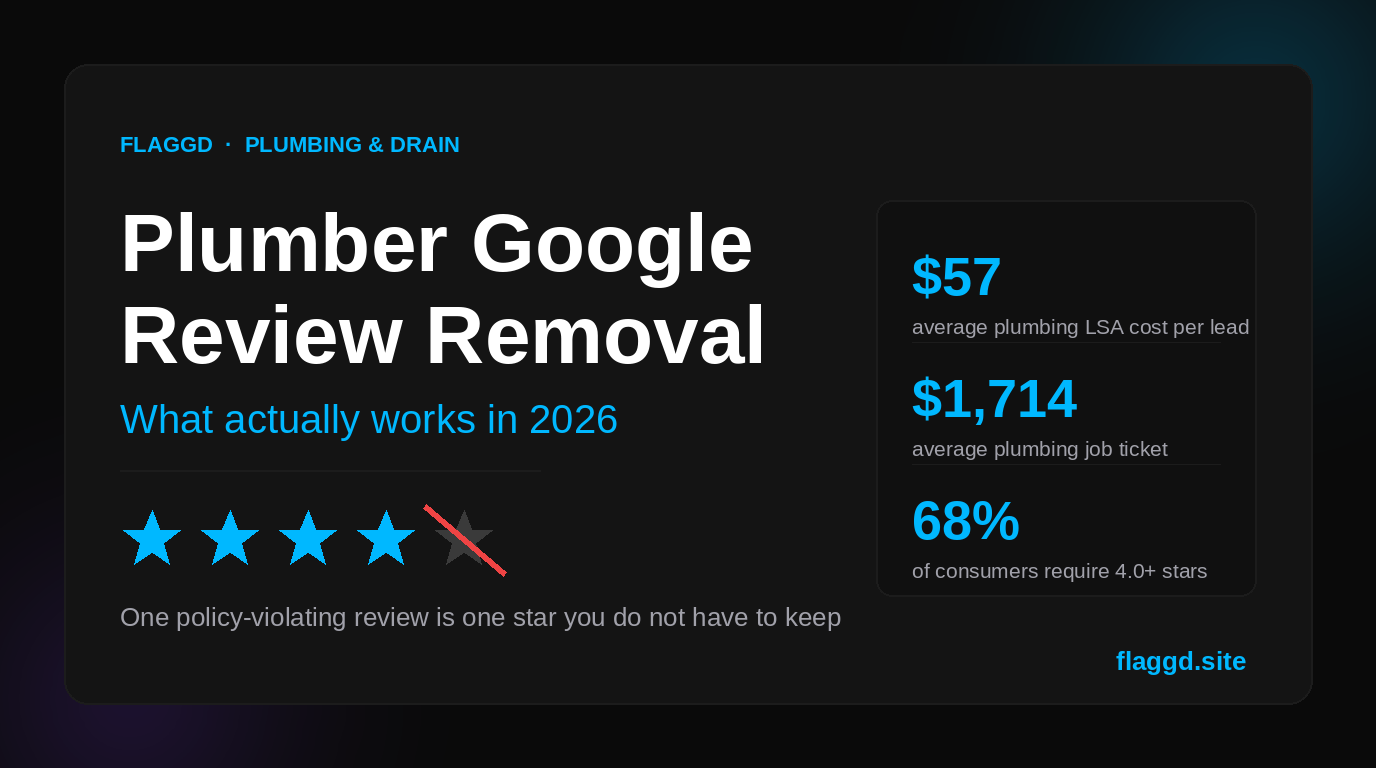
- A star costs you paid leads, not just organic ones. Star ratings affect Local Services Ads ranking, and February 2026 benchmark data puts plumbing at a $57 cost per lead, a 44.5% book rate and a $1,714 average ticket.
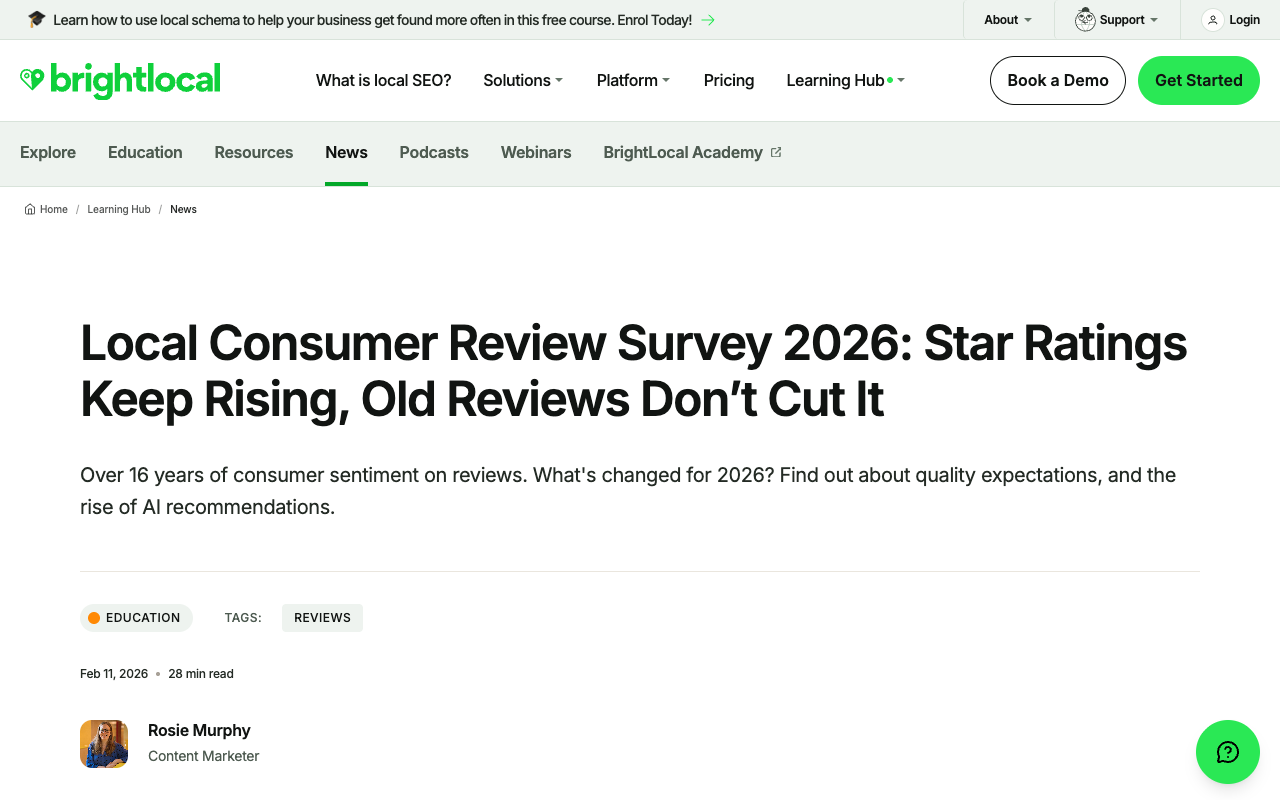
- Rating expectations tightened in 2026. BrightLocal's 2026 survey found 68% of consumers require at least 4 stars and 31% will not go below 4.5, up from 17% a year earlier.
- Two replies create legal exposure. Conditioning a refund or discount on deletion runs into the FTC's review rule, and naming a customer's address or a technician in public turns a review problem into a privacy problem.
- Why plumbing listings collect reviews other trades never see
- The Local Services Ads myth that costs plumbers weeks
- The plumbing review types Google actually removes
- What Google will not remove, however unfair it feels
- The dispatch-record evidence pack that wins disputes
- Filing: three routes, and how long each one takes
- What one star costs a plumbing company in 2026
- The two replies that turn a review problem into a legal one
- Between call-outs: making the next dispute a 20-minute job
A one-star lands at 6am naming a technician who left you in March and an address you have never dispatched to, and by the time the first van rolls your rating has gone from 4.7 to 4.4. Plumber Google review removal matters at exactly that moment, because in plumbing the rating is not a vanity number: BrightLocal's 2026 Local Consumer Review Survey found that 68% of consumers now require a minimum of 4 stars before they will use a local business, and 31% will not go below 4.5, up from 17% a year earlier. The homeowner with water on the floor does not shortlist you and then reject you. They never see you. We have filed enough trade disputes to know which plumbing reviews Google acts on and which come back denied, and the difference is almost never how unfair the review is. It is whether the filing names a policy category and attaches records.
Why plumbing listings collect reviews other trades never see
Plumbing has a structural review problem that dentists and law firms do not. Almost every other local business meets its customer in a calm state, on a scheduled day, at a price agreed in advance. You meet yours at 2am, in a flooded utility room, at emergency rates, with a diagnosis that changes once the wall is open.
That produces four review patterns that are unusually common in this trade and unusually easy to mistake for one another. Telling them apart is the whole job, because two of them are removable and two are not.
- Quote shock. The diagnosis changed once the wall came off and the invoice doubled. Real customer, real job, genuine anger. Not removable, and the one that stings most.
- Mistaken identity. Three companies in your metro share a first word. The reviewer is describing someone else's van. Removable, and more common than owners expect.
- The subcontracted job. A builder brought you in, the homeowner never hired you, and the review lands on your listing because yours is the name on the invoice. Usually stays, and the reply matters more than the flag.
- The manufactured attack. A burst of one-stars from week-old accounts, or a demand for a refund with a review attached. Removable, and the pattern is the proof.
The trade also carries a reviewer population no one warns you about: the tenant whose landlord hired you, the neighbour affected by the shutoff, the property manager's assistant, and the homeowner whose warranty callback was declined. Some of those are customers in Google's sense and some are not, and the distinction is what decides your filing. Our general contractor and home services guide covers the shared ground; this one is about the parts that are specific to pipes, dispatch and paid leads.
The Local Services Ads myth that costs plumbers weeks
Most plumbing shops running paid leads believe they have two separate review systems, and so they go looking for a dispute button inside the Local Services Ads dashboard. There isn't one, and the search burns days while the review sits there suppressing lead flow.
Google is explicit about this. Its Local Services Ads reviews documentation states that customer reviews are managed through Google Business Profile Manager, not the Local Services Ads account, and that star ratings and review counts affect how a business is ranked within Local Services Ads. One review pool, one dispute path, two surfaces that both get worse when a fake review sticks.
| Question | Google Business Profile | Local Services Ads |
|---|---|---|
| Where the reviews live | The source of record | Displays the same reviews |
| Where you file a removal | Here, always | No dispute path of its own |
| What the rating affects | Map pack and organic visibility | Ad ranking, so paid lead volume |
| Badge status in 2026 | Not applicable | Google Verified since 20 October 2025 |
| Money-back guarantee | Never existed | Discontinued with the badge change |
The badge change matters more than it looks. Google consolidated the Google Guaranteed, Google Screened and License Verified badges into a single Google Verified badge on 20 October 2025, and the money-back guarantee that used to sit behind the green checkmark went with it. The badge still signals that you passed screening, but it no longer buys the homeowner any financial reassurance. Your star rating is now carrying more of the trust load on that ad unit than it was a year ago, which is precisely why a fake one-star hurts your paid leads and your organic ones at the same time.
The plumbing review types Google actually removes
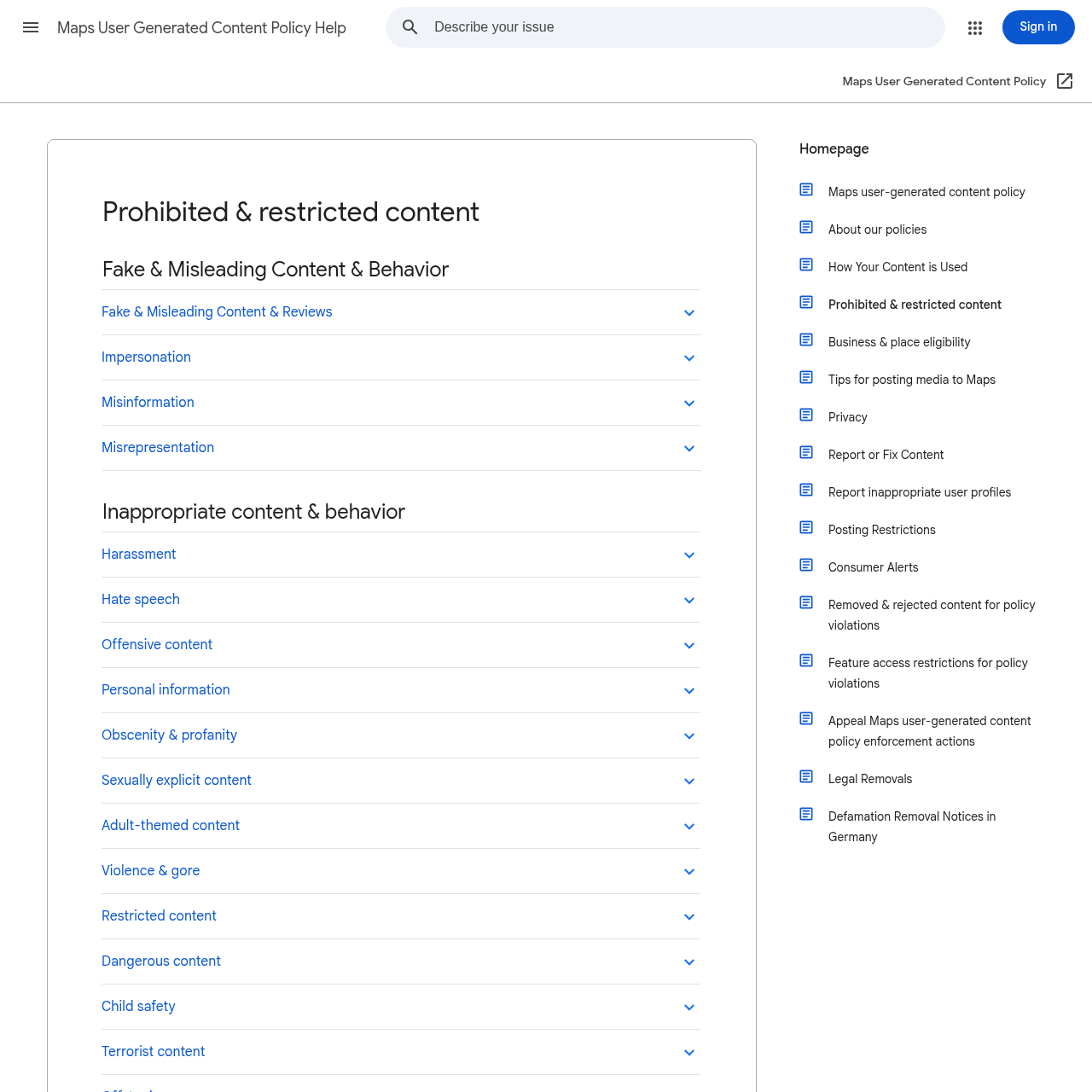
Google does not remove reviews for being wrong, unfair or commercially damaging. It removes content that breaches a named policy in its prohibited and restricted content rules for user contributed content. Your job is translation: take what you know happened and restate it as the category Google recognises.
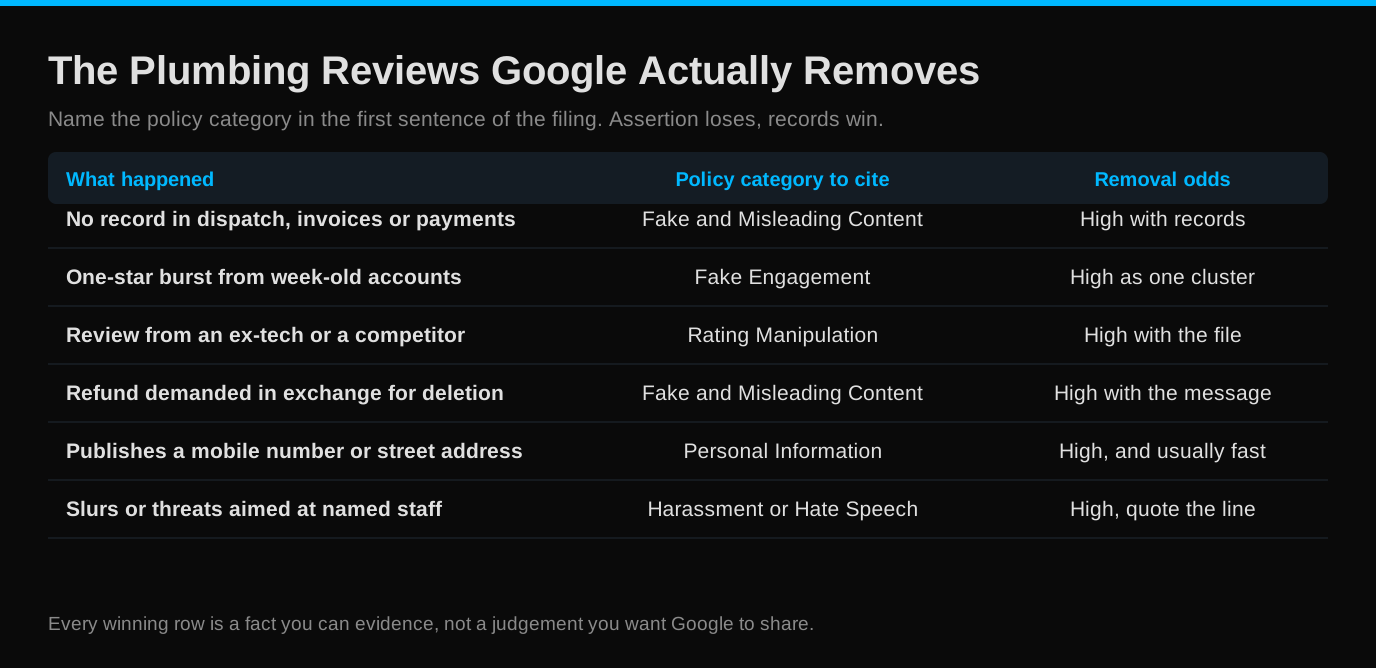
| What happened | Policy category to cite | Removal odds |
|---|---|---|
| No record of the name, number or address in dispatch, invoices or payments | Fake and Misleading Content | High with records, low without |
| Several one-stars in an afternoon from accounts created that week | Fake Engagement | High when filed as one cluster |
| Review from a former apprentice, service tech or a competing shop's owner | Rating Manipulation (conflict of interest) | High when the employment file is attached |
| Review demanding a refund in exchange for deletion | Fake and Misleading Content, plus the written demand | High when the message is attached |
| Review publishing a technician's mobile number or a customer's street address | Personal Information | High, and usually fast |
| Slurs or threats aimed at a named member of staff | Harassment or Hate Speech | High, quote the exact line |
| Five-stars your own team posted to offset a bad month | Rating Manipulation, and an FTC problem | Removed, with your profile at risk |
| A complaint about a different company with a similar name | Off Topic or Fake and Misleading Content | Moderate, show both listings |
Notice what those winning rows have in common. Each one is a fact you can evidence, not a judgement you want Google to share. The mistaken-identity row is the one plumbers under-use most: if a metro has three shops whose names begin with the same word, some share of those reviews genuinely belong somewhere else, and a side-by-side screenshot of the two listings plus your no-record search is a strong filing. If you want the full category list rather than the plumbing subset, our breakdown of every Google review violation type covers all of them.
What Google will not remove, however unfair it feels
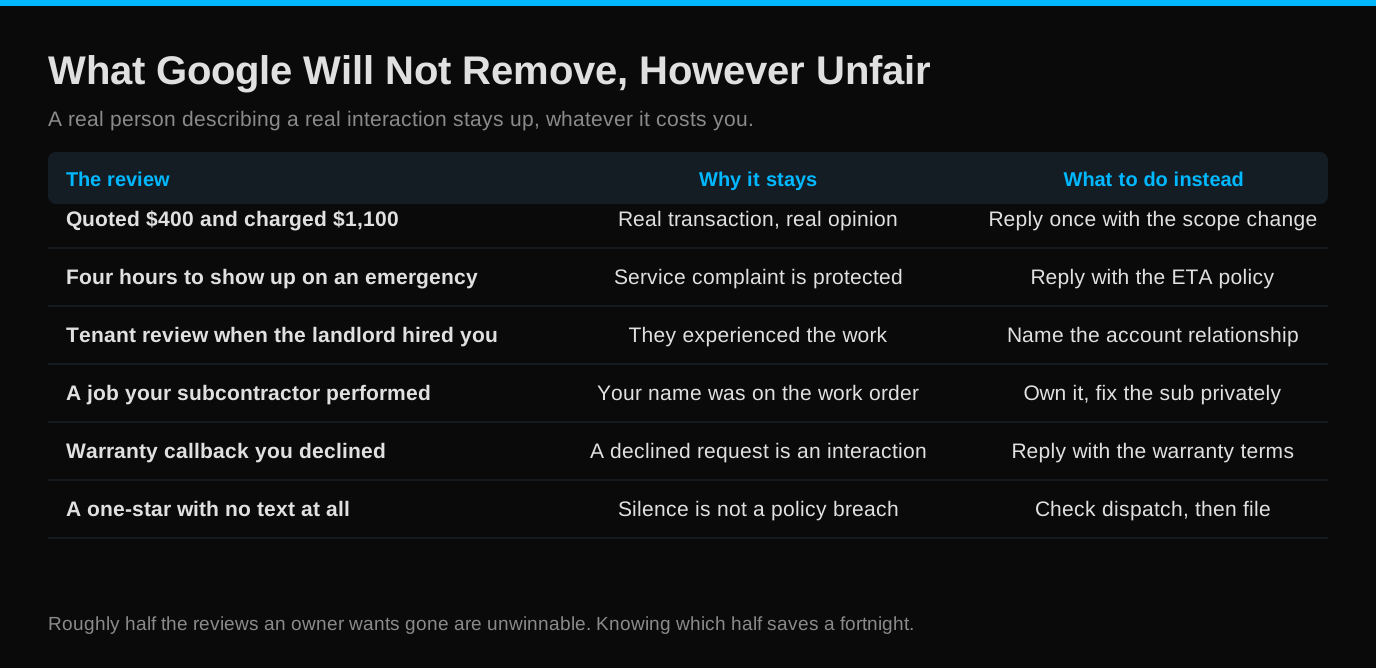
Roughly half the reviews a plumbing owner wants gone are unwinnable, and knowing which half saves you the fortnight you would otherwise spend appealing. The rule is simple even when the outcome is not: if a real person describes a real interaction in their own words, the review stays, no matter how much revenue it costs you.
| The review | Why it stays | What to do instead |
|---|---|---|
| "They quoted $400 and charged $1,100" | Real transaction, real opinion about price | Reply once with the scope change, publish your diagnostic fee policy |
| "Took four hours to show up on an emergency call" | A service complaint is protected opinion | Reply with the actual ETA policy, fix the dispatch gap |
| Tenant review when the landlord hired you | They experienced the work, so it counts | Reply naming the account holder relationship, not the tenant |
| Review of a job your subcontractor performed | Your name was on the work order | Own it publicly, then fix the sub relationship privately |
| Warranty callback you declined as out of scope | A declined request is still an interaction | Reply with the warranty terms in one sentence |
| A one-star with no text at all | Silence is not a policy breach on its own | Check dispatch first, file only if there is no record |
The textless one-star deserves a note, because plumbers file more of these than anything else and win fewest. A bare rating with no words is not automatically fake. It becomes a filing only when your four-field dispatch search comes back empty, and then the case you make is the absence of a record, not the absence of text. If your last attempt already came back denied, what to do after a denial walks through the escalation properly.
The dispatch-record evidence pack that wins disputes
Plumbing shops are better placed than most trades to win these disputes, and almost none of them realise it. A field service platform logs the call, the dispatch, the technician, the arrival time, the parts, the invoice and the payment. That is a paper trail a dentist would envy, and it turns a subjective argument into an evidence submission.
Run the same search every time, on four fields: the reviewer's display name, any phone number they mention, any service address they mention, and the date they say the work happened. Then export the result, including the empty result.
| Evidence source | What it proves | Where it usually lives |
|---|---|---|
| Dispatch and job history export | No job at that name, address or date | ServiceTitan, Housecall Pro, Jobber or equivalent |
| Call recording and inbound call log | The number never called you, or what was actually quoted | CallRail, your VoIP provider, the LSA message log |
| Invoice and payment processor search | No transaction ever existed | QuickBooks, Stripe, your card terminal |
| GPS and timestamped job photos | Where the van actually was, and the condition on arrival | Fleet tracking, technician app uploads |
| Employment file | The reviewer is a former employee, so conflict of interest | Payroll records, separation paperwork |
| The reviewer's public profile | Account age, review count, five-stars for your competitor | Google Maps, captured as a screenshot with the URL visible |
| The demand message | The review is leverage, not a description of service | Texts, email, or the LSA in-product messages |
Capture before you reply, always. Reviewers edit and delete, and an edited review takes your evidence with it. Screenshot the review with its timestamp and the reviewer's profile URL visible, then build the pack. Our guide to documenting evidence for a review dispute has the capture checklist in full, and it applies unchanged to a plumbing shop.
Filing: three routes, and how long each one takes
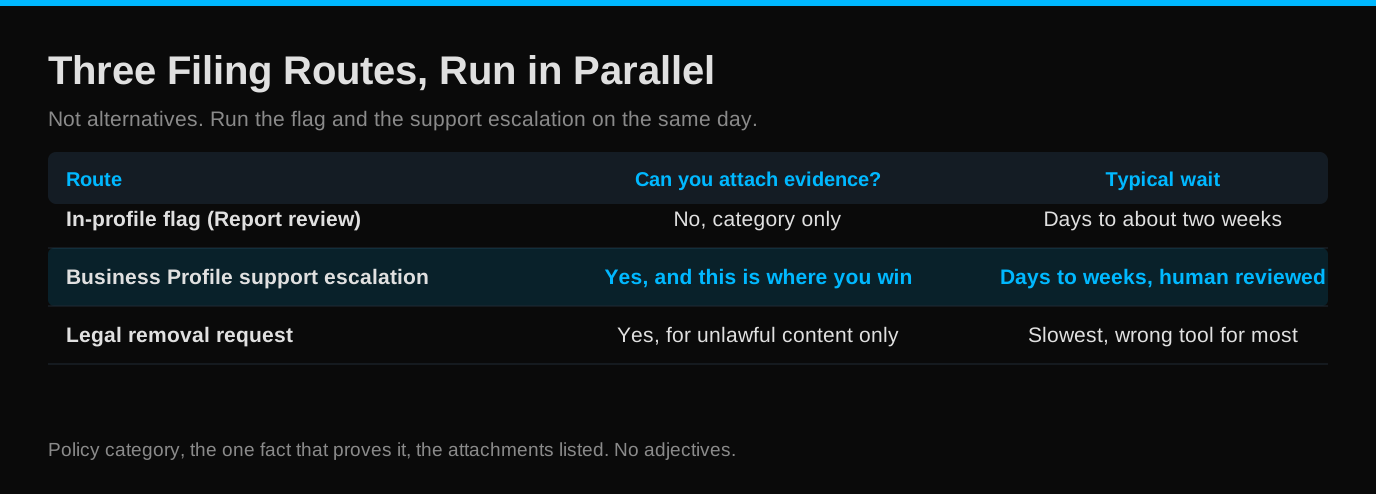
There are three ways to put a plumbing review in front of Google, they are not alternatives, and the mistake almost everyone makes is running them in sequence instead of together. Run the flag and the support escalation in parallel on the same day.
| Route | Can you attach evidence? | Typical wait |
|---|---|---|
| In-profile flag (three-dot menu, Report review) | No, category only | A few days to about two weeks |
| Business Profile support escalation | Yes, and this is where you win | Days to a few weeks, human reviewed |
| Legal removal request | Yes, for unlawful content specifically | Slowest, and the wrong tool for most cases |
Write the escalation the way an adjuster reads a claim. First sentence: the policy category by name. Second: the one fact that proves it. Third: the attachments, listed. Nothing about how long you have been in business, nothing about how much the review has cost you, no adjectives at all. "This review breaches Fake and Misleading Content. A search of our dispatch system, invoices and payment records on the reviewer's name, the phone number in the review and 14 August returns no record. Attached: dispatch export, invoice search, payment search." That is the whole filing, and it beats two paragraphs of frustration every time. If you want realistic expectations on the clock, how long Google takes to remove a review sets them out.
What one star costs a plumbing company in 2026
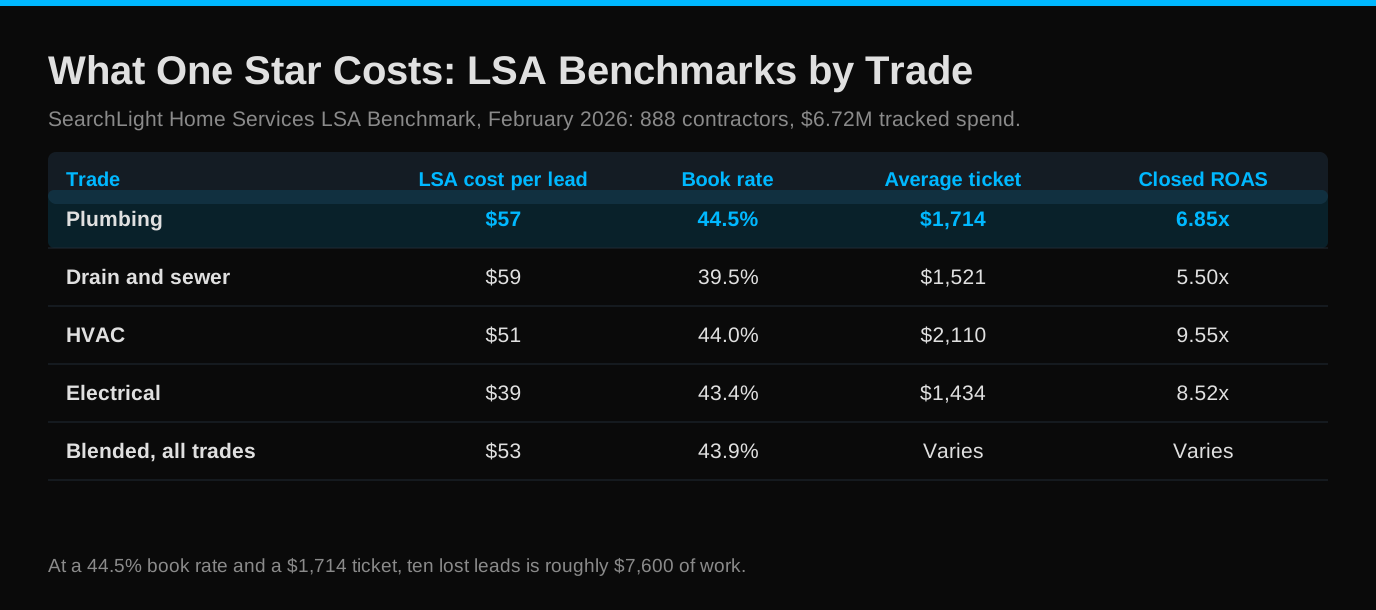
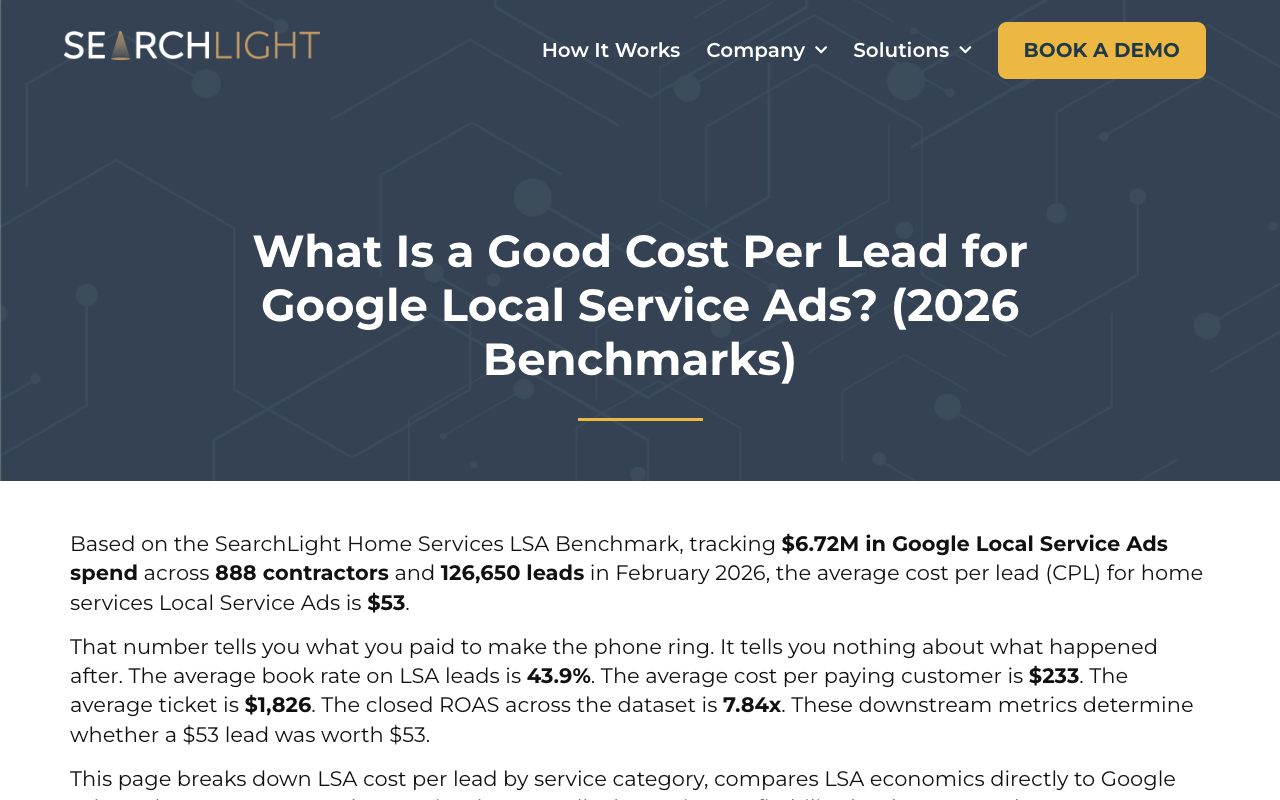
Plumbing is one of the few trades where you can settle the "is it worth twenty minutes of searching" question with arithmetic rather than argument, because the lead economics are published and your ticket size is large. Here is the February 2026 benchmark set from SearchLight's home services LSA data, drawn from 888 contractors and $6.72M in tracked spend.
| Trade | LSA cost per lead | Book rate | Average ticket | Closed ROAS |
|---|---|---|---|---|
| Plumbing | $57 | 44.5% | $1,714 | 6.85x |
| Drain and sewer | $59 | 39.5% | $1,521 | 5.50x |
| HVAC | $51 | 44.0% | $2,110 | 9.55x |
| Electrical | $39 | 43.4% | $1,434 | 8.52x |
| Blended, all trades | $53 | 43.9% | Varies | Varies |
Work it with your own numbers, but the shape holds. At a 44.5% book rate and a $1,714 ticket, every ten Local Services Ads leads you do not receive is roughly $7,600 of work that went to the shop above you. Rating drives that ad ranking, so a fake one-star that shaves your average from 4.6 to 4.4 is not a cosmetic problem, it is a lead-flow problem with a dollar figure attached. Add the organic side, where 68% of consumers filter at 4.0 and 31% at 4.5, and the twenty minutes you spend running a dispatch search is the cheapest marketing work available to you that week.
The two replies that turn a review problem into a legal one
Plumbing owners are direct people, which is usually a virtue and occasionally an expensive one. Two replies in particular convert a bad afternoon into a regulatory or privacy problem, and both are written in the first ten minutes after the review appears.
The first is the trade. "Take the review down and I will refund the call-out fee" feels like customer service and reads like suppression. The FTC's Rule on the Use of Consumer Reviews and Testimonials took effect on 21 October 2024 and prohibits unfounded legal threats, physical threats, intimidation and certain false public accusations used to prevent or remove a negative review. Fix the problem because it needs fixing, tell the customer it is fixed, and stop there. What they then do with the review is their business, and that is the point.
The second is the correction. The instinct to reply "you live at 14 Oakfield Road, we attended on the 8th, and the tenant let us in" is understandable and it publishes a customer's address, tenancy status and movements to the open internet. Keep the public reply to one short paragraph that names no address, no unit, no third party and no technician, then take the detail to a phone call. Our guide to responding to negative reviews has templates that hold that line, and the FTC fake review rule in 2026 covers the compliance side in more depth.
One more line worth naming, because it is specific to licensed trades: never respond by threatening to report the reviewer to anyone, and never imply their complaint puts their own licensing, insurance or tenancy at risk. That is exactly the intimidation the rule describes, and in a trade where you may hold a licence yourself, it hands a complainant a second place to file.
Between call-outs: making the next dispute a 20-minute job
Everything above is faster when the groundwork is already done, and the groundwork is boring enough that most shops skip it until the second attack. Four things, none of which take a full afternoon.
- Alerting, so you find out in hours not weeks. A review you discover a fortnight late has already done its damage to your ad ranking. Set up monitoring once and forget it.
- A saved four-field search in your dispatch platform. Name, phone, address, date. Save it as a template so any office staffer can run it without you.
- A one-page filing template. Category, proving fact, attachment list. Written calmly today, it stops an angry version being written at 6am.
- Review velocity from real jobs. Ten genuine reviews a month means a single one-star moves your average by a rounding error instead of two tenths.
Velocity is the one that does double duty. It is the only defence that also works on the reviews Google was never going to remove, and for a plumbing shop it is unusually easy, because you complete more discrete jobs per month than almost any other local business. The ask at the end of a successful emergency call converts better than any other moment in this trade. Set up review monitoring and alerts first, then build the request into the invoice step.
Frequently asked questions
Plumber Google review removal is a translation exercise, not a fairness argument. In your head the review is a customer who refused to pay for the second visit and went looking for revenge. To Google it has to be a breach of a named content policy, evidenced by records your dispatch platform already holds and can export in a couple of minutes. Shops that make that translation get removals. Shops that write to Google about how unfair the reviewer is get a denial a week later and conclude the process is rigged. Run the four-field search before you file, name the category in your first sentence, run the flag and the escalation together, and remember that in this trade the rating is buying your paid leads as well as your organic ones. If you would rather hand the filing to a team that does it every day, that is what we are here for, and either way the reviews that break Google's rules do not have to stay on your listing.