
Key Takeaways
- Yes, a removed Google review can come back. The reviewer has an appeal of their own, and Google has just widened it: its own page now says appeals for content violations are available for up to one year after the content was removed.
- The two sides get opposite rights. You get one appeal, covering up to 10 reviews, and only after Google tells you it found no policy violation. They get one appeal per removal, with a year to use it.
- Their appeal has an outcome yours does not: Canceled. If they edit or delete the review after filing, the appeal dies with it, and so does their one attempt.
- The account appeal is the one that moves many reviews at once. When an account is restricted, every review it ever left comes down, and Google reviews that content again as part of the restriction appeal.
- Account restrictions took down 0.7% of all reviews contributed to Maps in 2025, against 15.4% removed as fake or misleading, on 292M reviews removed and 782K accounts restricted.
- A removed Google review is a decision, not a deletion
- Two appeal systems, pointed in opposite directions
- Your side: one appeal, ten reviews, no second go
- Their side: one year, one attempt
- The two things that cancel an appeal
- The account appeal that restores everything at once
- What Google's own 2025 numbers say about the odds
- When a removed Google review is not your problem
- What we would do in the week after a removal
- Frequently asked questions
The review disappeared, you closed the tab, and six weeks later it is sitting on your profile again with the same one star. Nothing malfunctioned. A removed Google review can come back because the person who wrote it has an appeal of their own, and Google has quietly widened it: the appeals page now carries a policy update saying appeals for content violations are available for up to a year after removal. We read both appeal pages line by line, pulled the status labels Google publishes for each side, and rendered Google's own Maps enforcement report for the 2025 figures. The short version is that your win is provisional, the other side's clock is far longer than yours, and the appeal that can undo the most damage is not the one about your review at all.
A removed Google review is a decision, not a deletion
The mental model most owners carry is that a removed review is gone, in the way a deleted file is gone. Google's own documentation says something softer. Its page on removed and rejected content tells contributors that their content "may still be available in your Google Maps profile, but may be marked as 'Not posted,' 'Private,' 'Not Accepted,' or similar". The review stops being served to the public. It does not stop existing, and the record it leaves behind is what an appeal acts on later.
Only one category is described as final. Google says that "in some cases, your content or edits may be deleted entirely due to legal requirements or the severity of the violation". That is the exception, not the rule, and you have no way to tell from your side of the profile which of the two happened to the review you reported.
So there are three realistic routes by which a review you got taken down shows up again, and they are worth separating because only one of them is an appeal in the formal sense:
| Route back | Who drives it | What Google's pages say | Can you see it coming? |
|---|---|---|---|
| Content appeal | The reviewer | Up to one year after removal, once per removal. Approved means the content is restored | No. It is tracked in their Maps profile, not yours |
| Feature access appeal | The reviewer | Content removed because of the restriction is also reviewed as part of the appeal | No, and it can return several reviews at once |
| Edit and repost | The reviewer | "You may be able to edit and repost your content" after reviewing the policies | Partly. It arrives as a new review, usually reworded |
Notice who is in the "who drives it" column every time. That asymmetry is the whole subject of the next section.
Two appeal systems, pointed in opposite directions
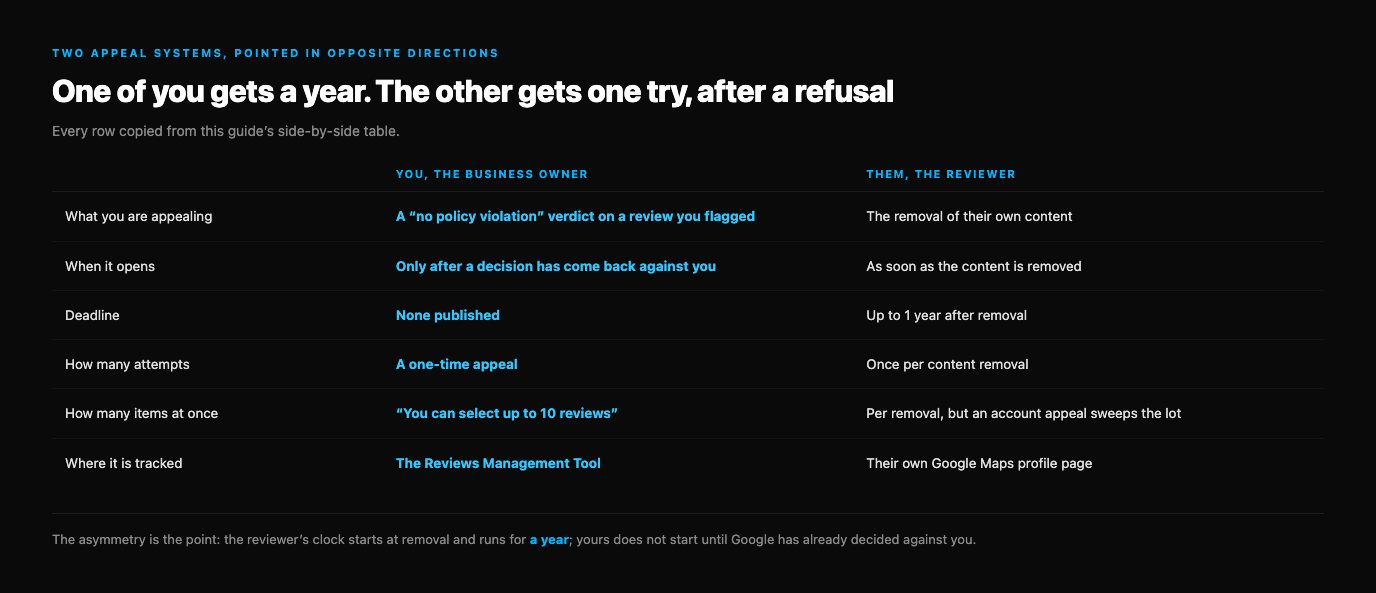
Google runs two separate appeal processes over the same review, and almost every guide in this niche describes only one of them. Yours lives in the Business Profile help centre and exists to challenge a decision not to remove. Theirs lives in the Maps user-generated content help centre and exists to challenge a decision to remove. They have different deadlines, different limits and different outcome labels, and neither one is visible from the other side.
Reading them side by side is uncomfortable, because the side with less at stake commercially has the more generous clock:
| You, the business owner | Them, the reviewer | |
|---|---|---|
| What you are appealing | A "no policy violation" verdict on a review you flagged | The removal of their own content |
| When it opens | Only after a decision has come back against you | As soon as the content is removed |
| Deadline | None published | Up to 1 year after removal |
| How many attempts | A one-time appeal | Once per content removal |
| How many items at once | "You can select up to 10 reviews" | Per removal, but an account appeal sweeps the lot |
| Where it is tracked | The Reviews Management Tool | Their own Google Maps profile page |
| Outcome labels | Pending, no policy violation, escalated | Approved, denied, canceled |
| Success means | The review comes down | The review goes back up |
One honest caveat before you build a plan on that table. Google states that "at this time, appeals are only available for certain types of content policy violations and Google Accounts", and adds that "references to the appeals process in notifications from Google aren't a confirmation of eligibility". The reviewer may get an email that mentions appealing and still have nothing to file. The right reading is that their route is wide, not that it is guaranteed.
Your side: one appeal, ten reviews, no second go
Your appeal is not a general-purpose complaint line. It unlocks at one specific moment, which is when Google has looked at a review you flagged and decided it stays. Google's instruction is plain: "if a flagged review doesn't qualify for removal, submit a one-time appeal". Before that verdict there is nothing to appeal, and after you spend it there is no second one. Our walkthrough of what happens after you flag a Google review covers the step before this.
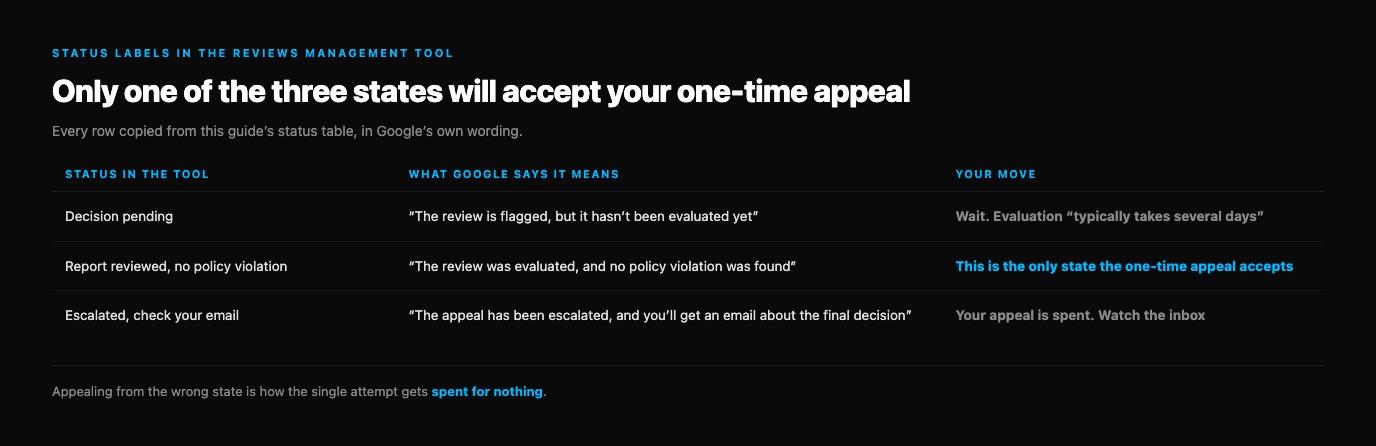
You find that moment in the Reviews Management Tool, which is where Google tells you to "revisit this tool" to check the status of a report. There are three labels, and only the middle one opens the door:
| Status in the tool | What Google says it means | Your move |
|---|---|---|
| Decision pending | "The review is flagged, but it hasn't been evaluated yet" | Wait. Evaluation "typically takes several days" |
| Report reviewed, no policy violation | "The review was evaluated, and no policy violation was found" | This is the only state the one-time appeal accepts |
| Escalated, check your email | "The appeal has been escalated, and you'll get an email about the final decision" | Your appeal is spent. Watch the inbox |
The sentence almost everyone skips is "you can select up to 10 reviews". Read next to "one-time", that is a sequencing rule, not a convenience feature. If you are being hit by a coordinated run of fake reviews, batching your ten strongest cases into a single appeal spends the one attempt well, while appealing the first review that annoyed you spends it on a sample of one. Our review bombing response playbook sets out the triage order we use when the queue is longer than ten.
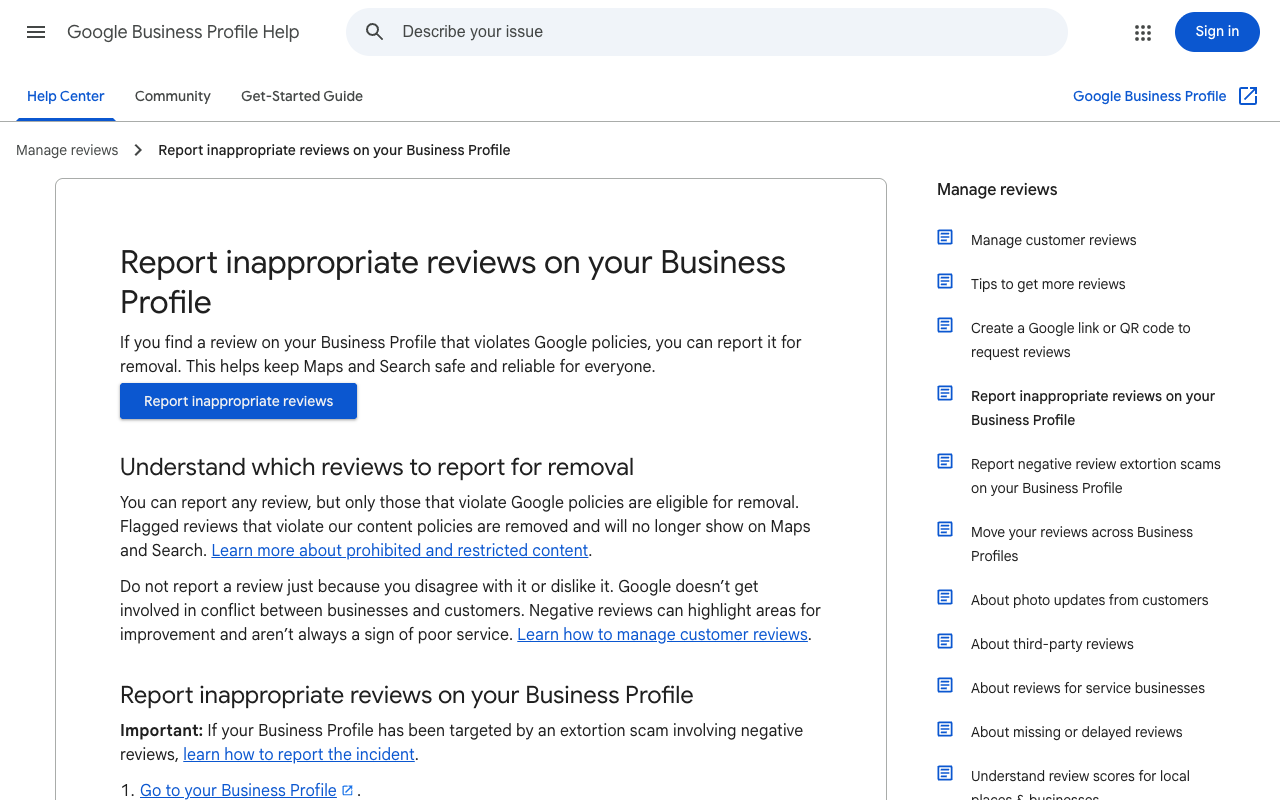
Two housekeeping points. Google asks you not to report a review "just because you disagree with it or dislike it", which is also the quickest way to burn an appeal on a case that was never going to land. And merchants in the EEA can report third-party reviews directly on Google, which matters for the DSA route covered in our guide to the EU appeal. If your request has already come back refused, what to do after a denial is the piece to read next.
Their side: one year, one attempt
Here is the part that changes how you should think about a win. Google's appeals page opens with a banner headed "Appeals Policy Update", and it reads: "We've updated our policy on appealing content removals. Appeals for content violations are now available for up to one year after your content has been removed." Google is flagging this as a change on the page itself, which is as close to an announcement as this corner of the help centre gets.
A year is a long time to hold a decision open. A review you removed in January can be restored in November, long after you stopped looking, and nothing in your Business Profile tooling will tell you the appeal was filed. The reviewer tracks progress on their own Maps profile page. You find out by noticing the review again.
Their appeal resolves into three states, and the third has no equivalent on your side:
| Outcome | What happens to the review | What it means for your profile |
|---|---|---|
| Approved | Content removed in error is restored | The star rating returns with it and your average moves back |
| Denied | Content that violates the policy stays down | The removal is now settled, because they only get one |
| Canceled | The appeal ends without a verdict | Same practical result as denied, by a different road |
Worth saying plainly: an approved appeal is Google correcting itself, not Google siding with the reviewer against you. If the review genuinely breached a policy and you evidenced that properly, the appeal is the system working. If it came back, the honest conclusion is usually that the original case was thinner than it looked, which is an argument for documenting the evidence before you file rather than after.
The two things that cancel an appeal
The canceled state is the most interesting rule on the page, because it punishes an instinct. Google says an appeal may be canceled if the appealed content is edited or deleted, or if the account becomes ineligible. In other words, a reviewer who files an appeal and then tidies up the wording of the review has just ended their own case, and their single attempt went with it.
Deleting or editing the content after submitting an appeal cancels the appeal. And on the account side, Google adds the counterpart that catches people out: deleting content does not resolve a feature restriction.
That second sentence matters more than it looks. A reviewer whose account has been restricted cannot buy their way back by deleting the offending reviews, so the restriction and everything it took down stay in place until an appeal decides otherwise. For you, it means a restricted account's removals are stable right up until the moment the account appeal lands.
There is no equivalent trap on your side, because you are not appealing your own content. The nearest thing is spending the one-time appeal early, which we have already covered, and it is the mistake we see most often.
The account appeal that restores everything at once
Up to here we have treated reviews one at a time. Google's enforcement does not always work that way, and the exception is the single most useful thing in this article. Its transparency report states the mechanism bluntly: "if an account is restricted from posting reviews, all past reviews will also be removed." One enforcement action against a person wipes their whole contribution history, including whatever they left on your profile.
That is the good news. The bad news is the mirror of it, in the feature access appeal: content removed because of the restriction is also reviewed as part of the appeal. So a reviewer who wins back their account does not have to file a separate appeal for each review. The whole set is looked at again in one go, and it can all come back together. If three of a competitor's accounts were restricted in the same sweep, the recovery is lumpy and arrives without warning.
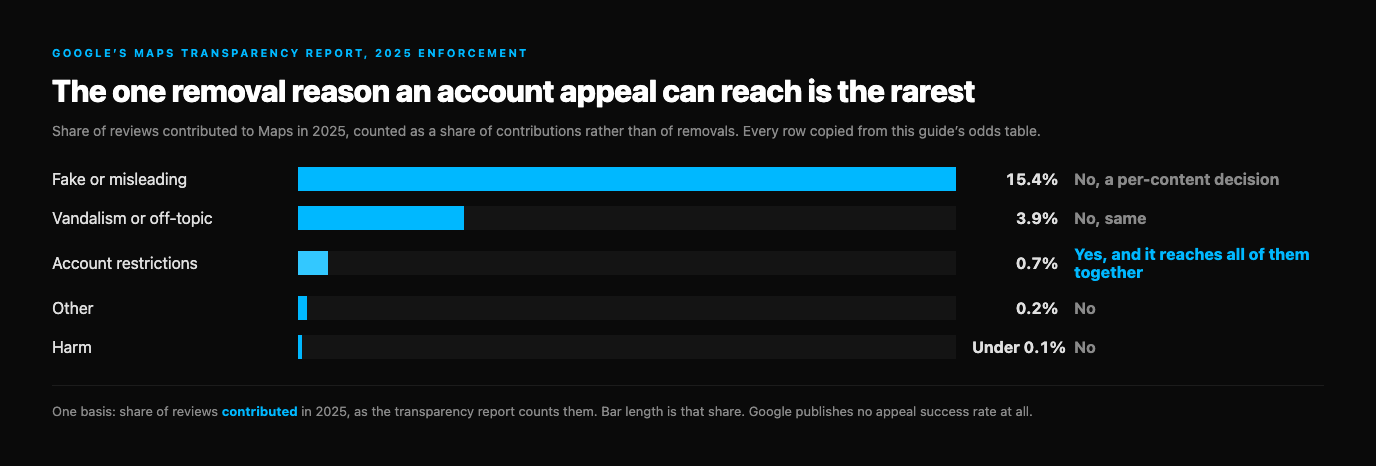
How common is that? Google publishes the breakdown, as a share of all reviews contributed in 2025:
| Reason a review was removed (2025) | Share of reviews contributed | Does an account appeal reach it? |
|---|---|---|
| Fake or misleading | 15.4% | No, this is a per-content decision |
| Vandalism or off-topic | 3.9% | No, same |
| Account restrictions | 0.7% | Yes, and it reaches all of them together |
| Harm | Under 0.1% | No |
| Other | 0.2% | No |
Read the 0.7% carefully, because it is a share of every review contributed to Maps in 2025, not a share of removals. On a base that produced 292M removed reviews, a small percentage is a very large number of reviews whose fate is tied to somebody's account rather than to their words.
What Google's own 2025 numbers say about the odds
Google does not publish how many appeals it receives or how many succeed. We looked, and the Maps transparency report stops at enforcement volumes. Anyone quoting you a reinstatement rate for Google review appeals is quoting something Google has not released, so treat the absence as the finding rather than filling it in.
What the report does give you is the scale of the machine making these decisions in the first place:
- 292M reviews blocked or removed
- 159M photos and videos removed
- 79M place edits removed
- 782K accounts restricted
- 13M Business Profiles removed
Two caveats Google attaches to its own figures, and both should change how you quote them. The data for each year is "a 'snapshot' of content published or removed as of January 31st of the following year", so a 2025 number is a January 2026 reading rather than a running total. And the report notes that appeal options "may vary based on violation or location", which is the same hedge as the eligibility warning on the appeals page, arriving from the other direction.
One more detail worth knowing before you count stars. When a review comes down, Google says "all accompanying content (for example, star rating, photos or videos) is also removed". The reverse holds on restoration, which is why a returning review moves your average and not just your review count. For the wider picture of how moderation is trending, see whether Google actually removes flagged reviews.
When a removed Google review is not your problem
There are two questions that sound identical and are not, and mixing them up wastes weeks. The first is the one this article answers: a review you had removed has come back, or might. The second is that your own good reviews have vanished and you want them returned. They share a verb and almost nothing else.
The second case is usually a filter, a display bug, or a profile merge, and the appeal machinery above does not touch it, because you are not the author of the missing content and there is no enforcement decision against you to appeal. That one has its own route, and we wrote it up separately in why Google reviews disappear and how to get them back.
A third case sits between them. If your Business Profile was suspended and reinstated, reviews can go missing as a side effect of the profile's own history rather than any decision about the reviews, which is covered in profile suspension and review disputes.
Diagnose which of the three you have before you file anything. The tell is simple: ask whether a decision was made about the content, and whose content it was.
What we would do in the week after a removal
A removal is the start of a year-long window, so the work that pays is the work that makes a return visible and survivable rather than a surprise.
- Screenshot the removal, with the date. If the review returns in nine months you will want the original text, the rating and the day it came down, and none of that is retrievable afterwards from your side.
- Write down the ground you won on. If it returns, the appeal has effectively overturned that reasoning, and knowing which ground failed tells you whether a different one is still open.
- Set a reminder for the twelve-month mark. That is when the reviewer's window closes and the removal becomes genuinely settled. Before then it is provisional.
- Check your review count, not just your rating. A restored review moves both, and the count is the earlier signal. Our review monitoring setup covers the alerting.
- Do not spend the one-time appeal on anything you have already won. Keep it for the next refusal, batched up to ten.
- Keep earning reviews. The only durable answer to a review that might return is a denominator large enough that it does not matter when it does.
A removal that holds starts with the right ground
Reviews that come back are usually reviews that were removed on a thin case. Flaggd reads the reviews on your profile against Google's content policies, tells you which ones have a real ground behind them, and files the evidenced dispute under the ground that actually fits.
Flaggd is our own service and this page recommends it. We dispute content that breaches Google policy on profiles our clients control. We are not a law firm, we do not give legal advice, and nobody can guarantee a removal or prevent an appeal against one. The enforcement figures above were read from Google's Maps transparency report on 10 November 2026 and cover 2025 as of Google's own 31 January snapshot.
Frequently asked questions
Can a removed Google review come back?
Yes. The person who wrote it can appeal, and Google's Maps appeals page now says appeals for content violations are available for up to one year after removal. An approved appeal restores content that was removed in error, and the star rating returns with it. You will not be told it was filed, because the reviewer tracks it on their own Maps profile page.
How long does a reviewer have to appeal a removed Google review?
Up to one year after the content was removed, under a policy update Google flags at the top of that page, and only once per removal. Google also warns that appeals are "only available for certain types of content policy violations and Google Accounts", and that a mention of appealing in one of its notifications is not a confirmation of eligibility.
How many times can a business appeal a Google review decision?
Once. Google's Business Profile page says that if a flagged review does not qualify for removal you can submit a one-time appeal, after which the tool shows the report as escalated and the final decision arrives by email. There is nothing to appeal while the status still reads decision pending.
Can I appeal more than one Google review at a time?
Yes, and you should. Google states that "you can select up to 10 reviews". Because the appeal is one-time, that limit is a sequencing rule rather than a convenience: batching your ten best-evidenced cases uses the attempt far better than appealing whichever review annoyed you first.
What cancels a Google content appeal?
Editing or deleting the appealed content after filing, or the account becoming ineligible. A canceled appeal ends with no verdict and the single attempt is spent. Google adds the counterpart on the account side: deleting content does not resolve a feature access restriction, so a restricted reviewer cannot clear it by removing the reviews that caused it.
Why did several removed reviews reappear at the same time?
That points at an account-level appeal. Google removes all of an account's past reviews when it restricts the account from posting, and the content removed because of the restriction is reviewed again as part of that appeal, so one result can restore a whole history. Per Google's Maps transparency report, account restrictions took down 0.7% of all reviews contributed to Maps in 2025, counted as a share of contributions rather than of removals.
What percentage of Google review appeals succeed?
Google does not publish it. The transparency report gives enforcement volumes and stops there, and Google's reporting and appeals overview describes aims rather than outcomes. In the EU, Article 20 of the Digital Services Act adds an internal complaint route on top, which we cover in our EU appeal guide. Any specific reinstatement rate quoted elsewhere is not sourced to Google.