Key Takeaways
- Most pest control disputes turn on who the customer was. Tenants, home buyers and neighbours all end up on your profile. A tenant whose unit you treated has a genuine experience and stays up; a neighbour who watched the truck does not.
- You already keep the best evidence in the trades. Federal rules require a commercial applicator record carrying the address, date, product, EPA registration number and the applicator's certification number, kept for at least two years.
- The chemical complaint is a regulator matter, not a Google one. Google will not decide whether an application was lawful, so a "they poisoned my dog" review almost never comes down. Your state lead agency is the venue that matters.
- A review that prints an address and an infestation is the fastest removal you have. Personal Information is decided on the text alone and needs no records from you.
- Trading a free retreatment for a deletion is a rule violation. The FTC review rule reaches suppression, with civil penalties up to $53,088 per violation. Honour the warranty, say nothing about the review.
- Why a pest control one star costs more than the job
- Who the customer actually was
- Which pest control reviews Google actually removes
- What Google will not remove, however wrong it is
- The chemical complaint is a regulator matter
- The records only a pest control company has
- Filing and escalating: the routes and the clock
- Two replies that turn a review into a legal problem
- Before the next swarm season
The one star lands on a Tuesday in May, from a name nobody at the office recognises, about a treatment at an address you have never invoiced. Pest control Google review removal nearly always starts there, because far more people experience your service than ever hire it: tenants, home buyers, neighbours, a landlord's brother-in-law, and the occasional person who has you confused with a same-name franchise two counties over. The stakes are seasonal and unforgiving. BrightLocal's 2026 Local Consumer Review Survey of 1,002 US consumers found that 68% will only use a business rated four stars or better, up from 55% a year earlier, that 31% will not go below 4.5, and that 32% look specifically for reviews posted in the last two weeks. Walk into swarm season carrying a fresh 1.0 and you lose the quarter that pays for the year. We file these disputes every week, and what separates a removal from a denial is never how unfair the review is. It is whether the filing names a Google policy category and attaches the records a licensed applicator is already required to keep.
Why a pest control one star costs more than the job
This is a fragmented, local, high-frequency trade, which is the worst possible shape for review damage. The 26th edition of A Strategic Analysis of the U.S. Structural Pest Control Industry, published in April 2026 and summarised by the National Pest Management Association, put 2025 service revenue at $13.416 billion across 16,565 firms, with 81.4% of them running one or two locations and 109,384 technicians in the field.
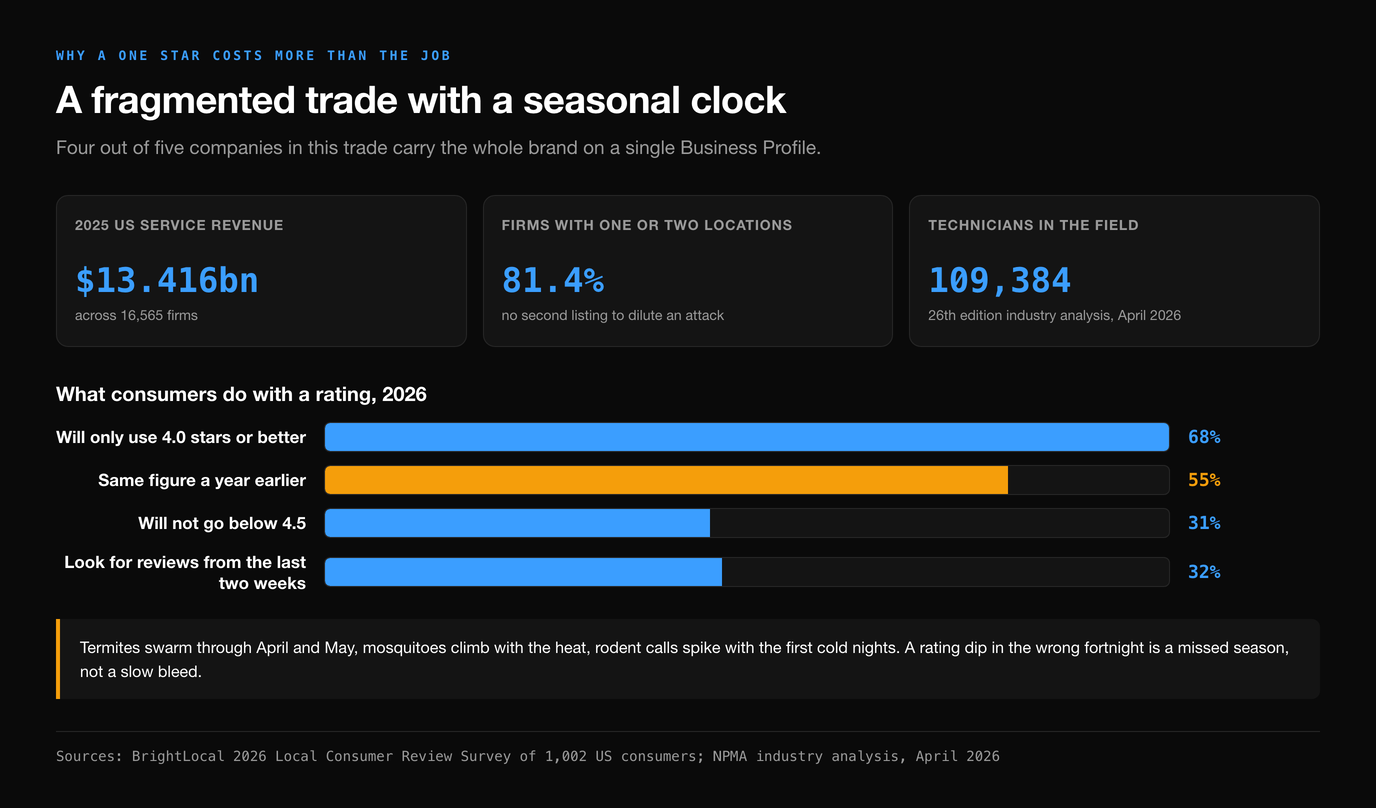
Four out of five companies in your trade therefore have a single Business Profile carrying the entire brand. There is no second location to dilute an attack and no national review base to absorb it. Six bad weeks show up in the map pack as a rating, and the rating is what a homeowner compares against the two other trucks that serve the same zip code.
Then there is the calendar. Subterranean termites swarm through April and May, ants and mosquitoes climb with the heat, and rodent calls spike with the first cold nights. Demand arrives in compressed windows, so a rating dip in the wrong fortnight is not a slow bleed, it is a missed season. That is the honest reason to run disputes promptly rather than "when things quieten down": things quieten down after the money has gone elsewhere.
Who the customer actually was
Every other trade sells to the person who receives the work. Pest control frequently does not. You are hired by a property manager and judged by a tenant, hired by a seller's agent and judged by a buyer, hired by an HOA and judged by whoever lives in unit 14. Google does not care who signed the contract. It cares whether the person writing had a genuine experience at your business, which is the test the prohibited and restricted content policy applies to every contribution.
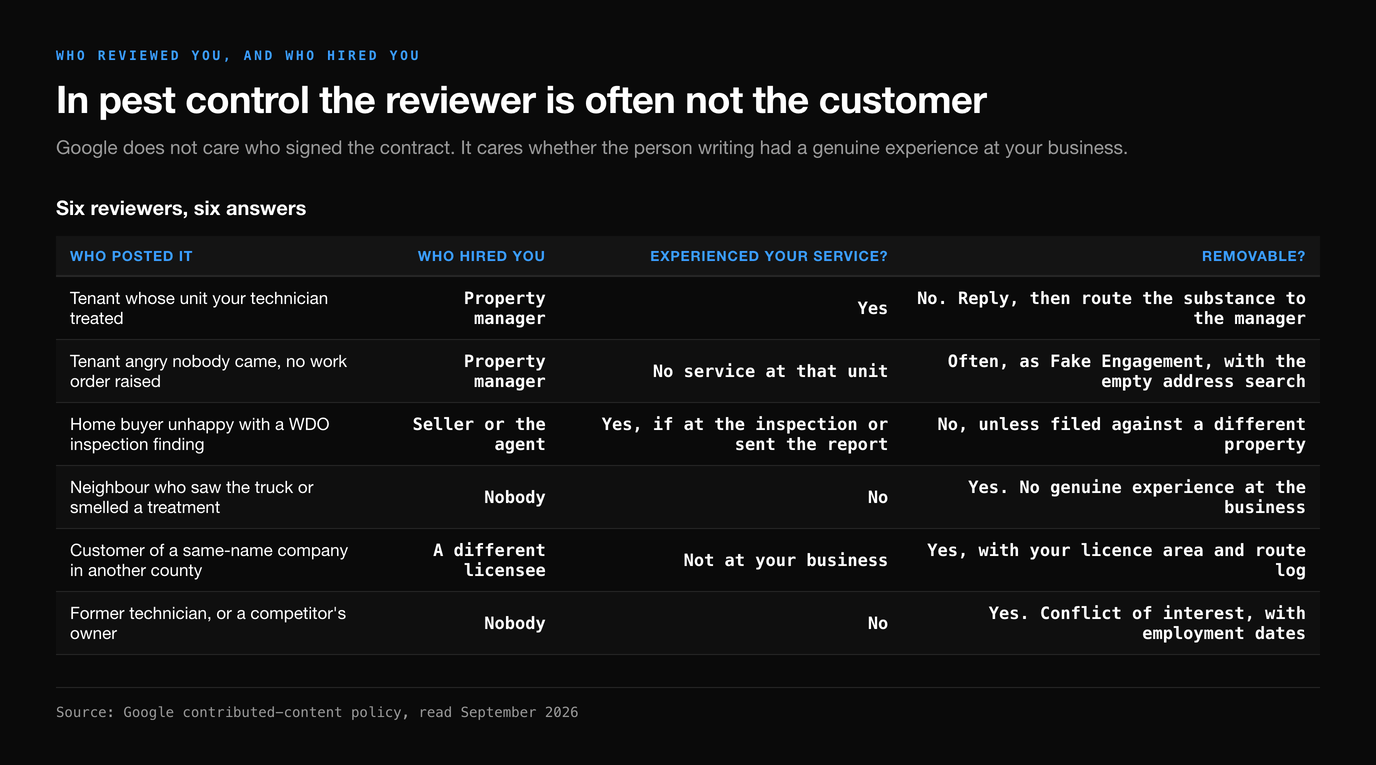
So sort the review by experience rather than by invoice. This is the table we build first on any pest control case, because it decides whether there is a filing at all.
| Who posted it | Who hired you | Experienced your service? | Removable? |
|---|---|---|---|
| Tenant whose unit your technician treated | Property manager | Yes | No. Reply, then route the substance to the manager |
| Tenant angry that nobody came, where the manager never raised a work order | Property manager | No service at that unit | Often, as Fake Engagement, with the empty address search |
| Home buyer unhappy with a WDO inspection finding | Seller or the agent | Yes, if they were at the inspection or received the report | No, unless the report is filed against a different property |
| Neighbour who saw the truck or smelled a treatment | Nobody | No | Yes. No genuine experience at the business |
| Customer of a same-name company in another county | A different licensee | Not at your business | Yes, with your licence area and route log |
| Former technician, or a competitor's owner | Nobody | No | Yes. Conflict of interest, with employment dates |
Rows one and three are genuine experiences and will never come down, however lopsided the billing feels. Filing them as fake spends the credibility you need on rows two, four, five and six. Our guide for apartment and multifamily operators covers the tenant relationship in more depth, and the contractors and home services guide covers the ground the trades share.
Which pest control reviews Google actually removes
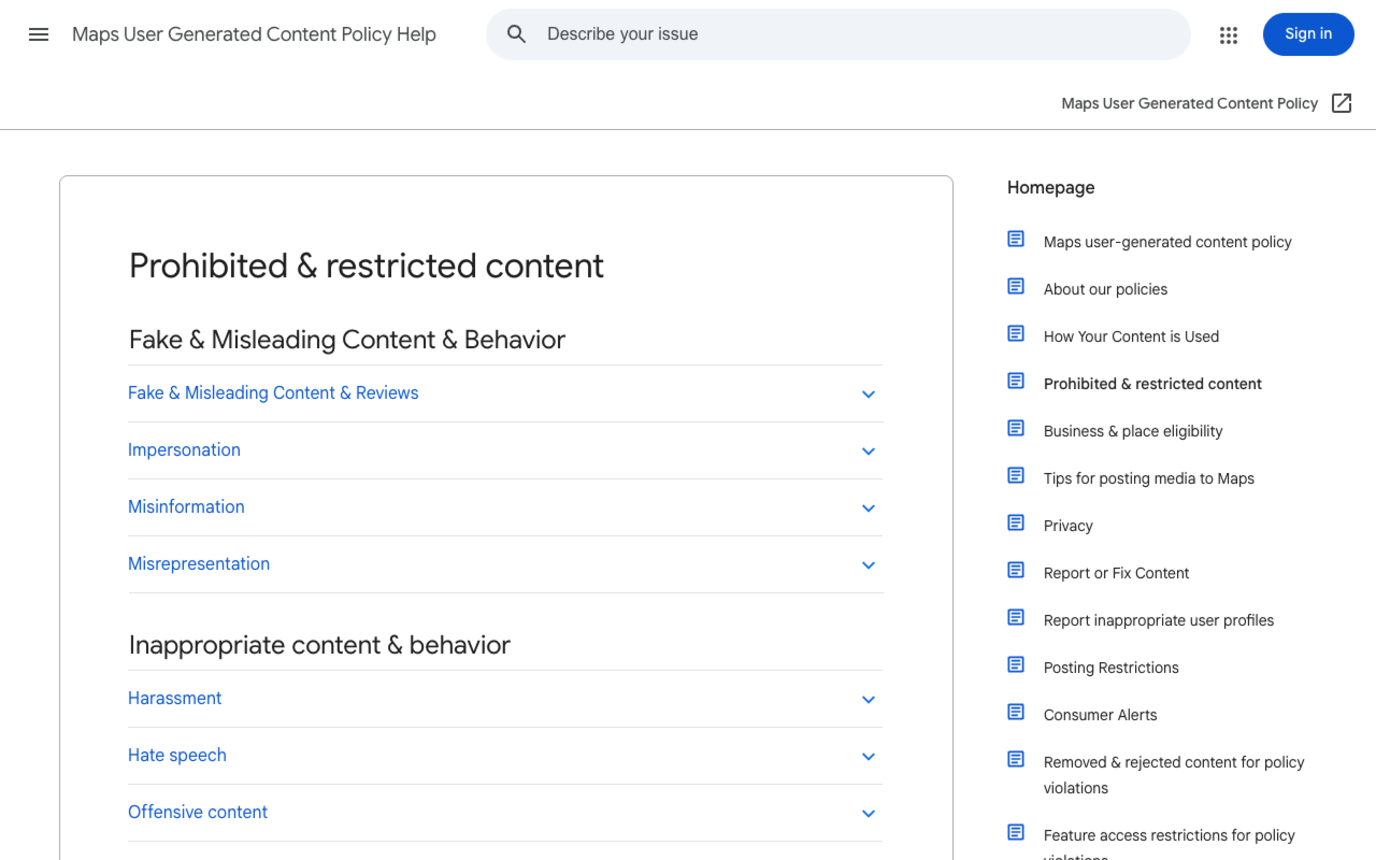
Google publishes what it enforces, and the list is narrower than most owners assume. The policy names each category: Fake Engagement, Rating Manipulation, Impersonation, Misrepresentation, Harassment, Personal Information, Off-Topic, Advertising and Solicitation, and several more. A filing has to land inside one of them by name. Nothing comes down for being harsh, and nothing comes down because you disagree with it.
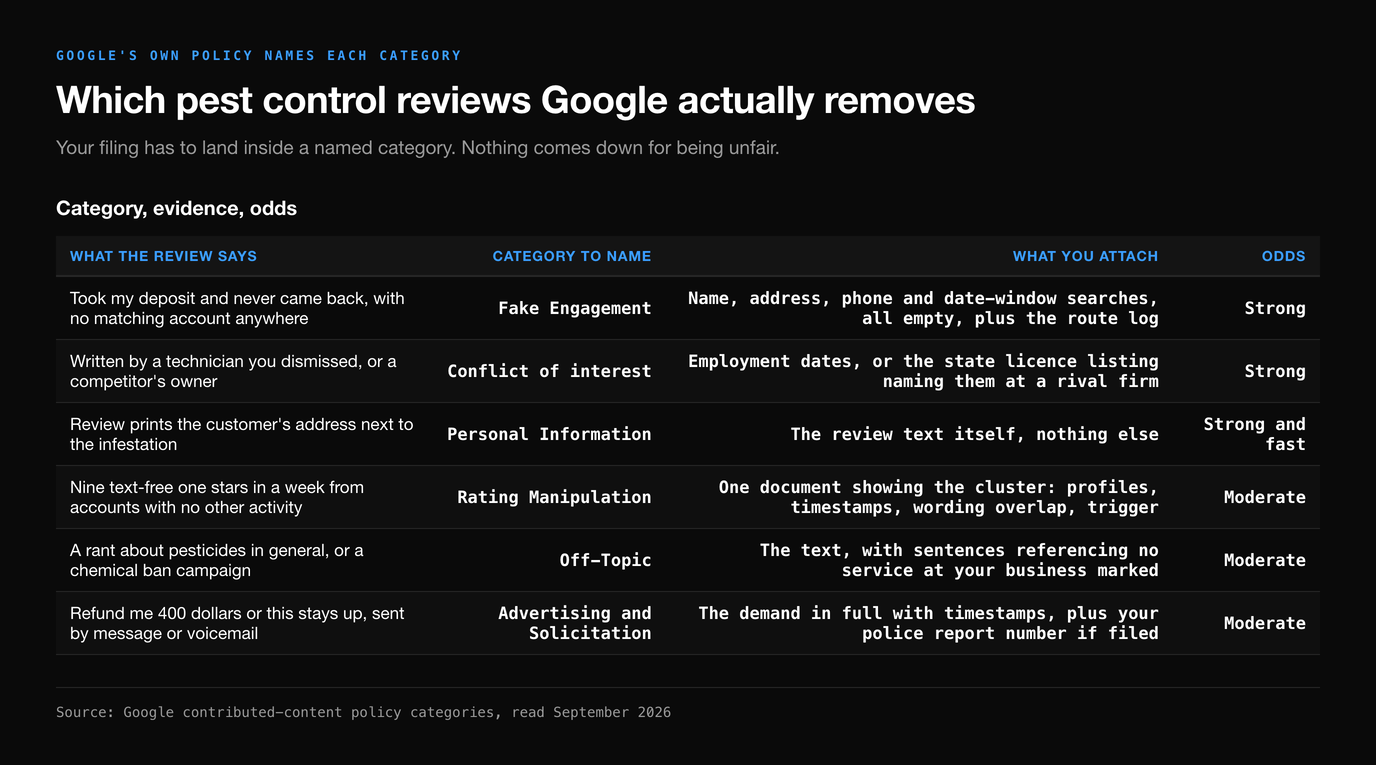
Here is how the complaints we see in this trade map onto those categories, with the evidence that actually moves each one.
| What the review says | Category to name | What you attach | Odds |
|---|---|---|---|
| "Took my deposit and never came back", no matching account anywhere | Fake Engagement | Name, address, phone and date-window searches, all empty, plus the route log | Strong |
| Written by a technician you dismissed, or by a competitor's owner | Conflict of interest | Employment dates or the state licence listing that names them at a rival firm | Strong |
| Review prints the customer's address next to the infestation | Personal Information | The review text itself, nothing else | Strong and fast |
| Nine text-free one stars in a week from accounts with no other activity | Rating Manipulation | One document showing the cluster: profiles, timestamps, wording overlap, the trigger event | Moderate |
| A rant about pesticides in general, or about a chemical ban campaign | Off-Topic | The text, with the sentences that reference no service at your business marked | Moderate |
| "Refund me $400 or this stays up", sent by message or voicemail | Advertising and Solicitation | The demand in full, with timestamps, plus your police report number if filed | Strong |
Note what the strong rows share: a document or a search result, not an argument. If you want the categories in full rather than the pest control subset, every violation type explained walks through all of them, and removing reviews left by competitors covers the conflict-of-interest filing in detail.
What Google will not remove, however wrong it is
Four complaints make up most of the pest control reviews owners want gone, and all four are staying. "The bugs came back." That is a warranty conversation, and the customer genuinely had the service. "They charged me for a quarterly I cancelled." Billing disputes are experiences of your business, even when your terms are on your side.
"The technician was 40 minutes into a two-hour window." Genuine, and arguing it publicly reads worse than the review. "They sprayed while my kids were home." Genuine experience, and the substance belongs to a regulator rather than to Google, which is the next section.
Each of these is reply work. One short public paragraph that takes the point seriously, names no product and no personal detail, and offers a phone number does more for the next reader than a removal would. BrightLocal's 2026 survey found 80% of consumers are more likely to use a business that responds to all its reviews, while 42% avoid the ones that ignore feedback entirely. Our reply templates hold that line without conceding anything you would not say in front of a regulator.
The chemical complaint is a regulator matter, not a Google one
This is the review that frightens owners most, and the one where the wrong instinct does the most damage. A customer writes that your technician used something dangerous, that a pet fell ill, that the label was ignored. Google will not adjudicate any of it. There is no policy category for "the allegation is false", and a serviced customer describing their own service is exactly what the platform is built to publish.

The venue that does decide it is your state lead agency for pesticide regulation, which investigates label violations under federal law. Every registered product carries the line the EPA describes in its introduction to pesticide labels: "It is a violation of Federal law to use this product in a manner inconsistent with its labeling." The agency's phrase for it is that the label is the law. If a complaint is filed, an inspector will ask for your application record, not for your Google reply.
So treat the review and the allegation as two separate tracks. Pull the record for that address and date the same day, check it against the label rate and the site restrictions, and if something went wrong, fix it properly and document the fix. Then write a public reply of three sentences that names no product, no diagnosis and no address, and invites a phone call. Owners lose these cases by arguing chemistry in a review response, which produces a permanent public record written under pressure, in a paragraph a regulator can later read.
The records only a pest control company has
Here is the advantage this trade never uses. Restaurants have a POS export. Movers have a bill of lading. You are a licensed applicator, which means parts of your record are mandated by regulation, dated, address-keyed and in several states filed with a public body. Under 40 CFR 171.303(b)(7)(vi), certification plans require commercial applicators to keep restricted use pesticide records for at least two years, carrying the name and address of the person the application was made for, the location, the date and time, the product brand name and EPA registration number, the amount applied, and the name and certification number of the certified applicator. Most state programmes extend a similar service record to general use structural work, so check your own state's rule before assuming a job falls outside it.
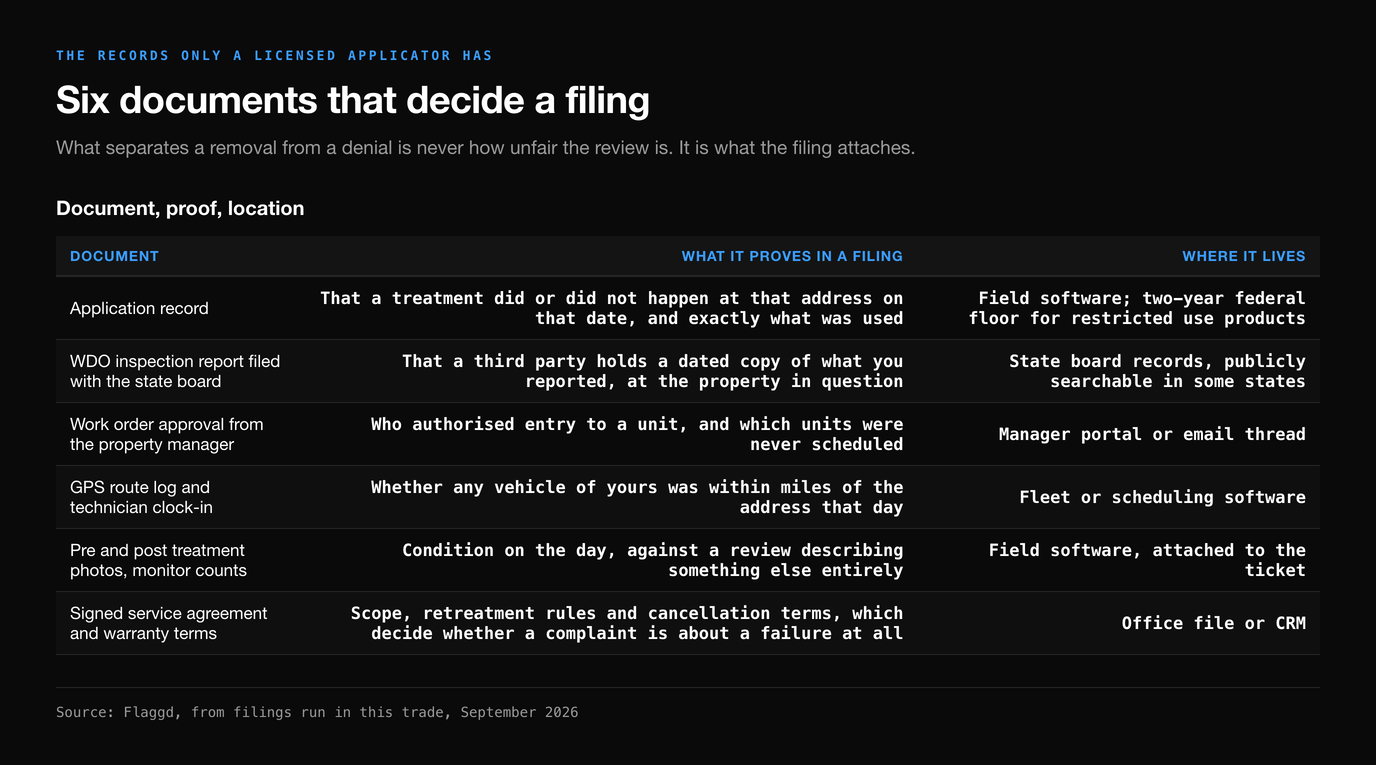
| Document | What it proves in a filing | Where it lives |
|---|---|---|
| Application record | That a treatment did or did not happen at that address on that date, and exactly what was used | Field software, two-year federal floor for restricted use products |
| WDO inspection report filed with the state board | That a third party holds a dated copy of what you reported, at the property in question | State board records, publicly searchable in some states |
| Work order approval from the property manager | Who authorised entry to a unit, and which units were never scheduled | Manager portal or email thread |
| GPS route log and technician clock-in | Whether any vehicle of yours was within miles of the address that day | Fleet or scheduling software |
| Pre and post treatment photos, monitor counts | Condition on the day, against a review describing something else entirely | Field software, attached to the ticket |
| Signed service agreement and warranty terms | Scope, retreatment rules and cancellation terms, which decide whether a complaint is even about a failure | Office file or CRM |
The second row deserves a moment, because it is unusual. In California, structural pest control operators must file the address of each property inspected or worked on with the Structural Pest Control Board within ten business days, and those filings stay publicly searchable by address for two years. A dispute over a termite inspection can therefore be evidenced against a state database instead of your own paperwork, which is a far stronger position than any trade normally gets. Redact customer details before anything is attached, and keep the pack to the single point you are proving. Documenting evidence for a review dispute covers the format that case reviewers actually read.
Filing and escalating: the routes and the clock
Start with the in-profile flag, because it is free and occasionally enough, but understand what it is: a one-click report with no field for a work order, a route log or an application record. Treat a denial there as "nothing was read", not as a verdict. Then take the same review to the review management tool inside your Business Profile, where an appeal carries an explanation and a named category, and file your evidence pack as one document.
Name one category per filing. A case that argues the reviewer was never a customer and that the review is off-topic and that a competitor is behind it reads as an owner who is upset rather than as a policy breach, and it gives the reviewer three things to disbelieve instead of one to verify.
On timing, plan in weeks and do not refile in between, which pushes you back down the queue. How long Google takes to remove a review sets realistic expectations, and what to do when a request is denied covers the second pass, which is where most evidenced pest control cases actually land.
Swarm Season Is No Time To Learn Google's Dispute Process
Send us the review, the service ticket and the route log. Flaggd maps it to the right policy category, builds the evidence pack and files the escalation while your technicians keep running the board.
Flaggd is our own review dispute service. We file removals against Google's published content policies; we do not buy, sell or suppress legitimate reviews.
Two replies that turn a review into a legal problem
The first is the trade. In this industry the callback and the one star arrive in the same week, so "we will come back out if the review comes down" feels like customer service and reads like suppression. The FTC's Rule on the Use of Consumer Reviews and Testimonials took effect on 21 October 2024 and reaches conduct used to prevent or remove a negative review, with civil penalties running to $53,088 per violation. Honour the retreatment because the agreement says so, and say nothing about the review while you do it.
The second is the correction, and pest control makes it worse than most trades because the facts are intimate. The instinct to reply "we treated 14 Oakfield Road for German cockroaches on 8 May after your landlord reported an infestation in three units" is understandable, and it publishes a person's address, their pest problem and their tenancy to the open internet. That is the same Personal Information category you would use against someone else, and it can cost a tenant a lease.
Keep the public reply to one paragraph naming no address, no product and no third party, then take the detail to a phone call. The FTC fake review rule in 2026 covers the compliance side in more depth.
Before the next swarm season
Most of the work that wins a dispute happens before the review exists. Make sure a technician cannot close a ticket without the address, the product, the rate and a photo, because a filing built on a complete record takes twenty minutes and one built on a reconstructed one takes a week. Keep route logs for at least two seasons, since termite and tenant disputes surface long after the visit.
Then ask for the reviews. Velocity is the only defence that also works on the reviews Google was never going to remove, and in a trade with recurring quarterly visits you have four natural moments a year to ask. Set up review monitoring and alerts so a cluster is caught in days rather than at the end of the month, and build the request into the post-service message your software already sends.
Frequently asked questions
A tenant reviewed us but the property manager is our customer. Can we get it removed?
Usually not, and this is the filing most pest control companies get wrong. If a technician treated that unit, the tenant was present for a service at your hands and Google counts it as a genuine experience regardless of who signed the contract. It becomes removable only when no service happened at that address: no work order, no route stop, no application record. Then it is a Fake Engagement filing, won by showing the empty address search rather than by explaining the billing relationship.
The review claims we poisoned a pet. What do we file?
Nothing, in most cases, because Google does not adjudicate whether an application was safe or lawful, and a serviced customer describing their own service is a genuine experience. The venue that decides it is your state lead agency for pesticide regulation, and your defence there is the application record showing product, EPA registration number, rate and applicator certification number. Reply publicly in one short paragraph that names no product, no diagnosis and no address.
Someone reviewed us for a branch in another state. Is that removable?
Yes, and it is one of the strongest filings in this trade because the evidence is public. Pest control is full of shared names across separate licensees, franchises and acquired brands, so customers routinely land on the wrong profile. Attach your state licence showing the counties you work in, your route log for the date range, and a screenshot of the listing the reviewer most likely meant.
The review posts the customer's address and says the house had roaches. Does that help us?
It is often the fastest removal available to you, and it does not depend on whether the reviewer was a customer. Google's Personal Information policy covers information about a living identifiable person whose disclosure could cause harm, and a street address tied to an infestation qualifies on both counts. File the review text itself, do not repeat any part of it in a reply, and expect no records to be needed from you.
Can we offer a free retreatment in exchange for taking the review down?
No. The FTC's Rule on the Use of Consumer Reviews and Testimonials took effect on 21 October 2024 and reaches conduct used to suppress or remove a negative review, with civil penalties running up to $53,088 per violation. Retreat the property because the warranty says so, and say nothing at all about the review while you do it. If the customer takes it down afterwards of their own accord, that is their decision.
We got nine one-star reviews in a week after winning a commercial contract. What now?
Treat it as one case, not nine. Build a single filing that shows the pattern: the accounts, the posting timestamps, the overlap in wording, the absence of those names and addresses from your service history, and the contract award date sitting in front of it all. Rating Manipulation and Fake Engagement are both pattern findings, and a cluster shown in one document gets acted on far more often than nine separate flags.
Google denied our flag. Is that the end of it?
No. The in-profile flag is a one-click report with nowhere to attach a work order, a route log or an application record, so a denial there usually means nothing was read rather than that the case was weighed. Take the same review to the review management tool in your Business Profile, where an appeal carries an explanation, and file the evidence pack as one document naming a single policy category.
Pest control Google review removal is a sorting exercise before it is a filing exercise. In your head the review is the tenant you never billed, or the buyer whose deal fell through, or the customer whose ants came back in August. To Google it has to be a breach of a named content policy, evidenced by records you are already required to keep. Sort the review by who experienced the service, name one category, attach the application record and the route log, and accept early that callbacks and billing rows are reply work. If you would rather hand the filing to a team that does this every week, that is what we are here for.