Key Takeaways
- Your property management system is the evidence. The strongest multifamily filing is a no-record search across the PMS, guest cards, access control and payments on the reviewer's name, phone, email and unit. Assertion loses, records win.
- Policy category, not unfairness, decides it. Google acts on named categories: Fake Engagement, Rating Manipulation, Harassment, Personal Information. "This resident is angry about an eviction" is not one, and disputes framed that way come back denied.
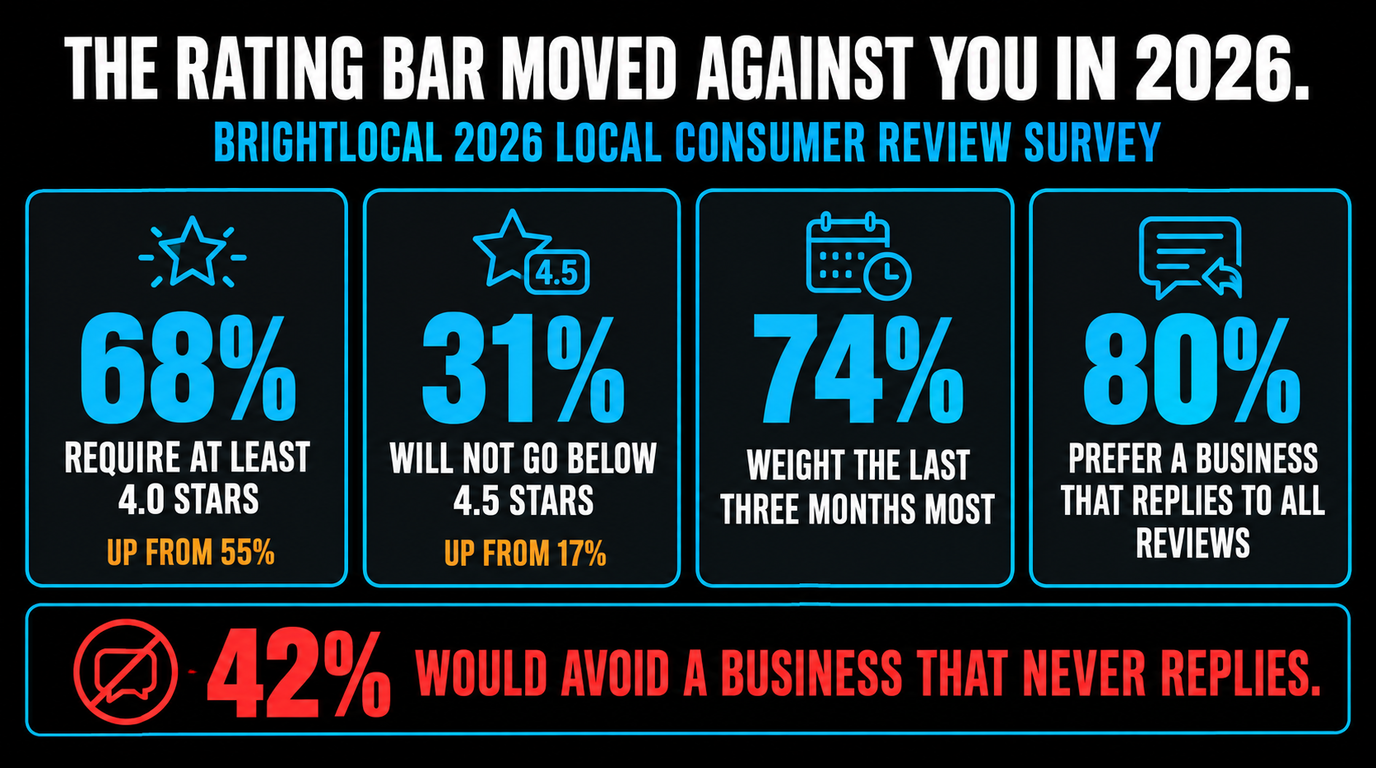
- Rating expectations moved against you in 2026. BrightLocal's 2026 survey found 68% of consumers now require at least 4 stars, up from 55% a year earlier, and 31% will not go below 4.5.
- Turnover is what makes the arithmetic hurt. Published 2026 benchmarks run from roughly $1,800 direct to about $3,900 all-in per unit, so a rating drop costing a 150-unit community a few extra move-outs is a five-figure problem.
- Two replies create legal exposure. Conditioning a concession on deletion runs into the FTC's review-suppression rule, and confirming tenancy, eviction or accommodation details publicly puts fair housing material into a record you do not control.
- Why apartment listings collect more removable reviews than most local businesses
- The resident review types Google actually removes
- What Google will not remove, however unfair it feels
- The leasing-office evidence pack that wins disputes
- Filing: three routes, and how long each one takes
- What a rating drop costs a 150-unit community
- The two replies that create a legal problem instead of solving one
- Between turns: making the next dispute a 20-minute job
A one-star lands on your community at 11pm, it names a unit number that has been vacant since March, and by Monday your rating has gone from 4.4 to 4.1. Apartment Google review removal matters at that moment because the rating is doing the filtering your leasing office used to do: BrightLocal's 2026 Local Consumer Review Survey found that 68% of consumers now require a minimum of 4 stars before they will use a local business, up from 55% a year earlier, and 31% will not go below 4.5. A prospect who never calls you is not a lead you lost, it is a lead you never knew existed. We have filed enough multifamily disputes to know which ones Google acts on and which come back denied inside a week, and the difference is almost never how unfair the review was.
This is written for community managers, regional managers and property management owners, not for an agency: the policy categories Google enforces, the evidence pack you can pull from your PMS in twenty minutes, the three filing routes and their real timelines, and the two replies that turn a review problem into a compliance problem.
Why apartment listings collect more removable reviews than most local businesses
Most negative reviews anywhere are honest reports of a bad experience, and multifamily is no exception. What makes apartment communities unusual is the size of the minority that is not, and the reasons are structural rather than bad luck.
Your customer relationship ends in a dispute more often than most. Restaurants part with customers over a meal. You part with residents over a security deposit, a damage charge, a lease break fee or an eviction, and the person on the other side has a specific dollar amount they believe you took from them. That produces a steady flow of reviews written weeks after move-out, about an accounting decision rather than a stay.
Non-residents review you constantly. Declined applicants, guests who could not find parking, delivery drivers who disliked the gate and neighbours with a complaint about your dumpster all land on the community's listing. Some of that describes a genuine interaction and stays. A large slice describes no interaction with your business at all, which is exactly the ground Google removes on.
Management changes inherit a stranger's reputation. When a new company takes over, the listing does not reset: you acquire every review about the previous operator's staff, pricing and maintenance failures, and prospects read them as yours. That is a real business problem, and it is not usually a removal case, which is the distinction most new operators get wrong.
Staff are named, and named staff get attacked. Residents deal with the same leasing agent and maintenance tech for a year or more, so multifamily reviews name individuals far more often than most categories do. When a review moves from "the office is slow" to naming a leasing agent and publishing her mobile number, it crosses into Google's harassment and personal information policies and becomes straightforwardly removable.
Lease-up and renewal season make you a target. Coordinated attacks cluster around lease-up, a rent increase notice, or a competitor's own lease-up down the road, because that is when a rating drop converts into lost traffic fastest. Our guide to reputation management for multi-location businesses covers the portfolio-level groundwork this article builds on.
The resident review types Google actually removes
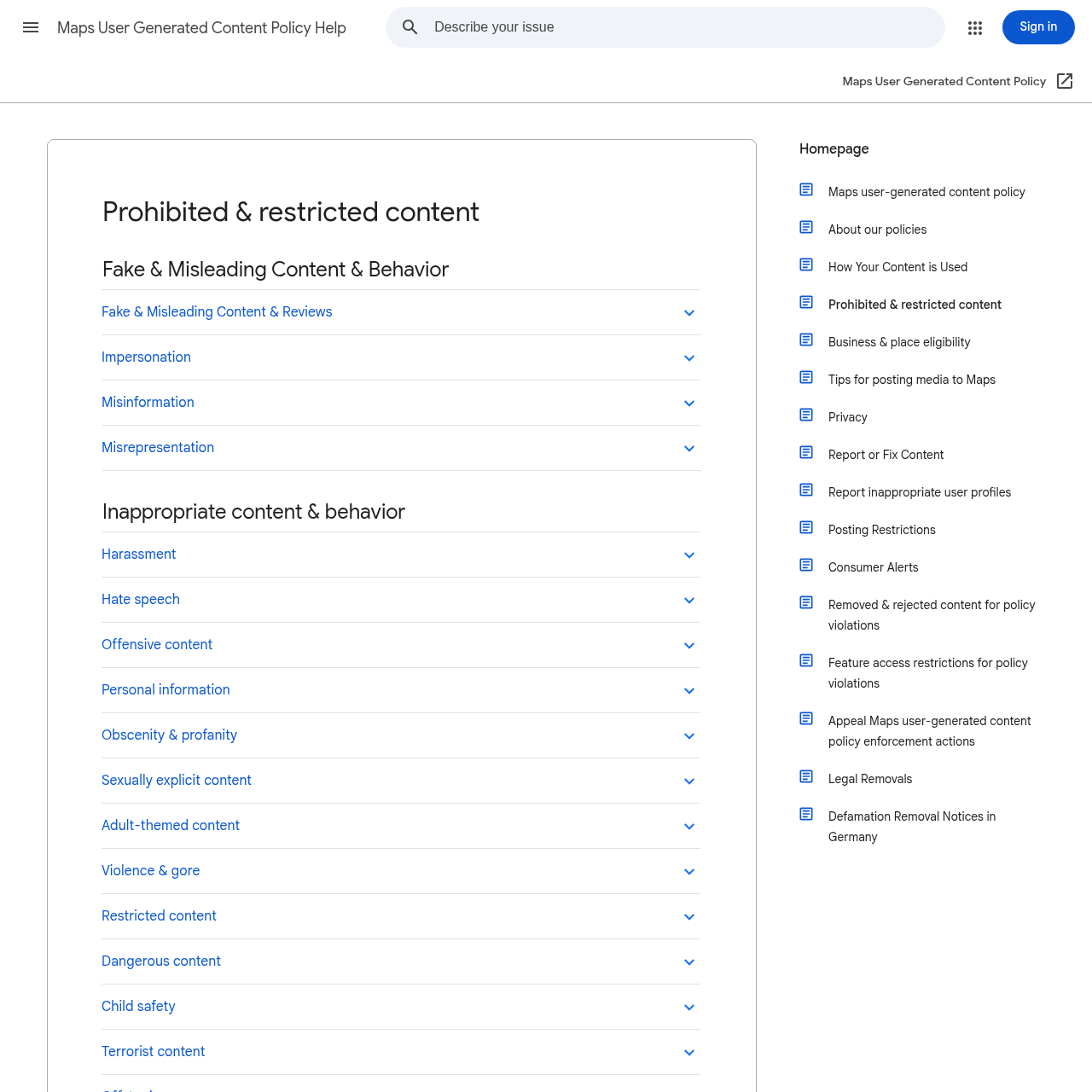
Google publishes named prohibited and restricted content categories in its Maps user contributed content policy, and every dispute is judged against those names rather than against your description of events. Your job is to translate what happened at the community into the category a moderator recognises. The table below is that translation for the scenarios multifamily operators file most.
| What happened | Google policy category to cite | Removal odds |
|---|---|---|
| Reviewer has no record in the PMS, guest cards, access control or payments | Fake & Misleading Content | High with records, low without |
| Several one-stars in an afternoon from accounts created that week | Fake Engagement | High when filed as one cluster |
| Review from a former leasing agent or maintenance tech | Rating Manipulation (conflict of interest) | High when the HR file is attached |
| Five-star reviews your own staff wrote to offset a bad week | Rating Manipulation (also an FTC problem) | Removed against you, not for you |
| Review names a leasing agent and abuses her personally | Harassment | High |
| Review publishes a staff member's mobile number or home address | Personal Information | Very high |
| Rant about the city, a bus route or a neighbouring business | Off-topic | Moderate to high |
| Sustained profanity with no description of the community | Obscenity & Profanity | High |
| Review posted by a competing community's manager | Rating Manipulation (competitor) | Moderate, needs strong linkage |
| Review that is actually about a different community you do not operate | Fake & Misleading Content | High, and common in large portfolios |
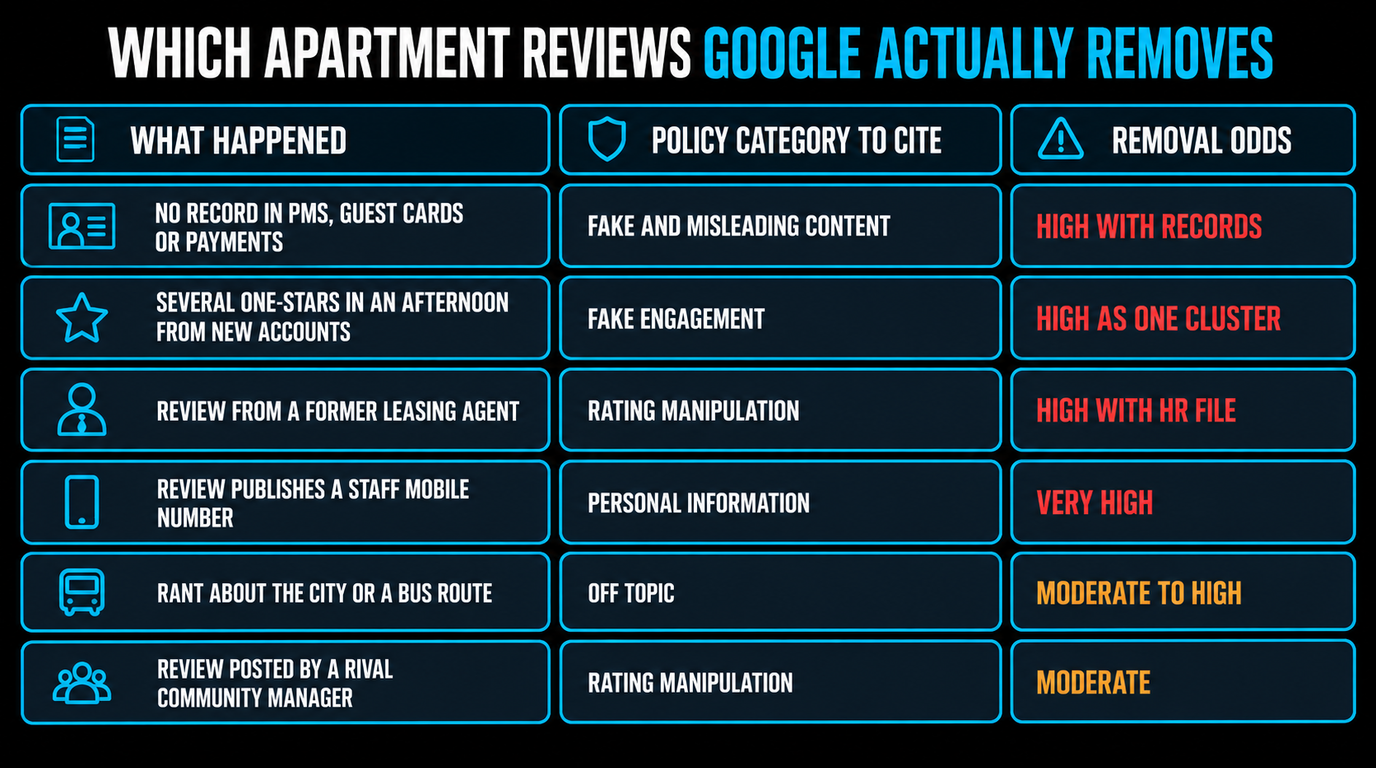
Two rows deserve a note. The conflict-of-interest row is the one multifamily operators under-use, because Google's Rating Manipulation policy names employment, family ties and competitor status explicitly, and a departed leasing agent is squarely inside it. Our breakdowns of what qualifies as a conflict of interest and removing reviews from former employees cover that filing in detail. The staff-written five-star row is the one to read twice, because it is the only entry in the table that hurts you when Google finds it.
What Google will not remove, however unfair it feels
Roughly half the disputes multifamily operators want to file are unwinnable, and knowing which half saves you the week you would otherwise spend appealing. A review stays up when it describes a real interaction in the reviewer's own words, no matter how much it costs you.
- The deposit dispute. A former resident disagrees with your damage charges and says so. A real transaction, a real opinion, and a review that stays.
- The eviction review. Being evicted does not remove someone's status as a customer. This is the case operators most often assume is automatic, and it is not.
- The declined applicant. A tour and an application are a genuine interaction. Unless the review crosses into harassment or personal information, it stays.
- The maintenance complaint you already fixed. Resolution afterwards does not make the original experience untrue. Reply and show the fix.
- The previous management company's reviews. They described a real experience at that address. Bury them with new velocity, do not file on them.
If your review sits in that group, skip the filing and write a reply instead, because the reply is doing more work than you think. BrightLocal's 2026 survey found 80% of consumers are more likely to use a business that responds to all of its reviews, and 42% would avoid one that never replies. Our guide on responding to negative reviews covers the structure that works on billing disputes specifically, and the section on legal lines below covers what a multifamily reply must never contain.
The leasing-office evidence pack that wins disputes
This is the part multifamily is unusually well equipped for and unusually bad at using. Between the PMS, the CRM and the access control system you already hold more identity data than almost any other local business, and most operators file without touching any of it. Pull the records before you file, not after you are denied. The general evidence documentation method applies everywhere; the table below is the multifamily version.
| Claim you are making | Evidence to attach | Where it lives |
|---|---|---|
| This person was never a resident or applicant | Null search on name, phone, email and unit across the full resident and applicant history | Property management system |
| They never toured either | Guest card log and tour history for the period the review describes | Leasing CRM / ILS lead feed |
| The unit number in the review is wrong or was vacant | Unit availability and occupancy report for those dates | Property management system |
| Nobody by that name ever entered the property | Fob, gate and package room access logs for the window | Access control system |
| The maintenance failure described never got reported | Work order history for the unit and building for that period | Maintenance module / ticketing |
| The reviewer is a former employee | Employment dates, separation record, and any staff-only detail quoted in the review | HR file |
| This is a coordinated cluster, not five opinions | Timestamps, profile URLs, account ages, other communities rated that week, shared phrasing | Screenshots taken within 48 hours |
| The review belongs to a different property | Your portfolio list showing the named community is not yours, plus the correct listing | Portfolio roster |
One discipline matters more than any single record: search four fields, not one. Reviewers use a first name only, a maiden name, a partner's Google account or a nickname, so a search on the display name alone produces a null result you cannot defend. Search name, phone, email and unit, and say in the filing that you searched all four. A moderator reading "no record on name, telephone, email or unit across the full resident and applicant history" is handed a conclusion; one reading "this person was never a resident" is handed an opinion.
Filing: three routes, and how long each one takes
There are three ways into Google's moderation queue and they are not interchangeable. The mistake that costs operators the most time is using the fastest route for the case that needs the slowest one, then treating the denial as a verdict.
| Route | Can you attach evidence? | Typical turnaround | Best for |
|---|---|---|---|
| In-profile flag on the review | No | Days | Violations visible in the text: profanity, slurs, a published phone number |
| Business Profile support escalation | Yes, to a human | Roughly one to three weeks | Everything that needs records: no-record cases, ex-employees, wrong property |
| Community forum / Product Experts | Partially, in public | Variable | Stalled cases and multi-review clusters after support has stalled |
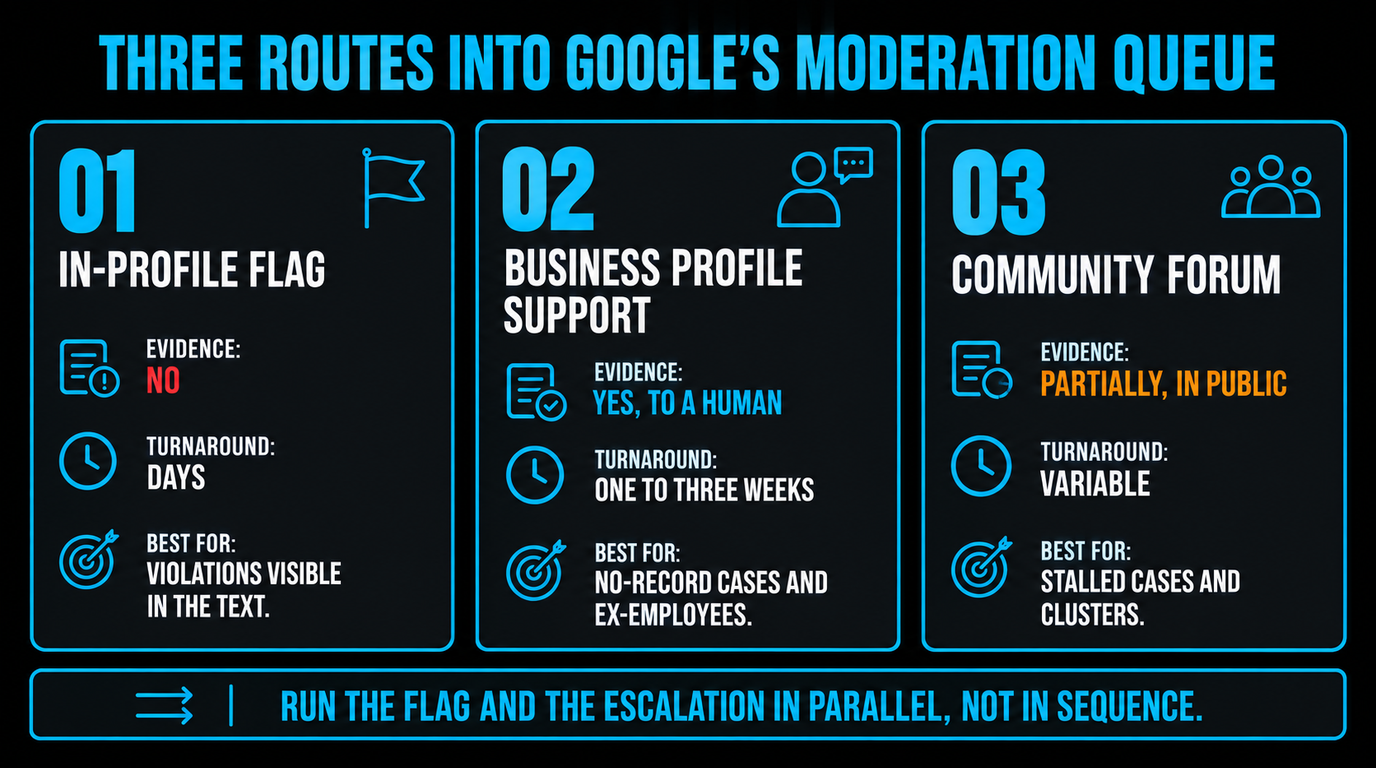
Run the flag and the escalation in parallel, not in sequence. The flag costs you sixty seconds and occasionally resolves the obvious cases on its own. The escalation is where a real multifamily case is actually decided, because it is the only route with somewhere to put the PMS export. Waiting for the flag to fail before you escalate adds a week for nothing.
A denial is a first pass, not a verdict. The in-profile flag is decided without your records because the form has nowhere to put them, so a denial there tells you almost nothing about the merits. What to do next is set out in our guide on what to do when a removal request is denied, and the realistic waiting periods are in how long Google takes to remove a review.
File a cluster as one case. When six reviews arrive together, six separate flags produce six independent low-confidence decisions, and the pattern that would have won the case is invisible in every one of them. Present the wave once, with the timestamps and account ages in a single table, and let the moderator see what you see. If a wave is in progress right now, our review bombing emergency playbook is the faster read.
What a rating drop costs a 150-unit community
Multifamily has an advantage over most local businesses here: you already know what a lost resident costs, because you calculate it every time a unit turns. That makes the review question unusually easy to settle with arithmetic rather than argument.
| Input | Published 2026 benchmark | What it means for the dispute |
|---|---|---|
| Consumers requiring 4.0+ stars | 68% (BrightLocal 2026, up from 55%) | Slipping under 4.0 removes you from most shortlists silently |
| Consumers requiring 4.5+ stars | 31% (BrightLocal 2026, up from 17%) | The 4.6 to 4.3 slide is not cosmetic; it costs traffic |
| Weight given to the last three months | 74% prioritise recent reviews (BrightLocal 2026) | A cluster does its damage now, so speed matters more than volume |
| Turnover cost per unit | Roughly $1,800 direct to about $3,900 all-in; sources disagree | Every avoidable move-out is a four-figure event before vacancy |
| Days vacant per turn | Mid-30s nationally in recent RealPage data | Slower traffic means longer vacancy, which is the compounding cost |
| Lost rent per vacant day | Your own average rent divided by 30 | The only number in this table you should trust precisely |
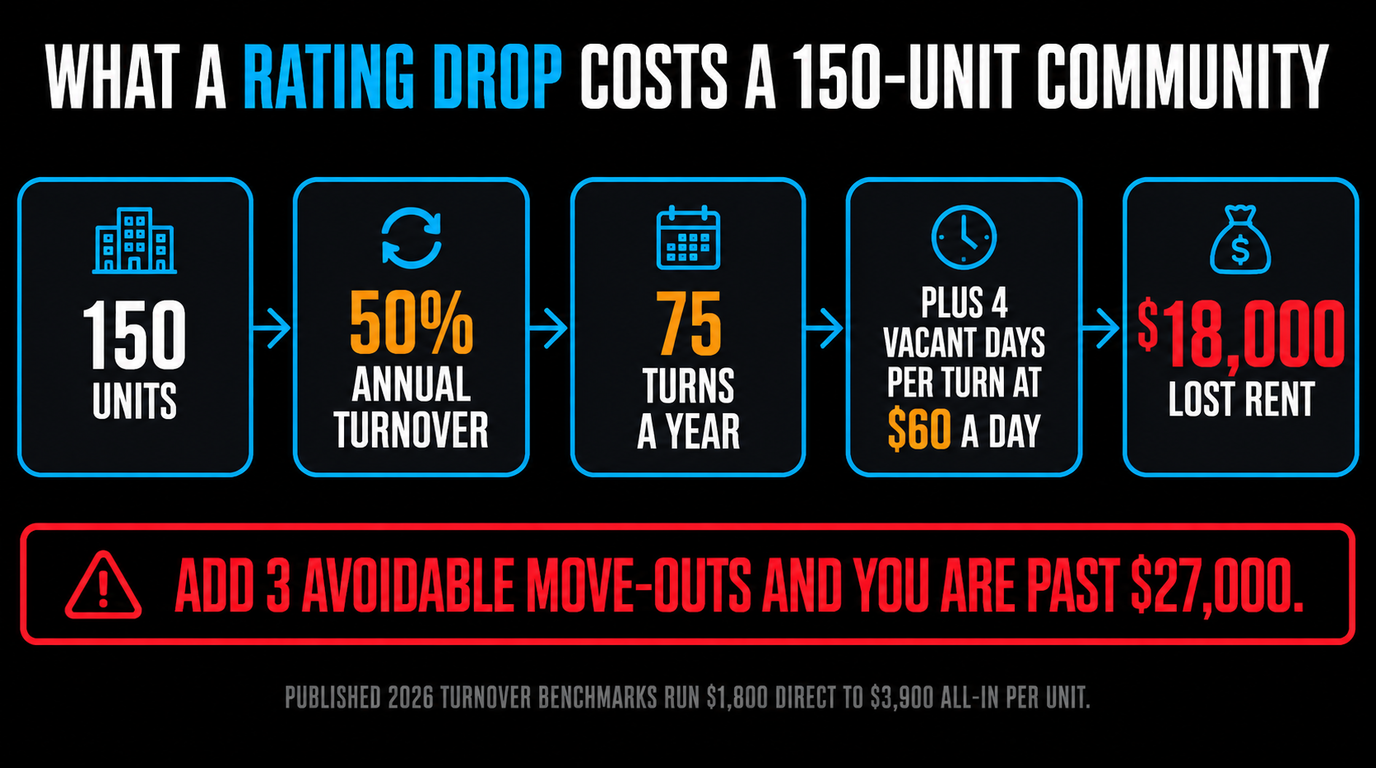
Work it through with your own numbers rather than ours. Take a 150-unit community at 50% annual turnover: 75 turns a year. If a damaged rating slows traffic enough to add even four vacant days to each turn, at $60 a day that is roughly $18,000 in lost rent over the year, before a single extra move-out. Add three avoidable move-outs at a mid-range turnover cost and you are past $27,000. Published benchmarks vary widely by market, asset class and what each source counts as a turnover cost, so treat the middle rows as order-of-magnitude anchors rather than quotes and check them against your own operating statement. Either way, the arithmetic settles whether a fake review is worth twenty minutes of PMS searching.
The two replies that create a legal problem instead of solving one
Multifamily carries a compliance overlay that most local businesses do not, and both of the moves that get operators into trouble are ones that feel like reasonable customer service in the moment.
Do not condition anything on the review coming down. The FTC's Rule on the Use of Consumer Reviews and Testimonials took effect on 21 October 2024, and it prohibits using unfounded or groundless legal threats, physical threats, intimidation or certain false public accusations to prevent or remove a negative consumer review. A deposit release, a rent credit, a transfer to a better unit or a lease-break waiver offered in exchange for deletion is the version of this that multifamily reaches for. Fix the problem, tell the resident what you fixed, and say nothing at all about the review. Residents update reviews on their own initiative far more often than operators expect, and a self-initiated update carries none of the exposure. What the rule means in practice is covered in our FTC fake review rule breakdown.
The same rule is why the staff-written five-star row in the table above matters. It restricts undisclosed testimonials from officers, managers, employees and agents, and it reaches solicitations directed at employees and their immediate relatives. A regional manager asking the leasing team to "get some good ones up this week" is describing conduct the rule addresses, and Google's Rating Manipulation policy removes those reviews anyway. Ask every resident at renewal and at a completed work order instead, uniformly and without screening for who is happy first, which is the line our guide to review gating and whether it is legal walks through.
Do not litigate a tenancy in a public reply. The instinct when a review is unfair is to correct the record: they were three months behind, they broke the lease, they were evicted in March, they were the subject of six noise complaints. Every one of those sentences puts details of a specific person's housing history into a permanent public record you do not control, in an industry where consistency of treatment across protected classes is exactly what a fair housing investigation examines. Confirming that a named individual requested a reasonable accommodation is worse still. Fair housing risk shows up in ordinary resident communication rather than in dramatic moments, and a review reply is resident communication published to the world.
- Acknowledge without confirming. "We take concerns about maintenance response times seriously" says something without confirming this person lives there.
- State the standard, not the case. "Our team targets a 24-hour response on emergency work orders" is verifiable, general, and does not discuss an individual.
- Move it offline immediately. Give the office number or the manager's email and stop. No facts, no dates, no dollar amounts, no unit numbers.
Between turns: making the next dispute a 20-minute job
Every removal described above gets faster when the groundwork is already done, and the groundwork is unglamorous enough that it never survives a busy leasing season unless someone writes it down.
Alert on every community, not just the troubled one. Most operators learn about a cluster days later from a regional report. Same-day detection is what keeps evidence capturable, because a screenshot you did not take is a case you cannot file. Our review alerts setup guide covers the mechanics.
Make the four-field search a documented procedure. Write down which systems get searched, on which fields, and who does it. When it is a checklist rather than a scramble, an assistant manager can build the pack without waiting for the regional, and every filing in the portfolio looks the same to a moderator.
Fix your intake data. Most no-record disputes turn on whether the guest card carries a real phone number and email rather than a first name and "walk-in". Clean intake converts "we do not recognise this person" into a provable claim, and it costs nothing but discipline at the front desk.
Ask for reviews at renewal, every time. A community taking ten reviews a month absorbs a one-star inside a fortnight; one taking two a quarter carries it for a year. With 74% of consumers weighting the last three months most heavily, velocity is defensive infrastructure, and it is the only thing that helps with the reviews Google was never going to remove.
- →Every Google review violation type, explained
- →Reputation management across a multi-location portfolio
- →Removing reviews left by former employees
- →Emergency playbook for an active review bombing wave
- →Recovering your star rating after an attack
- →Building the review velocity that absorbs a bad month
Frequently asked questions
Apartment Google review removal is a translation problem more than a fairness problem. The review on your listing is described in your head as a vindictive ex-resident who owed three months of rent, and it has to be described to Google as a breach of a named content policy, backed by records your PMS already holds. Communities that make that translation get removals; the ones that write to Google about how unfair the reviewer is get denials a week later. Pull the four-field search before you file, cite the category by name, run the flag and the escalation in parallel, and reserve the reply for reviews that were never coming down, keeping it short enough that it never discusses a tenancy in public. If you would rather hand the filing to a team that does it daily, that is what we are here for, and either way the reviews that break Google's rules do not have to stay on your community's listing.