Key Takeaways
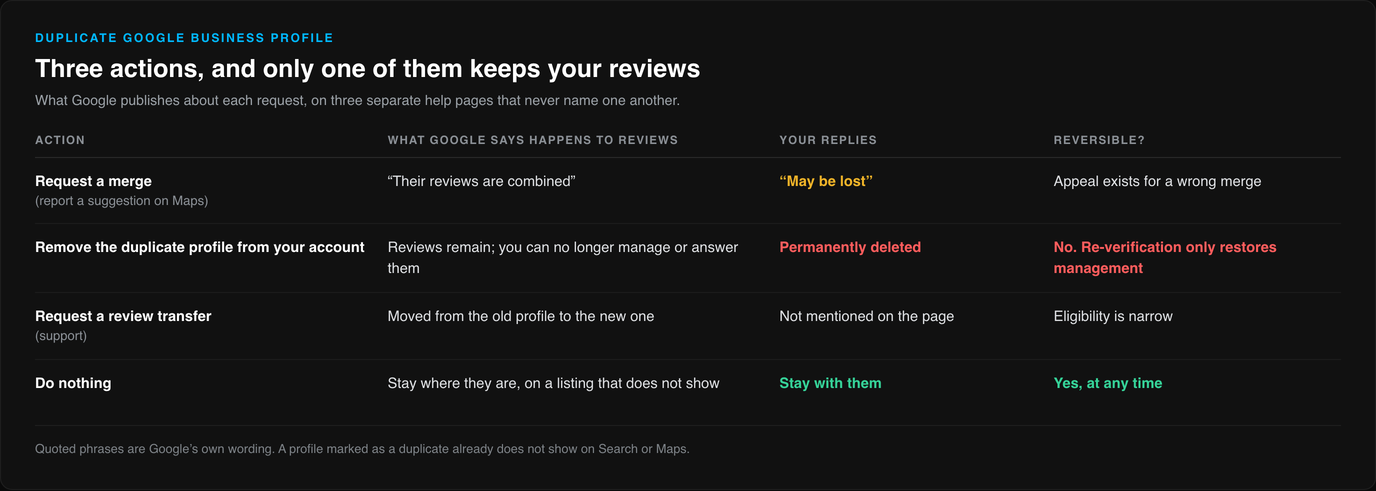
- There are three actions, not one, and they do different things to your reviews. A merge combines them, a removal deletes your side of the conversation, and a transfer request moves them in one narrow circumstance. Google documents all three on three separate pages, and none of those pages mentions the other two.
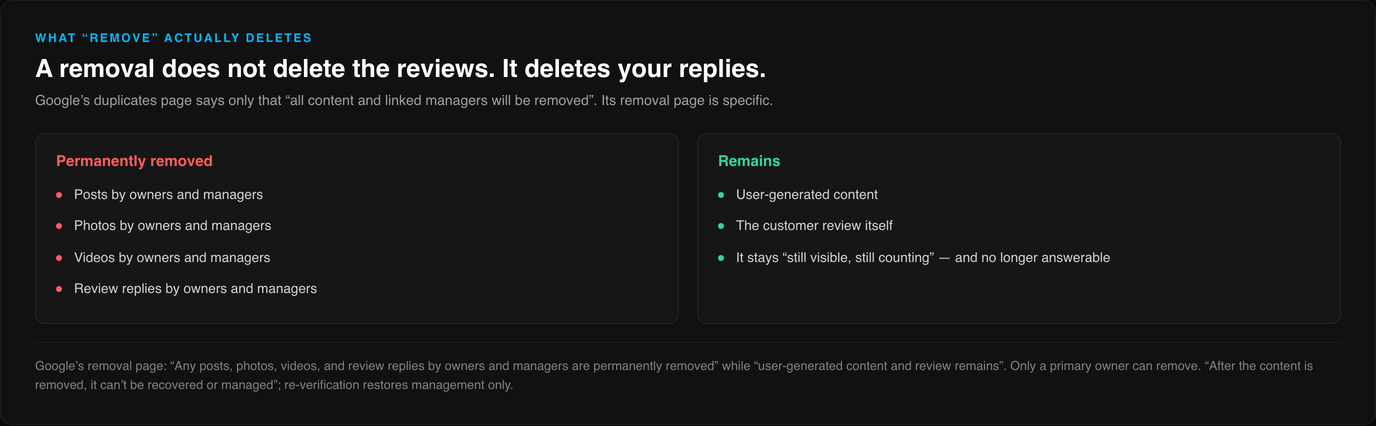
- Removing a duplicate does not delete its reviews. It deletes your replies. Google's duplicates page says only that "all content and linked managers will be removed". Its removal page is specific: "Any posts, photos, videos, and review replies by owners and managers are permanently removed" while "user-generated content and review remains".
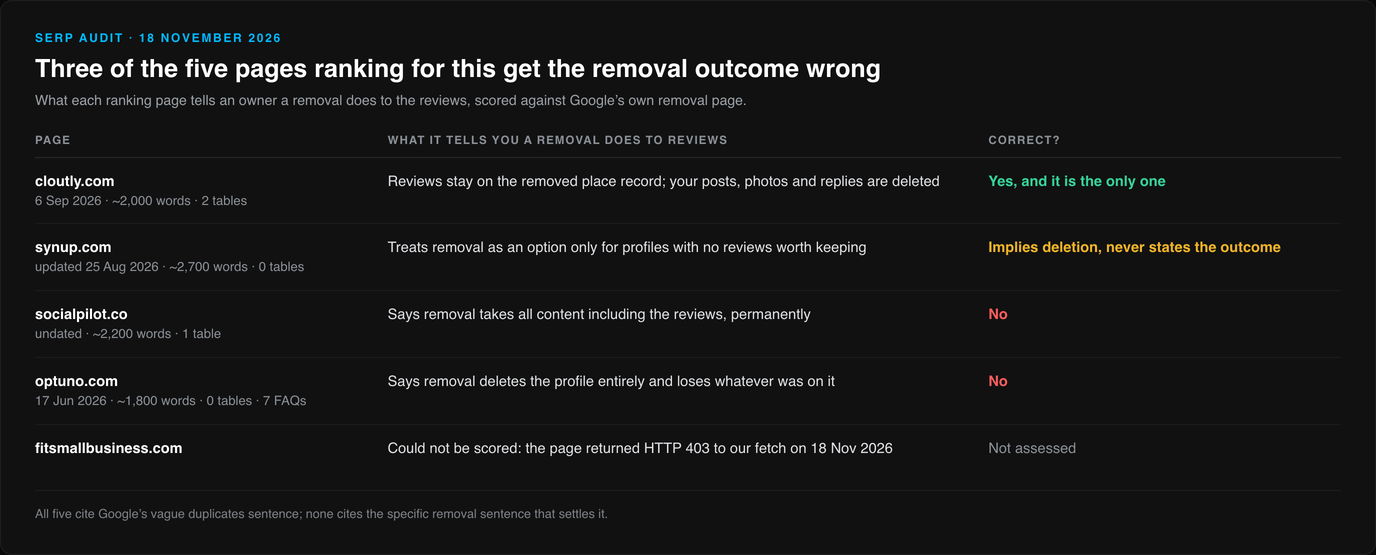
- Three of the five pages ranking for this get that outcome wrong, in both directions, because they all cite the vague sentence and none cites the specific one. Two tell you a removal takes the reviews with it. It does not, and believing it leads owners to remove the profile holding reviews they wanted.
- A merge has two published conditions: "the profiles must represent the same business and should have the same info", and "all merge requests are subject to review". Two verified locations at two addresses are not the same business, which is where review sets actually die.
- One documented case, January 2025: an agency asked Google to merge a closing location into a nearby open one. A specialist replied "we are only merging over about 90 of the reviews", roughly 200 did not arrive, and the agency was told the decision was final. Nobody had recorded the original review count.
- Three actions, and only one of them keeps your reviews
- What "remove" actually deletes, in Google's own words
- Three of the five pages ranking for this get it wrong
- How a merge works, and the two conditions it has to meet
- Merging two locations is not a duplicate merge
- The transfer request Google documents, and how narrow it is
- If Google marked a real second location as a duplicate
- What to capture before you touch either profile
- Frequently asked questions
You have found a second listing for your own business, and somewhere across the two of them sits a review set you did not write and cannot rebuild. The reason a duplicate Google Business Profile is dangerous is not that it splits your rankings, which is what most of the advice on it worries about. It is that cleaning it up means choosing between three different requests, one of which is irreversible, and Google documents each one on a different help page without ever naming the other two. We read all three pages against each other, checked what the five pages ranking for this question tell owners the review outcome is, and found that three of the five state it incorrectly. Here is what each action does to the reviews, the replies and the star average, and which order to do things in.

Three actions, and only one of them keeps your reviews
Google uses one word, duplicate, for several different situations. Its own page lists the reasons a profile gets marked as one: "a verified profile already exists for the same business on Google", "multiple profiles have the same address", and "multiple profiles exist for the same business that offer different services". The consequence is the same in each case, and it is worth knowing before you act: "if a profile is considered a duplicate, it won't show on Google Search or Maps."
So the duplicate is already invisible. That matters, because it removes the urgency that pushes owners into the destructive option. Nothing is being shown to a customer that you need to take down today. What you are deciding is where the reviews end up, and you get three choices.
| Action | What Google says happens to reviews | Your replies | Reversible? |
|---|---|---|---|
| Request a merge (report a suggestion on Maps) | "Their reviews are combined" | "May be lost" | Appeal exists for a wrong merge |
| Remove the duplicate profile from your account | Reviews remain; you can no longer manage or answer them | Permanently deleted | No. Re-verification only restores management |
| Request a review transfer (support) | Moved from the old profile to the new one | Not mentioned on the page | Eligibility is narrow, see below |
| Do nothing | Stay where they are, on a listing that does not show | Stay with them | Yes, at any time |
Doing nothing is in that table deliberately. It is the right answer more often than any guide admits, and it is the only row you can change your mind about. The next section is why the second row is the one to be careful with.
What "remove" actually deletes, in Google's own words
The duplicates page gives you one sentence about removal, and it is ambiguous enough to be read either way: "when you remove a duplicate profile, all content and linked managers will be removed, so make sure to remove the correct profile." Reviews are content. Read that in isolation and you would conclude your reviews go with it, which is exactly what two of the pages ranking for this tell you.
They do not. The sentence has a sibling on a different help page, and that one is specific: "Any posts, photos, videos, and review replies by owners and managers are permanently removed." Then, in the next breath, "user-generated content and review remains." Customer reviews are user-generated content. They stay on the place record. What is permanently destroyed is everything you wrote, including every reply you ever composed to a review.
That is a worse outcome than the one owners are braced for, not a better one. You end up with the reviews still visible, still counting, and no longer answerable, because Google's removal page adds that "after the content is removed, it can't be recovered or managed", and "to manage your business again, you must re-verify your Business Profile."
Two more details are worth having before anyone in your organisation clicks it. Only the primary owner can do it: "only the primary owners can remove the profile content and managers." It does not take the listing down: "after removal, your business might still show up on Search and Maps, unless it's considered ineligible business." Removal is an account action, not a cleanup. If what you want is the listing gone from Maps, that is a separate request about the listing itself.
Three of the five pages ranking for this get it wrong
We scored the five results a business owner actually meets for this query. All five cite Google's duplicates page. None of the five cites the removal page that defines what removal destroys, and the error propagates in both directions, which is the tell that nobody checked.
| Page | What it tells you a removal does to reviews | Correct? |
|---|---|---|
| cloutly.com, 6 Sep 2026, ~2,000 words, 2 tables | Reviews stay on the removed place record; your posts, photos and replies are deleted | Yes, and it is the only one |
| synup.com, updated 25 Aug 2026, ~2,700 words, 0 tables | Treats removal as an option only for profiles with no reviews worth keeping | Implies deletion, never states the outcome |
| socialpilot.co, undated, ~2,200 words, 1 table | Says removal takes all content including the reviews, permanently | No |
| optuno.com, 17 Jun 2026, ~1,800 words, 0 tables, 7 FAQs | Says removal deletes the profile entirely and loses whatever was on it | No |
| fitsmallbusiness.com | Could not be scored: the page returned HTTP 403 to our fetch on 18 Nov 2026 | Not assessed |
One more inherited error worth flagging, because it wastes an afternoon: optuno routes you to a control called "Merge duplicate profiles" under advanced settings. Google's current duplicates page documents no such button. The only merge route it gives is a suggestion filed on Maps, which is the next section.
How a merge works, and the two conditions it has to meet
A merge is the only action that brings two review sets together, and Google describes it in four short sentences. The route: "to request a merge when 2 or more Business Profiles for the same business exist on Maps, report a suggestion on Google Maps." The outcome: "when 2 profiles are merged, their reviews are combined, but replies to reviews may be lost." The gate: "all merge requests are subject to review." And the test: "for the merge to be successful, the profiles must represent the same business and should have the same info."
Read that last sentence as the load-bearing one. It is not a formality about tidy data, it is the criterion a reviewer applies to your request, and "should have the same info" is doing real work: name, address and phone on the two records are the evidence that they are one business. If the duplicate carries an old address or a former trading name, matching those fields to the surviving profile before you file the suggestion is the cheapest thing you can do to improve the odds.
The replies clause is the one to act on, though, because it is the only loss Google tells you to expect in writing. Replies are usually the most carefully written content on a profile, they are the part a prospective customer reads to judge how you handle a complaint, and they are the one element you can reconstruct from a backup.
Before you file a merge suggestion: copy every reply on both profiles into a document, paired with the reviewer name, date and star rating so you can find the review again afterwards. Google's own wording is that replies "may be lost", with no restoration route named and no notification when it happens. Thirty minutes of copy and paste is the entire insurance policy.
On ranking, the practitioner evidence is older but points one way. In a 2020 write-up, Sterling Sky's Joy Hawkins reported that merging a dentist's duplicate into the main listing was followed by what she called huge spikes in local rankings, and that merging two listings that both ranked behaved like combining the ranking power of both. She frames these as case studies, not a controlled test, and notes that listings Google marks as moved, at a different address, do not show the same benefit. Hold that point: it is the next section.
Merging two locations is not a duplicate merge
This is where review sets are actually lost, and it does not look like a duplicate problem at all. A business closes one site and keeps another nearby. The closing site has years of reviews. Someone reasons that the reviews should follow the customers to the surviving location, and asks Google to merge the two.
That is not a duplicate. Two verified locations at two addresses are two businesses by the test in the previous section, and a practitioner in the thread below puts it flatly: Google will not merge two profiles verified at two separate addresses. What happens when you ask anyway is documented.
In a January 2025 Local Search Forum thread, an agency opened a support ticket to move a closing client location's reviews to a nearby open one, and Google agreed to do the merge. After escalation to a specialist the reply was "we are only merging over about 90 of the reviews". Around 200 did not come across. A new ticket was refused, and the poster's summary was that "their decision was final and thats it".
Two things in that thread matter more than the numbers. The agency had no record of the review count before the request, so there was nothing to appeal with. And the merge was agreed before it was scoped: support said yes first, and the partial outcome arrived later from someone else. Treat an agreement to merge as the start of the risk, not the end of it, and if the two records sit at different addresses, read our note on another business's reviews landing on your profile first.
The transfer request Google documents, and how narrow it is
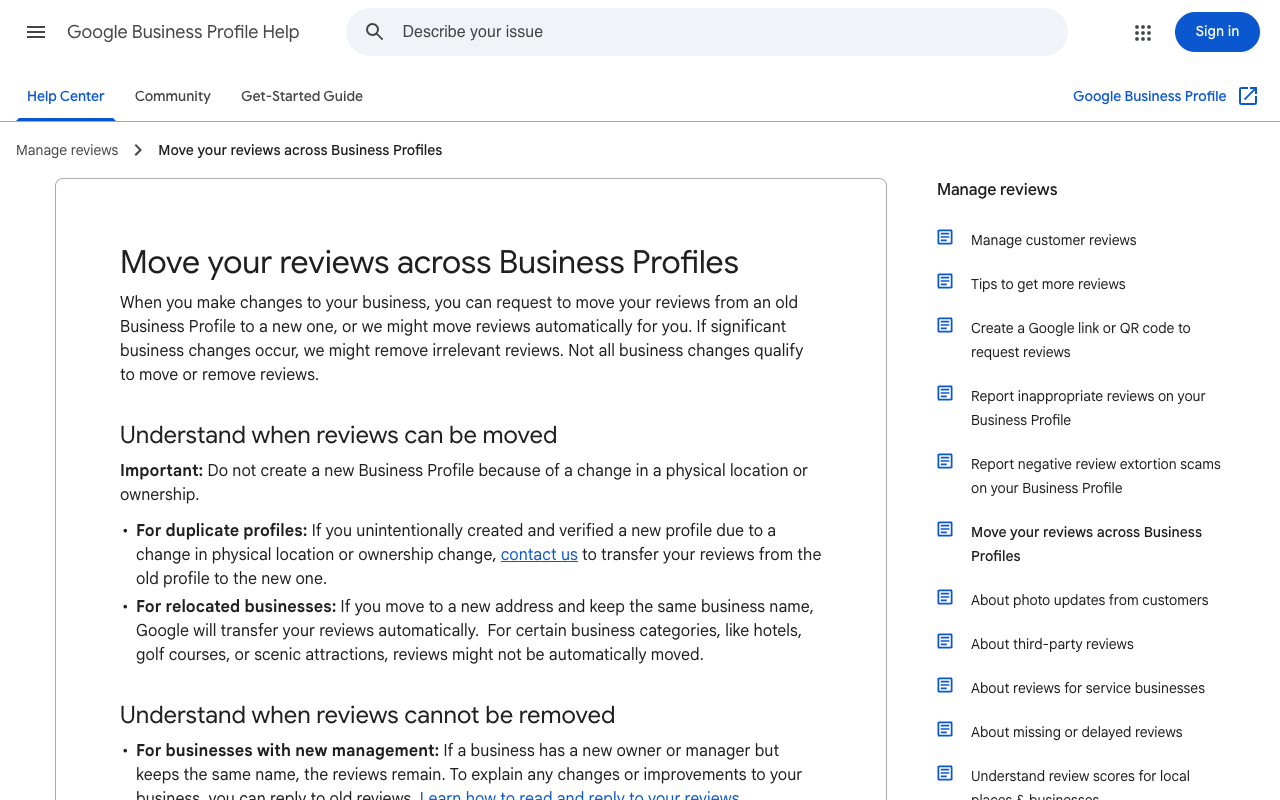
There is a third route, on a third page, and almost nothing written about duplicates mentions it. Google's page on moving reviews across profiles has a duplicate-profiles provision: if you "unintentionally created and verified a new profile due to a change in physical location or ownership change", you can ask support "to transfer your reviews from the old profile to the new one".
Note how narrow that is. It covers one accident, the duplicate you made yourself while moving premises or taking the business over. It does not cover a stray listing someone else created, a second location, or a profile you built because a rename went wrong. The same page opens with the instruction that should have prevented the accident: "do not create a new Business Profile because of a change in a physical location or ownership."
For a straightforward move, you are not meant to need any of this. Google says that "if you move to a new address and keep the same business name, Google will transfer your reviews automatically", with an exception for certain categories: hotels, golf courses and scenic attractions, where it says reviews might not move automatically. The same page also confirms the cases where nothing needs doing at all. New owner or manager, same name, and "the reviews remain". A minor name change, and the reviews remain, which we unpick in our guide to what a business name change does to your reviews.
Its own caveat is the sentence to quote at anyone promising a clean transfer: "not all business changes qualify to move or remove reviews."
If Google marked a real second location as a duplicate
The mirror image of this problem is the expensive one. You run two genuine locations, or two genuinely distinct businesses, and Google decides one is a duplicate of the other. Because a duplicate "won't show on Google Search or Maps", that listing and every review on it drop out of sight, and no amount of flagging reviews will bring them back, because the reviews are not the problem.
Google's duplicates page names the route: if profiles for "2 distinct and eligible businesses were incorrectly merged", you contact support to appeal the duplicate status. The standard it applies is one line, and it is worth building the appeal around it: "to appeal a duplicate status, both businesses must be eligible and distinct from one another." Where both businesses serve customers at the same address, the page says you will be asked to provide evidence of permanent signage, which is a specific, physical thing to go and photograph rather than a paperwork exercise.
The other shape of this is a listing you cannot get into. Google's answer there is sequential: "if a verified profile exists for your business and is owned by someone else, you can request access from the current owner", and "if you don't get a response after 3 days, you have the option to claim the profile." It adds the caveat most guides leave off, that "the option to claim a profile isn't always available". If you are stuck at that step, our walkthrough of getting a human at Google support is the next thing to read.
One warning on reclaiming, and there is a documented case for it. In a May 2024 Local Search Forum thread, a manager whose access request went unanswered used the verify route instead, became primary owner, and watched seven years of review replies vanish. The reviews themselves came back. The replies never did, and a practitioner in the thread described that as the normal behaviour of a verification, adding that it does not happen with an ordinary transfer of access. Copy the replies before you start a claim, not after.
What to capture before you touch either profile
Every bad outcome on this page shares one feature: nobody wrote down what was there first. The January 2025 case lost about 200 reviews with no baseline to appeal with. This is an hour of work, and it is the difference between a dispute you can make and a loss you can only describe.
| Capture | Why it is the one that matters | Time |
|---|---|---|
| Review count and star average on both profiles, dated | The baseline the January 2025 case did not have | 5 min |
| Every owner reply, copied verbatim with its reviewer and date | The only loss Google tells you to expect, and the only one you can rebuild | 30 min |
| Individual review URLs for your most valuable reviews | Lets you prove a specific review existed and where it lived | 15 min |
| Screenshot both profiles: name, address, phone, category, hours | The "same info" test is applied to these fields | 10 min |
| Which Google account is primary owner of which profile | Only a primary owner can remove, and removal is irreversible | 10 min |
| Any open review report or dispute, with its filing date | A request filed on a profile you are about to change has nowhere to land | 10 min |
Then act in this order: match the fields, file the merge suggestion, and leave the removal button alone until the merge has been decided. A duplicate that does not show on Maps is costing you very little while you wait, and reviews that vanish for other reasons are a far more common cause of a shrinking review count than a duplicate ever is.
Know which reviews are worth merging in the first place
A merge combines both star averages, so reviews that breach Google's content policies come across with everything else and drag the number with them. Flaggd reads the reviews on both profiles against those policies, tells you which clause each one actually breaches, and files the evidenced dispute before you ask Google to combine the sets.
Flaggd is our own service and this page recommends it. We dispute content that breaches Google policy on profiles our clients control. We are not a law firm, we do not give legal advice, and we cannot merge, remove or un-duplicate a profile on Google's behalf or guarantee any merge request is granted. Google's duplicates, profile-removal and review-moving help pages were read on 18 November 2026; the competitor table is our own assessment of what those pages told readers on that date; the January 2025 figures are one practitioner's account in a public forum thread, not a Google statement and not a rate.

Frequently asked questions
Do I lose my reviews if I merge duplicate Google Business Profiles?
Google's published outcome is that "their reviews are combined, but replies to reviews may be lost". The reviews are the part meant to survive; your replies are the part you are warned about. It is not automatic either: "all merge requests are subject to review", and the profiles "must represent the same business and should have the same info". Copy every reply first, because no route to restore them is published.
Does removing a duplicate Google Business Profile delete its reviews?
No, and this is the most common error in the advice on the subject. The duplicates page says only that "all content and linked managers will be removed". The removal page is specific: "any posts, photos, videos, and review replies by owners and managers are permanently removed", while "user-generated content and review remains". The reviews stay and your replies are destroyed, irreversibly.
How do I request a merge of two Google Business Profiles?
Google documents one route, and it is on Maps rather than in your dashboard: "report a suggestion on Google Maps" for two or more profiles of the same business. Guides that send you to a "Merge duplicate profiles" control under advanced settings are describing something Google's current page does not document. Match the name, address, phone and category across the two records before you file.
Which duplicate profile should I keep?
Google says only that "if you created a duplicate profile by mistake, you can remove it without affecting your verified listing", and to "make sure to remove the correct profile". It does not tell you to keep the one with more reviews or the older one, which is what several guides advise. The verified profile you actively manage is the one to keep, and since the duplicate does not show on Search or Maps, the decision is rarely urgent.
Can Google merge two locations so the reviews move to the surviving one?
Not reliably. Two verified locations at two addresses are not one business under the merge condition. The January 2025 thread above is the documented case: support agreed to the merge, a specialist then said only about 90 of the reviews would come across, roughly 200 did not, and a further ticket was refused. Plan a closure as a possible review-loss event rather than a transfer.
Google marked my second location as a duplicate. How do I appeal?
Contact support to appeal the duplicate status, on the basis Google publishes: "both businesses must be eligible and distinct from one another". Where both serve customers at one address you will be asked for "evidence of permanent signage", so photograph each site first. Until it succeeds, the flagged profile does not show on Search or Maps, which is why its reviews vanished from view rather than being deleted.
Can I transfer reviews from a duplicate profile I created myself?
There is one narrow provision: if you "unintentionally created and verified a new profile due to a change in physical location or ownership change", you can ask support to move the reviews to the new profile. It covers that accident only. For an ordinary relocation, Google says it transfers reviews automatically if the name stays the same, except for categories such as hotels, golf courses and scenic attractions.