Key Takeaways
- The test has three conditions, not one. Google allows a rename without a new profile only for "a minor name change, in which the proper nouns and services described in the business name remain unchanged and the business category remains unchanged". Every ranking page on this subject mentions the first. None mentions the category.
- Fail the test and your reviews are stranded, not deleted. Google's instruction is that you "must mark the existing Business Profile as closed and then create a new Business Profile". Reviews "remain on the profile" you just closed, and "customers can leave new reviews for temporarily closed businesses but not for permanently closed ones".
- The address instruction is the opposite of the name instruction. Move and keep the name, and "Google will transfer your reviews automatically", with an exception for "hotels, golf courses, or scenic attractions". Google also says plainly: "Do not create a new Business Profile because of a change in a physical location or ownership."
- Even an eligible rebrand carries a discretionary clause. On the same page Google reserves the right to act: "If significant business changes occur, we might remove irrelevant reviews." That is a might, and it is the only sentence on the page that can cost you reviews while you are doing everything right.
- A rename is an edit, and edits are enforced. Google blocked 79 million inaccurate or unverified edits to Business Profiles in 2025. In a February 2025 practitioner thread, a profile renamed after an acquisition was suspended, and the appeal was refused despite a business licence and a utility bill.
- The rebranding test Google publishes, in three parts
- What "considered a new business" actually costs you
- Changing your address is the opposite instruction
- The Google business name change test, applied to six renames
- "Significant business changes" and the reviews Google calls irrelevant
- The suspension path, and one documented case
- Your replies, your open reports, and what does not travel
- What we would do in the fortnight before a rename
- Frequently asked questions
You are about to rename the business, and the one asset nobody can rebuild for you is the review set. A Google business name change is an edit, and in 2025 Google blocked 79 million inaccurate or unverified edits to Business Profiles, so the question is not whether the field will take your new name: it is whether Google still regards the renamed business as the same business. Get that wrong and the documented outcome is not deletion, which is what every page on this subject implies. It is that you must close the old profile, open a new one, and leave the reviews sitting on a listing that can never receive another. We read Google's rebranding criteria against its own review-moving page clause by clause, applied the published test to six realistic renames, and worked through a February 2025 practitioner thread in which a rename after an acquisition took the whole profile down.

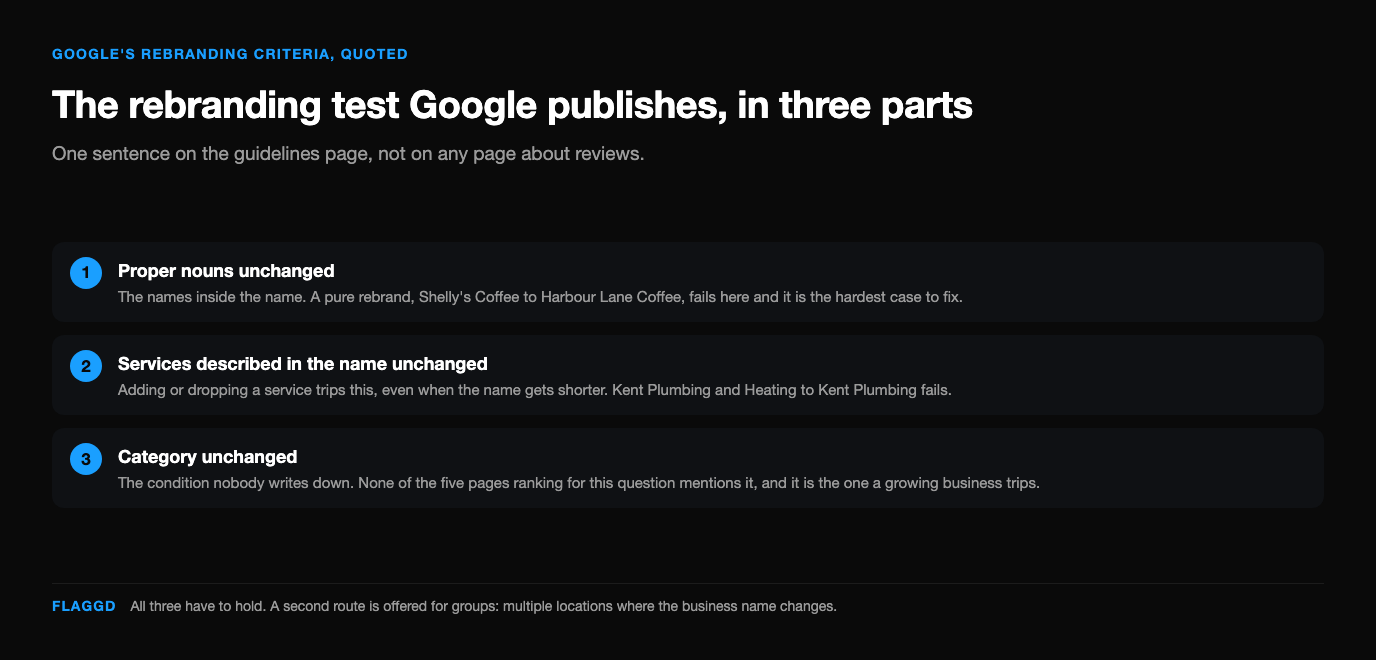
The rebranding test Google publishes, in three parts
The rule is one sentence long and it lives on the guidelines page, not on any of the pages about reviews, which is why owners researching their reviews never meet it. Google says your profile "may be eligible for rebranding (defined as an eligible name change without creating a new Business Profile) if you make a minor name change, in which the proper nouns and services described in the business name remain unchanged and the business category remains unchanged".
Read it as a three-part test, because that is how it is written. Proper nouns unchanged. Services described in the name unchanged. Category unchanged. All three have to hold. A second route is offered in the next sentence for groups: "You may also be eligible for rebranding if you have multiple locations and the business name changes."
We read the five pages currently ranking for this question. All five say some version of "edit the existing profile instead of creating a new one". Not one of them quotes the test, and not one of them mentions the category condition at all, even though it is the condition most likely to be tripped by the kind of rename a growing business actually does.
If "Kent Plumbing & Heating" becomes "Kent Plumbing Group" and the primary category moves from Plumber to General contractor, two of the three conditions have gone, and no amount of careful editing inside the dashboard changes that.
Notice what the test does not ask about. It does not ask whether you still own the business, whether the trading entity is the same, or whether you kept the same staff, premises and phone number. It is a text-and-category test applied to the listing, which means a rebrand that is trivial to your customers can fail it, and a change of ownership that keeps the name passes it without being a name change at all.
What "considered a new business" actually costs you
Here is the sentence that decides the stakes, and it is as blunt as policy prose gets: "If your business changes its name but doesn't meet the criteria above, then it's considered a new business. You must mark the existing Business Profile as closed and then create a new Business Profile with your new business name."
Now put that next to what Google says about closed profiles on its review page: "If your business closes for a while or permanently, the reviews remain on the profile. Customers can leave new reviews for temporarily closed businesses but not for permanently closed ones." Those two sentences together are the real answer to the question in this article's title, and it is sharper than "you lose your reviews".
Your reviews are not deleted. They are stranded. They stay, publicly, on a profile labelled permanently closed, where nobody can add to them and where they do nothing for the business you now trade as. The new profile starts at zero. That tells you where the effort goes: not into recovering review text, which is intact, but into deciding whether the rename is worth restarting the count. Our guide to a profile marked permanently closed on Google covers that label in its own right.
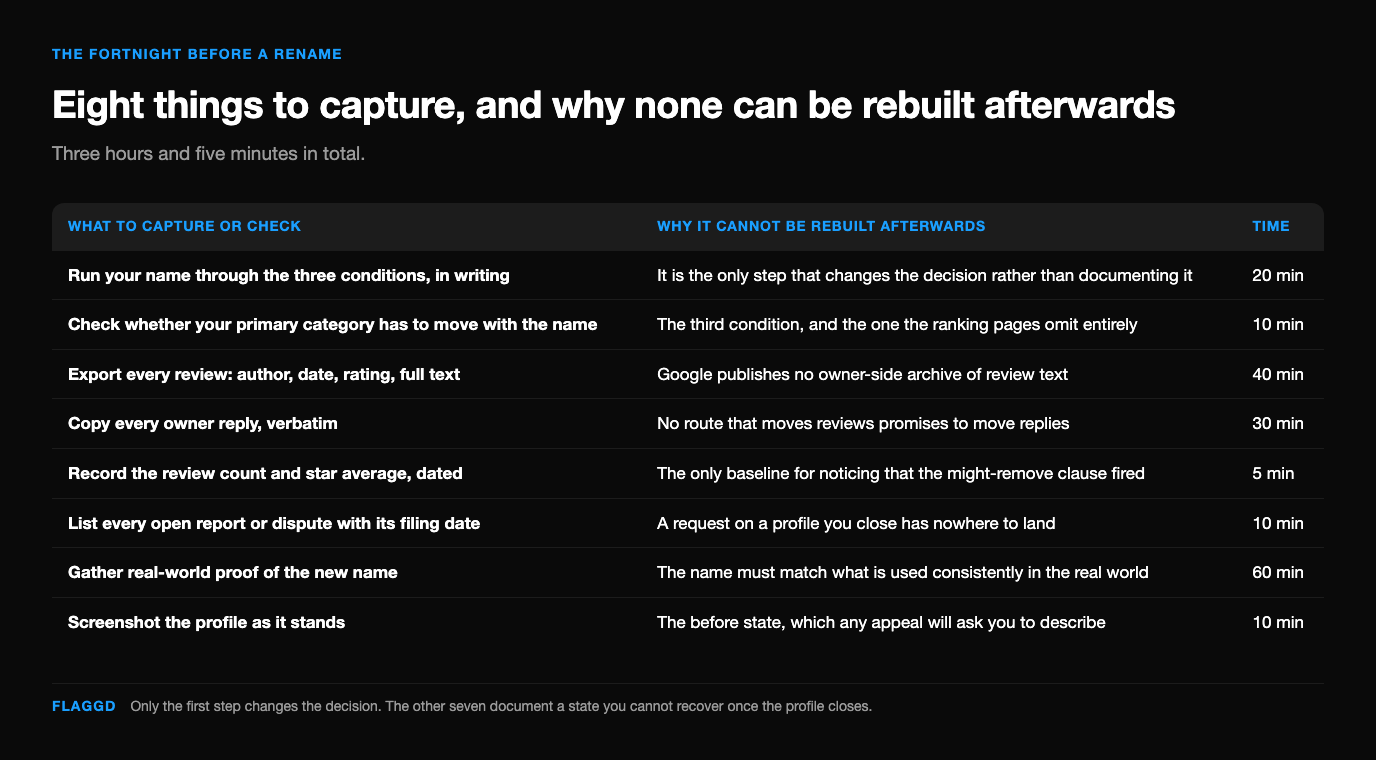
| The change you are making | Google's own wording | What happens to the reviews | What happens to your replies |
|---|---|---|---|
| Minor name change, test met | "If a business makes a minor name change ... the reviews remain" | Stay, on the same profile, with the count and average intact | Stay. It is the same profile throughout |
| Multi-location group rename | "if a business with multiple locations changes its name, the reviews remain" | Stay, per location | Stay |
| Name change, test failed | "it's considered a new business ... mark the existing Business Profile as closed" | Stranded on the closed profile; the new one starts at zero | Stranded with them, on a listing nobody is reading |
| New address, same name | "Google will transfer your reviews automatically" | Transfer automatically, no request needed | Travel with them; the profile itself moves |
| New address, hotel or golf course | "reviews might not be automatically moved" | Might not move. Plan as though they will not | No separate provision; assume the same |
| New owner or manager, same name | "If a business has a new owner or manager but keeps the same name, the reviews remain" | Stay, including the previous regime's | Stay. Google suggests replying to old reviews to explain changes |
| A duplicate you created by mistake | "contact us to transfer your reviews from the old profile to the new one" | Transferable on request, for your own duplicate only | No documented guarantee. Export them first |
The last row is the only route Google documents for getting a review set onto a different profile, and it is narrower than it looks: it covers a duplicate of your own business that you created for a move or an ownership change. If you buy a business and keep its name, nothing needs transferring at all, which we worked through in detail for owners who bought a business with bad Google reviews.
Changing your address is the opposite instruction
This is where owners get hurt by reading one page and not the other. For a name change that fails the test, Google tells you to close the profile and create a new one. For a move, Google tells you the opposite, in bold on its own page: "Do not create a new Business Profile because of a change in a physical location or ownership."
A relocation is handled for you: "If you move to a new address and keep the same business name, Google will transfer your reviews automatically." No form, no request. The profile persists and the address is a field on it.
Google names them: "For certain business categories, like hotels, golf courses, or scenic attractions, reviews might not be automatically moved." The common thread is that the reviews are substantially about the place rather than the operator, so they do not follow the operator to a new place.
If you run anything in that family, treat a move as a review-loss event and capture everything first. The word in the policy is "like", so the list is illustrative rather than closed.
The practical trap is doing both at once. A rename plus a relocation is two changes, and the one that fails the test governs: if the new name is a new business in Google's terms, you are closing a profile, and the automatic address transfer never gets the chance to apply. Sequence them instead, and leave weeks between. If a second listing appears in the meantime, our page on another business's reviews showing on your Google profile covers what a merge does and does not undo.
The Google business name change test, applied to six renames
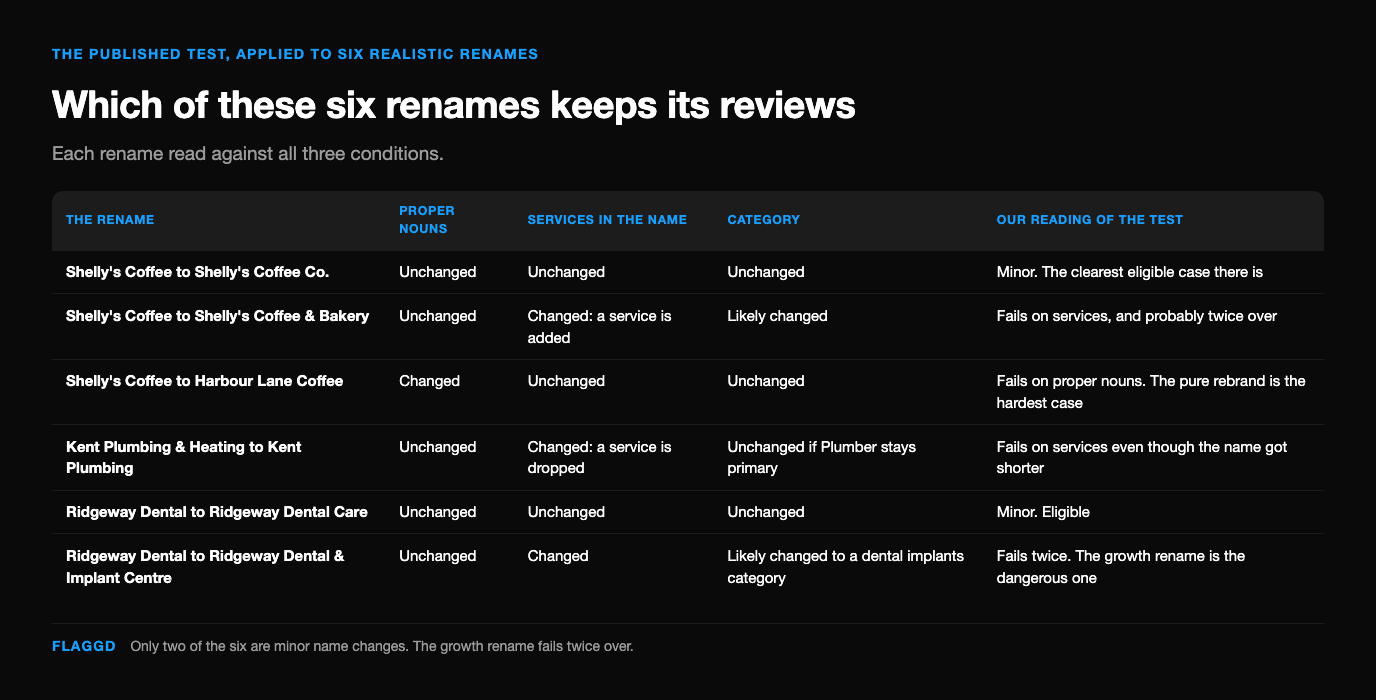
The test is only useful once you run your own name through it, so here is the exercise on six renames of the kind we see most often. Google's guidelines use a coffee shop called Shelly's Coffee as their worked example, so we kept it and added a trade and a dental practice.
| The rename | Proper nouns | Services in the name | Category | Our reading of the test |
|---|---|---|---|---|
| Shelly's Coffee to Shelly's Coffee Co. | Unchanged | Unchanged | Unchanged | Minor. The clearest eligible case there is |
| Shelly's Coffee to Shelly's Coffee & Bakery | Unchanged | Changed: a service is added | Likely changed | Fails on services, and probably twice over |
| Shelly's Coffee to Harbour Lane Coffee | Changed | Unchanged | Unchanged | Fails on proper nouns. The pure rebrand is the hardest case |
| Kent Plumbing & Heating to Kent Plumbing | Unchanged | Changed: a service is dropped | Unchanged if Plumber stays primary | Fails on services even though the name got shorter |
| Ridgeway Dental to Ridgeway Dental Care | Unchanged | Unchanged | Unchanged | Minor. Eligible |
| Ridgeway Dental to Ridgeway Dental & Implant Centre | Unchanged | Changed | Likely changed to a dental implants category | Fails twice. The growth rename is the dangerous one |
To be clear about what that table is: it is our reading of Google's published test, not a set of Google rulings, and Google does not publish decisions on individual names. Run the exercise anyway, because it reframes the decision usefully. The renames that read as the smallest commercial events (dropping a service you no longer offer, adding one you now do) are the ones that fail, while the pure cosmetic tidy passes. The pattern that costs owners their review count is growth, not rebranding.
"Significant business changes" and the reviews Google calls irrelevant
One sentence sits at the top of Google's review-moving page and belongs to none of the categories underneath it: "If significant business changes occur, we might remove irrelevant reviews." It is the only line on the page that can cost you reviews while you are following every rule, and the page never defines either "significant" or "irrelevant".
Treat it as a budget line rather than a risk to argue about. If your rename is accompanied by a real change in what you sell, some proportion of your older reviews describe a service you no longer provide, and Google reserves the right to take a view on them. No appeal is described for this, because nothing was alleged against the review.
The practical hedge is a dated export before you touch anything, so that a drop in count is something you can measure rather than something you half-remember.
The clause also explains why "minor" is doing so much work in the test. Google's interest is that the reviews on a listing describe what the listing now represents, and a change small enough to leave the proper nouns, the services and the category alone cannot have made the old reviews irrelevant.
The suspension path, and one documented case
A failed name change has a worse outcome than a reset review count, and it is the one no competitor page quantifies: the edit itself can take the profile down. Google's guidelines warn that including unnecessary information in a business name "isn't permitted, and could result in the suspension of your Business Profile", and your rename lands in the same pipeline that blocked 79 million inaccurate or unverified edits to Business Profiles in 2025, against the 80 million updates contributors suggested that year. Google does not break out how many blocked edits came from owners, so read it as the scale of the filter rather than a rejection rate.
For what that looks like in practice, a February 2025 thread on Local Search Forum is the most complete account we found. An agency's client acquired another business along with its Business Profile and renamed that profile to the client's own name. Google suspended it. The appeal went in with the client's business licence and a utility bill, both in the client's name at the acquired business's address, and Google refused it with the line "your Business Profile isn't eligible to display on Google". No reinstatement is reported anywhere in the thread.
The owner had real documents and still lost, because the documents answered the wrong question. They proved the client existed and traded there. The test asks whether the proper nouns in the name survived, and renaming an acquired business to your own name changes them by definition. A practitioner in the same thread put the mechanism in one line: change the name and it is no longer the same verified business.
The alternative on offer was the one the test implies: keep the acquired name and inherit its reputation, or start a new listing and rebuild. Our guide to a suspension during a review dispute covers the appeal mechanics and the evidence that does move it.
Treat that as a single documented case rather than a measured rate, because forum threads are evidence of what can happen and not of how often it does. It is still worth more than the warnings on the ranking pages, none of which cites anything at all.
Your replies, your open reports, and what does not travel
Reviews get all the attention in this decision, and two other assets are quietly at stake. Neither has a documented restore route.
Your owner replies. If the reviews stay where they are, so do the replies, and the question never arises. But every route that puts reviews on a different profile is silent about them: the duplicate-transfer provision mentions only reviews. Replies are often the most careful writing on the profile, and the one part you can reconstruct from a copy. Make one.
Any report in flight. A removal request belongs to a review on a profile. If that profile is about to be marked closed, the request has nowhere to land, and nothing tells you it has been orphaned. Let an open dispute finish before you rename, or accept that you are abandoning it. Our page on tracking a removal request's status is the right place to start if you are not sure what is still open.
Google gives owners no archive: no export of a review it took down, no copy of a reply that vanished with a profile, no record of an unanswered report. Whatever you want to compare later has to be captured first, which is the discipline we set out in documenting evidence for a review dispute.
What we would do in the fortnight before a rename
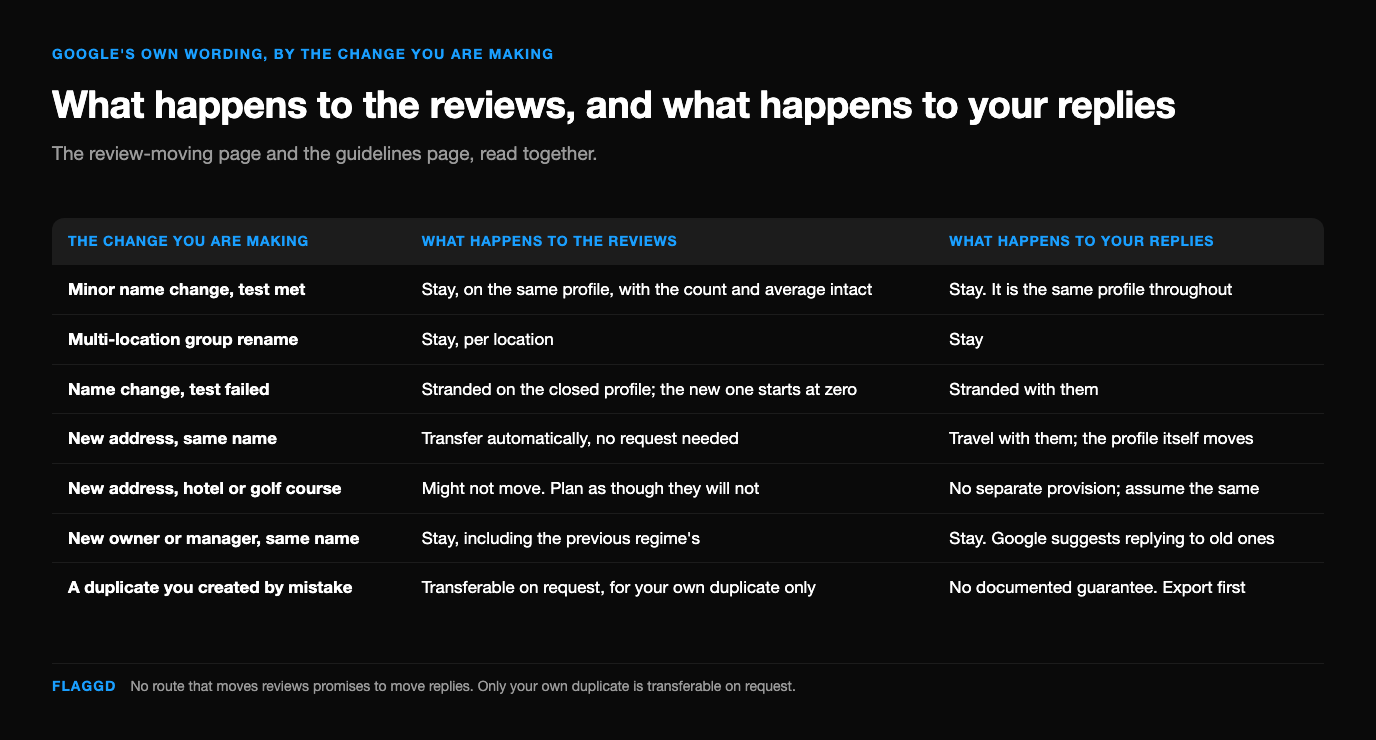
A rename is one of the few review-management events you get to schedule. Two weeks is enough, and most of the work is capture rather than negotiation.
| What to capture or check | Why it cannot be rebuilt afterwards | Time |
|---|---|---|
| Run your name through the three conditions, in writing | It is the only step that changes the decision rather than documenting it | 20 min |
| Check whether your primary category has to move with the name | The third condition, and the one the ranking pages omit entirely | 10 min |
| Export every review: author, date, rating, full text | Google publishes no owner-side archive of review text | 40 min |
| Copy every owner reply, verbatim | No route that moves reviews promises to move replies | 30 min |
| Record the review count and star average, dated | The only baseline for noticing that the "might remove" clause fired | 5 min |
| List every open report or dispute with its filing date | A request on a profile you close has nowhere to land | 10 min |
| Gather real-world proof of the new name: signage, invoice, website, registration | The name must match what is "used consistently" in the real world | 60 min |
| Screenshot the profile as it stands: name, category, address, hours | The before state, which any appeal will ask you to describe | 10 min |
Under three hours, and it is the difference between a rename you can audit and one you can only worry about. Then change one thing at a time: signage and website before the listing, and the address left alone until the name has settled.
Know what is on the profile before you rename it
A rename is a bad time to discover you have reviews that breach Google's content policies and were never disputed. Flaggd reads the reviews on your profile against those policies, tells you which clause each one actually breaches, and files the evidenced dispute while the profile is still the one they were written about.
Flaggd is our own service and this page recommends it. We dispute content that breaches Google policy on profiles our clients control. We are not a law firm, we do not give legal advice, and we cannot decide eligibility for a rebrand on Google's behalf or guarantee a profile survives a rename. Google's rebranding criteria and review-moving pages were read on 15 November 2026; the six-rename table is our own reading of the published test, not a set of Google rulings; the 79 million blocked edits and 80 million suggested updates are Google's figures for 2025 from its Maps announcement of 16 April 2026.
Frequently asked questions
Will I lose my Google reviews if I change my business name?
Only if the change fails Google's test. Google's review-moving page says the reviews remain for a minor name change. If your rename does not meet the criteria it is "considered a new business", and you are told to close the old profile and open a new one. The reviews are not deleted: they stay on the closed listing, which can no longer receive new ones.
What counts as a minor name change on Google?
Google's guidelines for representing your business define it as a change "in which the proper nouns and services described in the business name remain unchanged and the business category remains unchanged". All three conditions have to hold. Dropping a service from the name counts as a change even though the name got shorter. Groups get a second route: multiple locations changing name may also be eligible.
Do Google reviews transfer when I move to a new address?
Automatically, if you keep the same name: "Google will transfer your reviews automatically." Google also says plainly not to create a new profile for a change of location or ownership. The exception is categories "like hotels, golf courses, or scenic attractions", where reviews "might not be automatically moved".
Can I move my reviews to a new Business Profile myself?
No. One request route is documented and it is narrow: a duplicate you created and verified yourself because of a location or ownership change can be sorted by contacting support to "transfer your reviews from the old profile to the new one". Nothing covers moving a review set onto a profile you opened for a rename that failed the test.
Can a name change get my Business Profile suspended?
It can. Google warns that unnecessary information in a name "could result in the suspension of your Business Profile", and the edit goes through the same filter that blocked 79 million inaccurate or unverified edits in 2025. A February 2025 forum thread records a rename after an acquisition being suspended and the appeal refused. One case, not a rate.
Do my replies to reviews survive a rename?
If the reviews stay put, so do the replies, because nothing moved. Every documented route that puts reviews on a different profile mentions reviews only, and promises nothing about replies. Copy them verbatim before you change anything: they are the one part a backup genuinely restores.
What happens to reviews on a profile I mark permanently closed?
They stay visible. Google says the reviews "remain on the profile" and that customers "can leave new reviews for temporarily closed businesses but not for permanently closed ones". A closed profile keeps its history and its average but cannot grow, which is exactly where a failed name change leaves you.