Key Takeaways
- If you bought a business with bad Google reviews, they came with the place, not the owner. Google's wording is flat: if a business has a new owner or manager but keeps the same name, the reviews remain. A change of ownership is not a removal ground and never has been.
- Two of the five scenarios do move reviews, and neither is about the old owner being bad. A same-name address change moves them automatically, and a profile you created by mistake during the handover can have them moved on request.
- You cannot buy the reviews. The Consumer Review Fairness Act voids any form-contract term that transfers intellectual property rights in review content, so no schedule in the purchase agreement conveys them. What the schedule should carry is the Google account.
- There is exactly one documented clean slate, and it is expensive. Where a genuinely different business is at the location, Google says the previous business should be marked permanently closed and not renamed, which costs you the whole review history and the profile's age.
- Ninety days of new reviews beats an appeal on arithmetic. Removing five violating one-stars from a 3.1-star, 80-review profile gets you to about 3.24; 72 new five-star reviews gets you to 4.0, and 74% of consumers weight the last three months most.
- Why the reviews came with the business
- The five ownership scenarios, in Google's own words
- What the purchase agreement cannot buy
- The one documented clean slate, and what it costs
- What is actually removable from the old regime
- The profile audit to run before you close
- Handover mechanics, and the timers nobody mentions
- The ninety-day arithmetic
- Frequently asked questions
You bought a business with bad Google reviews attached to it: you changed the sign, kept the staff, put money into the kitchen, and inherited a 3.1-star profile full of complaints about a man who has not worked there since spring. That is not cosmetic. 2,117 US small businesses changed hands through brokers in the second quarter of 2026 at a median price of $349,250, 68% of consumers now want at least four stars before they will use a local business, and Michael Luca's work at Harvard put a one-star swing at 5 to 9% of revenue for independent operators, so the rating you inherited is a line item you already paid for. This guide sets out which ownership scenarios move reviews, what a new owner can genuinely get removed, what the one documented clean slate costs, and the arithmetic that decides whether you should be appealing at all. We read Google's ownership, transfer and review-moving pages line by line, checked the statute that decides whether reviews can be sold at all, and ran the maths for five starting ratings.

Why the reviews came with the business
A Google Business Profile is a record of a place. The reviews on it are written by members of the public about their experience at that address, and Google treats the continuity of the place as the thing that matters. Same address, same phone number, broadly the same trade, so the profile carries on and so does everything on it.
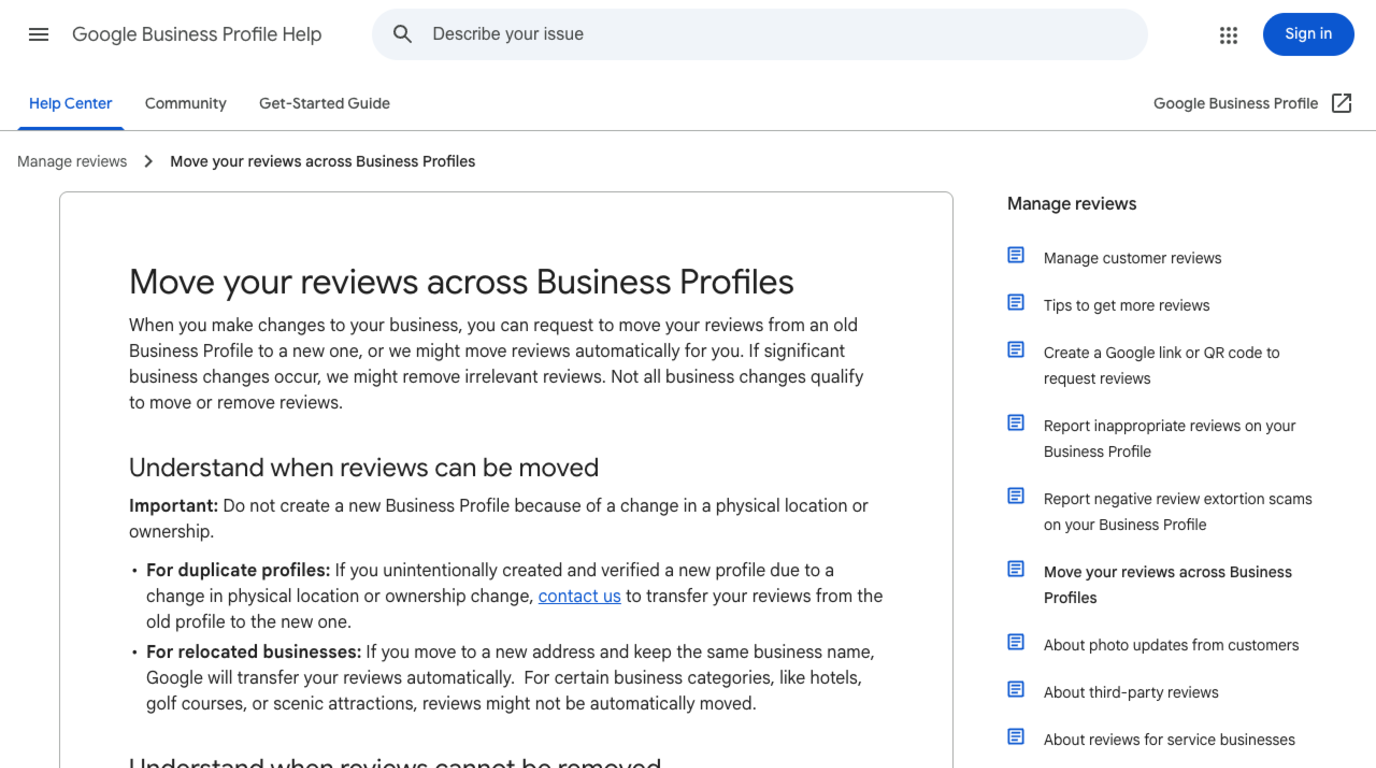
This is not an interpretation. Google's page on moving reviews across Business Profiles states it in one line: if a business has a new owner or manager but keeps the same name, the reviews remain. The same page tells you not to create a new profile because of a change in physical location or ownership, which is the single most expensive mistake a buyer makes in the first week.
So the instinct that the reviews are the seller's problem is wrong in a useful way. They are not about you, but they are yours, in the same sense the lease and the grease trap are yours. The only question worth asking is which individual reviews break a policy on their own terms, and that has nothing to do with the sale.
The five ownership scenarios, in Google's own words
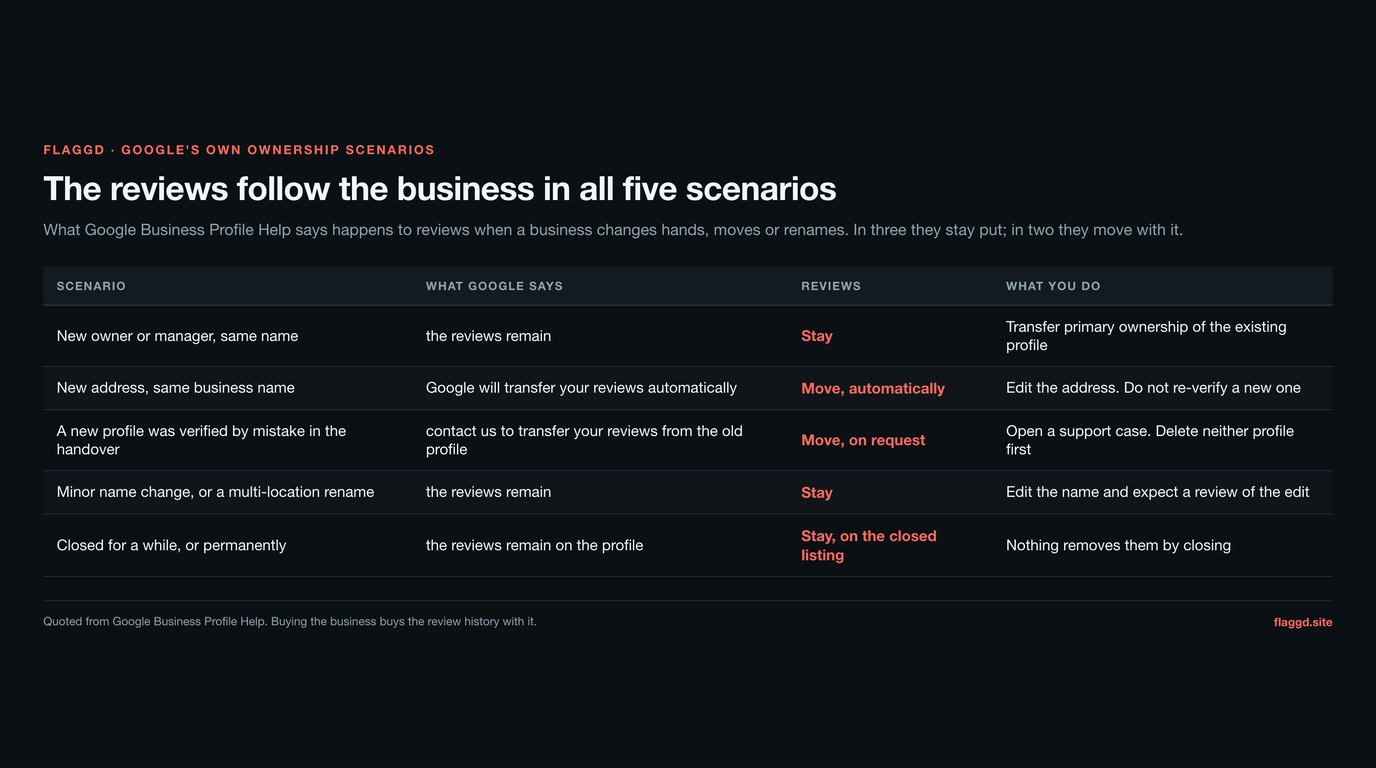
Owners arrive with one question, can I get rid of these, when there are five different situations that resolve differently. Two move reviews. Three do not. None turns on the previous owner's conduct.
| Scenario | What Google says | Reviews | What you do |
|---|---|---|---|
| New owner or manager, same name | "the reviews remain" | Stay | Transfer primary ownership of the existing profile |
| New address, same business name | "Google will transfer your reviews automatically" | Move, automatically | Edit the address on the existing profile. Do not re-verify a new one |
| A new profile was created and verified by mistake during the handover | "contact us to transfer your reviews from the old profile to the new one" | Move, on request | Open a support case. Delete neither profile first |
| Minor name change, or a multi-location brand renames | "the reviews remain" | Stay | Edit the name and expect a review of the edit |
| Closed for a while, or permanently | "the reviews remain on the profile" | Stay, on the closed listing | Nothing. Closing a profile does not hide its reviews |
The third row is worth reading twice, because it is the only route by which a buyer's own error becomes recoverable. New owners who cannot get the seller to release the profile get impatient, verify a fresh listing, and end up with a 4.8-star profile nobody can find and a 3.1-star profile with all the traffic. Google will move the reviews between them if you ask, and will not if you have already deleted one.
What the purchase agreement cannot buy
A surprising number of asset purchase agreements list "online reviews and ratings" on the intangibles schedule, and the line has nothing behind it. A review is the reviewer's own writing, licensed to Google by the person who typed it: the seller never owned it, so cannot sell it, and the profile is an account permission rather than a chattel.
There is a statute pointing the same way, and it bites harder than most buyers expect. The Consumer Review Fairness Act, 15 U.S.C. section 45b, makes a provision of a form contract void where it restricts a person's ability to review a business, penalises them for doing so, or requires them to transfer intellectual property rights in review content. That third limb is the one that matters here. If the seller's customer terms contained a clause assigning review copyright to the business, that clause was void when they wrote it, and it is void in your hands too. Worse, keeping it in your own terms is a per se unfair practice the FTC can act on, which our guide to the Consumer Review Fairness Act works through in detail.
So strike the reviews from the schedule and put the useful thing in. The asset that does exist, and that sellers routinely forget to hand over, is the Google account holding primary ownership. Name the email address in the agreement, make the transfer a closing condition, and confirm it before the money moves.
Inherited reviews that actually break the rules
Flaggd reads every review on a newly acquired profile against Google's content policies, files the ones with a real category and evidence, and tells you plainly which ones are simply old bad news.
Flaggd is our own service. We dispute reviews that breach Google policy; we do not sell, remove or suppress reviews that do not, and nobody can guarantee a removal.
The one documented clean slate, and what it costs
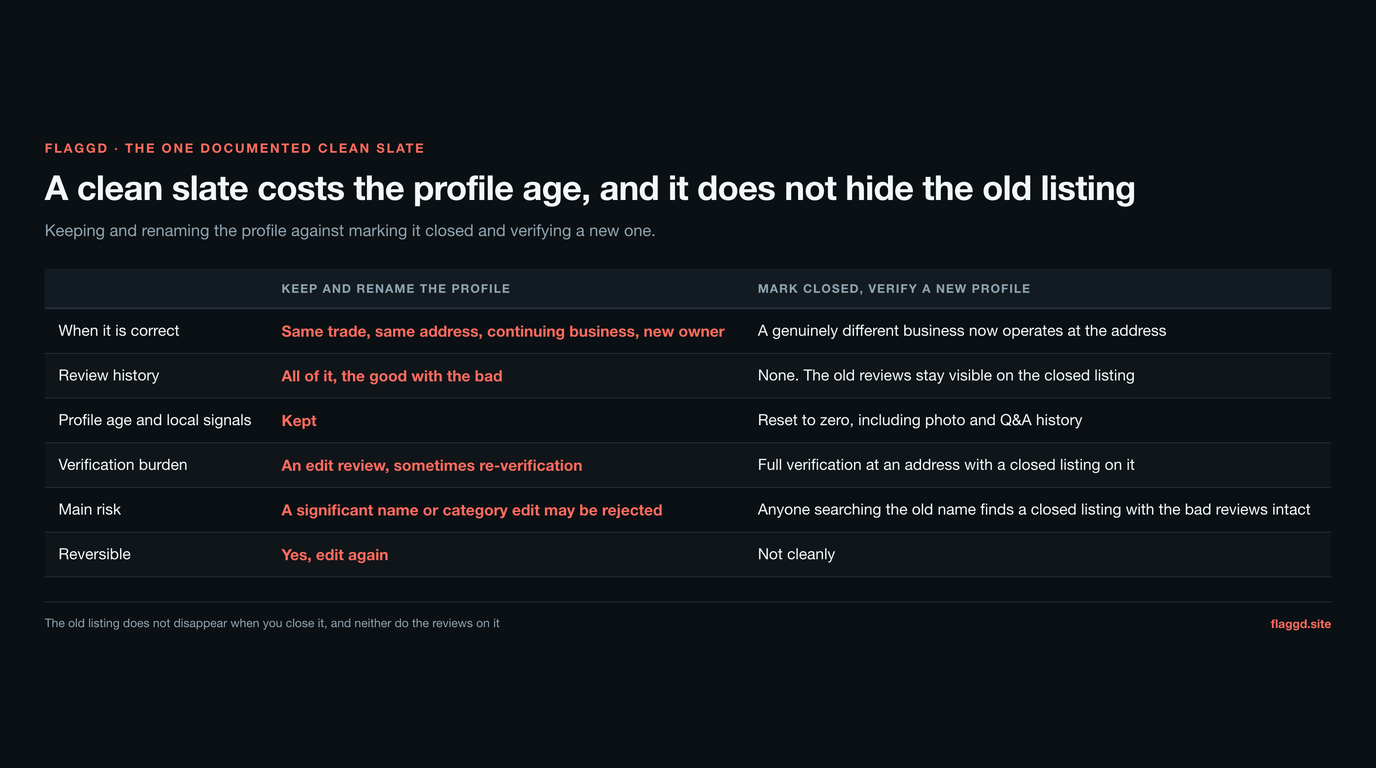
There is a route to a profile with no inherited reviews on it, and Google writes it down. The policy overview says that if a different business is now at the location, or the business has changed significantly, the previous business should be marked as permanently closed and not renamed. The same page warns that edits attempting to significantly change the nature of a business are often fraudulent or a sign the listing should be removed, and that Google may reject significant changes to a business name or category.
Read together, those sentences draw a real line. Renaming a hardware shop to a slightly different hardware shop is an edit. Renaming a failed steakhouse to a tattoo studio is a new business, and the honest move is to close the old listing and verify a new one. What buyers miss is the price of standing on the right side of that line deliberately.
| Keep and rename the profile | Mark closed, verify a new profile | |
|---|---|---|
| When it is correct | Same trade, same address, continuing business, new owner | A genuinely different business now operates at the address |
| Review history | All of it, the good with the bad | None. The old reviews stay visible on the closed listing |
| Profile age and accumulated local signals | Kept | Reset to zero, including photo and Q&A history |
| Verification burden | An edit review, sometimes re-verification | Full verification of a new listing at an address with a closed one on it |
| Main risk | A significant name or category edit may be rejected | Anyone searching the old name finds a closed listing with the bad reviews intact |
| Reversible | Yes, edit again | Not cleanly, and duplicate-listing risk rises |
The trade is a bad rating against no rating and no history. For a business found by name that can be worth it; for one that lives on map-pack visibility for a competitive term, throwing away a profile's age to escape thirty complaints is usually the more expensive option, and the local SEO side of profile optimisation is where that cost lands. One warning: making the name, category and address changes in one burst is the editing pattern that triggers an eligibility check, which is how owners end up with a suspended Business Profile on top of the rating they were trying to fix. Space the edits out.
What is actually removable from the old regime
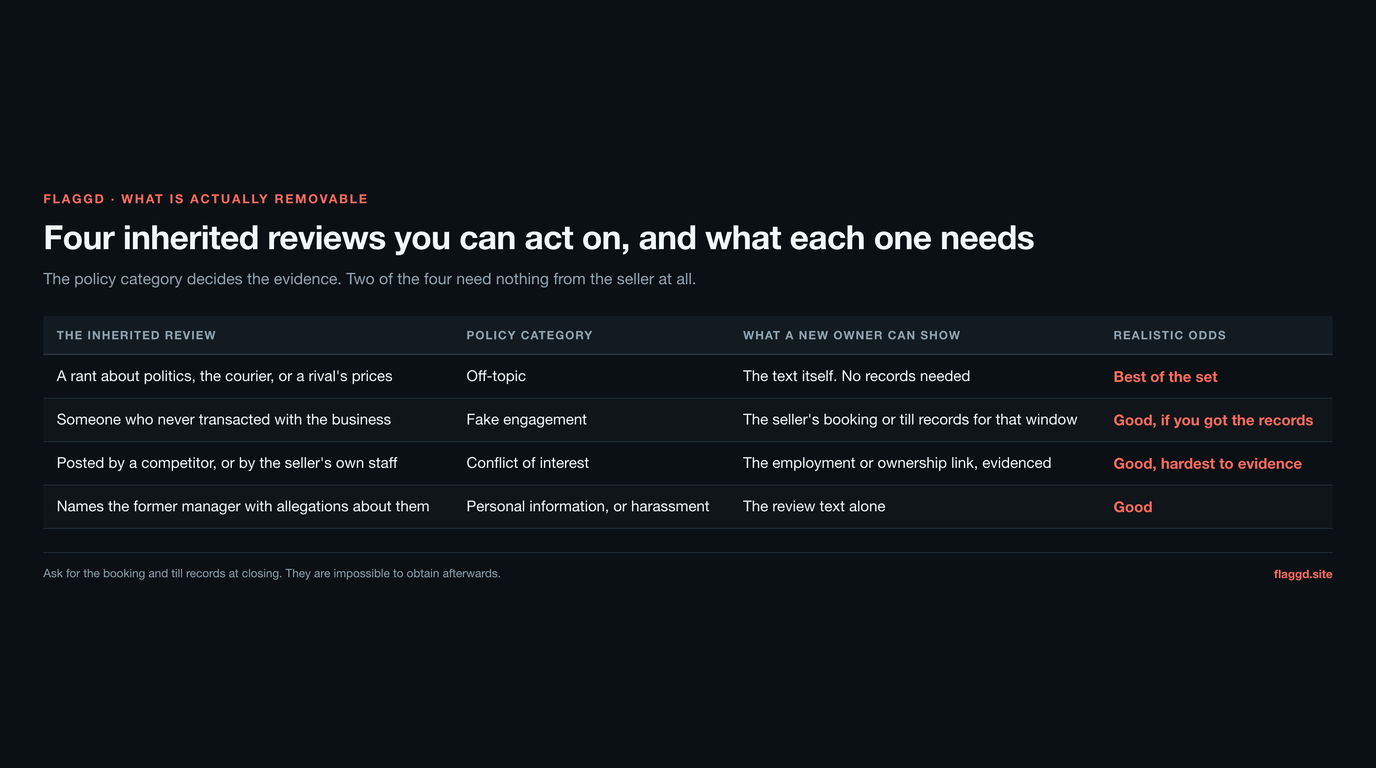
Here is the part that pays. Nothing about a change of ownership makes a bad review removable, and nothing about it makes a violating review unremovable: fake, off-topic and conflicted reviews do not become legitimate with age. A profile that has been through a sale is usually one nobody has policed for years, so the hit rate on a first pass beats a well-tended listing.
Google's contributor policy is the yardstick: contributions must reflect a genuine experience at a place, must not be general or political commentary or a personal rant, and must not misrepresent the location. Map each inherited one-star onto that, not onto how unfair it feels.
| The inherited review | Policy category | What a new owner can show | Realistic odds |
|---|---|---|---|
| A rant about politics, the courier, or a rival's prices | Off-topic | The text itself. No records needed, so the seller's cooperation is irrelevant | Best of the set |
| Someone who never transacted with the business | Fake engagement | The seller's booking or till records for that window, which is why you ask for them at closing | Good, if you got the records |
| Posted by a competitor, or by the seller's own staff | Conflict of interest | The employment or ownership link, evidenced rather than asserted | Good, hardest to evidence |
| Names the former manager in full with allegations about them personally | Personal information, or harassment | The review text. You do not need the named person's consent to report it | Depends on the wording |
| A cluster of one-stars that arrived in one week two years ago | Spam, or coordinated fake engagement | The timing pattern and reviewer profiles, reported as a set rather than one by one | Moderate |
| "Under the old owner the food was terrible" | None | Nothing. It was accurate when it was written | Not removable |
| A bare one-star with no text, from the old regime | None | Nothing. A rating with no text breaks no rule | Not removable |
Two of the seven rows are dead ends, and saying so up front is what stops a buyer spending three months on reports that were never going to land. The rows that do work want evidence, and evidence for events that predate you has to come from the seller, which is a closing-checklist problem rather than a Google one. Our walkthrough of documenting evidence for a review dispute covers the formats that get read, and the off-topic category is where a new owner should always start.
One line on the policy overview page almost nobody quotes: Google may limit or suspend user generated content for a profile whose contributions are consistently unhelpful, harmful, off-topic or in breach of policy, and its own example is a series of poor reviews for reasons unrelated to the business itself. That is a real mechanism for a brigaded listing. It is also Google's lever to pull, not yours to request as a shortcut.
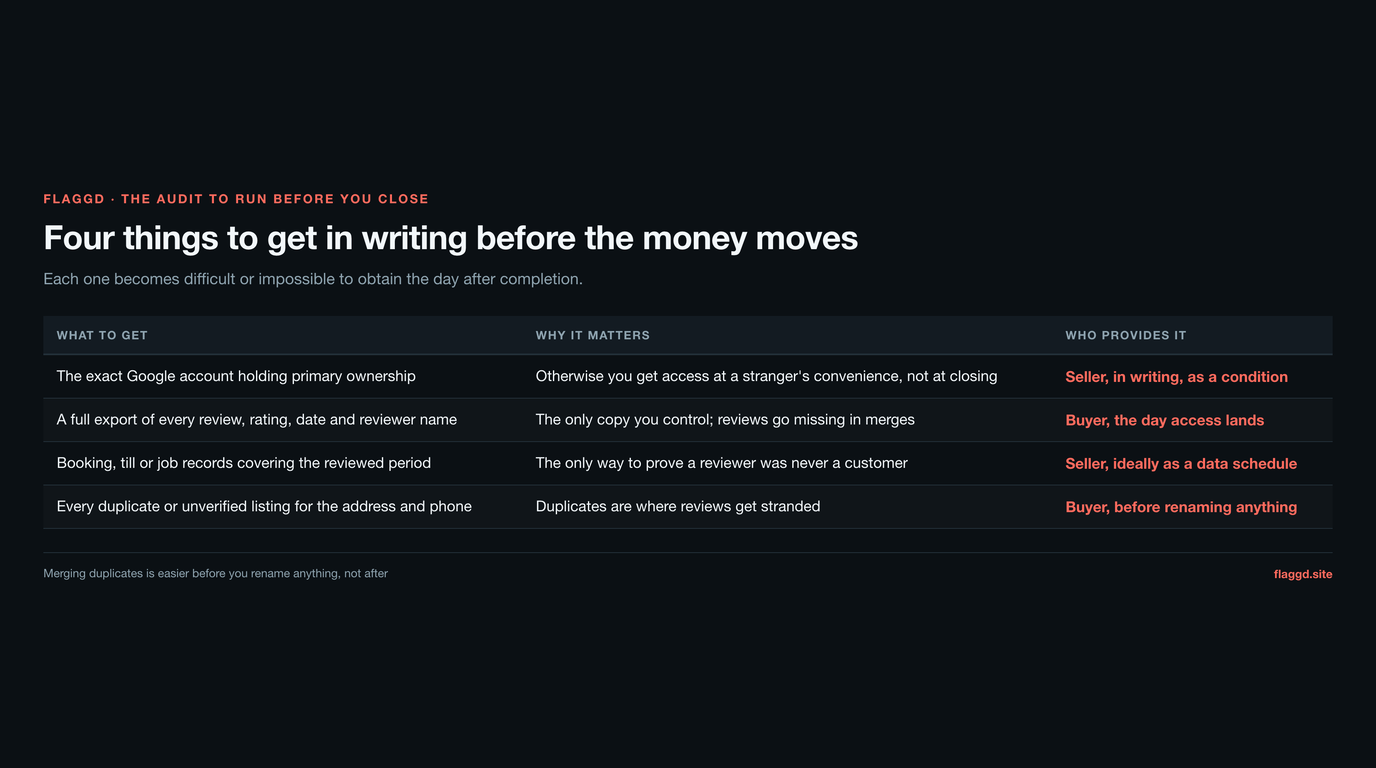
The profile audit to run before you close
Everything above is easier if it happens before completion, when the seller still wants the deal to close. Thirty minutes of diligence on the Business Profile is the cheapest work in the whole transaction, and it is almost never done.
| What to get | Why it matters | Who provides it |
|---|---|---|
| The exact Google account holding primary ownership | If it is the seller's brother-in-law's personal Gmail, you get access at his convenience, not at closing | Seller, in writing, as a condition |
| A full export of every review, rating, date and reviewer name | It is the only copy you control, and reviews can go missing in a merge or a reinstatement | Buyer, the day access lands |
| Booking, till or job records covering the reviewed period | The only way to prove a reviewer was never a customer, and impossible to obtain later | Seller, ideally as a data schedule |
| Every duplicate or unverified listing for the address and phone number | Duplicates are where reviews get stranded, and merging is easier before you rename anything | Buyer, via a Maps search |
| Screenshots of any warning alert, deactivated review function or open appeal | These are review-integrity penalties, not suspensions, and they have their own appeal route | Seller's dashboard |
| The seller's customer terms and any review-related clause | A non-disparagement or review-IP clause is void and becomes your FTC exposure if you keep using it | Seller's contract pack |
| The name, categories and hours exactly as currently verified | Your baseline for judging which later edits count as significant | Buyer, recorded pre-change |
The third row is the one buyers thank us for. Once the seller has wound up and left the country, a reviewer claiming a service you cannot find in any record simply stands, because the records that would have disproved it went with the old till system. Ask for a flat export while the deal still needs signing, and check it against the reviews before you complete. That is also the moment to work out which inherited one-stars are fake by Google's definition rather than merely bad news.
Handover mechanics, and the timers nobody mentions
The correct handover is dull. The seller opens profile settings, goes to people and access, selects your account and sets it to primary owner. Google says explicitly that doing it this way means business information such as reviews is maintained. What surprises buyers is that access and control are not the same thing, and there are documented waits on both sides.
| Action | Documented wait | What is blocked or at stake |
|---|---|---|
| You accept primary ownership | 7 days before you can manage all features | You cannot delete or undelete the profile, remove other owners or managers, or reassign primary ownership |
| You request access and the seller ignores you | 3 days for them to respond | After 3 days you may have the option to claim, and Google says that option is not always available |
| You ask support to move reviews off a mistakenly created profile | No published timeframe | Both listings stay live and split your traffic while it is open. Delete nothing |
| You change the name, category and address together | None, and that is the problem | Significant edits may be rejected, and a burst of them is a classic trigger for an eligibility check |
The seven-day lockout is worth planning around, because for that week you are nominally the owner and still cannot remove the seller's other managers. Do the transfer while everyone is friendly, keep the seller on as a manager for a fortnight rather than cutting them off, and tidy the access list once the week is up. That week is also the time to leave the listing alone: reporting reviews is safe, restructuring the profile is not.
The ninety-day arithmetic
This is the section most review-removal companies leave out, which is odd, because it tells you how much removal is worth. A star average is a mean, and its stubbornness is a function of how many reviews are already in the denominator. Write the numbers down and the strategy picks itself.
| Inherited average | Reviews on the profile | New 5-star reviews to reach 4.0 | To reach 4.5 |
|---|---|---|---|
| 2.9 | 25 | 28 | 80 |
| 3.1 | 80 | 72 | 224 |
| 3.5 | 40 | 20 | 80 |
| 3.8 | 150 | 30 | 210 |
| 4.2 | 300 | already above | 180 |
Now put removal next to it. Take the 3.1-star profile with 80 reviews. Suppose five of the one-stars genuinely violate policy and all five come down, which would be a good result. The average moves to roughly 3.24. That is a real gain and it is not four stars. Seventy-two new five-star reviews is four stars, and for a business doing twenty transactions a week that is a quarter's work rather than a fantasy.
The reader-side numbers push the same way. In BrightLocal's 2026 Local Consumer Review Survey, 68% of consumers say they need at least four stars, 31% will not go below 4.5, and 74% weight the last three months most heavily. That last figure is the acquired profile's friend: a page whose recent reviews are all from your tenure reads as a different business even while the historic average drags. Front-load the new reviews and let recency do work no appeal can do. The methods in getting more positive Google reviews and the recovery sequence in rebuilding a star rating apply unchanged, whether the damage came from an attacker or from a previous owner.
So the order of operations is: secure the profile, export everything, report the reviews that have a real policy category behind them, and spend the rest of the quarter on new ones. Do not incentivise anything. A discount offered for a deleted review converts an inherited rating problem into an enforcement problem of your own making.
Frequently asked questions
Can Google remove reviews just because the business changed hands?
No. Google's own page on moving reviews across profiles says that if a business has a new owner or manager but keeps the same name, the reviews remain. Reviews attach to the place, not to whoever holds the keys, so a change of ownership is not a removal ground and a report filed on that basis will be rejected. What you can report is a review that breaks a content policy on its own terms, which is a separate question entirely.
The seller still controls the profile and will not hand it over. What can I do?
Request access through the profile itself. Google notifies the current owner and gives them three days to respond, and if you get no response after three days you may have the option to claim the profile. Google is explicit that the claim option is not always available, so treat it as a fallback. The plan is a clause in the purchase agreement naming the Google account that holds primary ownership and making the transfer a condition of closing.
Can I buy the reviews as part of the asset purchase agreement?
No, and a clause that tries is worse than no clause. Under the Consumer Review Fairness Act, 15 U.S.C. section 45b, a provision of a form contract is void if it requires an individual to transfer intellectual property rights in review or feedback content. The reviews belong to the people who wrote them and are licensed to Google, so there is nothing on the seller's side to convey. What the schedule should carry is the Google account that holds primary ownership.
We changed the name and the entire concept. Can we start a fresh profile?
Sometimes, and it is a bigger decision than it looks. Google's policy overview says that if a different business is now at the location, or the business has changed significantly, the previous business should be marked as permanently closed and not renamed. That is the one documented route to a clean slate, and it costs you every review you inherited, including the good ones, plus the profile's age, while the old reviews stay publicly visible on the closed listing. Take it only when the business genuinely is a different one.
A second listing appeared during the sale. Which one do we keep?
Keep the old one and ask Google to move the reviews. Google's guidance covers this case directly: if you unintentionally created and verified a new profile because of a change in physical location or ownership, contact them to transfer your reviews from the old profile to the new one. Do not delete either profile before you ask, because a deleted profile takes its reviews with it and the transfer request then has nothing to work from.
Does replying "under new management" to every old review help?
It helps the reader and does nothing to the number. A dated, unemotional reply saying when the business changed hands gives the next person a reason to discount an old complaint, and it is worth doing on the worst dozen. It does not remove anything, it does not move the average, and replying to all eighty in one afternoon reads as a burst of profile activity at the moment your listing is least stable.
How many new reviews do I need to get back to four stars?
It depends almost entirely on how many reviews are already in the denominator, which is why the arithmetic comes before the plan. A profile at 3.1 stars over 80 reviews needs about 72 new five-star reviews to reach 4.0 and roughly 224 to reach 4.5; the same 3.1 over 25 reviews needs about 28. Removing five genuinely violating one-stars from that 80-review profile lifts it to about 3.24, which is real but small: removal is precision work, not a rating strategy.
Can I ask the previous owner's unhappy customers to delete their reviews?
You can ask, and you must not pay. Only the author can delete their own review, so an honest note explaining that the business changed hands and inviting them back is legitimate. Attaching a discount, a refund or a free service to the deletion is not: incentivising a review, or its removal, is what the FTC's reviews rule and Google's own policies exist to catch.
Buying a business means buying its Google profile, and the reviews on it are less a defect the seller failed to disclose than an asset you have not finished paying for. Nothing about the sale makes a bad review removable, and nothing about it protects a review that was always fake, off-topic or conflicted. Secure the account at closing rather than after it, take the export while you can, report the handful with a real category behind them, and spend the quarter making the recent half of that page yours. The historic average will take a year to forgive the old owner. The last three months, which is what most people read, can be yours by Christmas.