Key Takeaways
- Review extortion is a federal crime under 18 U.S.C. § 875(d). Demanding payment in exchange for removing negative reviews, not posting reviews, or taking favorable action constitutes extortion. Federal penalties include up to 20 years imprisonment and substantial fines.
- Warning signs include explicit payment demands, threats to flood reviews, vague "resolution fees," timing with disputes, and escalating threats. Any message linking a financial demand to review action is a red flag—document it immediately.
- Do not pay the extortionist. Payment constitutes evidence of successful extortion, may enable additional demands, and complicates your legal position. Instead, preserve all evidence and report to law enforcement.
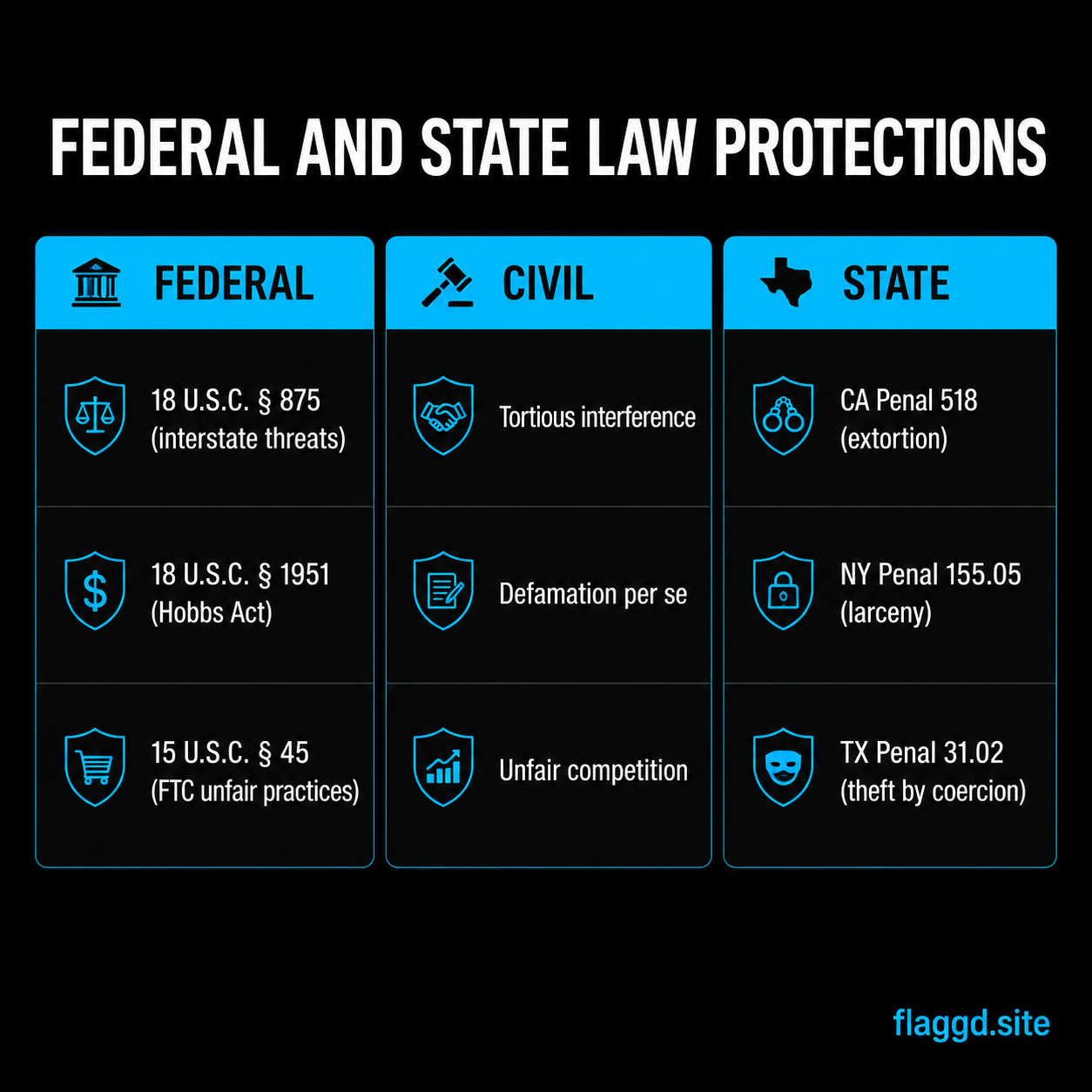
- Multiple federal and state laws protect extortion victims. Federal statutes include 18 U.S.C. § 875(d) (extortion), 18 U.S.C. § 1341 (mail fraud), 18 U.S.C. § 1343 (wire fraud), and the Hobbs Act. States also have independent extortion and business tort statutes.
- Report to the FBI IC3, your state Attorney General, local law enforcement, and consult an extortion attorney. Criminal prosecution and civil lawsuits are both viable paths to holding extortionists accountable and recovering damages.
Review extortion is no longer a theoretical risk for small businesses and service providers—it is an active, documented threat. Someone sends you a message with a simple premise: remove the negative review you posted about my business, or I will post ten more. Or: I've had a bad experience, and for the right price, we can work this out. Or: delete your complaints about my service, or face legal consequences from my attorney. These are extortion attempts. They are federal crimes. And they happen to business owners regularly enough that the FBI and state attorneys general have issued warnings and guidance about the threat.

What separates review extortion from ordinary review disputes is the explicit or implicit demand. A business that flags a review for policy violations is not engaging in extortion—they are using legitimate review management tools. A customer who leaves honest negative feedback is not engaging in extortion—they are exercising their right to review. But when someone explicitly or implicitly demands payment, removal of competition, favorable treatment, or other consideration in exchange for review action, the line into criminal territory is crossed. This guide walks you through the definition of review extortion under federal law, the warning signs that should trigger immediate action, the types of extortion schemes currently circulating, the critical mistakes victims should avoid, the federal and state laws that protect you, how to document evidence for law enforcement and civil proceedings, and the agencies and resources you should contact if you become a victim.
What is review extortion and federal law
Review extortion is the crime of demanding payment, goods, services, favorable reviews, or removal of negative reviews in exchange for not posting damaging reviews, flooding a business with negative reviews, or engaging in other harmful review-based action. The demand is typically backed by an explicit or implicit threat. The extortionist gains leverage over the victim through the threat of negative publicity via reviews.
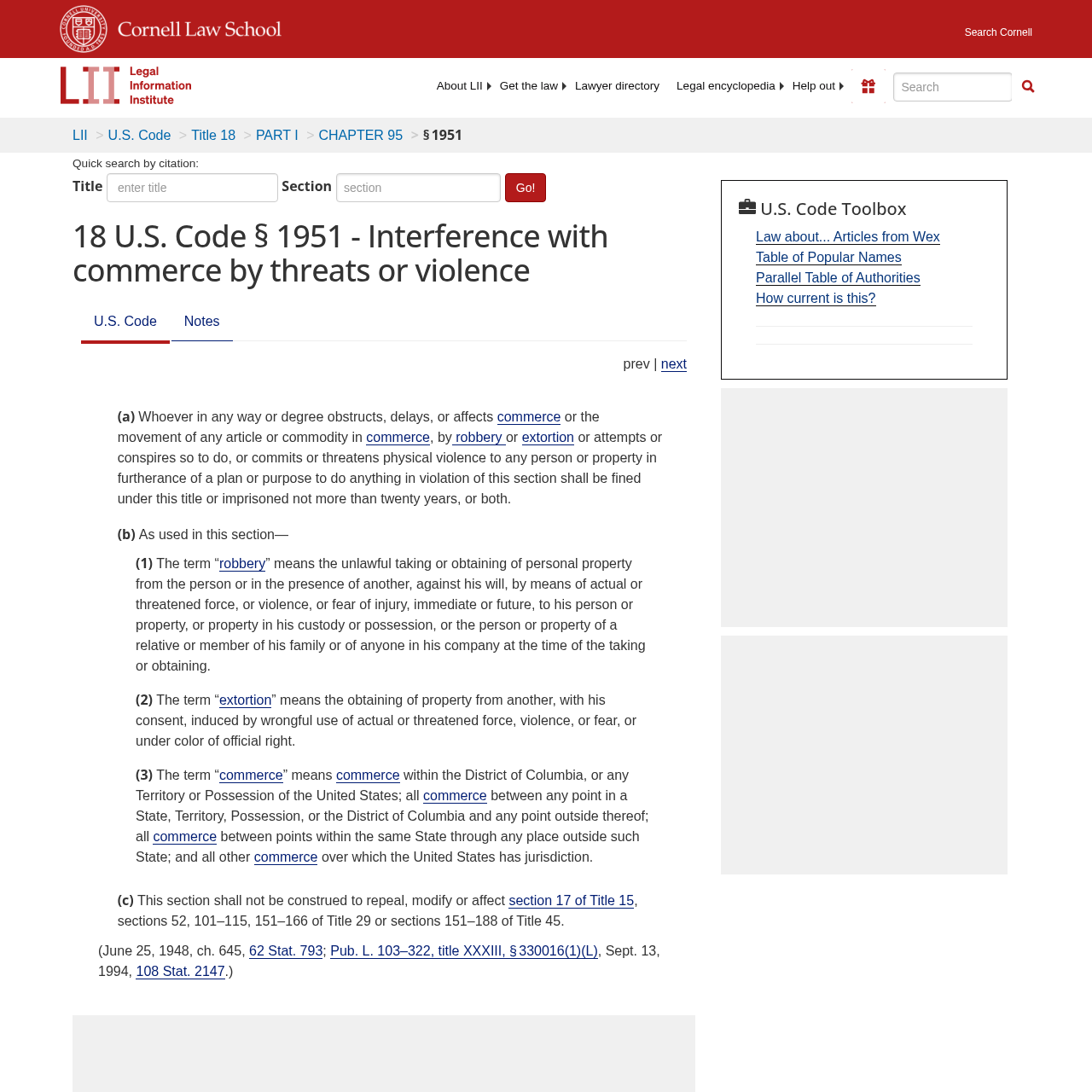
The federal statute most directly applicable to review extortion is 18 U.S.C. § 875(d), which criminalizes extortion via electronic communication. The statute reads: "Whoever transmits in interstate or foreign commerce any communication containing any threat to injure the property or reputation of the addressee or of another person, with intent to extort from any person any money or other thing of value..." commits a federal crime punishable by imprisonment up to 20 years and fines. The "threat to injure the property or reputation" component maps directly to review extortion—threatening to post negative reviews is a threat to reputation. The "intent to extort from any person any money or other thing of value" maps to the demand element.
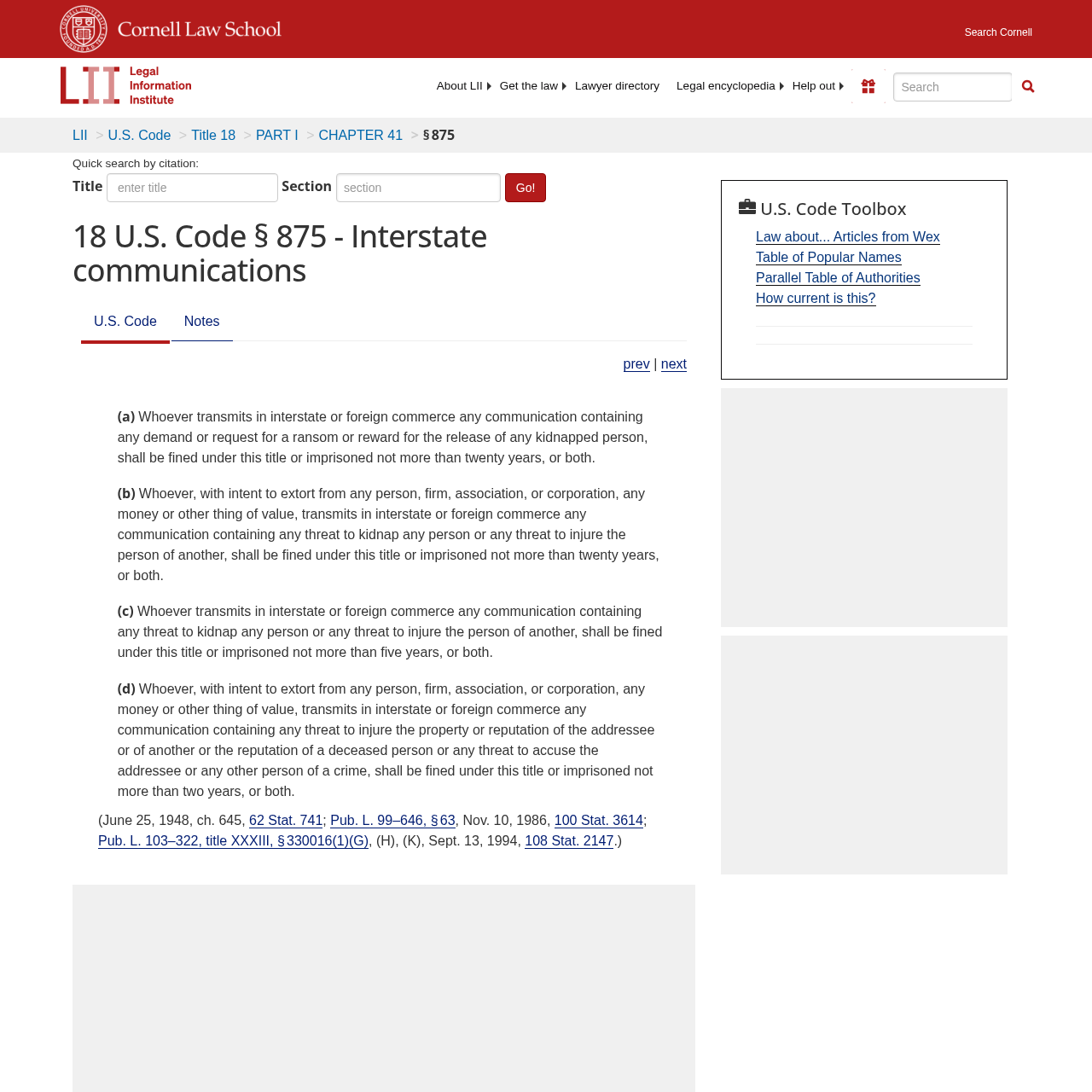
For a review extortion offense to be proven, the prosecution must establish five elements: (1) the defendant transmitted a communication in interstate or foreign commerce (email, private messages, comments—essentially any digital communication crossing state lines qualifies); (2) the communication contained a threat to injure property or reputation; (3) the threat was explicit or implicit (the defendant does not need to say the word "threat"—a reasonable person would perceive the message as threatening); (4) the defendant intended to extort property or money from the victim; and (5) the threat was the means by which the defendant sought to obtain the property or money. All five elements must be proven beyond a reasonable doubt for criminal conviction.
Two additional federal statutes frequently apply in review extortion cases. The federal mail fraud statute (18 U.S.C. § 1341) applies if the extortionist uses the U.S. postal system in furtherance of the scheme. The federal wire fraud statute (18 U.S.C. § 1343) applies if any wire communications (phone calls, texts, online video calls) are used in addition to email or messages. Both carry penalties of up to 20 years imprisonment and substantial fines. State extortion statutes vary by jurisdiction but typically mirror the federal language, criminalizing threats to reputation or property in exchange for money or value. Many states also have tortious interference with business statutes that allow civil (non-criminal) suits against extortionists.
Warning signs: how to recognize extortion
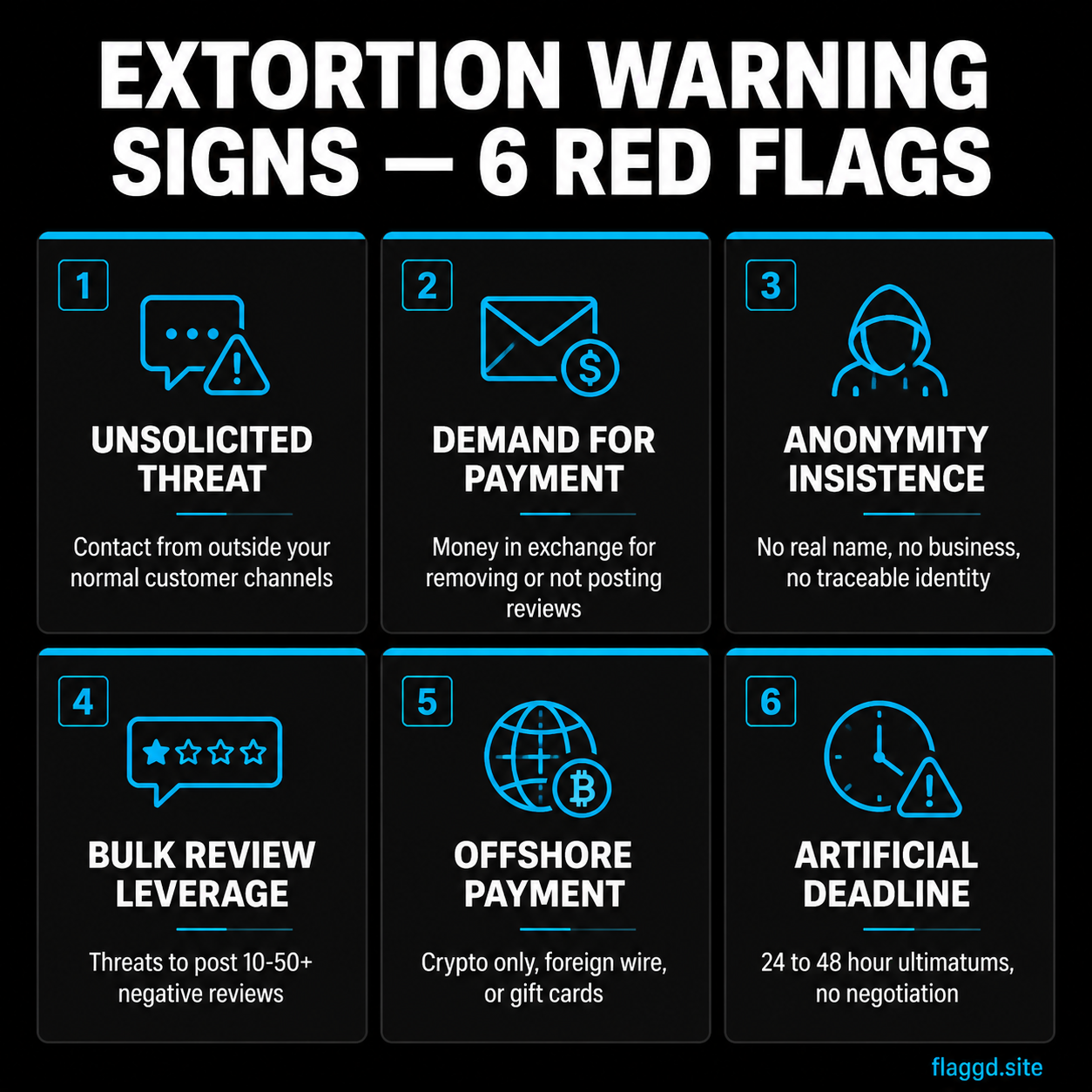
Extortion attempts often come disguised as legitimate dispute resolution or settlement offers. Learning to recognize the specific language and patterns that signal extortion—as opposed to genuine complaints or review disputes—is critical for victims to act quickly.
Explicit payment demands tied to review removal. "Remove this review and the matter is closed." "Pay me $500 and I will delete my post." "If you compensate me for my experience, I can remove the negative review." These statements directly link money to review action. This is unambiguous extortion—no reasonable person would misinterpret the demand.
Threats to flood reviews unless compensated. "If you don't contact me to resolve this, I will post one negative review every day across every platform." "I have friends who can also leave detailed reviews if you're not interested in making this right financially." "I'm planning a campaign against your business unless you make me an offer." These are explicit threats conditioning review-posting action on compensation.
Vague demands with implied threats. "We can resolve this for the right price." "There are ways to handle this that benefit both of us." "I'm willing to be reasonable if you are." "This situation could go very badly for your business, but we can work it out." These statements do not explicitly mention reviews, but the implication is clear to anyone reading in context—the extortionist is offering to "resolve" the review situation if the victim meets their unstated but implied financial demand.
Timing aligned with business disputes or service failures. A customer has a bad experience. Days later, a negative review appears. The business tries to address the complaint. The customer then sends a message: "You know, we can fix this if you're willing to be reasonable." The timing suggests that the negative review was posted specifically to create leverage for an extortion demand, rather than out of genuine frustration that coincidentally led to a demand.
Escalating threats if initial demands are refused. First message: "Let's work this out." No response or refusal. Second message: "I thought we could be professional about this." Still no compliance. Third message: "If you ignore this, I will make sure everyone knows what happened here." "You are making a mistake by not taking this seriously." Escalation demonstrates intent—the extortionist is not making a casual complaint; they are systematically increasing pressure to coerce compliance.
Demands framed as "fees" or "consulting costs." "I provide review management consulting services. My fee is $2,000, and I can help ensure your online reputation improves." "I offer reputation mediation. Payment is $1,500, after which we will work together to resolve negative content." This framing attempts to legitimize the demand by dressing it in professional language, but the core transaction remains: pay money or face negative reviews.
| Warning sign | Red flag indicator | Action |
|---|---|---|
| Explicit payment demand linked to review action | "Pay $X and I'll remove/not post negative reviews" | Unambiguous extortion — document and report immediately |
| Threats to post multiple reviews unless compensated | "I will post daily unless you make me an offer" | Clear extortion threat — preserve all messages and report |
| Vague "resolution" or "working it out" with payment implied | "We can resolve this for the right price" (after posting review) | Implicit extortion — document context and pattern |
| Timing of review tied to dispute or complaint | Bad experience → negative review posted → demand arrives | Suspicious sequence — note dates and preserve timeline |
| Escalating threats after refusal | First soft, then increasingly aggressive language | Pattern demonstrates intent — document full sequence |
| Demands disguised as "services" or "consulting fees" | "My reputation consulting fee is $2,000" | Extortion with professional framing — report to authorities |
Types of review extortion schemes
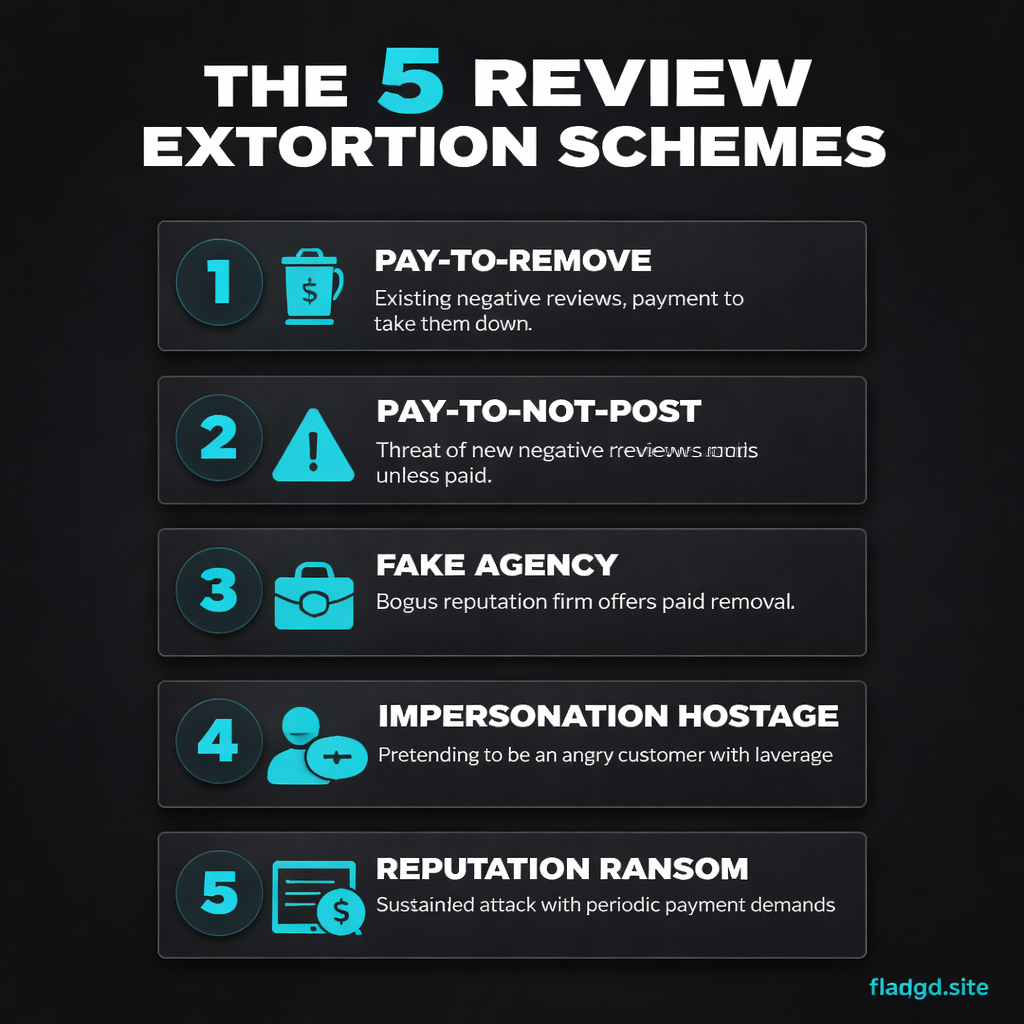
Review extortion takes several distinct forms. Understanding the variations helps victims recognize when they are being targeted, even if the extortionist's language does not match the stereotype.
Direct extortion: explicit payment demand. A customer leaves a negative review. The business owner (or someone claiming to represent the customer) sends a message: "Remove this review and we're done. Cost is $500." Or: "I posted that review. Delete it and pay me $2,000, and I'll never contact you again." This is the clearest form of extortion—a direct transaction: money for removal or silence. Many victims pay out of panic, which is why this scheme persists.
Indirect extortion: threat of review flooding. An unsatisfied customer messages: "You have 48 hours to contact me about resolving this. If you don't, I have 20 friends who will each post detailed negative reviews about your company." Or: "I'm willing to put this behind us if you're willing to compensate me appropriately. Otherwise, my next step is to ensure this goes viral across every platform." The threat is not about one review—it is about a coordinated campaign of multiple reviews designed to tank the business's rating. The demand is implicit: meet my financial terms, or face the flood.
Hybrid extortion: bad service plus demand. A customer has a genuinely poor experience. They leave a negative review. The business attempts to resolve the issue privately, but the customer escalates: "I'm not interested in your discount or replacement. What I want is for you to acknowledge that you treated me unfairly by [specific claim]. If you don't publicly admit fault and compensate me for my suffering, this review is staying up and I'm filing a complaint with the [agency]." Here, the extortionist uses a real grievance as leverage for a larger financial or public relations demand that goes beyond normal customer compensation. The line between reasonable resolution and extortion is crossed when the demand becomes disproportionate to the original harm and is explicitly tied to review action.
Professional extortion: "reputation management" disguises. A third party messages the business: "Your online reputation is at serious risk due to negative reviews. I offer professional reputation management and review mitigation services. My fee is $5,000. For that, I will ensure your rating improves significantly over the next 60 days." When pressed on what "improvement" means, the extortionist implies (or states) that they will contact reviewers to have negative content removed—meaning they have a network of extortionists or will themselves engage in extortion on the business's behalf. This variant victimizes the business owner a second time, selling them a "service" that depends on extorting the original reviewers.
Competitor-driven extortion: A competitor posts a negative (or false) review about the target business, then or shortly after, sends a message: "I have the ability to remove that review and influence others to post positive ones. This is a one-time offer—$10,000." The competitor is using their own review as leverage, essentially creating a ransom situation. The target business must either pay to have the review removed or accept ongoing reputational damage from a competitor.
The don't-do list: what victims should avoid
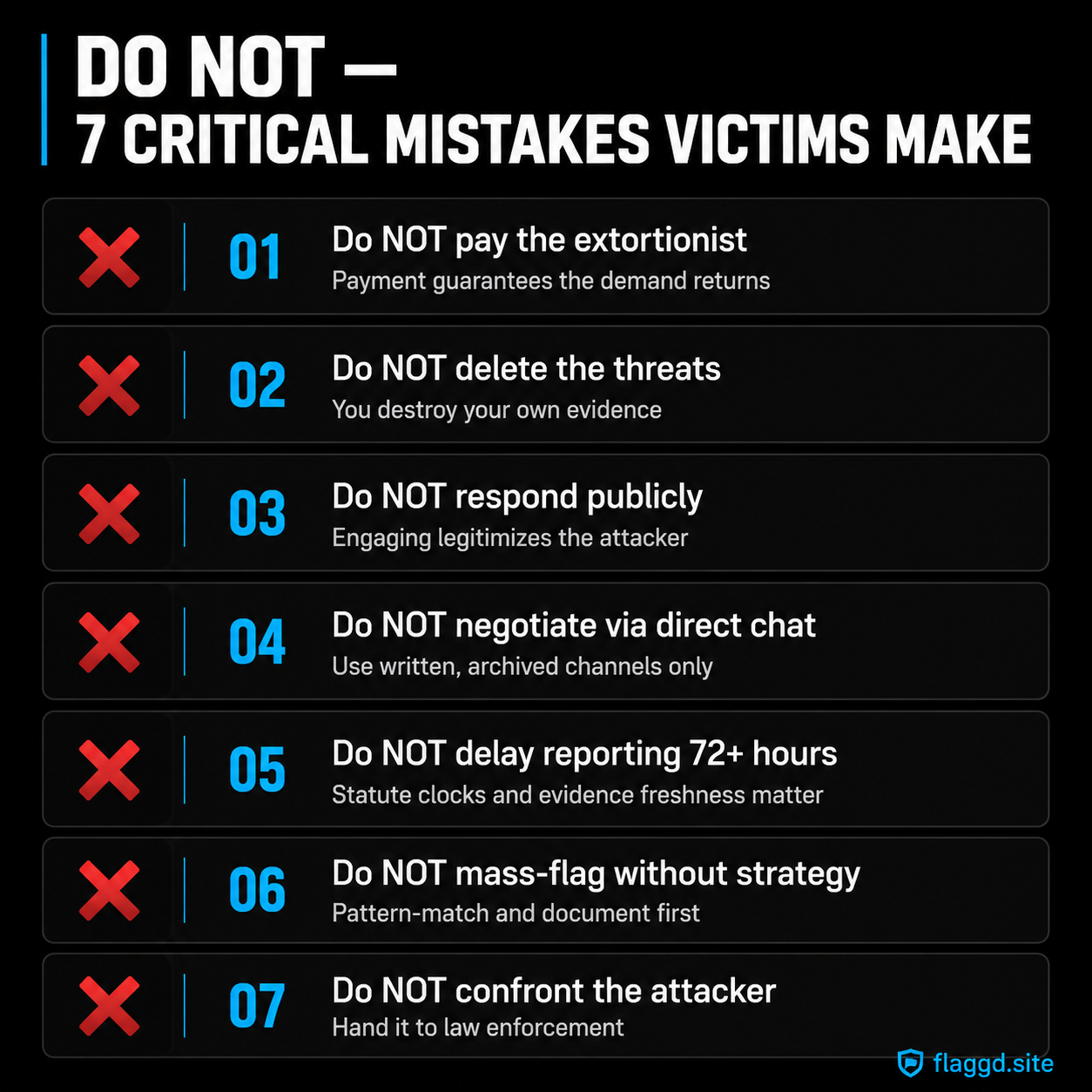
The instinct to "handle it quickly" often leads victims to make decisions that weaken their legal position. Here is what you should categorically avoid if you believe you are being extorted.
Do not pay the extortionist. This is the most critical rule. Paying money validates the extortionist's threat and provides evidence that their scheme worked. Payment creates a documented trail showing the victim's acknowledgment of the demand and voluntary transfer of funds—exactly what prosecutors use to prove extortion was successful. Additionally, payment often signals to the extortionist that the victim can be leveraged again, leading to repeat demands. It establishes a financial relationship that complicates your legal claim. Law enforcement's advice is uniform: do not pay under any circumstances.
Do not threaten the extortionist back. A natural response to an extortion threat is to send an angry, threatening message: "Stop this now or I will go to the police." While going to police is correct, the threatening tone can be twisted by the extortionist into a claim of mutual wrongdoing or counter-threats. The extortionist might then report you for threats, and their attorney could argue you were equally culpable in a dispute. Maintain a calm, factual tone in any communication. Better yet, stop communicating entirely once the extortion is clear.
Do not ignore the threats and hope they disappear. Extortionists escalate pressure when victims ignore demands. Documented escalation (soft requests → veiled threats → explicit demands) is powerful evidence of criminal intent. By ignoring the threats, you allow the extortionist to establish a pattern that courts and prosecutors find highly persuasive. Furthermore, delay in reporting gives the extortionist more time to act on their threats, post the reviews, contact others, or pursue alternative damage.
Do not attempt vigilante response or "doxxing" the extortionist. If you identify the extortionist and attempt to retaliate—posting their personal information online, contacting their employer, harassing them, or hacking their accounts—you have now committed crimes yourself. These actions destroy your credibility as a victim, give the extortionist a legitimate counter-claim against you, and may result in criminal charges against you. Law enforcement and courts will not sympathize with vigilante justice, even against someone who initially wronged you.
Do not post angry, detailed public rebuttals to the negative review. While responding professionally to a review is encouraged, posting a lengthy, emotional rebuttal that attacks the reviewer or details the dispute in a way that looks defensive can damage your case. Prosecutors and civil courts will see the response and judge your credibility. If your response looks like you are engaged in a tit-for-tat dispute rather than a victim of crime, the sympathy for your position weakens. Keep any public response brief, professional, and factual. Let your legal team handle the full explanation.
Do not delete or alter evidence. Once you recognize extortion, every communication becomes evidence. Do not delete messages, even to "clean up" your phone. Do not edit or screenshot selectively. Do not alter timestamps or change the context of messages. Prosecutors and opposing counsel can and will subpoena communication records from platforms and service providers. If you have visibly tampered with evidence, your entire case collapses—judges and juries assume you did so because the full, unaltered evidence incriminates you, not the extortionist.
Legal protections: federal and state laws
Victims of review extortion have multiple legal avenues to seek justice and compensation. Federal criminal law, state criminal law, and civil law all provide tools to hold extortionists accountable.
Federal extortion under 18 U.S.C. § 875(d). This is the primary federal statute and applies to virtually all review extortion cases involving electronic communication (email, private messages, social media comments). The statute provides for criminal prosecution resulting in imprisonment up to 20 years and substantial fines. The U.S. Department of Justice (DOJ) prosecutes these cases through U.S. Attorneys' offices. Once reported to the FBI, the FBI will investigate and, if evidence supports criminal charges, refer the case to the DOJ for prosecution.
Federal mail fraud (18 U.S.C. § 1341) and wire fraud (18 U.S.C. § 1343). If the extortionist uses the U.S. postal system (sending letters with payment demands, court notices, or settlement offers), the mail fraud statute applies. If wire communications beyond email are involved (phone calls, video calls, instant messaging services), the wire fraud statute applies. Both carry up to 20 years imprisonment and substantial fines. These statutes are prosecuted by the FBI and DOJ.
The Hobbs Act (18 U.S.C. § 1951). The Hobbs Act criminalizes extortion affecting interstate commerce. If the victim's business operates across state lines or if the extortion affects interstate transactions, the Hobbs Act provides an additional federal avenue. The DOJ frequently uses this statute in organized extortion cases.
State extortion statutes. Every state has its own extortion law, typically modeled on or similar to federal law. State statutes vary in wording and penalties, but all criminalize obtaining money or property through threats. State attorneys general and state/local law enforcement prosecute these cases. State penalties can range from a few years to 20+ years imprisonment depending on the severity and jurisdiction.
State civil remedies: tortious interference with business and tortious interference with economic advantage. Even if criminal prosecution does not materialize or stalls, victims can pursue civil lawsuits against extortionists. Tortious interference statutes in most states allow businesses to sue individuals who intentionally damage their business relationships, reputation, or economic position through wrongful means (like threats of negative reviews). Civil lawsuits can result in compensatory damages (actual financial losses, lost profits, harm to reputation), punitive damages (extra damages designed to punish egregious misconduct), and injunctive relief (court orders preventing further conduct).
Restraining orders and protective orders. If an extortionist has posted reviews, sent threatening messages, or contacted the victim multiple times, a victim can petition a court for a civil restraining order (sometimes called a protective order or order of protection). This is a civil remedy available in all states, and it requires the extortionist to cease contact and review-posting behavior. Violating a restraining order is itself a crime, which incentivizes compliance.
Platform-specific remedies. Google, Yelp, Facebook, TripAdvisor, and other review platforms have their own content policies prohibiting extortion, harassment, and off-topic attacks. If an extortionist has posted threatening messages in review comments or sent threats through platform messaging, victims can report the conduct to the platform. Platforms can suspend or ban the extortionist's account, remove reviews and comments, and in some cases, turn over the extortionist's identity to law enforcement based on court orders.
Documenting and preserving evidence
Evidence is the foundation of both criminal and civil cases against extortionists. Proper documentation and preservation are critical to making your case credible and admissible in court.
Screenshots with timestamps. For each threatening message, email, review comment, or social media post, take a full-page screenshot that shows the sender's name, the message content, the date and time, and ideally the URL or platform indicator. Do not crop or edit screenshots—include the full context. Multiple screenshots showing escalation are more powerful than one isolated message.
Full email headers. If threats arrive via email, preserve the full email including headers. Email headers contain metadata—the sender's email server, the transmission date and time, and routing information—that proves authenticity. Most email clients allow you to view "full headers" or "show original." Copy and save this complete header with the email body.
Chain of custody documentation. For legal proceedings, document when you received each message, from which account or platform it came, and how you accessed it (e.g., "Received threatening email from [email address] on May 15, 2026 at 3:42 PM EST in Gmail inbox. Forwarded to self as backup on same date at 3:45 PM, then printed and scanned to PDF on May 16, 2026 at 10:00 AM EST"). This timeline and record of handling makes the evidence admissible in court by showing you did not tamper with or alter it.
Payment demands in any form. If the extortionist demanded payment via any channel (email payment offer, request for bank account, Bitcoin address, gift card codes), preserve all of these. Screenshots, copies of emails, and forwarded messages all count. The demand itself is the crux of the extortion charge.
Threats both explicit and implied. Preserve not just the most damaging statements but the full conversation thread showing escalation. If the extortionist started soft ("let's work this out") and escalated ("if you don't respond by Friday, I will..."), the progression is crucial evidence of intentional pressure and extortion.
Context: timeline of the dispute. Create a written timeline showing when the service/product issue occurred, when you were contacted, when the review was posted, and when the extortion demand arrived. This narrative context helps prosecutors and judges see the logical flow and intent. Example: "March 10: Customer unhappy with service. March 12: Called me threatening legal action. March 15: Negative review posted. March 17: Email received stating 'Pay $1,000 by Friday or this review stays up and I post ten more.' This timeline shows the review was posted before the demand, suggesting it was created as leverage."
Storage and backup. Store originals in a secure location (encrypted external hard drive, cloud backup with strong authentication, sealed envelope). Create copies for your attorney. Avoid storing evidence only on your phone or in a single cloud account—redundancy ensures you do not lose documentation if a device fails or an account is compromised.
Do not alter, edit, or delete. Even if tempted to "clean up" or delete the conversation thread after reporting it, do not. Leave evidence exactly as received. Any visible alteration or deletion raises credibility questions and can result in evidence being excluded from court.
Victim support and reporting resources
Once you recognize you are a victim of review extortion, knowing where and how to report is essential. Multiple agencies and resources exist to support victims and pursue accountability.
FBI Internet Crime Complaint Center (IC3). The IC3 (ic3.gov) is the primary federal resource for reporting internet crimes, including extortion. You can file a complaint online without needing to contact a local FBI field office first. The complaint is reviewed by FBI agents and can initiate a formal investigation if warranted. Save your IC3 complaint number—you will need it when contacting other agencies or your attorney.
Local FBI field office. If you prefer in-person contact or want to speak with an agent directly, contact your local FBI field office. The FBI website (fbi.gov) provides contact information for every field office. Agents can advise you on evidence preservation, investigation timelines, and coordination with other agencies.
Your state Attorney General's office. Every state has an Attorney General (AG) with a consumer protection or cybercrime division. File a complaint with your state AG. Many state AGs have prosecuted extortion and related crimes. If your state AG decides to prosecute, they will coordinate with the FBI and local law enforcement. You can find your state AG's office through your state government website.
Local law enforcement (police, sheriff). File a report with your local police department or sheriff's office. Even if your local department does not have cybercrime expertise, filing a local report creates a paper trail and connects your case to state and federal authorities. Many local police departments will refer cybercrime complaints to state or federal agencies after taking an initial report.
U.S. Postal Inspection Service. If the extortionist used postal mail (sending letters with demands, threats, or settlement offers), report the matter to the U.S. Postal Inspection Service (postalinspectors.uspis.gov). Mail fraud is a federal crime, and postal inspectors have significant investigative resources.
Platform reporting (Google, Yelp, Facebook, etc.). If the extortion involved threats posted in review comments or private platform messages, report the conduct directly to the platform. Google, Yelp, and Facebook all have reporting mechanisms for harassment, threats, and extortion. Platforms can remove content and suspend accounts. Provide detailed information about which messages, comments, or reviews constitute the threat. Some platforms will preserve account information and make it available to law enforcement upon subpoena or court order.
Attorney specializing in extortion or white-collar crime. Consult an attorney with experience in extortion, business torts, or cybercrime. Many attorneys offer free initial consultations. An attorney can advise you on evidence preservation, realistic outcomes, civil vs. criminal remedies, and how to coordinate with law enforcement. If criminal prosecution stalls, your attorney can pursue a civil lawsuit for damages. During a consultation, provide all documentation of the extortion threats and ask about:
- Likelihood of criminal prosecution
- Civil lawsuit options and potential damages recovery
- Statute of limitations (how long you have to file a lawsuit)
- Whether you should pay for a private investigator
- Insurance coverage (some business liability policies cover extortion-related losses)
Victim advocacy organizations. Some nonprofits and victim advocacy groups assist extortion victims with guidance, counseling, and connections to resources. The National Center for Victims of Crime (victimsofcrime.org) provides information on victim rights and can connect you to local services. State crime victim compensation programs may also assist if you incurred financial losses (though compensation programs typically cover violent crimes and may not cover extortion unless statutory requirements are met).
Coordinating multiple reports. Best practice is to report the extortion to multiple agencies simultaneously or in sequence: FBI IC3 (online, immediately), your state Attorney General (online complaint form), local law enforcement (in-person, with documentation), and the platform(s) where the threat originated. Provide each agency with the IC3 complaint number and any case numbers assigned by other agencies. This creates a coordinated paper trail that increases the likelihood of investigation and prosecution.
Frequently asked questions
Review extortion is not a gray area of the law—it is unambiguous federal crime. The moment you receive a message linking a financial demand to review action (remove this review, don't post negative reviews, take favorable action), federal and state extortion statutes apply. The path forward is clear: document everything without altering or deleting, stop communication with the extortionist immediately, report to the FBI IC3 and your state Attorney General, consult an attorney specializing in extortion, and pursue both criminal prosecution and civil remedies. Payment is never the answer—it only validates the scheme and invites additional demands. Legal protection exists in multiple forms—federal criminal law, state criminal law, civil tort law, platform enforcement, and restraining orders—all designed to hold extortionists accountable and provide victims with recovery. Your role as a victim is to preserve evidence, report to authorities, and work with legal counsel. The agencies and courts will do the rest.