
Key Takeaways
- A reposted Google review is a new review, not a restored one. Google tells contributors they can review the policies and then "edit and repost your content". No appeal is involved, so nothing in your Business Profile tools announces it.
- The repost can carry the original date. One documented case showed a review as posted four years earlier with a separate reposted marker five days old, which means a date-sorted review list will not put it at the top where you are looking.
- The second removal usually runs on a different clause than the first. Repetitive content covers "posting the same content multiple times either from the same account or multiple accounts", and that ground does not exist until there is a pattern to point at.
- Do not spend your one-time appeal on it. A repost is a new review with its own report, and your single appeal only unlocks after Google refuses a report. Reporting is free and repeatable; the appeal is neither.
- Google's enforcement is moving onto content, not people. Review removals rose from over 240 million in 2024 to over 292 million in 2025, while accounts hit with posting restrictions fell from more than 900,000 to more than 782,000. That is 373 reviews removed per restricted account, against 267 the year before.
- A reposted Google review is new, not restored
- The date trap that hides a repost from you
- What Google's policy forbids about posting again
- Three shapes of a repost, and which one Google acts on
- Why a reposted Google review is not an appeal job
- The evidence file that gets a repost removed
- What Google's enforcement numbers say about repeat posters
- When it is not a repost at all
- What we would do in the first 48 hours
- Frequently asked questions
You reported the review, Google took it down, you moved on, and now the same complaint is back on your profile in slightly different words. Google blocked or removed over 292 million policy-violating reviews in 2025 and put posting restrictions on more than 782,000 accounts, which sounds decisive until you divide one by the other: 373 reviews came down for every account that lost the ability to post, so the person whose review you got removed almost certainly kept the keyboard. A reposted Google review is the result, and it is a different problem from a restored one: nothing was reinstated, so nothing was appealed, and the removal you won is still on the record. We read Google's repetitive content and fake engagement clauses against its own page on removed content, pulled both of Google's annual Maps enforcement posts to compare the two years, and worked through a 2024 practitioner thread where a repost showed up dated four years old. Here is how to tell a repost from the three other ways a familiar one-star comes back, and what to file for each.
A reposted Google review is new, not restored
Google's page on removed and rejected content is written for contributors, not for you, which is why owners rarely read the sentence that matters. It tells the person whose review came down that they can review the policies and then "edit and repost your content". There is no form, no queue and no decision: a repost is just posting, and it happens the moment they decide to do it.
That one sentence separates a reposted Google review from the appeal route completely. An appeal asks Google to reverse itself, takes time, and can only be used once per removal. A repost asks nobody for anything. The practical consequence is that the strength of your original case has no bearing on whether the content comes back, only on whether it stays down the second time.
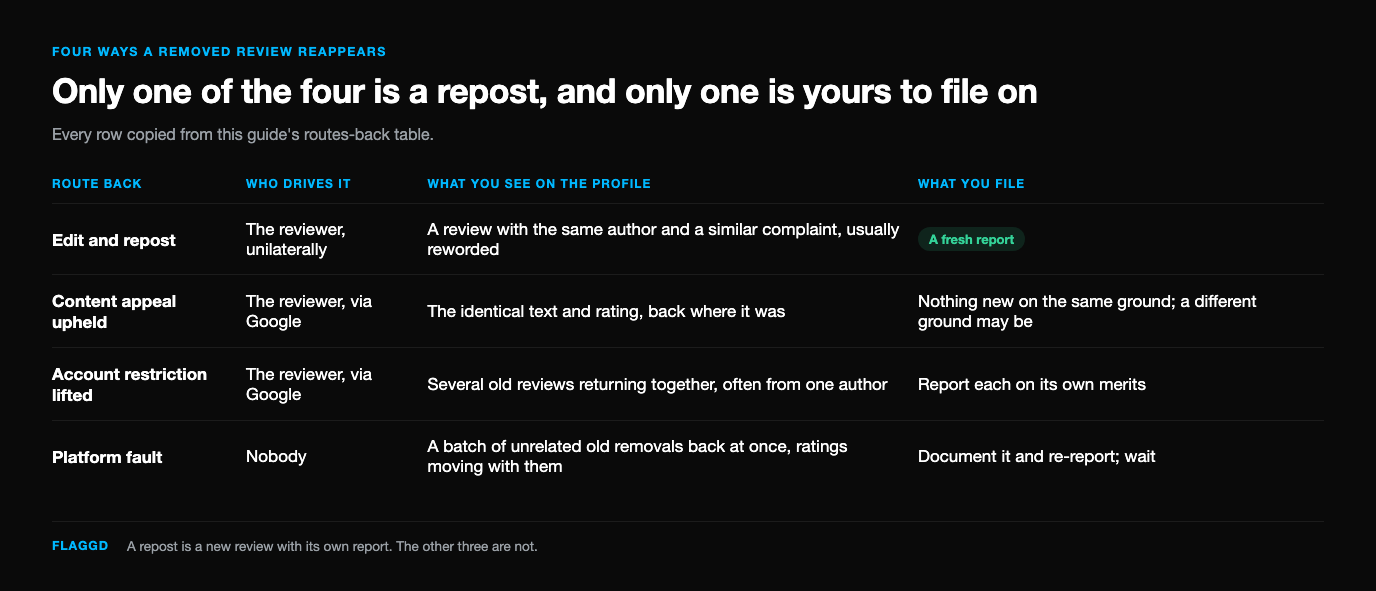
Four different events put a familiar one-star back on a profile, and owners routinely treat all four as the same event. They are not, and the remedy differs for each:
| Route back | Who drives it | What you see on the profile | What you file |
|---|---|---|---|
| Edit and repost | The reviewer, unilaterally | A review with the same author and a similar complaint, usually reworded | A fresh report, ideally under repetitive content or fake engagement |
| Content appeal upheld | The reviewer, via Google | The identical text and rating, back where it was | Nothing new is available on the same ground; a different ground may be |
| Account restriction lifted | The reviewer, via Google | Several old reviews returning together, often from one author | Report each on its own merits; the restriction is not yours to argue |
| Platform fault | Nobody | A batch of unrelated old removals back at once, ratings moving with them | Document it and re-report; wait before assuming an adversary |
Only the first row is a repost. Only the second and third are appeals, and we covered how those work in detail in our guide to whether a removed Google review can come back. The rest of this page is about the first row, because it is the one with no paper trail and the one every competitor page on this subject leaves out.
The date trap that hides a repost from you
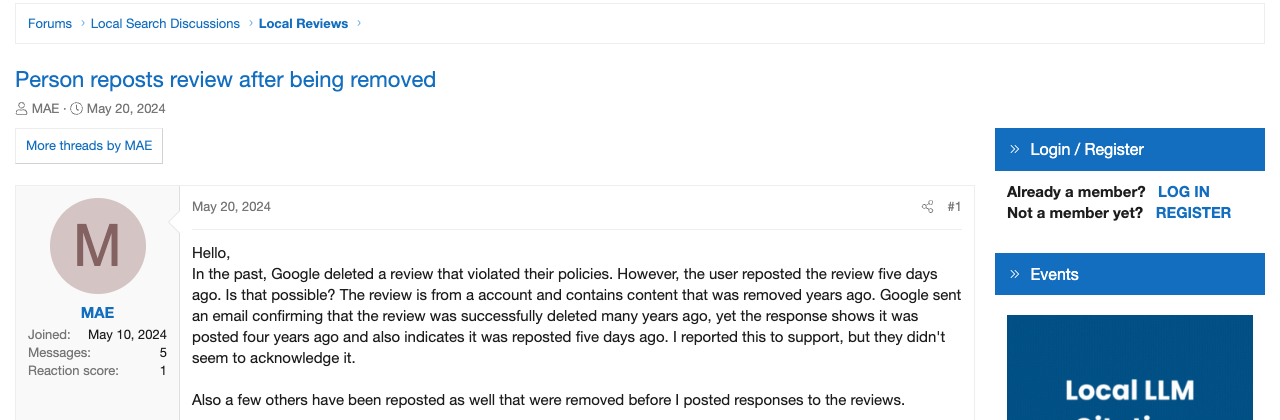
Here is the part that costs owners weeks. A repost does not reliably arrive at the top of your review list with today's date on it. In a May 2024 thread on Local Search Forum, a business owner described a review Google had removed years earlier reappearing and displaying as posted four years ago, with a separate marker showing it had been reposted five days before. Several other reviews, all removed previously, had come back the same way.
Most owners, and most review alerting, watch the newest reviews and the star average. A repost that inherits an old date triggers neither reliably: it is not new enough to surface in a date-sorted scan, and one review moves a hundred-review average by a hundredth of a star.
What does catch it is the review count and the author name. Track the count, not just the rating, and keep a list of the authors whose reviews you have had removed. Our review monitoring setup covers the alerting side.
The owner in that thread reported the repost to Google support and, in their words, support "didn't seem to acknowledge it". The forum moderator's advice was to go through the Reviews Management Tool rather than general support, and to say in the report that this exact review had already been removed once. That advice is right, and the next two sections are about making it land.
What Google's policy forbids about posting again
The ground you won on the first time is often the weakest ground available the second time, and owners keep re-filing the same case rather than the stronger one that only exists now. A repost creates a pattern, and Google's content policy has two clauses that are specifically about patterns.
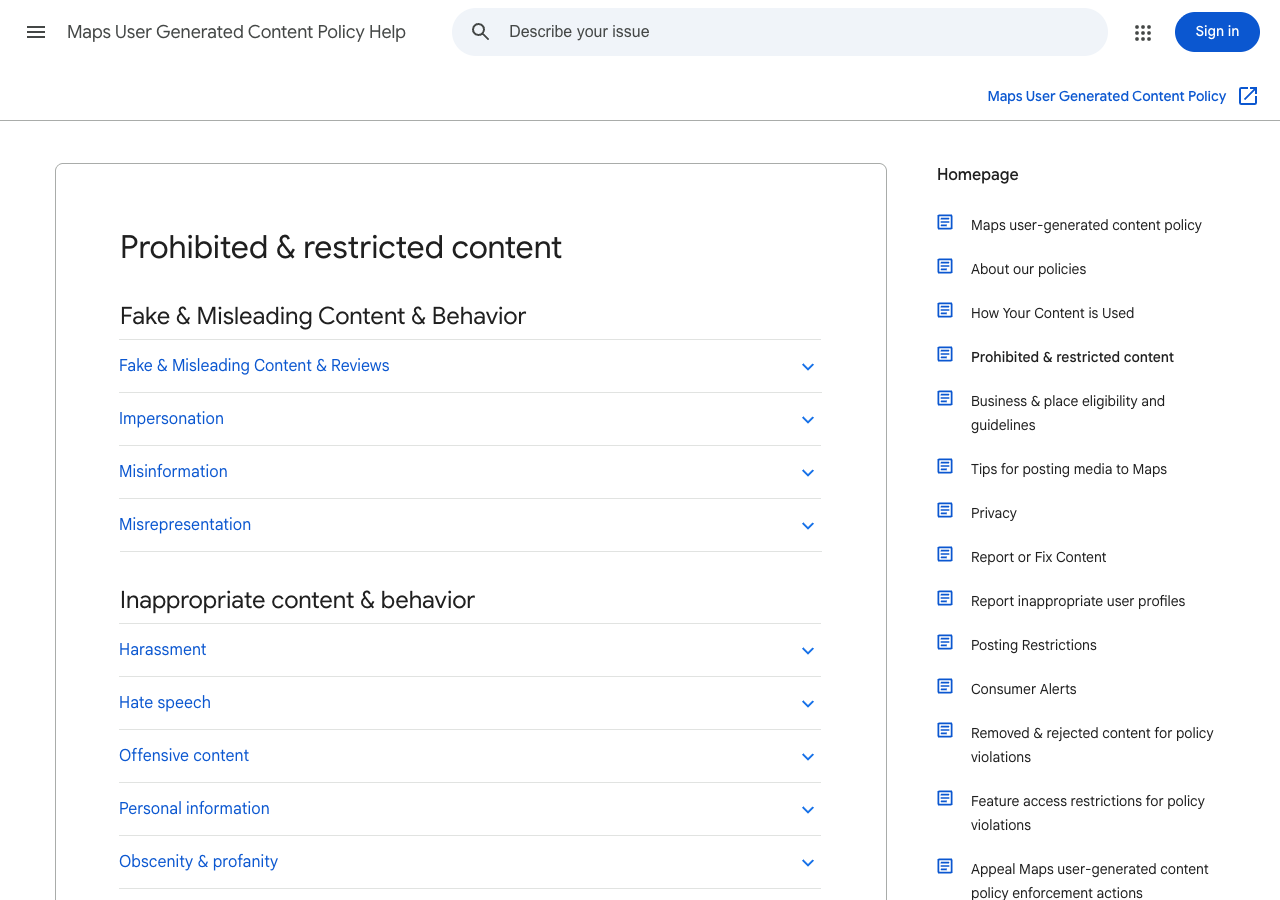
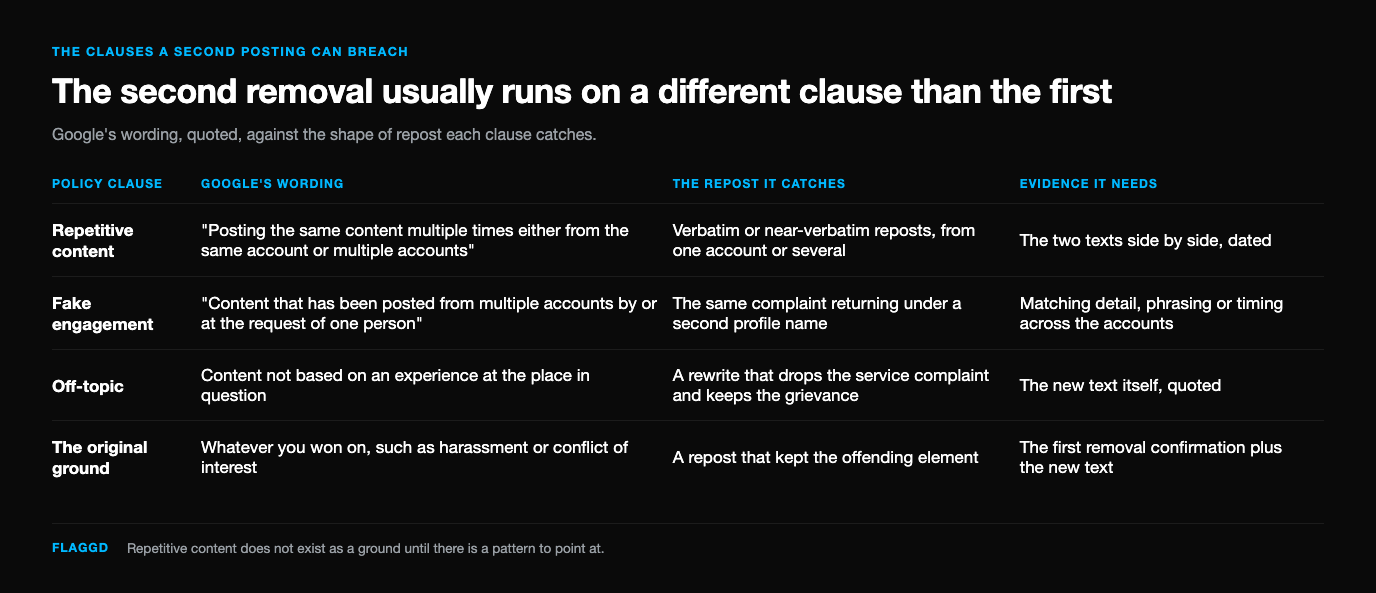
Under Unclear and repetitive content, Google prohibits "posting the same content multiple times either from the same account or multiple accounts". Under Fake engagement, it prohibits "content that has been posted from multiple accounts by or at the request of one person". Neither clause asks you to prove the complaint was false, which is the hard thing to prove. Both ask you to show repetition, which is the easy thing, because you have the screenshots.
| Policy clause | Google's wording | The repost it catches | Evidence it needs |
|---|---|---|---|
| Repetitive content | "Posting the same content multiple times either from the same account or multiple accounts" | Verbatim or near-verbatim reposts, from one account or several | The two texts side by side, dated |
| Fake engagement | "Content that has been posted from multiple accounts by or at the request of one person" | The same complaint returning under a second profile name | Matching detail, phrasing or timing across the accounts |
| Off-topic | Content not based on an experience at the place in question | A rewrite that drops the service complaint and keeps the grievance | The new text itself, quoted |
| The original ground | Whatever you won on, such as harassment or conflict of interest | A repost that kept the offending element | The first removal confirmation plus the new text |
File under the clause the new text actually breaches, not the one that worked last time. If the rewrite stripped out the profanity you won on and kept the rest, harassment is gone as a ground and repetition is what you have left. Our breakdown of every Google review violation type maps the full list if the repost has drifted somewhere else entirely.
Three shapes of a repost, and which one Google acts on
Reposts are not equally removable, and knowing which shape you are looking at tells you how much work the report needs before it is worth filing.
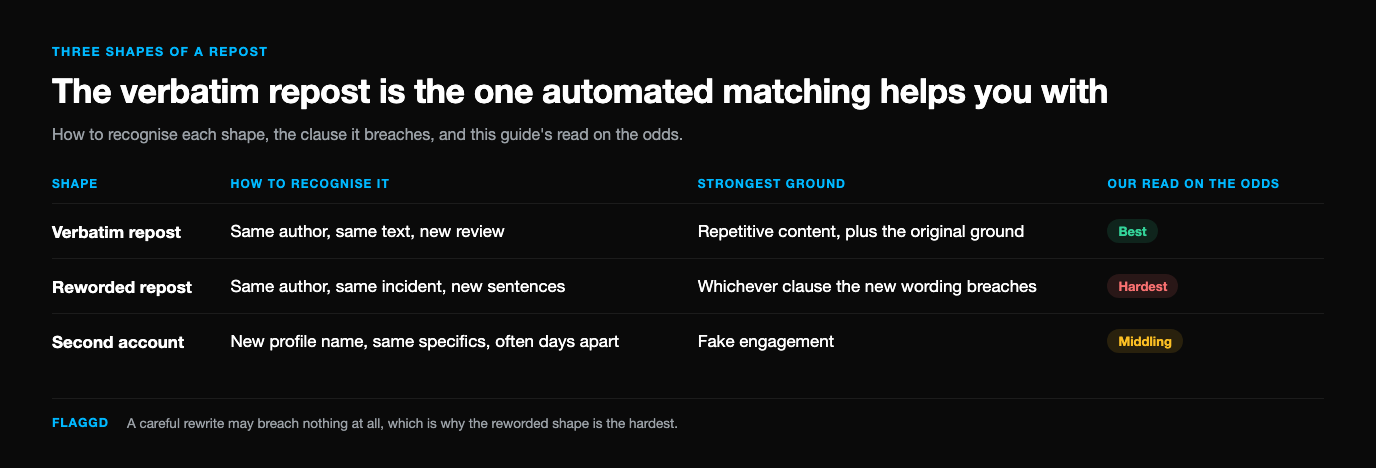
| Shape | How to recognise it | Strongest ground | Our read on the odds |
|---|---|---|---|
| Verbatim repost | Same author, same text, new review | Repetitive content, plus the original ground | Best. Automated matching is on your side and the comparison is one screenshot |
| Reworded repost | Same author, same incident, new sentences | Whichever clause the new wording breaches | Hardest. Google is assessing fresh text, and a careful rewrite may breach nothing |
| Second account | New profile name, same specifics, often days apart | Fake engagement | Middling, and better when the two display names overlap or the detail is identical |
Be honest with yourself about the middle row, because it is where owners waste the most effort. If someone rewrites a bad experience into a calm, specific, policy-compliant paragraph, that is a review Google will keep, and arguing otherwise burns credibility you may want later. The reworded repost that is removable is the one that kept the thing that got it removed: the accusation of a crime, the named employee, the demand, the second-hand account.
The second-account shape overlaps heavily with competitor behaviour, and the detection work is the same in both cases. If the pattern starts looking coordinated rather than personal, our guide to reviews left by competitors is the better playbook.
Why a reposted Google review is not an appeal job
This is the mistake that costs the most, and it comes from treating the repost as a continuation of the case you already won. It is not. The repost is a new review, so it gets a new report, and reporting is unlimited and free.
Google's Business Profile help page is explicit about the sequence: "If a flagged review doesn't qualify for removal, submit a one-time appeal", and "review evaluation typically takes several days". The appeal only exists after a refusal, it covers a selection of up to 10 reviews, and you get one. Spending it on a repost you have not even reported yet throws away the instrument you need for the case Google actually refuses.
Report the repost under the clause the new text breaches. Wait out the several days Google names. If it is refused, then consider the appeal, and when you do, fill the ten-review selection with your best-evidenced cases rather than this one review alone. A one-time appeal spent on one review is nine wasted slots. Our guide to what to do when a removal request is denied covers the batching in full.
One more asymmetry worth knowing, because it works in your favour for once: on the reviewer's side, editing or deleting the content after they file an appeal cancels that appeal, and the single attempt is spent. A reviewer who appeals and then reposts has thrown away their own route to restoration.
The evidence file that gets a repost removed
A repost report is a comparison, and a comparison you cannot produce is an assertion. The problem is that the first review is gone from your profile by the time you need it, and Google gives owners no archive of removed content. So the file has to be built before you need it, which in practice means building it now for every removal you have already won.
- The original text, screenshotted with the author name and star rating. This is the one item that becomes unobtainable. Capture it when you file the first report, not when you win.
- Google's removal confirmation, with its date. It establishes that Google has already judged this content once, which is the whole argument in the repetitive-content report.
- The ground the first removal succeeded on. If the repost kept the offending element, you are re-running a case Google has already accepted.
- The new review, screenshotted with both dates visible — the displayed posting date and any reposted or edited marker. The mismatch between them is what demonstrates this is a repost and not a first-time review.
- A phrase-level comparison. Pick the two or three sentences that survived the rewrite and quote them against each other. Google's reviewers are reading fast; do the matching for them.
- For a second account, the overlap. Display name similarity, the same incident detail, the same unusual spelling, reviews posted minutes apart. Any one is thin and three together are not.
Our longer guide on documenting evidence for a review dispute covers the file format and retention side, and what actually happens when you flag a review explains where this material goes once you submit it.
What Google's enforcement numbers say about repeat posters
Google publishes an annual summary of what it removed from Maps, and reading two years side by side says something about reposts that neither year says alone. The figures below are Google's own, from its April 2025 post covering 2024 and its April 2026 post covering 2025.
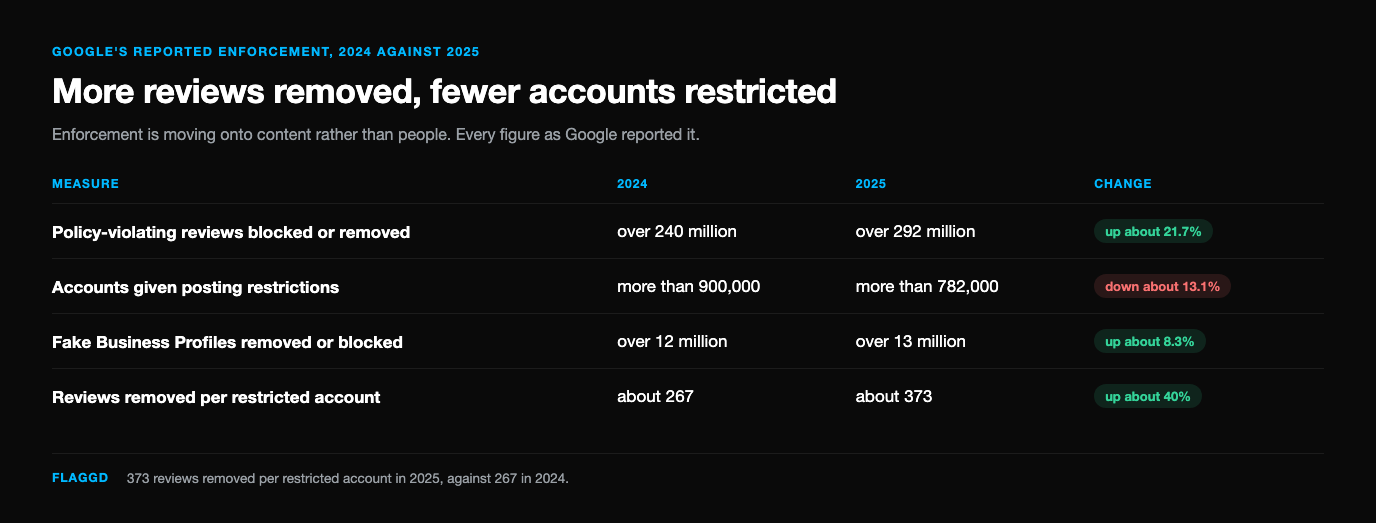
| Google's reported enforcement | 2024 | 2025 | Change |
|---|---|---|---|
| Policy-violating reviews blocked or removed | over 240 million | over 292 million | up about 21.7% |
| Accounts given posting restrictions | more than 900,000 | more than 782,000 | down about 13.1% |
| Fake Business Profiles removed or blocked | over 12 million | over 13 million | up about 8.3% |
| Reviews removed per restricted account | about 267 | about 373 | up about 40% |
The last row is ours, not Google's: it is the first row divided by the second, using the published minimums. Treat it as a ratio of two totals rather than a per-person rate, because Google does not say how many removals belonged to restricted accounts. Even as a rough ratio it points one way. Removals went up by a fifth while account restrictions went down by an eighth, so enforcement is landing harder on content and lighter on contributors.
For an owner, that is the structural reason reposts are worth planning for rather than treating as bad luck. Google took your review down and, on these numbers, most likely left the author's posting ability intact. Google also notes it blocked 79 million inaccurate or unverified edits to Business Profiles in 2025, which is a reminder that reviews are only one of the surfaces a determined person can reach.
When it is not a repost at all
Before you build a case against a person, rule out the three explanations that involve no person. Filing a repetitive-content report against a platform fault wastes a report and teaches you nothing.
| Not a repost | The tell | What to do instead |
|---|---|---|
| A platform fault | Several unrelated old removals return on the same day, from different authors | Screenshot the batch, check whether other owners are reporting it, re-report after a week |
| The spam filter releasing | The review was never confirmed removed to you, it simply was not visible for a while | Treat it as a first-time review and report on its merits if it breaches a clause |
| A profile merge or move | Review counts jump on both profiles, or reviews arrive that name a different location | Fix the duplicate listing first; the reviews follow the profile |
| A genuine second visit | Same author, new incident, new date, new specifics | Reply to it. A second real experience is not a policy breach |
The first row has a documented precedent: in May 2025 a local search agency reported a Google Business Profile fault that was "causing previously removed reviews, including those that were fake or violated policies, to reappear" across listings. We could not find a Google statement confirming it, so treat it as an industry report rather than policy, but it is the reason a one-day batch deserves patience. Our page on why Google reviews disappear and return covers the filter behaviour in the second row.
What we would do in the first 48 hours
A repost is time-sensitive in one direction only: the evidence is easiest to collect while both versions are fresh in your records, and the report is stronger when the two dates are close enough to look deliberate.
- Screenshot the new review with its dates visible, before anything changes. A reposted review can be edited again at any time, and your report should describe the version Google will be looking at.
- Decide which of the four routes back this is. One author returning is a repost. Several authors on one day is probably not.
- Pick the clause the new text breaches, not the clause that worked before. Repetition is usually the strongest and almost always the easiest to evidence.
- Report it in the Reviews Management Tool, not through general support, and say in plain terms that this content was removed previously and has been reposted.
- Hold the appeal. Several days is Google's own stated evaluation time. Nothing is lost by waiting and the one-time appeal is lost by not waiting.
- Add the author to a watch list. Someone who reposted once is the most likely person to repost again, and the second instance is far easier to evidence than the first.
- Keep earning reviews. The arithmetic in the enforcement table cuts both ways: a single returning one-star matters in proportion to how small your denominator is.
A repost needs a different ground, not a louder complaint
The report that fails is the one that re-argues the case you already won. Flaggd reads the reviews on your profile against Google's content policies, tells you which clause the current text actually breaches, and files the evidenced dispute under that ground with the comparison attached.
Flaggd is our own service and this page recommends it. We dispute content that breaches Google policy on profiles our clients control. We are not a law firm, we do not give legal advice, and nobody can stop a reviewer reposting or guarantee a removal. The enforcement figures above were read from Google's own Maps announcements of 7 April 2025 and 16 April 2026 on 13 November 2026; the per-account ratio is our arithmetic on those two totals, not a Google figure.
- →Can a removed Google review come back? The appeal routes
- →Google review spam: how to identify and report it
- →Track the status of a review removal request
- →Removing Google reviews left by former employees
- →Your removal request was denied: what to do next
- →How to document evidence for a review dispute
Frequently asked questions
Can someone repost a Google review after it was removed?
Yes. Google's page on removed and rejected content tells contributors they can review the policies and then "edit and repost your content". No appeal and no permission is involved, so it can happen at any time and nothing in your Business Profile tools tells you. The repost is a new review, which means a fresh report rather than an appeal.
Is a reposted Google review the same as a restored one?
No, and the difference decides what you file. A restoration is the identical content returning because the reviewer appealed and Google reversed itself, which means your original ground was overturned. A repost is new content they published themselves, which leaves your first removal standing and hands you a second ground. We cover the appeal side separately in can a removed Google review come back.
Does Google remove duplicate reviews from the same person?
Its content policy prohibits "posting the same content multiple times either from the same account or multiple accounts", under unclear and repetitive content. That is the most direct ground for a verbatim or near-verbatim repost. A heavily reworded second review is harder, because Google is then judging new text that may breach nothing on its own.
Why does a reposted review show an old date?
Because the profile can keep the original posting date and show the repost as a separate marker. A May 2024 Local Search Forum thread describes exactly that: a review displaying as four years old with a reposted marker five days old. Watch your review count and your list of removed authors, not just the newest reviews.
Should I use my one-time appeal on a reposted review?
No. Google's Business Profile page says the one-time appeal is for a flagged review that does not qualify for removal, so it only unlocks after a refusal, and a repost has not been reported yet. Report first, wait out the several days Google names, and save the appeal for a refusal with its ten-review selection filled properly.
What if the same complaint comes back under a different name?
That is the fake engagement clause, which covers "content that has been posted from multiple accounts by or at the request of one person". Report on that ground and show the overlap: matching incident detail, shared phrasing, similar display names, reviews posted minutes apart. One similarity is thin; three together are a pattern.
Several old removed reviews came back at once. Is that a repost?
Probably not. One author returning is a repost; several unrelated authors on one day is either an account-level appeal or a platform fault. An agency report from May 2025 described a Google Business Profile fault resurfacing previously removed reviews, and we found no Google statement confirming it, so document the batch and re-report after a week rather than building a case against a person.