Key Takeaways
- One family transacts and forty people experience the service. Google's test is genuine experience, not who signed. The relative the right-of-disposition statute passed over still attended the visitation, so their review stays up.
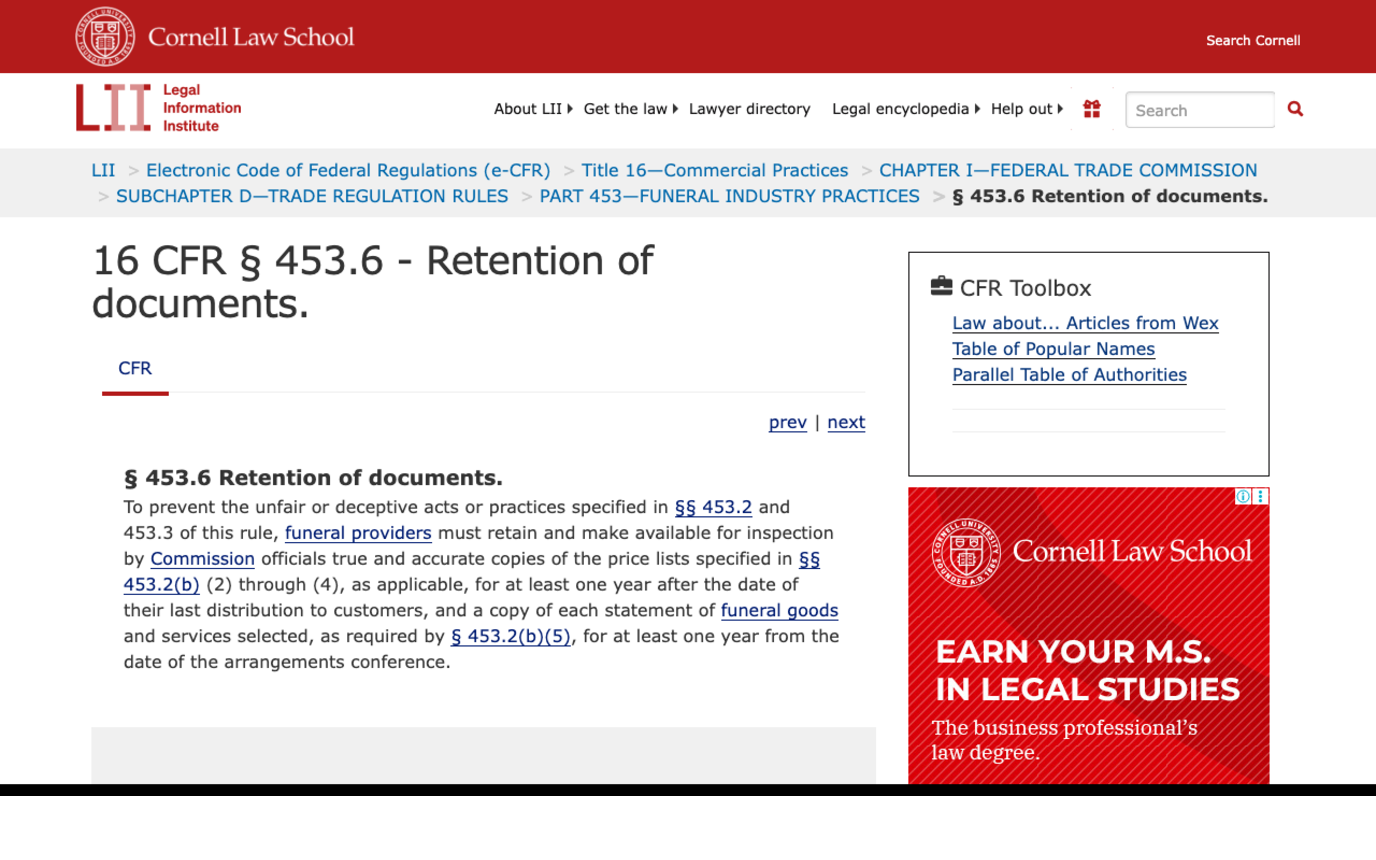
- Federal law already made you keep the evidence. 16 CFR 453.6 requires you to retain every Statement of Funeral Goods and Services Selected for a year, which is the strongest Fake Engagement exhibit any local trade has.
- The price review is a Funeral Rule matter, not a Google one. 16 CFR 453.2(b)(1) requires phone price answers, and the FTC has referred 559 homes to its offender programme since 1996.
- Naming the decedent is not a privacy removal. Google's personal information policy protects living identifiable people. A named survivor with an address does engage it.
- Two documents are live liabilities. Waiving a balance for a deletion breaches the FTC review rule at up to $53,088 per violation, and the non-disparagement clauses in inherited preneed contracts are void under the Consumer Review Fairness Act.
- Why one star costs a funeral home more than one call
- Who actually left the review
- Which funeral home reviews Google actually removes
- The price review is a Funeral Rule matter
- The records federal law already made you keep
- Why your reply is constrained, and not by HIPAA
- The review that is not yours: acquisitions, preneed and the cemetery
- Filing and escalating: the routes and the clock
- Three moves that turn a review into a legal problem
- Before the next first call
The one star arrives eleven days after the service, from a surname you recognise attached to a first name you do not, and it uses the word disrespectful. Funeral home Google review removal starts in that gap, because this is the trade where one person signs the contract and forty people form an opinion of how the day went, and Google counts all forty. BrightLocal's 2026 Local Consumer Review Survey found that 68% of consumers will only use a business rated four stars or better and 31% will not go below 4.5, and against the $8,300 median for a funeral with viewing and burial in NFDA's 2023 General Price List Study, a family that scrolls past your pin is a five-figure call you never get. What separates a removal from a decline is never how unfair the review is. It is whether your filing names one Google policy category and attaches the one record that settles it.
Why one star costs a funeral home more than one call
Most local businesses lose a transaction to a bad review. A funeral home loses a family, and families are the unit this trade sells to. The people who would have called you next are in the same church and the same three streets, and one credible review reaches all of them at the moment they are deciding.
The timing makes it worse. Nobody comparison shops a funeral home over six weeks; the search happens in an afternoon, under pressure, and a profile at 4.2 stars loses to the one at 4.8 without anyone reading past the first two reviews. Meanwhile the cremation rate keeps climbing, projected at 63.4% for 2025 in NFDA's cremation and burial report, compressing both the margin and the window in which you can demonstrate anything.
The asymmetry that shapes everything below: your strongest ground in a funeral review dispute is documentary and your weakest is emotional. You almost certainly have a signed authorization, an itemized statement and a chain of custody that answer the factual claim. None of that touches the sentence that is actually doing the damage, which is usually about tone, timing or how somebody felt spoken to on the worst day of their life.

Who actually left the review
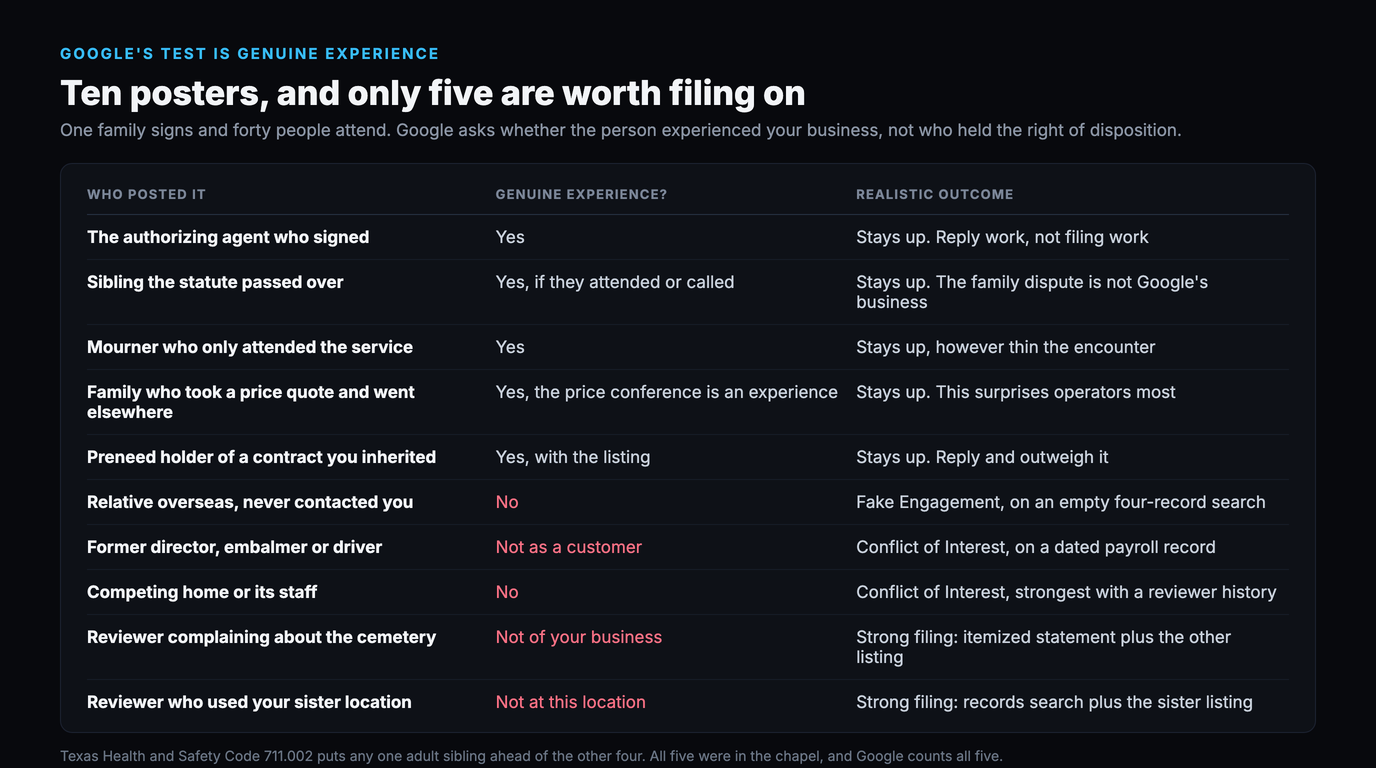
Google does not ask who paid you and does not ask who had legal authority. It asks whether the person had a genuine experience of your business. In deathcare those come apart further than in any other local trade, because the statutory decision maker is one person and the service is a public event. Texas is a representative example: Health and Safety Code 711.002 sets a priority list running from a person the decedent designated in writing, through the surviving spouse, then any one adult child, then either parent, then any one adult sibling. Any one. The other four siblings hold no authority and were all in the chapel.
| Who posted it | Genuine experience? | Realistic outcome |
|---|---|---|
| The authorizing agent who signed | Yes | Stays up. Reply work, not filing work |
| Sibling the statute passed over | Yes, if they attended or called | Stays up. The family dispute is not Google's business |
| Mourner who only attended the service | Yes | Stays up, however thin the encounter |
| Family who took a price quote and went elsewhere | Yes, the price conference is an experience | Stays up. This surprises operators most |
| Preneed holder of a contract you inherited | Yes, with the listing | Stays up. Reply and outweigh it |
| Relative overseas, never contacted you | No | Fake Engagement, on an empty four-record search |
| Former director, embalmer or driver | Not as a customer | Conflict of Interest, on a dated payroll record |
| Competing home or its staff | No | Conflict of Interest, strongest with a reviewer history |
| Reviewer complaining about the cemetery | Not of your business | Strong filing: itemized statement plus the other listing |
| Reviewer who used your sister location | Not at this location | Strong filing: records search plus the sister listing |
Three rows catch operators out. The passed-over sibling is the biggest single source of wasted filings here, because the signed authorization feels like it should settle everything and it settles only the question nobody at Google asked. The price-shopper row surprises people for the opposite reason: no service was performed and an arrangement conference is still an experience. The mourner row is the one worth internalising, because your reviewable population is the attendance of every service you run, not your case count.
Where the split works in your favour is the collision, and funeral homes collide more than most: family names repeat across a county, acquired homes keep trading under the old name, and a group's listings sit a mile apart with near identical signage. That is the dynamic behind self storage review disputes, and the answer is the same: show the collision rather than assert it.
Which funeral home reviews Google actually removes
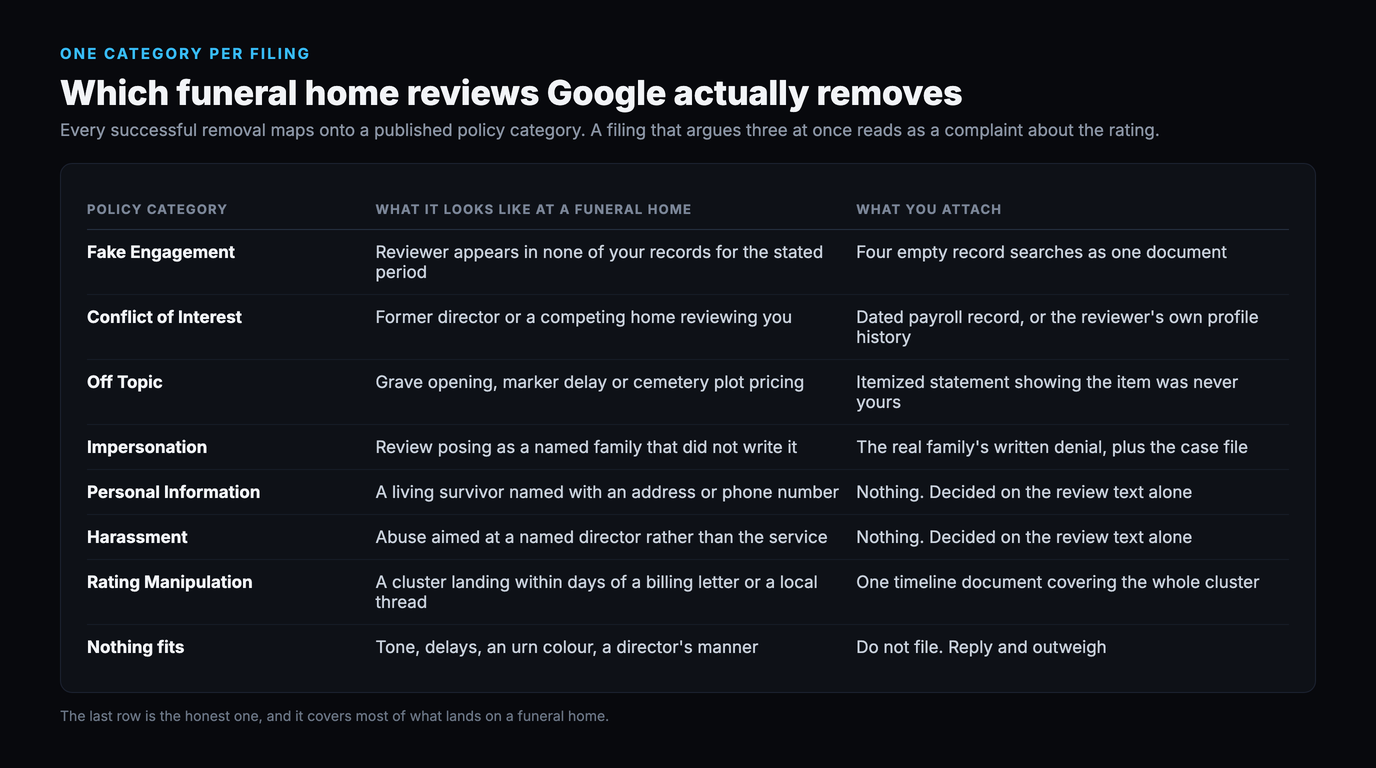
Google publishes its prohibited and restricted content policies for user contributions, and every successful removal maps onto one of them. Not onto accuracy, not onto fairness, and not onto whether you followed your own procedure. Name one category per filing and evidence that category alone. A filing that argues three at once reads as a complaint about the rating, which is the one thing Google is certain to decline.
| Policy category | What it looks like at a funeral home | What you attach |
|---|---|---|
| Fake Engagement | Reviewer appears in none of your records for the stated period | Four empty record searches as one document |
| Conflict of Interest | Former director or a competing home reviewing you | Dated payroll record, or the reviewer's own profile history |
| Off Topic | Grave opening, marker delay or cemetery plot pricing | Itemized statement showing the item was never yours |
| Impersonation | Review posing as a named family that did not write it | The real family's written denial, plus the case file |
| Personal Information | A living survivor named with an address or phone number | Nothing. Decided on the review text alone |
| Harassment | Abuse aimed at a named director rather than the service | Nothing. Decided on the review text alone |
| Rating Manipulation | A cluster landing within days of a billing letter or a local thread | One timeline document covering the whole cluster |
| Nothing fits | Tone, delays, an urn colour, a director's manner | Do not file. Reply and outweigh |
The last row is the honest one and it covers most of what lands on a funeral home. If you want the full map of what each category means outside this trade, our guide to every Google review policy violation type walks through them one by one, and what actually qualifies as conflict of interest is worth reading before you file the former-employee case, which is the one operators most often file too loosely.
The price review is a Funeral Rule matter
A large share of funeral home one stars are about money, and almost none of them are removable. What makes this trade different is that the price review frequently describes a federal compliance failure in public, on your own profile, where the FTC can read it. Reading it as a reputation problem and filing a report is the wrong first move; reading it as a warning is the right one.
| What the review says | The rule it describes | Removable? |
|---|---|---|
| "They would not give prices on the phone" | 453.2(b)(1) telephone price disclosure | No. Fix the phone script |
| "No written price list until we had chosen" | 453.2(b)(4) general price list, given at the start | No. Audit the arrangement room |
| "The bill was nothing like the quote" | 453.2(b)(5) itemized statement at the conference close | No. Reply with the signed statement offered privately |
| "They said the law required embalming" | 453.3 and 453.5 on required disclosures | No, and treat it as urgent |
| "They refused our outside casket" | 453.4(b) casket handling fee prohibition | No. Check the price list wording |
| Price complaint from someone who never enquired | No Funeral Rule issue at all | Yes. Fake Engagement |
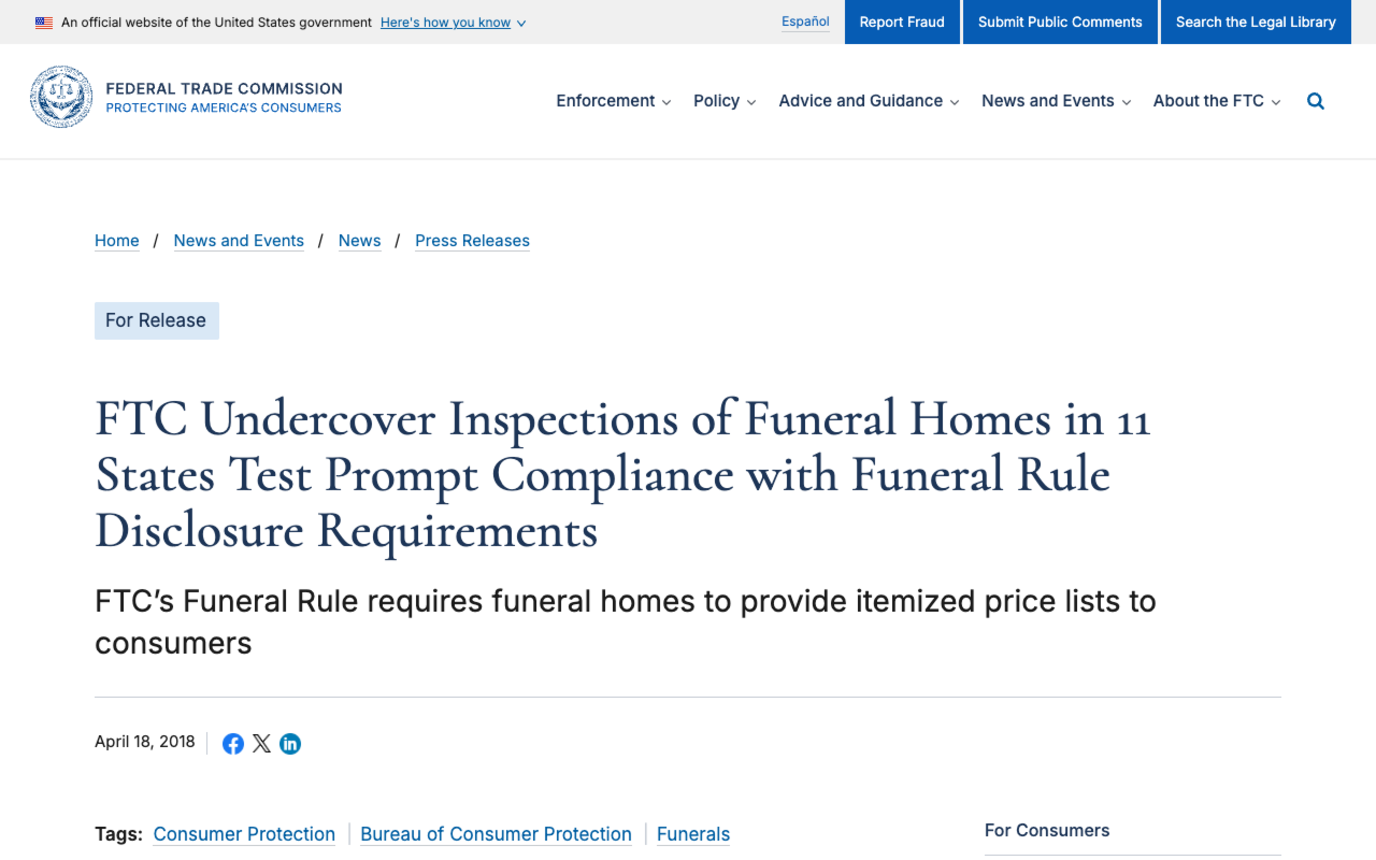
This is not a theoretical exposure. In its 2018 announcement of undercover inspections across eleven states, the FTC reported that five of thirteen homes shopped in Augusta and seven of fifteen in Lansing failed the price disclosure test, and that since its offender programme began in 1996 it had inspected nearly 3,200 homes and referred 559 for violations. A public review describing the exact failure those shoppers look for is the cheapest compliance audit you will be given.
The one exception worth filing: a price complaint from a name that appears in none of your records is not a Funeral Rule problem at all, it is a fabricated transaction. That is Fake Engagement, and the itemized statements you are already required to keep are what proves it.
The records federal law already made you keep
Every vertical has one document that decides identity filings. In pest control it is the applicator record, in self storage the gate log, in childcare the sign-in sheet. Funeral homes have the strongest version of it, because the retention is not a business habit you might have dropped: 16 CFR 453.6 requires you to keep a copy of every Statement of Funeral Goods and Services Selected for at least one year from the date of the arrangements conference, and your price lists for a year after last distribution, available for inspection by the Commission.
So when a review claims a service in the last twelve months, you can prove or disprove the relationship from a file you were legally obliged to have. Four records, searched as one exercise, is the exhibit:
- The first call sheet. The removal request, the caller, the time. It catches the relationship that never became a case.
- The Statement of Funeral Goods and Services Selected. Required by 453.2(b)(5) at every arrangement, itemising goods, services, cash advance items and the total.
- The register book and service folder. Who attended, who officiated, who carried. The only record reaching the mourner population.
- The authorization and chain of custody. The cremation or burial authorization with its identification tag number and the retort or interment log, which answers the "they lost my father" review on paper.
Attach them as one redacted document naming one category, and redact every other family before it leaves the building. Our walkthrough on documenting evidence for a review dispute covers the format reviewers actually read, which is one page rather than a bundle.
Why your reply is constrained, and not by HIPAA
Funeral directors are told constantly that they cannot discuss a case publicly because of HIPAA. That is not the reason, and the confusion costs replies. Funeral homes are not covered entities under HIPAA, so the rule that binds a dental practice does not bind you in the same way. Our HIPAA and Google reviews guide sets out what that regime actually does to a covered provider's reply, and the contrast is the point: your limits come from somewhere else.
They come from three places: your state funeral board's conduct rules, which in most states reach public disclosure about a case; your own contract, which frequently carries a confidentiality clause; and the plain fact that a reply naming a decedent or a family disagreement is read by every prospective family for years, and it is the reply rather than the review that they remember.
So the reply that works is short, dated and general. Acknowledge a real loss, state your general practice on the disputed point, and offer a named person and a direct line. Do not confirm or deny that you served the family, because in a contested-authority case even the denial takes a side. The pattern is the one in our guide to responding to negative Google reviews, tightened by one rule: never quote the review back.
The review that is not yours: acquisitions, preneed and the cemetery
Deathcare consolidates faster than almost any local trade, and the Google listing does not change hands cleanly when the business does. A home bought in 2024 inherits the profile, the star average and every review of the previous owner's staff and standards. That is not a policy violation: the family had a genuine experience of the business at that address under that name, and Google has no concept of a change of control.
The preneed book makes it worse, because a contract sold in 2009 is performed by you in 2026 and the review describes a promise made by somebody who retired a decade ago. Reply factually with the date you took over, without criticising the seller, and put your effort into volume rather than removal. One thing to check with counsel: preneed paperwork of that vintage often carries a non-disparagement clause, and the Consumer Review Fairness Act voids form-contract terms restricting a customer's ability to review a business. Inheriting one is harmless. Enforcing one is not.
The cemetery collision, by contrast, is a filing and a good one. Grave openings, marker installation and plot pricing belong to a separate business with a separate profile, and families blame the funeral home because you are the name they dealt with. Attach the itemized statement showing the disputed item was never yours to sell, plus a screenshot of the cemetery's own listing. A sister location in a group works the same way.
Not sure whether your one star is filable?
We read it against Google's published policies, tell you honestly which category fits, and file it with your records attached and every other family redacted.
Flaggd is our own review dispute service. We file removals against Google's published content policies; we do not buy, sell or suppress legitimate reviews.
Filing and escalating: the routes and the clock
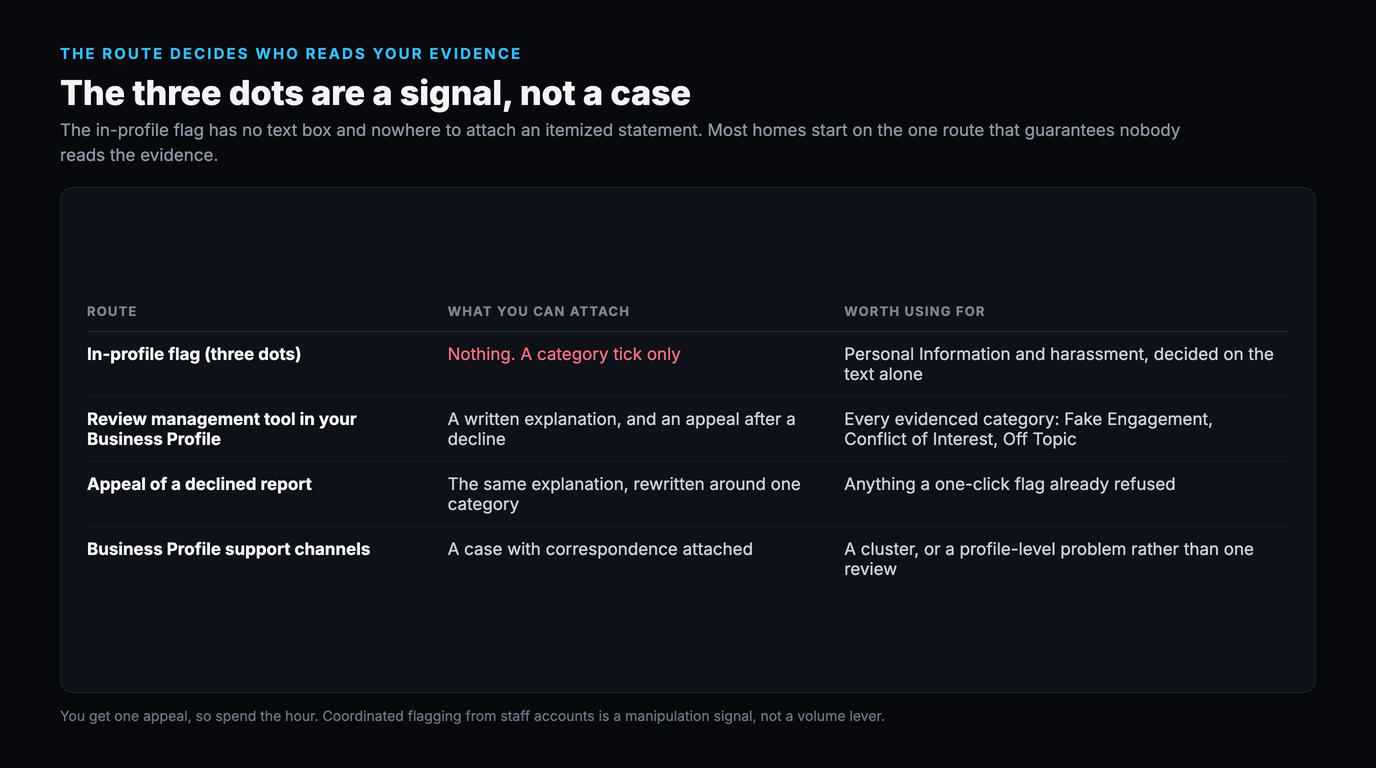
The route decides whether anybody reads your evidence, and most homes start on the one route that guarantees nobody will. The in-profile flag, the three dots beside the review, is a one-click report with no text box and nowhere to attach an itemized statement. It is a signal, not a case.
| Route | What you can attach | Worth using for |
|---|---|---|
| In-profile flag (three dots) | Nothing. A category tick only | Personal Information and harassment, decided on the text alone |
| Review management tool in your Business Profile | A written explanation, and an appeal after a decline | Every evidenced category: Fake Engagement, Conflict of Interest, Off Topic |
| Appeal of a declined report | The same explanation, rewritten around one category | Anything a one-click flag already refused |
| Business Profile support channels | A case with correspondence attached | A cluster, or a profile-level problem rather than one review |
One piece of trade folklore needs killing. A widely shared funeral marketing article still says Google will not act until five different users report a review, and tells directors to have staff flag it from personal accounts. Coordinated flagging from related accounts is a manipulation signal, not a volume lever. One evidenced report beats five ticks, and you get one appeal, so spend the hour. If both stall, the official routes to Google support are worth knowing in advance.
If several reviews arrive together, after a billing letter or a local social media thread about a service, file them as one pattern rather than six flags. Rating Manipulation and Fake Engagement are both pattern findings, and a cluster presented in a single timeline document gets acted on far more often than the same reviews reported separately. That is the approach behind recovering a rating after a coordinated attack.
Three moves that turn a review into a legal problem
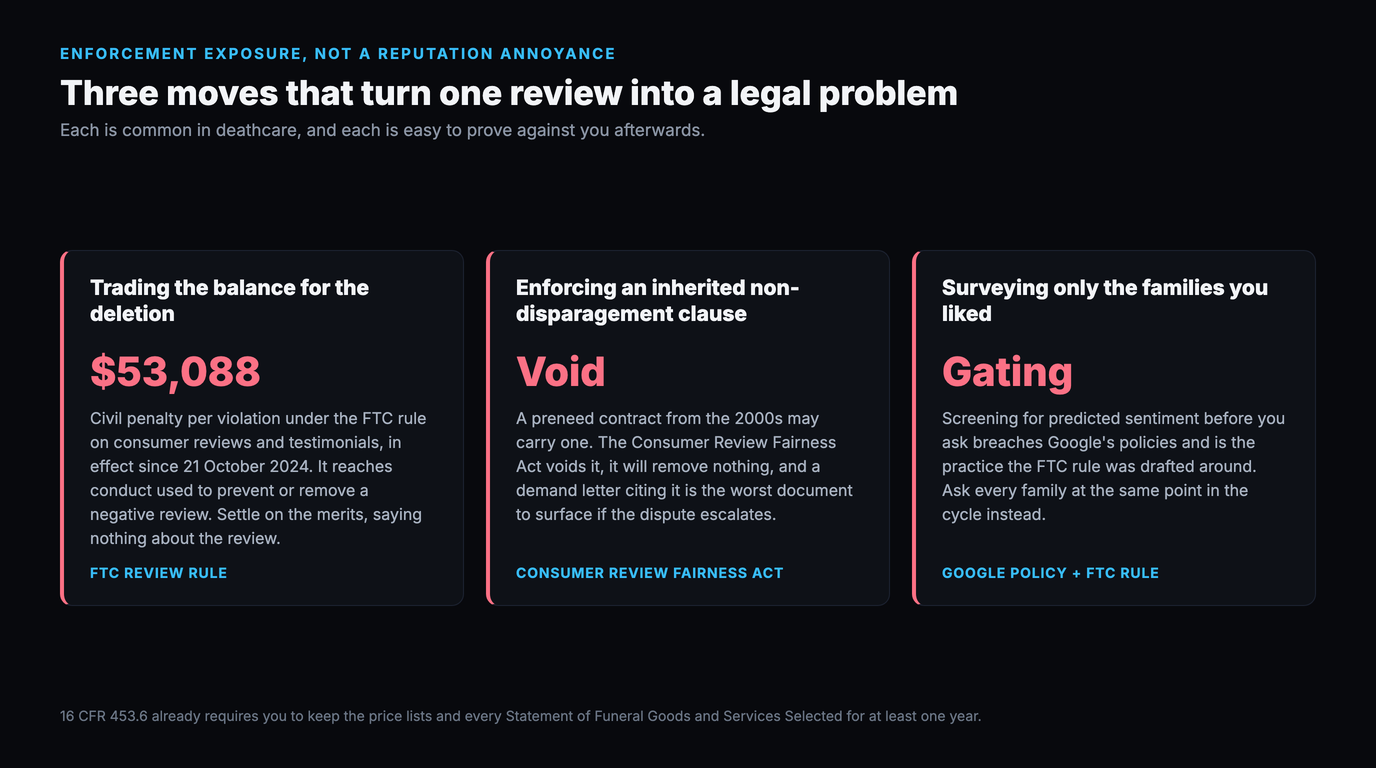
Each of these is common in this trade, and each converts a reputation annoyance into an enforcement exposure.
Trading the balance for the deletion. An unpaid balance or a pending insurance assignment nearly always sits between you and the family, which makes this offer easy to make and easy to prove. The FTC's rule on consumer reviews and testimonials took effect on 21 October 2024 and reaches conduct used to prevent or remove a negative review, with civil penalties running to $53,088 per violation. Settle on the merits, saying nothing about the review. Our explainer on the FTC fake review rule in 2026 covers the rest.
Enforcing an inherited non-disparagement clause. A preneed contract from the 2000s may well contain one. It is void under the Consumer Review Fairness Act, it will remove nothing, and a demand letter citing it is the worst document to have surfaced if the dispute escalates.
Sending the aftercare survey only to the families you liked. Screening for predicted sentiment before you ask is review gating, which breaches Google's policies and is the practice the FTC rule was drafted around. Our guide to whether review gating is legal sets out the compliant version: ask everyone at the same point in the cycle.
Before the next first call
Removal is the smallest lever here, because most funeral home one stars are genuine experiences Google was never going to touch. Volume is the large one, and this trade under-asks worse than any other: families are most grateful on the thank-you call two weeks after the service, and almost nobody asks then. Ask every family at the same point, not the ones you expect to be kind.
Then watch the profile, because the reviews that do get removed are caught in days rather than months. Set up review monitoring and alerts so a cluster after a billing letter surfaces while the timeline is provable, and build the flow that absorbs a bad month with a compliant request routine.
Frequently asked questions
A relative who was not the authorizing agent left a one-star review. Can we get it removed?
Almost never. Google's test is genuine experience, not who signed and not who held the right of disposition. A sibling who attended the visitation or called your office has experienced your business, and the statute putting somebody else in charge is a family law question. Keep the signed authorization for the contract argument; the review is reply work.
The reviewer does not appear anywhere in our records. What category do we file?
Fake Engagement, and you have an unusually strong version of it because 16 CFR 453.6 already required you to keep the paperwork. Search the first call sheet, the itemized statement, the register book and the aftercare list for the name and period. If all four come back empty, file those searches as one document naming that single category.
The review says we would not quote prices over the phone. Is that removable?
No, and read it as a compliance warning. 16 CFR 453.2(b)(1) requires you to tell anyone who asks by telephone any accurate price list information that reasonably answers their question, so the review describes a possible Funeral Rule breach in public. Fix the phone script and reply with your price list rather than an argument.
A review names the person who died. Does that make it a privacy removal?
No, and this mistaken filing is unique to deathcare. Google's personal information policy protects a living identifiable person, so naming a decedent does not engage it. If the review names a surviving family member alongside an address, phone number or financial detail, that part does engage it and is filable. Never repeat a name in your reply.
We bought this home two years ago and the review is about the previous owner. Can we remove it?
Usually not. The review attaches to the listing, and the listing carried on through the sale, so the family's experience of the business at that address still counts. Reply with the date of the ownership change, stated factually and without criticising the seller, and outweigh it with volume. Check whether inherited preneed contracts carry non-disparagement clauses, which are void.
Can we waive the unpaid balance if the family removes the review?
No, and this trade is unusually exposed because a balance or insurance assignment is nearly always outstanding. The FTC's review rule took effect on 21 October 2024 and reaches conduct used to prevent or remove a negative review, with penalties to $53,088 per violation. Settle on the merits and say nothing about the review.
Google declined our report. Is that the end of it?
No, but you get one appeal, so spend an hour on it. The in-profile flag has nowhere to attach a cremation authorization or an empty records search, so a decline there usually means nothing of yours was read. Appeal through the review management tool, name exactly one category, and attach one document that settles it.
Funeral home Google review removal is a sorting exercise before it is a filing exercise, and the sorting is unusual here because the paperwork is unusually good and the population of reviewers is unusually wide. You almost certainly have the record that answers the factual claim, and the claim doing the damage is almost never factual. Sort by who actually experienced the business, name one category, attach one redacted record, and put the time you save into asking every family two weeks later.